
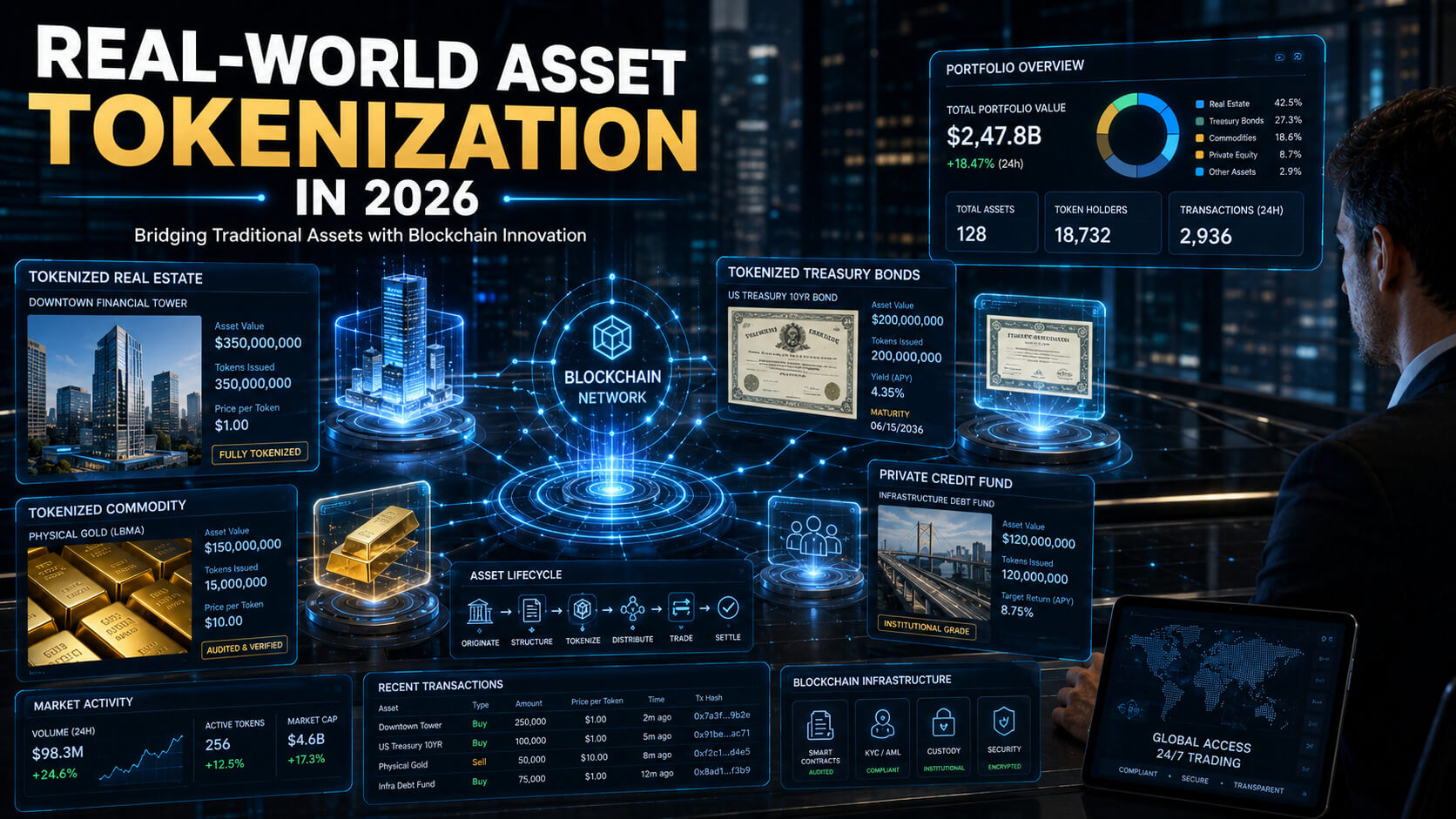
A $10 million commercial building in Manhattan. A Picasso painting worth $50 million. A portfolio of Treasury bonds. A vintage wine collection. Until recently, these assets shared one characteristic: they were difficult to divide, expensive to trade, and accessible only to wealthy investors.
Tokenization is changing that. By representing real-world assets (RWAs) as digital tokens on a blockchain, tokenization enables fractional ownership, 24/7 trading, instant settlement, and global access. A retail investor in Lagos can own a fraction of a Manhattan skyscraper. A college student in Berlin can hold $100 worth of tokenized Treasury bonds.
This is not a concept demo. In 2026, the tokenized RWA market has crossed $15 billion in on-chain value, with BlackRock, JPMorgan, and Goldman Sachs actively issuing tokenized financial products. The infrastructure is live. The regulatory frameworks are forming. And the market is accelerating.
What Is Real-World Asset Tokenization?
Tokenization is the process of creating a digital representation of a real-world asset on a blockchain. The digital token represents ownership rights, economic claims, or both. When someone buys a token, they acquire a verifiable, transferable claim on the underlying asset.
The blockchain serves as the ownership ledger. Instead of paper deeds, broker statements, or centralized databases, the blockchain records who owns what, enables peer-to-peer transfers, and executes distributions (dividends, rent, interest) through smart contracts.
Tokenization does not change the underlying asset. A tokenized building is still a physical building. Tokenization changes how ownership of that building is recorded, divided, and traded.
How Tokenization Works: The Technical Process
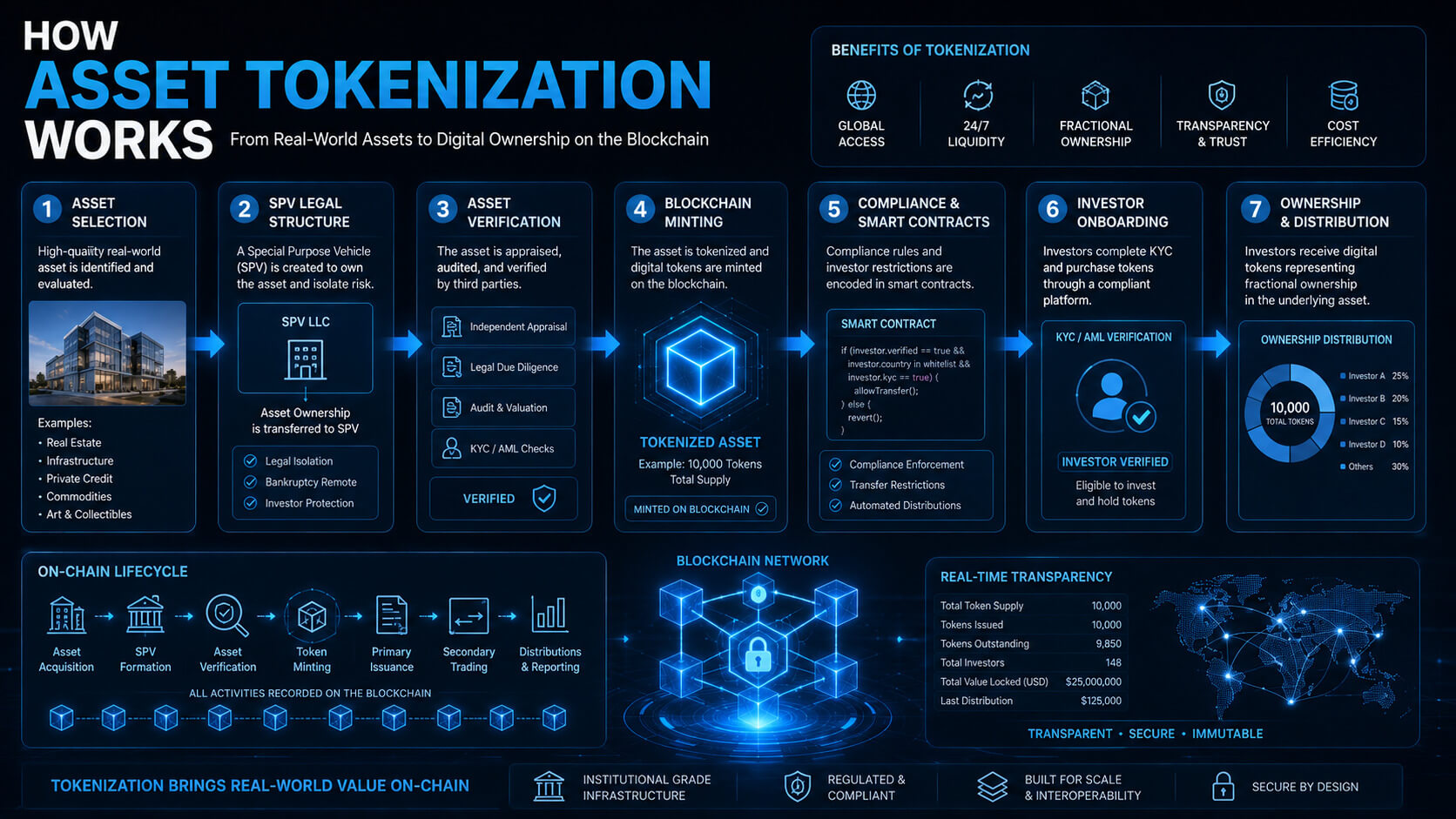
Step 1: Asset Selection and Legal Structuring
The asset owner works with legal counsel to create a structure (typically a Special Purpose Vehicle or SPV) that holds the asset. The SPV issues tokens that represent fractional ownership in the vehicle. This legal wrapper connects the digital token to real-world legal rights.
Step 2: Token Creation
Smart contracts are deployed on a blockchain (Ethereum, Polygon, Avalanche, and Stellar are common choices). These contracts define the token supply, ownership rules, transfer restrictions, and automated distribution logic. Each token is a programmable unit of ownership.
Step 3: Compliance and Distribution
KYC/AML verification ensures all token buyers meet regulatory requirements. Tokens are then sold through regulated platforms (security token exchanges) or private placements. Compliance rules are coded into the smart contracts, preventing transfers to unverified wallets.
Step 4: Secondary Trading
After initial distribution, tokens can be traded on secondary markets. This is where the liquidity advantage materializes. Traditional real estate transactions take 30 to 90 days. Tokenized real estate transfers settle in seconds.
Step 5: Asset Management and Distributions
Smart contracts automate ongoing management tasks: distributing rental income to real estate token holders, paying bond coupon payments, or allocating fund returns. This eliminates the administrative overhead of managing thousands of fractional owners.
What Is Being Tokenized in 2026?
| Asset Class | Market Size (Tokenized) | Key Platforms | Status |
|---|---|---|---|
| U.S. Treasuries | $3B+ on-chain | BlackRock BUIDL, Franklin Templeton, Ondo Finance | Fastest growing category |
| Private Credit | $2B+ on-chain | Maple Finance, Centrifuge, Goldfinch | Institutional adoption |
| Real Estate | $1.5B+ on-chain | RealT, Lofty, Propy | Growing retail adoption |
| Commodities (Gold) | $1B+ on-chain | Paxos Gold (PAXG), Tether Gold (XAUT) | Established market |
| Private Equity | Early stage | Securitize, Hamilton Lane | Institutional pilots |
| Art and Collectibles | Early stage | Masterworks, Artory | Niche but growing |
Tokenized Treasuries: The Breakout Category
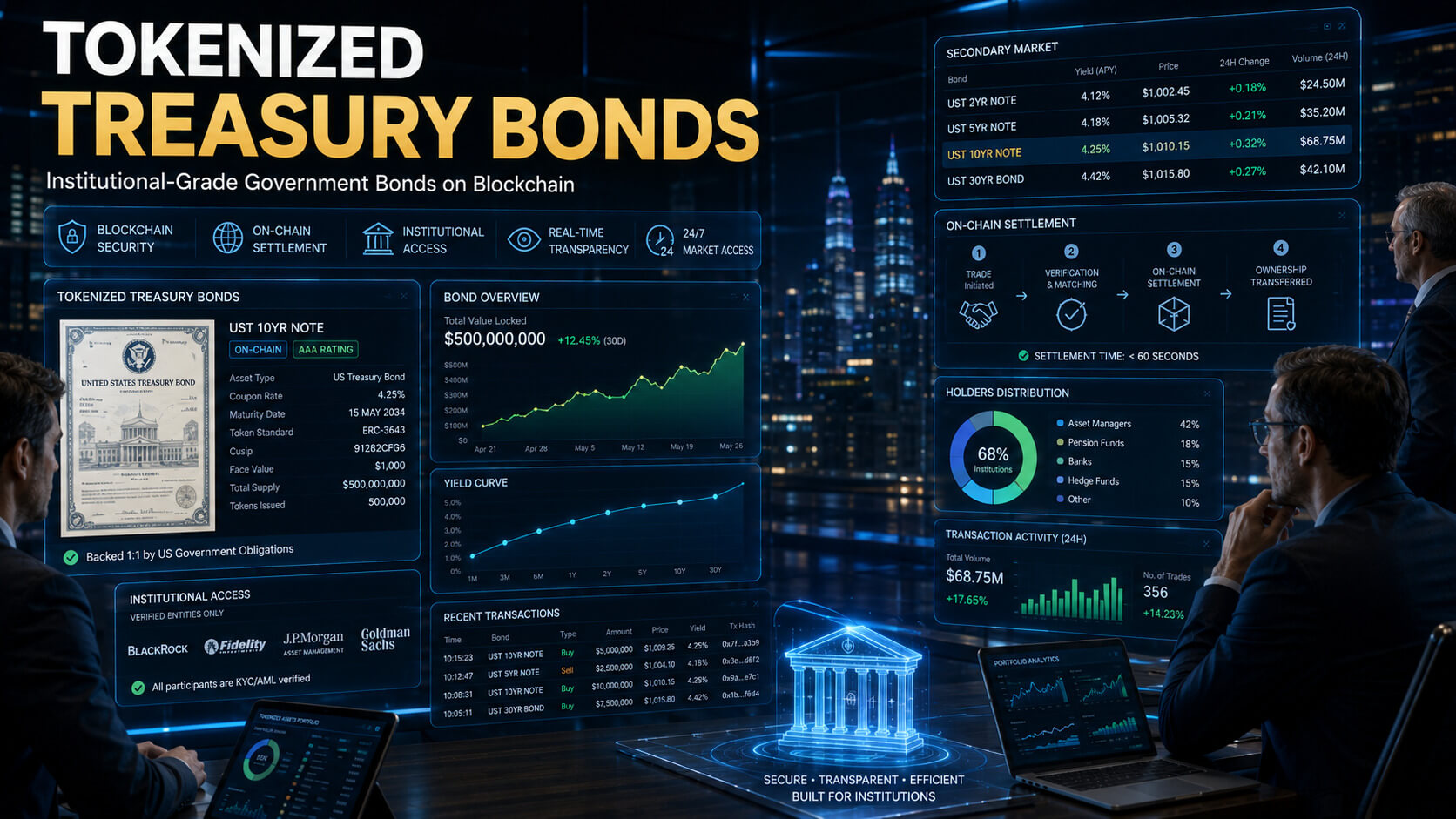
The single biggest driver of RWA tokenization in 2025 and 2026 has been U.S. Treasury bonds. BlackRock’s BUIDL fund (Build, Understand, Invest, Develop, Lead) became the largest tokenized Treasury product within months of launch, crossing $1 billion in assets.
Why Treasuries? They are low-risk, yield-bearing, and universally understood. Tokenizing them gives DeFi protocols access to risk-free yield, provides stablecoin issuers with transparent reserve assets, and gives global investors dollar-denominated returns without traditional banking intermediaries.
Why Tokenization Matters: The Five Core Advantages
1. Fractional ownership
A $10 million property can be divided into 10 million tokens at $1 each. This lowers the minimum investment threshold from millions to dollars, democratizing access to asset classes previously reserved for institutional investors.
2. Liquidity for illiquid assets
Real estate, private equity, and fine art are traditionally illiquid. Selling a building takes months. Selling a building token takes seconds. Tokenization transforms the liquidity profile of virtually any asset.
3. 24/7 global trading
Tokenized assets trade on blockchain networks that operate around the clock, across borders. No market hours, no settlement delays, no geographic restrictions (within regulatory bounds).
4. Automated compliance and distributions
Smart contracts enforce KYC requirements, transfer restrictions, and regulatory hold periods automatically. They also distribute income (rent, interest, dividends) to token holders without manual processing.
5. Transparent ownership records
Blockchain provides an immutable, publicly auditable record of ownership. This reduces disputes, simplifies audits, and increases trust between parties.
The Regulatory Landscape
Regulation is the single biggest factor determining the pace of RWA tokenization adoption. The landscape varies significantly by jurisdiction.
United States
The SEC treats most tokenized assets as securities. Tokenized offerings must comply with Reg D (accredited investors only), Reg A+ (limited public offering), or Reg S (non-U.S. investors). Security token exchanges (tZERO, INX) provide regulated secondary trading. Clarity is improving but remains incomplete.
European Union
The EU’s MiCA regulation provides the most comprehensive framework for crypto-assets including tokenized securities. The DLT Pilot Regime specifically enables tokenized security trading on distributed ledger infrastructure.
Singapore
The MAS has been proactive with tokenization sandboxes and Project Guardian, a collaborative initiative with JPMorgan, DBS, and SBI to test tokenized bond and FX trading.
United Arab Emirates
Dubai has established itself as a tokenization hub through DIFC and ADGM regulatory frameworks that explicitly accommodate tokenized securities.
Risks and Challenges
Regulatory uncertainty
Despite progress, many jurisdictions lack clear frameworks for tokenized securities. Cross-border token trading faces particularly complex regulatory challenges.
Smart contract risk
The legal enforceability of smart contract-based ownership is untested in many courts. A bug in the token contract could create ownership disputes that traditional legal systems are not equipped to resolve quickly.
Oracle dependency
Tokenized assets often require data oracles to connect on-chain tokens with off-chain asset values (property appraisals, bond prices). Oracle failures can cause price discrepancies and trading disruptions.
Liquidity bootstrapping
Tokenization enables liquidity, but liquidity does not appear automatically. Many tokenized assets still have thin secondary markets, especially for niche asset classes.
Custody and legal recovery
If a token holder loses their private keys, recovering ownership of the underlying asset involves complex legal processes that are still being defined.
Expert Tips for Understanding RWA Tokenization
1. Start with the legal structure, not the technology
The token is only as valuable as the legal rights it represents. Before investing in tokenized assets, understand the SPV structure, the jurisdiction, and what legal claims the token actually conveys.
2. Tokenized Treasuries are the lowest-risk entry point
If you want exposure to tokenized assets, start with tokenized U.S. Treasuries from established issuers (BlackRock BUIDL, Franklin Templeton). The underlying asset is risk-free. The tokenization layer is well-tested.
3. Liquidity claims require verification
Many tokenization platforms market “instant liquidity” for traditionally illiquid assets. Check actual secondary market trading volume before relying on this promise. Thin markets can mean significant price impact on sells.
4. Regulation is your protection
Regulated platforms (SEC-registered, MAS-licensed) provide investor protections that unregulated platforms cannot. The cheapest or easiest platform is not necessarily the safest.
5. Watch the institutional adoption curve
When BlackRock, JPMorgan, and Goldman Sachs are tokenizing assets, the technology has moved past experimental. Follow institutional adoption as a signal of market maturity and infrastructure reliability.
Frequently Asked Questions
What is blockchain tokenization of real-world assets?
Tokenization is the process of creating digital tokens on a blockchain that represent ownership of real-world assets such as real estate, bonds, commodities, art, or private equity. Each token conveys verifiable ownership rights and can be traded, transferred, or held like any blockchain-based digital asset. The underlying asset is held in a legal structure (typically an SPV), and the blockchain serves as the ownership ledger.
Is tokenized real estate a good investment?
Tokenized real estate offers benefits including fractional ownership (lower minimums), improved liquidity (faster trading), and automated income distribution. However, risks include regulatory uncertainty, thin secondary markets for many properties, and smart contract vulnerabilities. Evaluate tokenized real estate with the same due diligence you would apply to traditional property investment, plus additional scrutiny of the platform, legal structure, and token contract.
How big is the tokenized asset market?
The on-chain tokenized RWA market exceeded $15 billion in 2026, with tokenized U.S. Treasuries ($3B+), private credit ($2B+), and real estate ($1.5B+) as the largest categories. Industry projections from Boston Consulting Group and McKinsey estimate the market could reach $10 trillion to $16 trillion by 2030 as regulatory frameworks mature and institutional adoption accelerates.
Your Next Step
Real-world asset tokenization is moving from pilot programs to production infrastructure. The entry of BlackRock, JPMorgan, and major financial institutions validates that this is not a speculative experiment. It is a structural evolution of how assets are owned, traded, and managed.
If you are an investor, explore tokenized Treasury products as a low-risk starting point. If you are a business owner, evaluate whether your assets (real estate, receivables, intellectual property) could benefit from tokenization. If you are a developer, the infrastructure layer (token standards, compliance tooling, oracle networks) is where the biggest opportunities are being built.
The tokenization wave is early but accelerating. Understanding it now puts you ahead of the curve when it becomes mainstream.