

Your firewall is not a fortress. That expensive perimeter defense you invested in? Attackers are already inside it. The traditional castle-and-moat security model assumed that everything inside the network perimeter was trustworthy. That assumption has cost organizations billions.
Zero trust architecture flips this thinking entirely. Instead of trusting anyone based on their location inside a network, it treats every access request as potentially hostile. Every user, every device, every connection gets verified before gaining access to anything.
With 96% of organizations now favoring a zero trust approach and 81% planning to implement it within the next 12 months, this is not a theoretical framework. It is the security standard that enterprises, governments, and startups are racing to adopt in 2026.
This guide breaks down what zero trust actually means in practice, how NIST defines it, what the core pillars look like, and how organizations of every size can start implementing it today.
What Is Zero Trust Architecture?
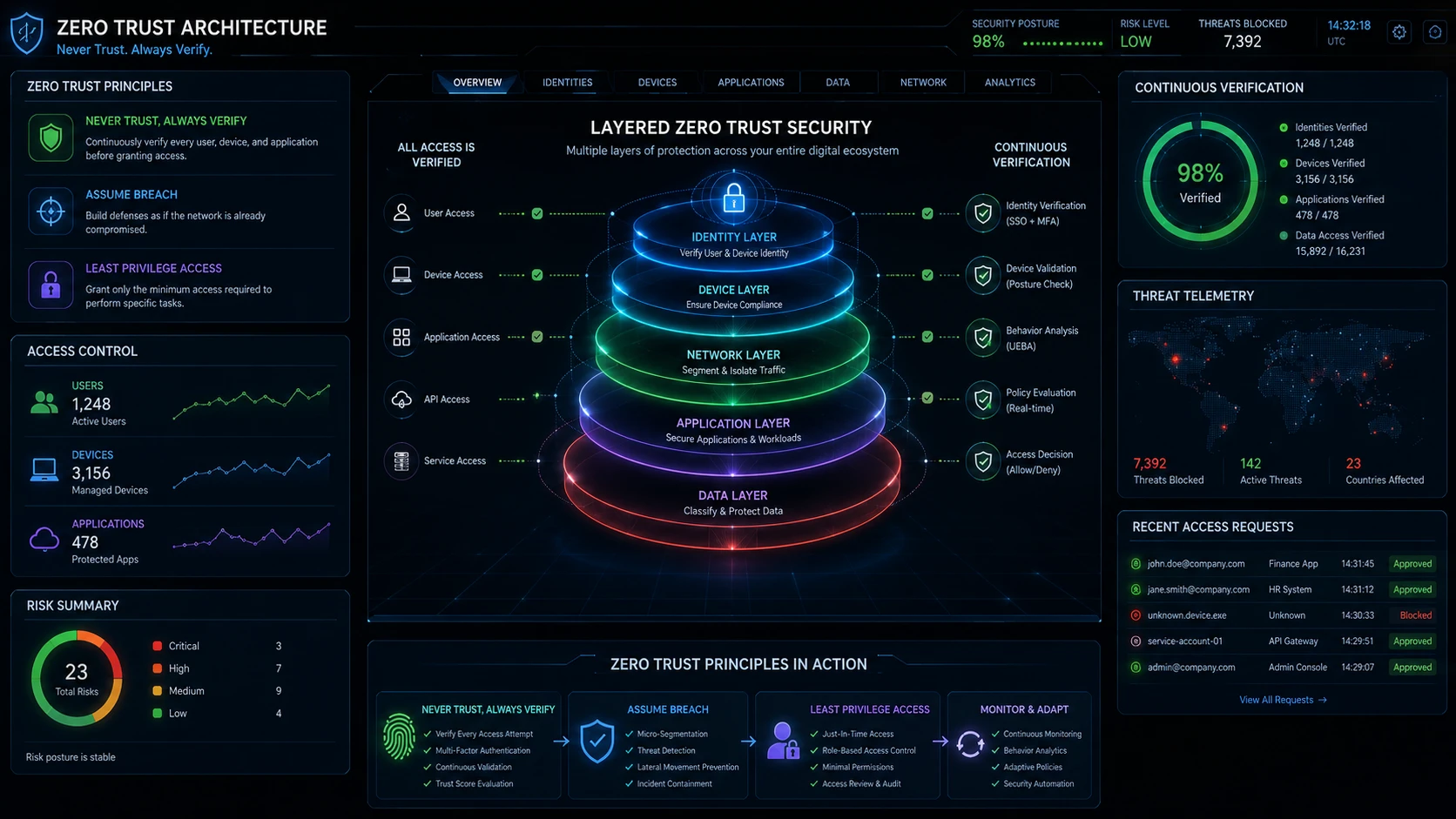
Zero trust architecture (ZTA) is a cybersecurity framework built on one core principle: never trust, always verify. NIST Special Publication 800-207 defines it as a set of cybersecurity paradigms that move defenses away from static, network-based perimeters and instead focus on users, assets, and resources.
In traditional security models, once a user passed the perimeter firewall, they could move freely across internal systems. Zero trust eliminates that implicit trust entirely. Every request for access gets authenticated, authorized, and encrypted regardless of where it originates.
Think of it this way. Traditional security is like a building with a locked front door but open hallways inside. Zero trust puts a locked door on every single room, and you need to prove who you are each time you enter one.
| Traditional Security | Zero Trust Architecture |
| Trust users inside the perimeter | Trust no one by default |
| Verify once at login | Verify continuously for every request |
| Broad network access after authentication | Least-privilege, micro-segmented access |
| Perimeter-focused defense | Identity-focused, data-centric defense |
| Assumes internal traffic is safe | Assumes breach has already occurred |
| Static security policies | Dynamic, context-aware policies |
The shift matters because the perimeter no longer exists in any meaningful sense. Remote work, cloud infrastructure, SaaS applications, and BYOD policies have dissolved the traditional network boundary. In 2026, 84% of organizations experienced identity-related breaches, proving that perimeter-only defenses are fundamentally broken.
The Three Core Principles of Zero Trust
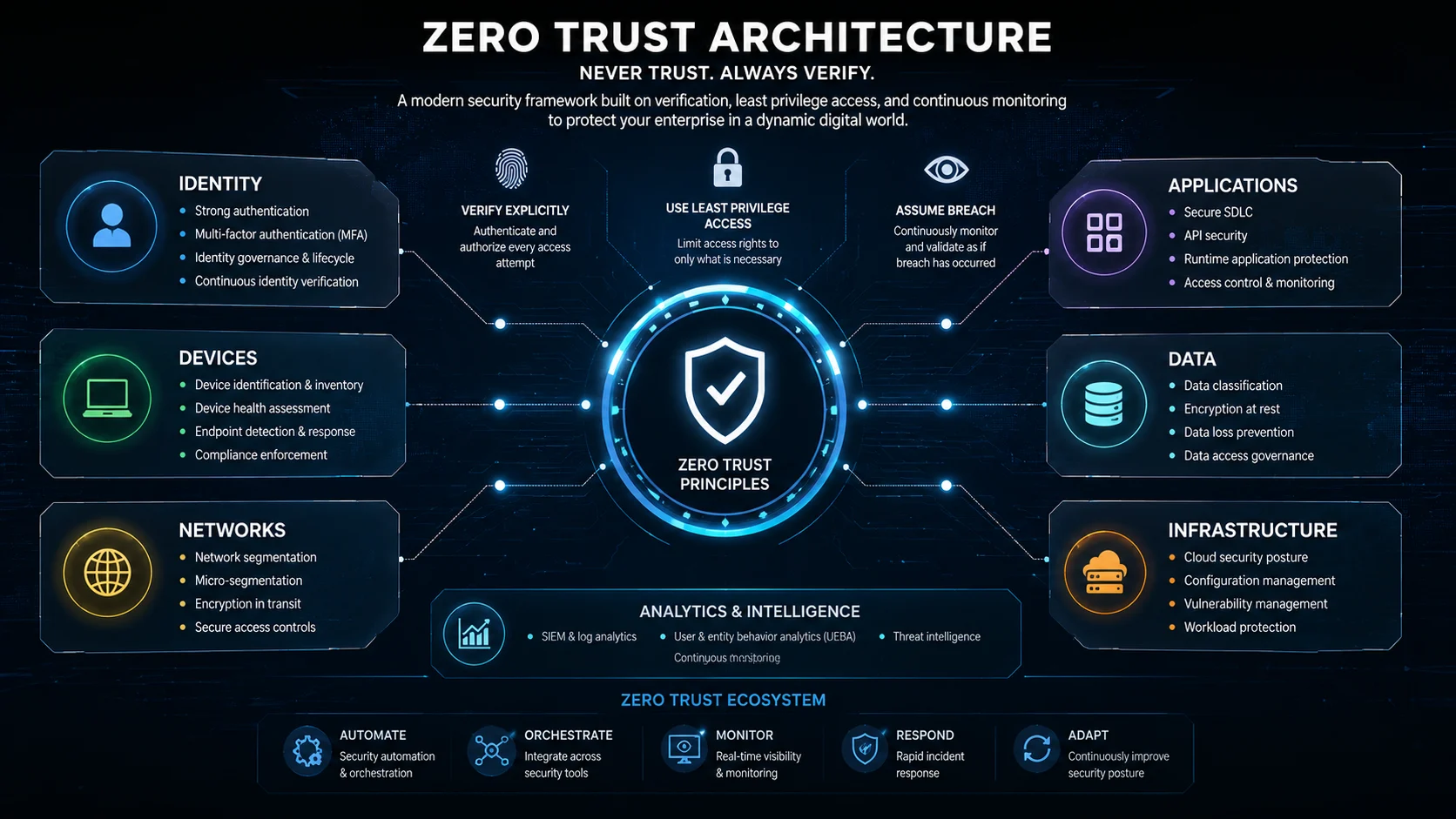
1. Never Trust, Always Verify
Every access request is treated as if it originates from an untrusted network. Whether a request comes from the CEO’s laptop inside headquarters or a contractor’s phone in another country, the verification process is the same. Identity, device health, location, behavior patterns, and request context all get evaluated before granting access.
2. Assume Breach
Zero trust operates under the assumption that attackers are already inside the network. This mindset drives the architecture to minimize blast radius through micro-segmentation, limit lateral movement, and encrypt all internal communications. If one segment gets compromised, the attacker cannot pivot freely to other systems.
3. Least Privilege Access
Users and applications receive only the minimum permissions they need to complete their specific task. Access is granted just-in-time, scoped to what is necessary, and revoked the moment it is no longer needed. This dramatically reduces the attack surface compared to broad, role-based access that lingers indefinitely.
The 7 Pillars of Zero Trust (NIST Framework)
NIST and the Department of Defense have defined seven pillars that form the foundation of a mature zero trust architecture. Each pillar addresses a different dimension of security, and all seven must work together for effective protection.
| Pillar | What It Covers | Key Technologies |
| Identity | User authentication and authorization through MFA, SSO, and continuous identity verification | IAM platforms, passwordless auth, biometrics |
| Devices | Endpoint health checks, compliance validation, and device trust scoring | EDR/XDR, MDM, device certificates |
| Networks | Micro-segmentation, encrypted communications, and software-defined perimeters | SD-WAN, ZTNA, network segmentation tools |
| Applications | Application-level access controls, API security, and workload isolation | CASB, WAF, service mesh, API gateways |
| Data | Data classification, encryption at rest and in transit, DLP policies | DLP solutions, encryption tools, data tagging |
| Infrastructure | Cloud and on-prem infrastructure security, container and VM hardening | CSPM, CWPP, infrastructure-as-code scanning |
| Visibility & Analytics | Continuous monitoring, behavior analytics, and automated threat response | SIEM, SOAR, UEBA, AI-driven analytics |
Why Zero Trust Is Non-Negotiable in 2026
Several converging forces have made zero trust a business requirement rather than a security nice-to-have.
The perimeter is gone. With 70% of workloads now running in the cloud and remote work becoming permanent for millions of workers, there is no single network boundary to defend. Employees connect from home networks, coffee shops, airports, and coworking spaces. Each connection point is a potential attack vector.
AI-powered attacks are accelerating. AI-driven cyberattacks increased by 427% year-over-year in 2025. Attackers use AI to craft convincing phishing emails, automate vulnerability scanning, and generate polymorphic malware that evades traditional defenses. Static, rule-based security cannot keep pace.
Regulatory mandates require it. The U.S. government’s Executive Order 14028 and OMB Memorandum M-22-09 require federal agencies to implement zero trust architectures. The EU’s NIS2 Directive and DORA regulation push similar requirements across European organizations. Compliance is no longer optional.
Breach costs keep climbing. The average data breach now costs $5.2 million. Organizations without zero trust implementation face costs 38% higher than those with mature ZTA deployments. The financial case for zero trust writes itself.
Supply chain attacks are surging. Incidents like SolarWinds and MOVEit proved that trusting third-party software and vendors without verification creates catastrophic exposure. Zero trust extends verification to every component in the supply chain.
How to Implement Zero Trust: A Practical Roadmap
Phase 1: Assess and Map (Weeks 1 to 4)
Start by identifying your protect surface, which is the critical data, applications, assets, and services (DAAS) that matter most. Map how traffic flows between these resources. Document who accesses what, from which devices, and through which pathways.
Action items: Inventory all users, devices, and applications. Classify data by sensitivity. Map network traffic flows. Identify your most critical assets.
Phase 2: Architect and Design (Weeks 5 to 8)
Design micro-segmentation policies around your protect surface. Define access policies based on identity, device health, and context. Select technologies that align with your existing infrastructure rather than ripping everything out.
Action items: Design network segments. Define identity verification policies. Select ZTNA, IAM, and micro-segmentation tools. Create policy documentation.
Phase 3: Deploy Identity Foundation (Weeks 9 to 16)
Identity is the cornerstone of zero trust. Deploy multi-factor authentication (MFA) across all users and systems. Implement single sign-on (SSO) with conditional access policies. Move toward passwordless authentication where possible.
Action items: Roll out MFA universally. Deploy SSO with conditional access. Implement privileged access management (PAM). Enable device health checks.
Phase 4: Segment and Monitor (Weeks 17 to 24)
Implement micro-segmentation to isolate workloads and limit lateral movement. Deploy continuous monitoring with behavior analytics to detect anomalies. Set up automated response playbooks for common threat scenarios.
Action items: Activate micro-segmentation policies. Deploy SIEM/SOAR integration. Enable UEBA for anomaly detection. Test incident response workflows.
Phase 5: Optimize and Mature (Ongoing)
Zero trust is not a one-time project. Continuously refine policies based on real traffic patterns and threat intelligence. Automate access decisions where confidence is high. Regularly audit and test your controls against evolving attack techniques.
Action items: Review and tighten policies quarterly. Conduct red team exercises. Expand coverage to new applications and data stores. Track maturity against NIST ZTMM levels.
Common Implementation Challenges (and How to Overcome Them)
| Challenge | Impact | Solution |
| Budget constraints (48% of orgs) | Delayed or partial implementation | Start with identity (highest ROI). Phase investments over 12 to 18 months. Leverage existing tools where possible. |
| Legacy system compatibility | Older systems may not support modern auth | Use identity-aware proxies to wrap legacy apps. Prioritize migration for highest-risk systems. |
| Organizational resistance (22%) | Stakeholder pushback slows adoption | Demonstrate breach cost savings. Start with pilot teams. Show measurable results before scaling. |
| Complexity and expertise gaps | Only 1% have fully implemented ZTA | Partner with managed security providers. Invest in training. Follow NIST maturity model incrementally. |
| User experience friction | Excessive verification frustrates users | Use risk-based adaptive authentication. Apply stronger checks only when risk signals are elevated. |
Zero Trust Tools and Technologies to Evaluate in 2026
| Category | Leading Solutions | What to Look For |
| Identity & Access (IAM) | Okta, Microsoft Entra ID, Ping Identity, CyberArk | Passwordless support, adaptive MFA, SCIM provisioning |
| Zero Trust Network Access | Zscaler Private Access, Cloudflare Access, Palo Alto Prisma | App-level segmentation, agent and agentless options, performance |
| Endpoint Detection (EDR/XDR) | CrowdStrike, SentinelOne, Microsoft Defender XDR | Real-time device posture, AI-driven threat detection, integration |
| Micro-Segmentation | Illumio, Guardicore (Akamai), VMware NSX | Workload visibility, policy automation, cloud-native support |
| SIEM/SOAR | Splunk, Microsoft Sentinel, Palo Alto XSOAR | Correlation engine, automated playbooks, UEBA integration |
Expert Tips for a Successful Zero Trust Rollout
Start with identity, not infrastructure. MFA and conditional access deliver the highest security improvement for the lowest investment. You can deploy strong identity controls in weeks while network segmentation takes months.
Do not try to boil the ocean. Pick your three most critical applications and build zero trust around them first. Prove the model works, measure the impact, then expand systematically.
Make the business case with breach math. The average breach costs $5.2 million. A zero trust platform might cost $200K to $500K annually. Frame the conversation around risk reduction, not technology spending.
Adopt risk-based authentication. Not every access request needs the same friction. Low-risk actions from trusted devices in known locations can pass with minimal checks. Reserve step-up authentication for high-risk scenarios.
Plan for the human element. Security awareness training must accompany technical controls. Users who understand why they are being asked to verify will be more cooperative and less likely to find workarounds.
Measure maturity, not perfection. Use the CISA Zero Trust Maturity Model to benchmark your progress. Moving from Traditional to Initial to Advanced is more valuable than chasing an Optimal score on day one.