

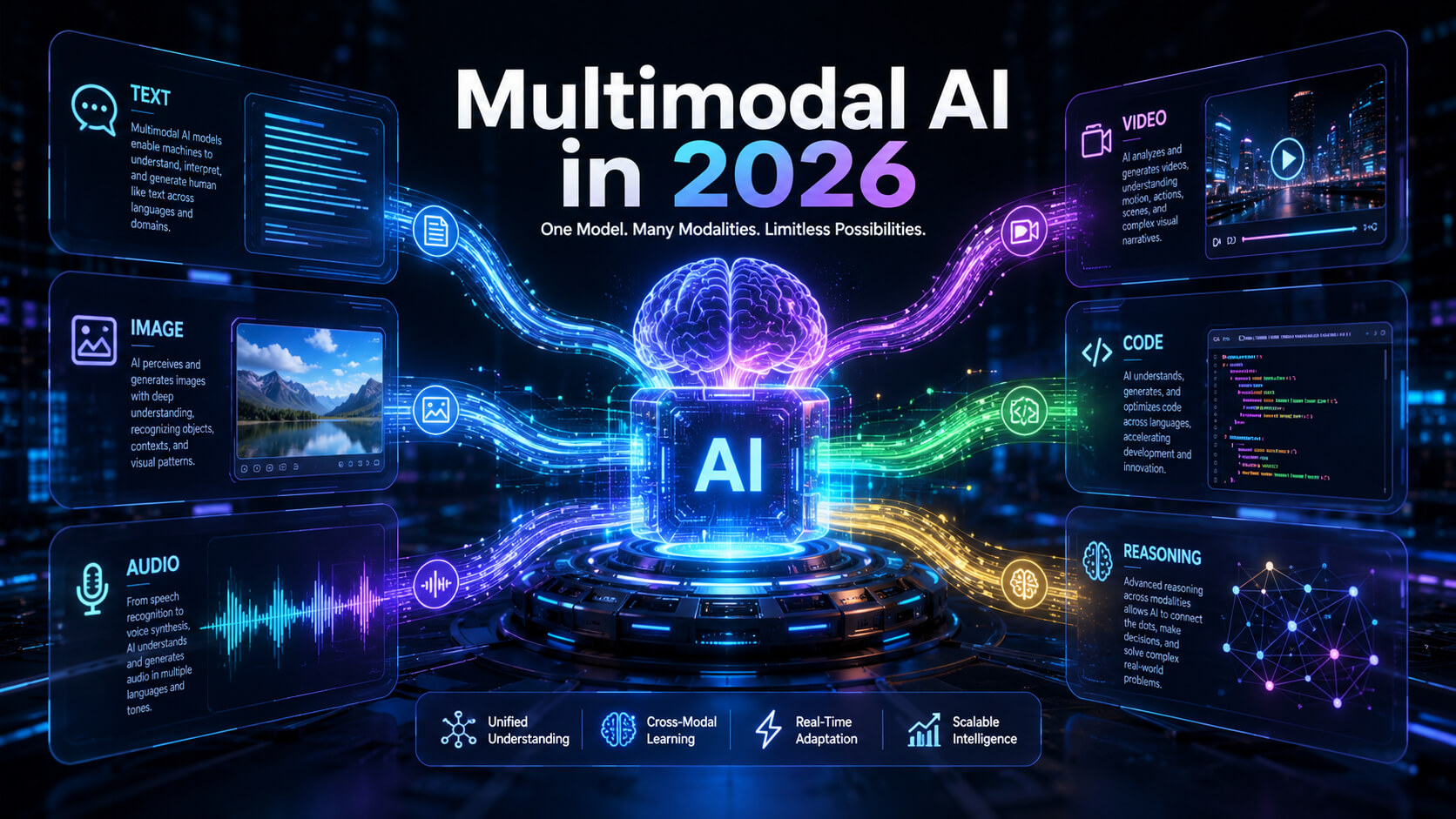
For most of AI’s history, models were specialists. Language models processed text. Vision models analyzed images. Audio models handled speech. Each operated in its own silo, understanding one type of information while being blind to everything else.
Multimodal AI breaks those silos. These systems process text, images, audio, video, and code simultaneously, reasoning across data types the way humans naturally do. When you show a multimodal AI a photograph of a damaged car and ask “how much would this repair cost?”, it sees the image, understands the question, identifies the damage type, and estimates the cost. One system. Multiple senses. Integrated reasoning.
In 2026, multimodal AI has moved from research demonstrations to production applications. It is transforming healthcare diagnostics, manufacturing quality control, customer service, content creation, and scientific research. This guide explains how multimodal AI works, where it is being deployed, and what it means for businesses and industries.
What Is Multimodal AI?
Multimodal AI refers to artificial intelligence systems that can process, understand, and generate information across multiple data types (modalities) simultaneously. The core modalities include text, images, audio, video, and structured data (code, tables, graphs).
The key distinction from previous AI generations is integration. Earlier systems could handle multiple modalities separately (a language model plus a vision model working in sequence). Multimodal AI processes all modalities within a single model architecture, enabling cross-modal reasoning that sequential approaches cannot achieve.
When a multimodal model reads a medical chart, views an X-ray image, and listens to a patient describing symptoms, it synthesizes all three information sources into a unified understanding. The text, image, and audio are not processed independently. They inform each other.
How Multimodal AI Works: The Technical Foundation
Unified Representation Learning
Multimodal models learn to represent different data types in a shared mathematical space. Text, images, and audio are all converted into numerical vectors (embeddings) that exist in the same dimensional space. This allows the model to compare, combine, and reason across modalities directly.
When the model processes the sentence “a red car on a mountain road” alongside a photograph, both the text description and the image are mapped to nearby points in the shared space. The model understands that the text and image describe the same concept because their representations are mathematically similar.
Cross-Modal Attention
Transformer architectures power most multimodal models. Cross-modal attention mechanisms allow the model to focus on relevant parts of one modality based on information from another. When answering a question about an image, the model attends to the specific image regions relevant to the question.
This attention mechanism is what makes multimodal AI genuinely different from running separate models in sequence. The model does not process the image first and the text second. It processes both simultaneously, with each modality influencing how the other is interpreted.
The Leading Multimodal Models in 2026
| Model | Developer | Modalities | Key Capability |
|---|---|---|---|
| GPT-4o / GPT-5 | OpenAI | Text, image, audio, video, code | Native voice, real-time video understanding |
| Claude (Opus/Sonnet) | Anthropic | Text, image, code, documents | Long-context reasoning, document analysis |
| Gemini 2.0 | Google DeepMind | Text, image, audio, video, code | Native multimodal, 1M+ token context |
| Llama 4 | Meta | Text, image, video | Open-source multimodal foundation |
| Grok | xAI | Text, image, code | Real-time information integration |
Real-World Applications of Multimodal AI
Healthcare: Integrated Diagnostics
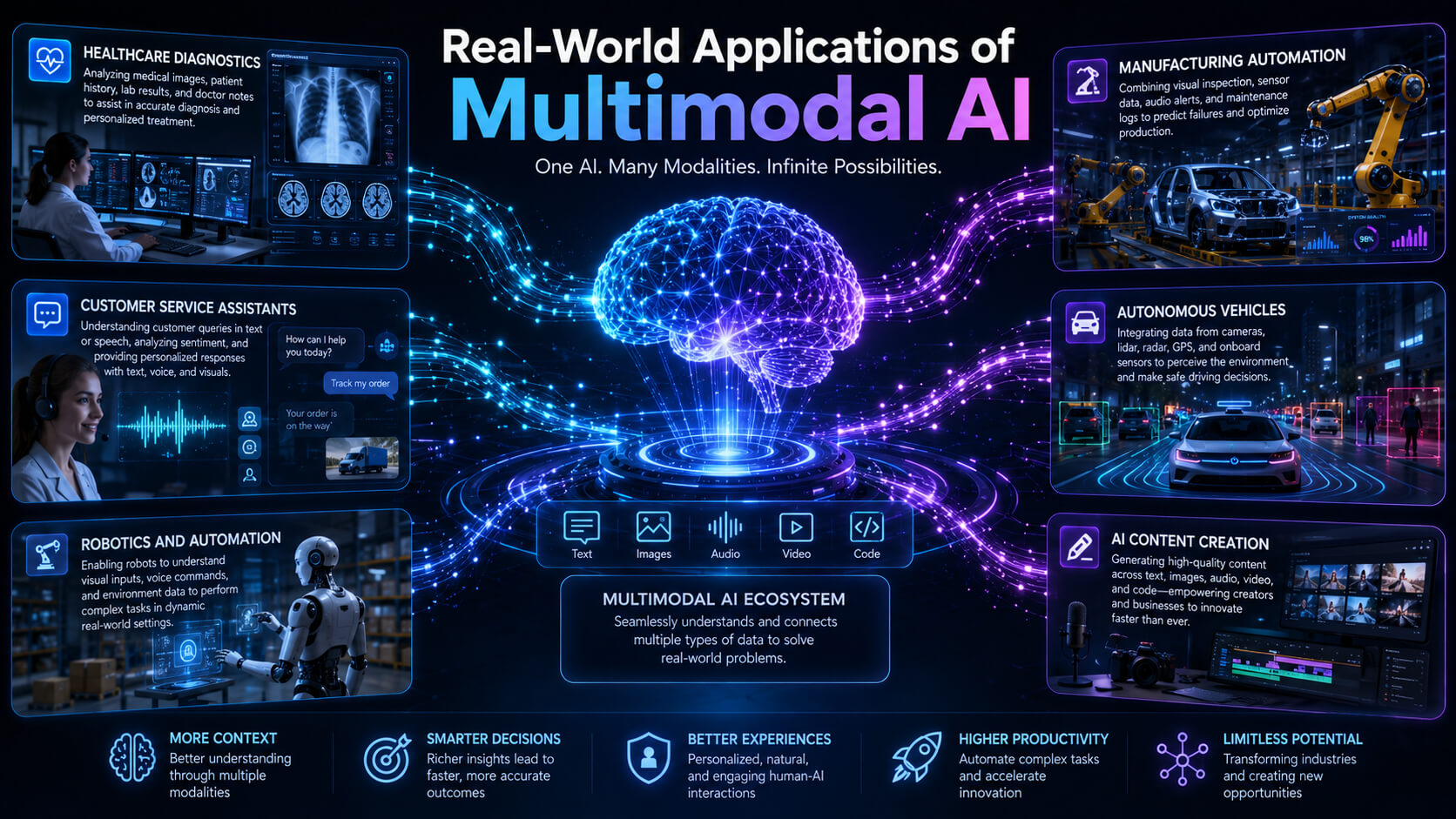
Multimodal AI is enabling diagnostic systems that combine medical imaging (X-rays, MRIs, CT scans), patient records (text), lab results (structured data), and clinical notes into a unified analysis. Instead of a radiologist reviewing an image in isolation, the AI considers the full clinical picture.
Early studies show that multimodal diagnostic AI achieves higher accuracy than single-modality systems, particularly for complex cases where the diagnosis depends on correlating visual findings with patient history and lab data.
Practical example: A dermatology AI that photographs a skin lesion, reads the patient’s medical history, and considers their medication list to differentiate between a drug reaction and a melanoma. The visual appearance alone might be ambiguous. The medication history resolves the ambiguity.
Manufacturing: Visual Quality Control
Manufacturing quality control traditionally relies on either human visual inspection or single-purpose computer vision cameras. Multimodal AI systems combine camera feeds (visual inspection), sensor data (temperature, vibration, pressure), and production logs (text records) to detect defects with greater accuracy and provide root cause analysis automatically.
Practical example: An automotive parts manufacturer uses multimodal AI that simultaneously analyzes camera images of each part, reads the machine settings that produced it, and correlates with historical defect patterns. When a defect is detected, the system identifies not just what is wrong but why, linking the visual defect to specific machine parameters.
Customer Service: Omnichannel Understanding
Multimodal AI transforms customer service by processing voice calls (audio), chat messages (text), product photos (images), and account data (structured data) within a single interaction. A customer can describe a problem verbally, send a photo of the issue, and receive a resolution that considers both inputs.
Practical example: An insurance claims agent (AI) receives a phone call from a policyholder who describes a fender bender, sends photos of the damage through the app, and the AI processes the verbal description, analyzes the damage photos, cross-references the policy terms, and generates a preliminary claim estimate in real time.
Content Creation: Cross-Modal Generation
Multimodal generative AI creates content that combines text, images, and audio. A marketing team describes a campaign concept in text, and the AI generates coordinated visual assets, copy variations, and even background music. A video editor provides rough footage and a script, and the AI produces a polished edit with graphics, transitions, and narration.
Scientific Research: Multi-Source Analysis
Researchers use multimodal AI to analyze experimental results across data types: microscopy images, spectral data, text-based research papers, and numerical datasets. The AI identifies patterns across these sources that would take human researchers weeks to correlate manually.
Challenges and Limitations
Computational cost
Multimodal models require significantly more compute than text-only models. Processing images and video alongside text increases memory requirements and inference latency. This creates cost barriers for real-time applications.
Hallucination across modalities
Multimodal models can generate confident but incorrect descriptions of images, misinterpret audio, or create false correlations between modalities. Cross-modal hallucination is harder to detect than text-only hallucination because verification requires expertise in each modality.
Training data bias
Multimodal models inherit biases from their training data across all modalities. Image-text models trained on internet data reflect the demographic and cultural biases present in web images and their associated captions.
Evaluation complexity
Measuring the quality of multimodal AI output is harder than evaluating text-only or image-only models. There are fewer established benchmarks, and human evaluation of cross-modal reasoning is expensive and subjective.
Privacy concerns
Multimodal AI that processes images, audio, and video raises significant privacy considerations, particularly in healthcare, surveillance, and customer-facing applications. Regulation around multimodal data processing is still developing.
Expert Tips for Working with Multimodal AI
1. Match the modality to the task
Not every problem requires multimodal input. If text alone provides sufficient context, adding images or audio increases cost without improving results. Use multimodal capabilities when cross-modal reasoning genuinely adds value.
2. Verify cross-modal claims carefully
When a multimodal AI describes an image or transcribes audio, verify the output against the source material. Cross-modal hallucinations can be subtle and confidently stated.
3. Consider latency and cost tradeoffs
Multimodal inference is slower and more expensive than text-only processing. For production applications, evaluate whether the accuracy improvement from multimodal input justifies the additional cost and latency.
4. Build with privacy by design
Multimodal systems that process faces, voices, or personal environments require careful privacy consideration. Implement data minimization, consent mechanisms, and anonymization where possible.
5. Start with the strongest use case
Deploy multimodal AI first in applications where cross-modal reasoning provides clear, measurable value. Healthcare diagnostics, quality control, and insurance claims processing are high-value starting points with quantifiable ROI.
Frequently Asked Questions
What is multimodal AI and how does it work?
Multimodal AI refers to AI systems that process multiple data types (text, images, audio, video, code) simultaneously within a single model architecture. It works by converting different data types into a shared mathematical representation space and using cross-modal attention mechanisms to reason across modalities. This enables the model to understand relationships between what it reads, sees, and hears, producing more comprehensive and accurate outputs than single-modality models.
What are the best multimodal AI models in 2026?
The leading multimodal models in 2026 include GPT-4o and GPT-5 (OpenAI), Gemini 2.0 (Google DeepMind), Claude Opus and Sonnet (Anthropic), Llama 4 (Meta, open-source), and Grok (xAI). Each has different strengths: Gemini excels at native multimodal processing with massive context windows, Claude leads in long-context document analysis, and GPT-4o provides the most polished voice and video capabilities.
How is multimodal AI used in healthcare?
Multimodal AI in healthcare combines medical imaging (X-rays, MRIs, CT scans), patient records, lab results, and clinical notes into integrated diagnostic systems. These systems achieve higher accuracy than single-modality tools, particularly for complex cases where the diagnosis depends on correlating visual findings with patient history. Applications include radiology, dermatology, pathology, and clinical decision support.
Your Next Step
Multimodal AI represents the most significant architectural shift in artificial intelligence since the transformer revolution. Systems that see, hear, read, and reason simultaneously are not science fiction. They are production tools reshaping industries today.
Identify the use case in your domain where cross-modal reasoning provides clear value. Test the leading models against your specific data types and requirements. And build your evaluation framework now, because as multimodal capabilities improve, the organizations prepared to deploy them will capture the most significant advantages.
Want to grow your AI, SaaS, or technology brand online? Publish high-authority guest posts through WritoryBuzz and improve your SEO, digital visibility, and industry credibility with strategic placements on trusted business and technology websites.