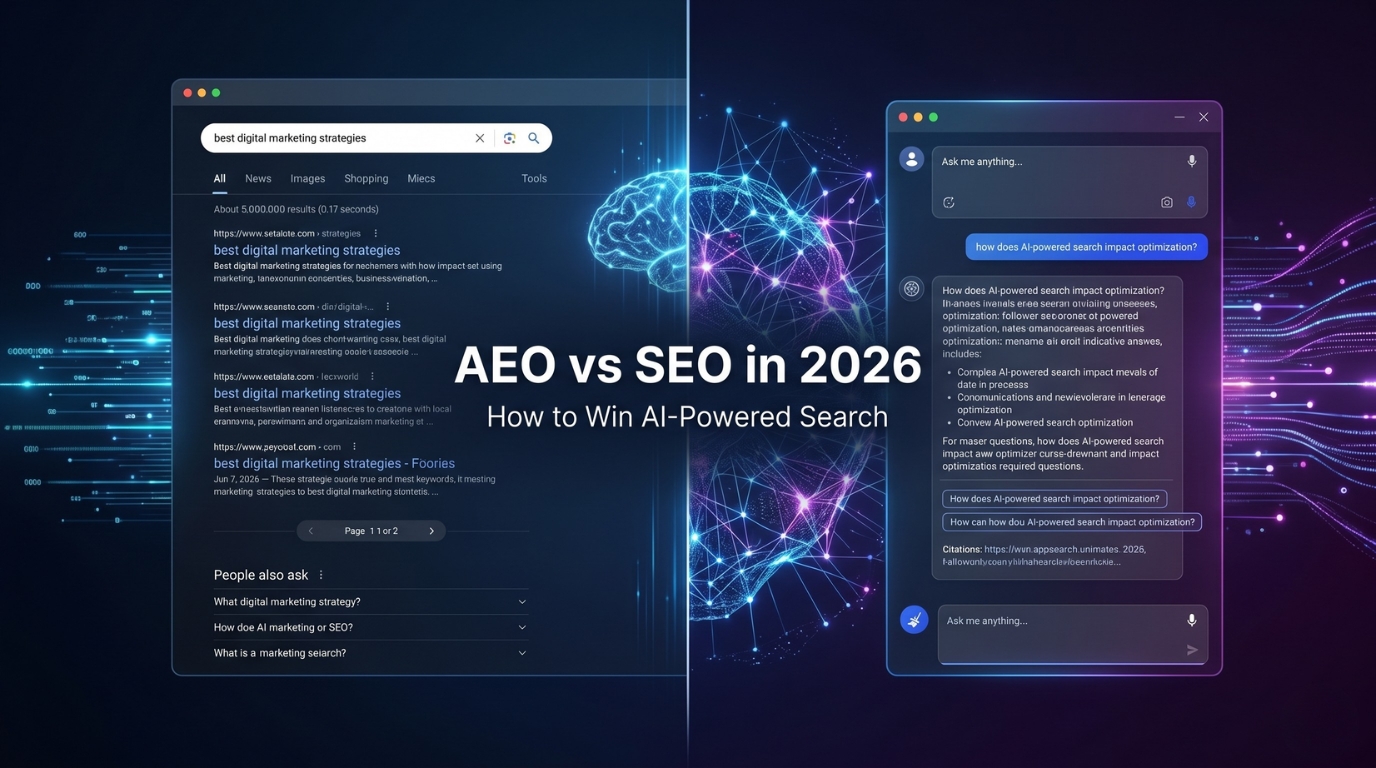
The internet has changed fundamentally. Users no longer want a list of blue links to click through. They want immediate and accurate answers to their questions.
This shift in user behavior forces digital marketers to adapt quickly. You cannot rely strictly on keyword density and backlink building to drive traffic anymore. Artificial intelligence now powers the core of digital discovery.
Brands must understand the critical differences between traditional optimization and the new AI-driven landscape. This guide breaks down the exact strategies you need to dominate search visibility this year. You will learn how to unify traditional tactics with the latest conversational algorithms.
The Evolution of Search: From Links to Direct Answers
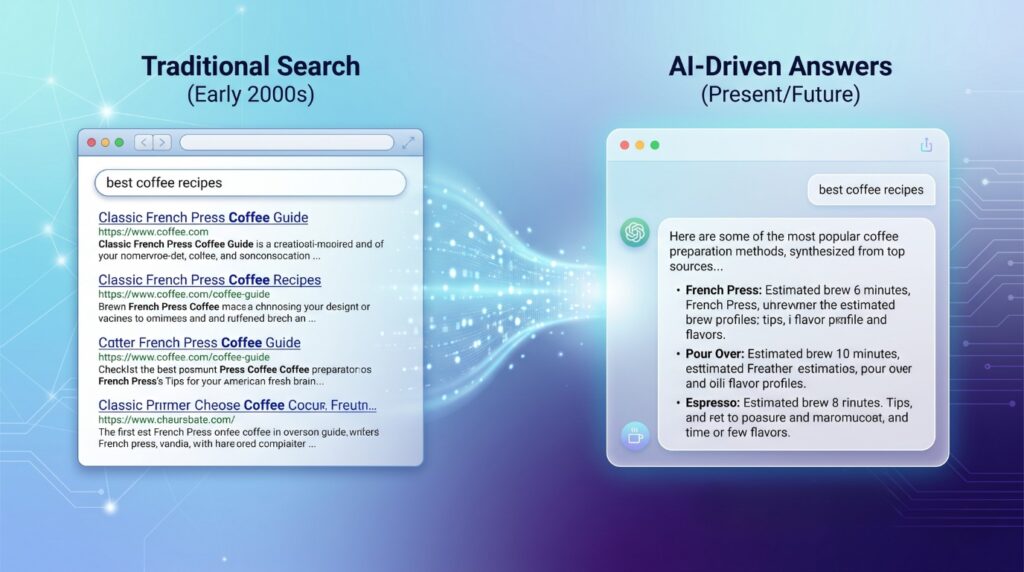
Search engines spent two decades acting as librarians. They cataloged web pages and handed users a stack of relevant documents. The user then had to read those documents to find the actual answer.
Today, platforms serve as subject-matter experts. Tools like ChatGPT, Perplexity, and Google’s AI Overviews read the documents for the user. They synthesize the information and generate a direct response instantly.
This technological leap requires a complete overhaul of your content strategy. You must shift your focus from ranking pages to supplying facts. Your content must feed the machines that answer the questions.
What is Traditional SEO Today?
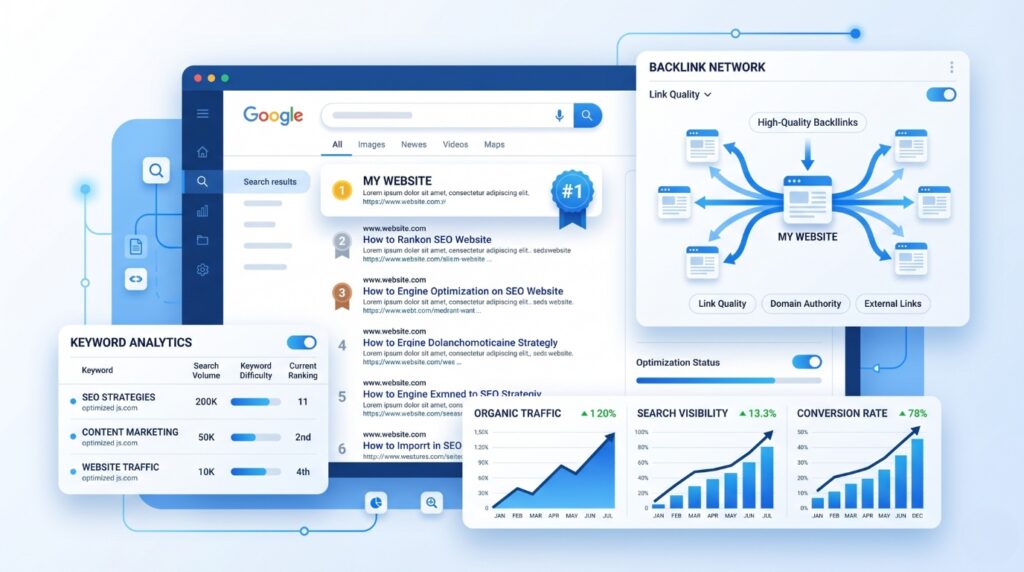
Search Engine Optimization (SEO) still plays a foundational role in digital marketing. It focuses on optimizing web pages to rank high on traditional search engine results pages. Professionals use technical audits, content creation, and link building to signal authority to crawlers.
The core metric of success in traditional SEO remains organic traffic. You want a user to click your link and land on your website. This model works exceptionally well for transactional queries that involve browsing products or services.
However, traditional SEO struggles with purely informational queries. Users rarely click through to a website if an AI tool gives them the exact answer right on the search page. This reality makes traditional SEO incomplete on its own.
What is Answer Engine Optimization (AEO)?
Answer Engine Optimization (AEO) specifically targets artificial intelligence platforms. It involves structuring your content so that AI models choose your data to formulate their answers. AEO focuses on absolute clarity, factual density, and direct phrasing.
Success in AEO looks very different from traditional SEO. You might not secure a direct website click. Instead, you secure a brand mention or a citation within the AI-generated response.
This brand visibility builds significant trust with end users. When an AI positions your company as the authoritative source, users view you as the definitive industry leader. AEO is about controlling the narrative inside the AI ecosystem.
Core Differences Between AEO and SEO
Marketers often confuse these two disciplines. You must understand their mechanical differences to build a strategy that targets both effectively. The table below highlights the distinct priorities of each approach.
| Strategic Focus | Traditional SEO | Answer Engine Optimization (AEO) |
| Primary Goal | Drive clicks to a specific web page. | Provide facts for AI to use in responses. |
| Content Format | Long form articles and landing pages. | Concise Q&A formats and structured data. |
| Key Metric | Organic traffic and keyword rankings. | Brand citations and AI overview inclusion. |
| User Intent | Browsing and deep research. | Immediate problem resolution. |
| Authority Signal | Number and quality of inbound links. | Entity recognition and factual consensus. |
You cannot choose one over the other. A modern digital strategy requires both. You need SEO to capture buyers and AEO to capture researchers.
Keyword Matching vs. Intent Resolution
Traditional search algorithms historically relied on exact keyword matching. If a user searched for the best running shoes, the algorithm looked for pages containing that exact phrase. Content creators stuffed keywords into headers to game the system.
Answer engines operate on intent resolution. They use Large Language Models (LLMs) to understand the concept behind the query. If a user asks for shoes to help with marathon training, the AI understands they need running shoes without needing the exact keyword.
This means you must write for semantic understanding. You must cover related concepts natively. Do not force keywords into sentences where they do not belong naturally.
Backlink Authority vs. Information Accuracy
Link building remains the backbone of traditional SEO. Search engines view a backlink as a vote of confidence from one site to another. A high number of quality links pushes your page up the rankings.
Answer engines prioritize information accuracy and consensus. They use Retrieval-Augmented Generation (RAG) to pull facts from multiple trusted sources. If your content provides a clear, verifiable fact that aligns with industry consensus, the AI will use it.
You must become a primary source of data to win in AEO. Publish original research, clear definitions, and unique statistics. AI models aggressively seek out raw data over heavily marketed opinion pieces.
Enter GEO: Generative Engine Optimization
The industry now recognizes a third pillar in this ecosystem. Generative Engine Optimization (GEO) bridges the gap between traditional search and conversational AI. GEO focuses on optimizing content specifically for generative search features like Google’s AI Overviews.
GEO requires a highly specific formatting strategy. You must structure your content to look appealing to a machine learning model. This involves using Markdown, clear hierarchical headings, and high-density informational bursts.
Companies mastering GEO see their content prominently featured at the top of search results. They bypass the traditional blue links entirely. They capture the user’s attention before they even scroll down the page.
Blending SEO, AEO, and GEO for Maximum Visibility
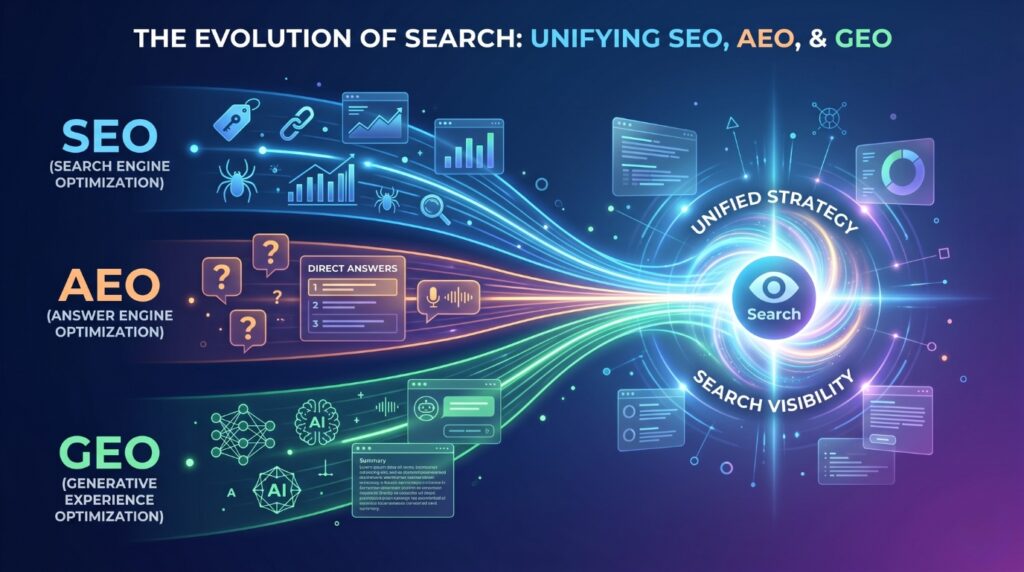
You isolate your brand if you focus on only one of these acronyms. The most successful enterprise brands blend all three into a single, cohesive content pipeline. They write for the user, format for the generative engine, and structure data for the answer engine.
Start by writing a comprehensive, SEO optimized article. Then, add a clear FAQ section at the top of the article to satisfy AEO requirements. Finally, use bulleted lists and bold text to highlight key facts for GEO.
This multi-layered approach guarantees visibility across all platforms. You capture the AI summary at the top of the page. You also secure the traditional organic ranking right below it.
Actionable Strategies to Win AI Search in 2026
Theory only gets you so far in digital marketing. You need concrete steps to update your existing content calendar. Implement these specific tactics to improve your AI search visibility immediately.
The goal is to make your content undeniable to an LLM. You want the machine to view your website as the most efficient place to find the truth. Here is how you achieve that.
Structuring Content for LLM Context Windows
Large Language Models process text in chunks called tokens. They have a limited context window for reading and understanding a single web page. You must put your most important information at the very top of your article.
Use the inverted pyramid style of writing. State the direct answer to the user’s question in the first two sentences. Spend the rest of the article providing context and supporting details.
Eliminate all fluff and introductory filler. AI models penalize pages that bury the answer under thousands of words of irrelevant background information. Get straight to the point immediately.
Building Conversational Authority
People talk to AI engines differently than they type into traditional search bars. They use full, conversational sentences. They ask complex, multi-part questions.
You must optimize your content for these conversational queries. Stop targeting short, robotic keywords. Start targeting the exact questions your sales team hears on customer calls.
Create dedicated glossary pages and knowledge bases. Define industry terms clearly and concisely. An AI engine will gladly cite your glossary if it provides the cleanest definition of a complex topic.
Common Mistakes to Avoid During the Transition
Many marketing teams panic and break their existing organic traffic channels. The most common mistake is deleting high-performing SEO content to replace it with short AEO answers. You should augment your existing content rather than replacing it.
Another major error involves ignoring technical infrastructure. AEO requires lightning-fast page load speeds and clean code. An AI bot will simply abandon your site if your server responds too slowly.
Finally, do not rely on AI to write all of your AEO content. If you publish the same AI-generated answers as your competitors, you offer zero unique value. You must inject human experience and original data to stand out to the algorithms.
Expert Tips for Technical AEO
Technical optimization separates the amateurs from the experts. You must implement robust Schema markup across your entire domain. Schema translates your content into a language that AI models process natively.
Use the FAQPage schema for any question-and-answer format. Use the Article schema to clearly identify the author and publication date. This structured data hands the facts directly to the AI without requiring it to guess your intent.
Keep your internal linking architecture perfectly organized. AI crawlers use internal links to understand the relationship between different concepts on your site. A messy site structure confuses the bot and destroys your AEO potential.
Frequently Asked Questions (FAQ)
What is Answer Engine Optimization (AEO)?
Search Engine Optimization is the process of structuring digital content so that search engines select it to generate direct responses to user queries. It prioritizes factual accuracy, concise formatting, and direct answers over traditional keyword density.
Will AEO replace traditional SEO?
No. AEO and traditional SEO serve different user intents. AEO satisfies immediate informational queries, while traditional SEO drives traffic for transactional and deep research queries. A modern strategy requires both disciplines working together.
How do I optimize content for AI search engines?
You optimize for AI by providing direct, fluff-free answers at the beginning of your content. You must utilize clear heading structures, implement Schema markup, and focus on establishing your brand as a primary source of original data.
Future-Proof Your Organic Visibility
The transition from keyword matching to intent resolution is permanent. Artificial intelligence will only become more integrated into our daily discovery habits. Brands that refuse to adapt their content strategies will disappear from search results entirely.
You have a brief window to establish your authority in these new answer engines. Audit your top-performing pages immediately. Add concise, direct answers to the top of those pages and implement correct technical formatting.
Do not let your competitors train the AI models before you do. If you need help structuring your enterprise data for the era of generative search, contact our strategy team for a comprehensive AEO architecture review.