

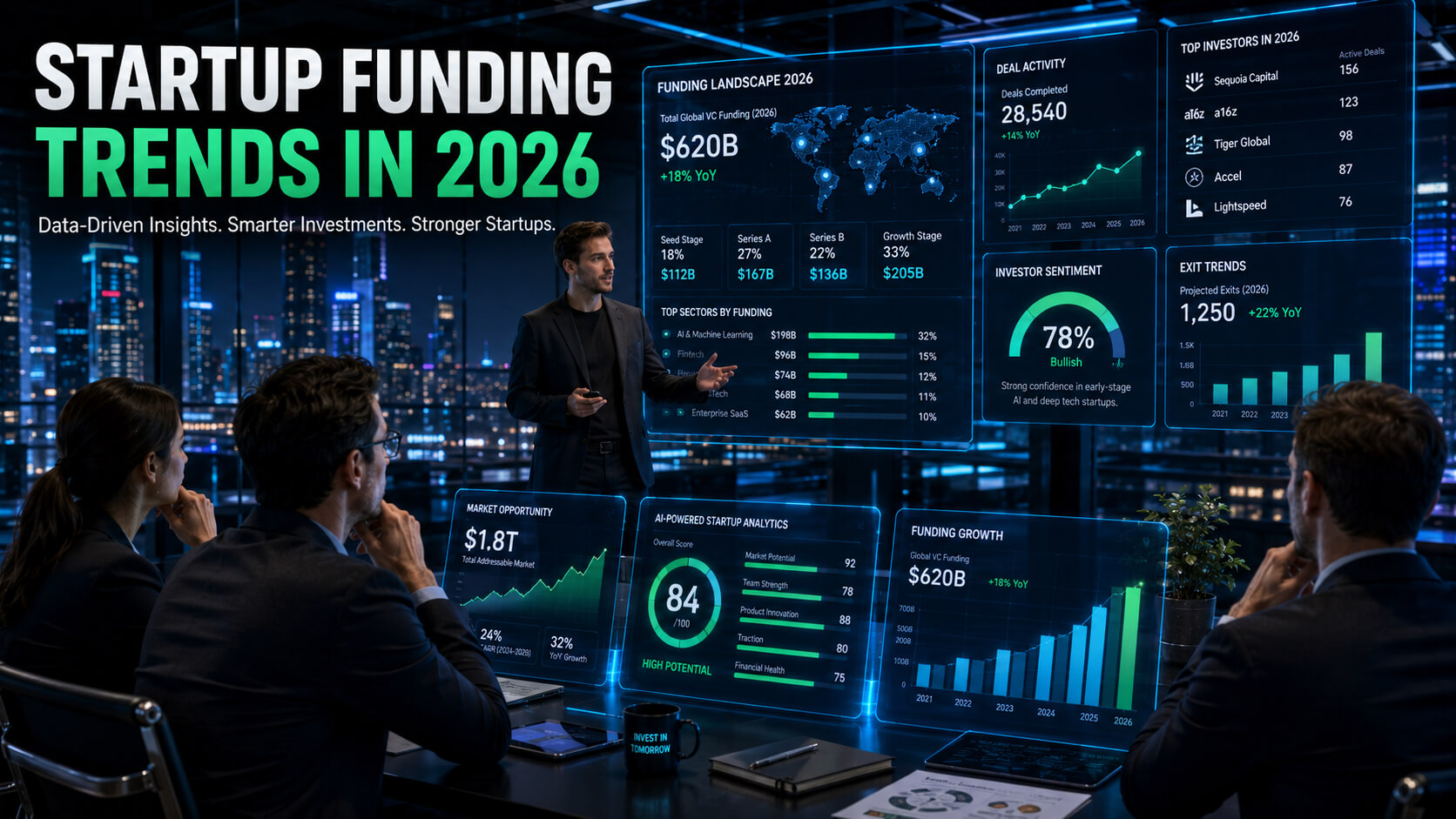
The startup funding market in 2026 has recovered from the correction of 2023 and 2024, but it looks nothing like the zero-interest-rate era of 2021. Capital is available. Valuations have stabilized. And investors have fundamentally changed what they look for in founders and companies.
The free-money era rewarded growth at all costs. The 2026 market rewards capital efficiency, regulatory awareness, defensible technology, and clear paths to profitability. Startups that understand this shift are raising faster and on better terms. Those still pitching 2021-era growth-at-any-cost narratives are struggling.
This guide maps exactly where venture capital is flowing in 2026, what investors prioritize in their evaluation process, and how to position your startup to attract funding in the current climate.
The Funding Landscape: By the Numbers
Global venture capital investment in 2025 recovered to approximately $340 billion, up from the trough of $250 billion in 2023. The 2026 trajectory suggests continued recovery, with Q1 investment pacing toward $350 to $380 billion annually.
But the distribution of that capital has shifted dramatically.
AI dominates
AI-related startups captured approximately 40% of all venture funding in 2025, up from 25% in 2023. In Q1 2026, that share is approaching 45%. The concentration is unprecedented in venture capital history.
Late-stage rounds have compressed
Mega-rounds above $100 million are fewer than in 2021, but individual round sizes are larger at earlier stages. Seed rounds that would have been $2 million in 2020 are now $5 million to $8 million.
Profitability expectations have moved earlier
Investors now expect clear unit economics by Series A, not Series C. The median Series A company in 2026 shows positive gross margins and a credible path to breakeven within 18 to 24 months of the round.
Where the Money Is Going: The Top Sectors
1. AI Infrastructure and Applications
Share of VC funding: Approximately 40 to 45%
AI is not just a sector. It is the sector. Investment spans the full stack: foundation model companies (though this is increasingly concentrated among a few players), AI infrastructure (compute, training tools, evaluation platforms), vertical AI applications (healthcare, legal, finance, education), and AI safety and governance tools.
The shift within AI funding is notable. In 2023, most AI investment went to foundation model companies. In 2026, the majority flows to application-layer companies that use existing models to solve specific industry problems. Investors have learned that building foundation models requires billions in compute. Building applications on those models can be done efficiently.
2. Climate Tech and Clean Energy
Share of VC funding: Approximately 12 to 15%
Climate tech has matured from a niche category to the second-largest venture investment sector. Carbon accounting, climate fintech, battery technology, grid modernization, and carbon removal are all attracting significant capital.
The regulatory tailwind (EU CSRD, SEC climate disclosures, carbon pricing expansion) creates mandatory demand for climate tech solutions. Investors view regulatory-driven demand as one of the most predictable growth curves available.
3. Cybersecurity
Share of VC funding: Approximately 8 to 10%
AI-powered threats have driven a corresponding surge in cybersecurity investment. Identity security, AI-native threat detection, post-quantum cryptography, and API security are the fastest-growing sub-sectors.
Cybersecurity startups benefit from a compelling investor narrative: the threat landscape is expanding faster than defense capabilities. As long as that gap exists, demand for better security tools grows.
4. FinTech (Restructured)
Share of VC funding: Approximately 8 to 10%
Fintech funding has restructured. The consumer neobank bubble of 2020 to 2022 has deflated. Capital now flows toward embedded finance infrastructure, B2B payments, RegTech, and stablecoin-based financial infrastructure.
Investors are prioritizing fintech companies with clear monetization models, regulatory compliance advantages, and infrastructure-level positioning over consumer acquisition-driven growth stories.
5. Defense Tech and Dual-Use Technology
Share of VC funding: Approximately 5 to 7%
Geopolitical tensions and increased government defense spending have pushed defense tech into mainstream venture capital. Autonomous systems, drone technology, cybersecurity, satellite infrastructure, and military AI are attracting both traditional VCs and specialized defense-focused funds.
The stigma around defense investing has largely disappeared among younger founders and investors. National security is increasingly viewed as a legitimate and important technology category.
What Investors Prioritize in 2026
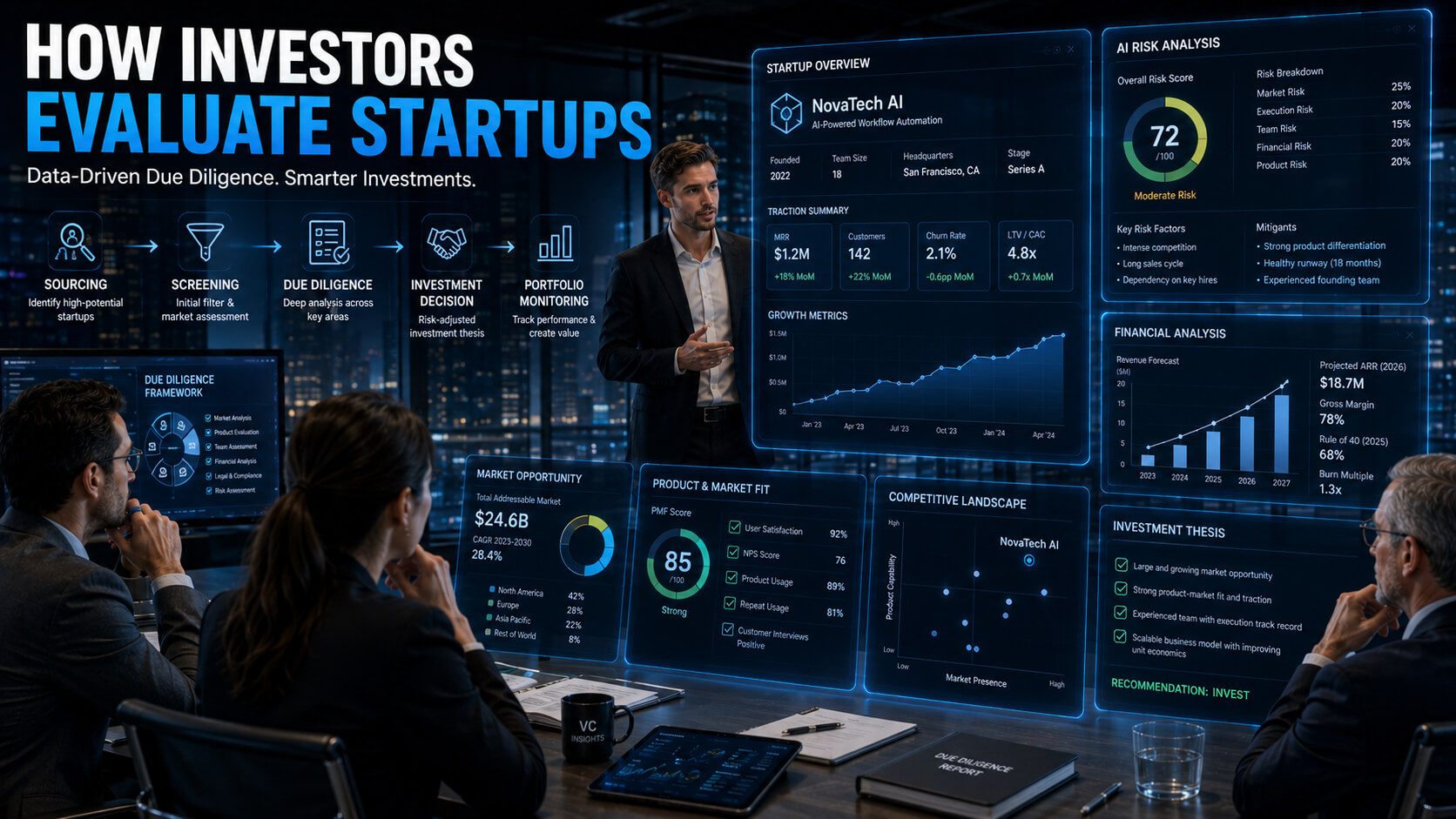
1. Capital Efficiency
Growth is still important, but efficient growth matters more. Investors now scrutinize burn multiple, gross margins, CAC payback periods, and runway management earlier than ever before.
A startup growing 80% annually with disciplined spending is more attractive than one growing 150% with uncontrolled burn. The market rewards sustainability over vanity metrics.
2. Defensible Technology
The rise of generative AI has created a new investor question: “What prevents this from becoming a commodity?”
Startups with proprietary datasets, network effects, deep workflow integration, regulatory moats, or unique infrastructure advantages attract significantly more investor interest than thin wrappers around public AI models.
3. Regulatory Awareness
Regulation is no longer viewed purely as a risk. In sectors like climate tech, fintech, cybersecurity, and healthcare, regulatory complexity creates barriers to entry that protect incumbents.
Investors increasingly favor founders who understand the regulatory landscape deeply and position compliance as a competitive advantage.
4. AI Integration
Even outside pure AI startups, investors expect companies to demonstrate how AI improves their operations, product capabilities, or cost structure.
A SaaS company without an AI roadmap now looks incomplete to many investors. AI has become an expected infrastructure layer, similar to cloud computing a decade earlier.
5. Founder-Market Fit
Generalist founders can still succeed, but domain expertise matters more than it did in 2021. Investors want evidence that founders deeply understand the industry they are disrupting.
A former compliance officer building RegTech or a former hospital administrator building healthtech has stronger credibility than a generic “smart founder” narrative.
What Has Become Harder to Fund
Consumer social apps
Unless there is a clear AI-native or creator economy angle, consumer social startups face intense skepticism. Investors remember the overfunded consumer cycles of the early 2020s.
Generic SaaS
Traditional horizontal SaaS products without clear differentiation or AI augmentation struggle to attract attention. Investors increasingly view undifferentiated SaaS as commoditized.
Crypto speculation platforms
Speculative trading platforms and meme-coin infrastructure have lost favor with institutional investors. Funding still exists in crypto, but it is flowing toward tokenization, stablecoins, infrastructure, and regulated financial applications rather than speculation.
“Growth at all costs” models
Businesses that depend on heavy subsidization, unsustainable customer acquisition spending, or unclear monetization paths are significantly harder to fund than in the ZIRP era.
How the Fundraising Process Has Changed
Diligence is deeper
Investors conduct more technical diligence, customer reference checks, and unit economics analysis than they did during the fast-moving 2021 cycle.
The days of raising a $20 million Series A after a few Zoom calls and a pitch deck are largely gone.
AI-generated pitch decks are common
Because AI tools can generate polished presentations instantly, investors place less weight on presentation quality and more emphasis on underlying metrics, traction, and technical depth.
Smaller teams are acceptable
AI-enhanced productivity means startups can achieve meaningful revenue milestones with fewer employees. Investors no longer expect rapid headcount growth as a signal of ambition.
Secondary markets matter more
Employees and early investors increasingly expect liquidity before IPO. Secondary share sales are becoming a standard part of late-stage fundraising discussions.
Expert Tips for Raising Venture Capital in 2026
1. Show efficiency from day one
Track burn multiple, CAC, gross margins, and payback periods early. Investors expect operational discipline even at seed stage.
2. Position AI as infrastructure, not a buzzword
Do not simply add “AI” to your pitch. Explain precisely how AI improves your economics, product capabilities, or defensibility. Investors have become highly skeptical of superficial AI narratives.
3. Build regulatory understanding into the company DNA
If you operate in fintech, healthtech, climate tech, or cybersecurity, regulatory literacy is a competitive advantage. Treat compliance as product strategy, not legal overhead.
4. Prioritize distribution advantages
Technology advantages erode quickly. Distribution advantages (partnerships, embedded workflows, network effects, community) persist longer and matter more to investors.
5. Expect a longer fundraising cycle
Rounds are taking longer to close than in 2021. Build more runway than you think you need before starting the fundraising process.