
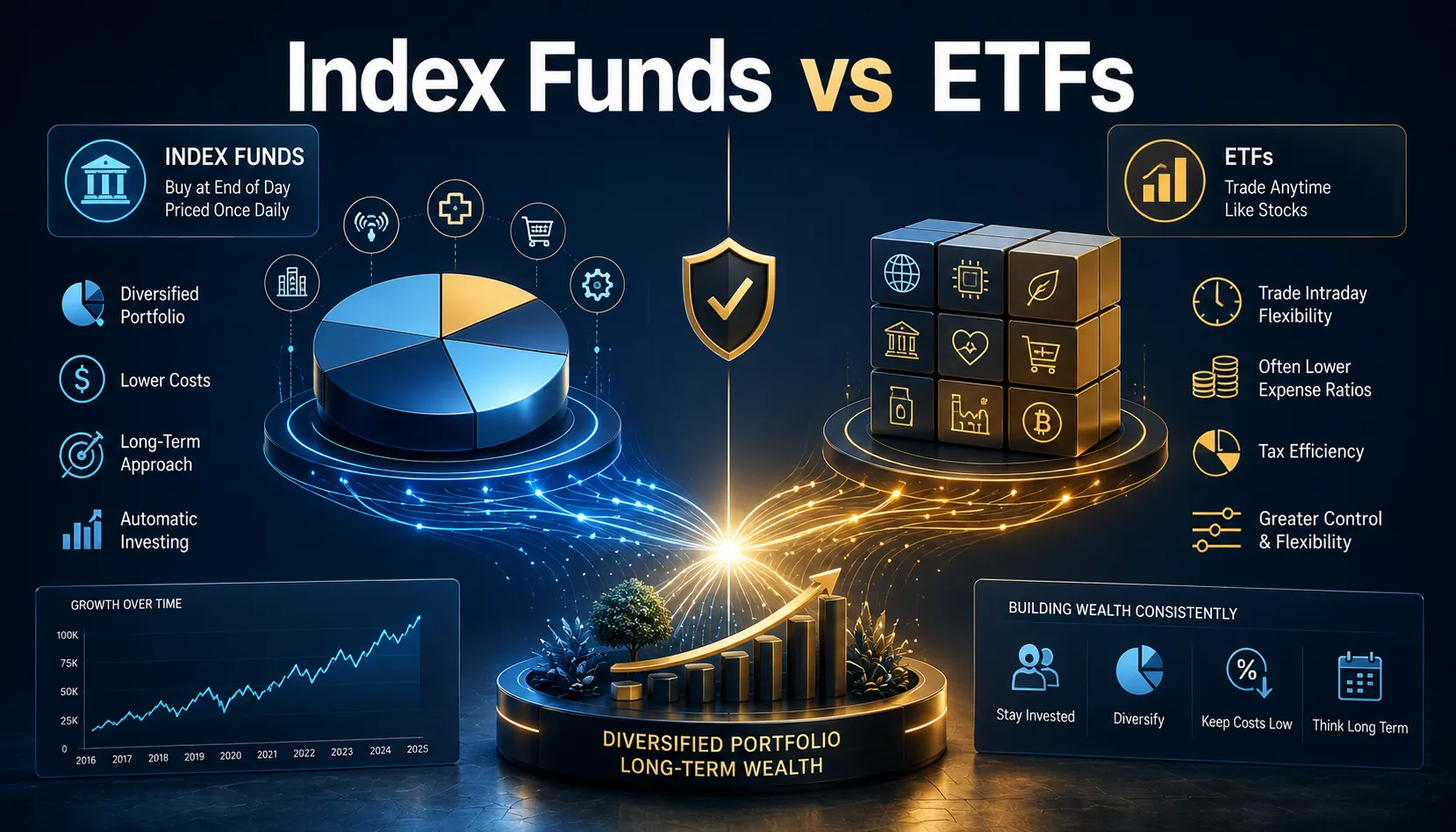
Most of the confusion about index funds versus ETFs comes from conflating two different questions: what they track versus how they trade.
Both can track the same index. Both can have similar expense ratios. But they are structured differently, trade differently, and in a taxable account, are taxed differently. Those differences matter depending on how you invest.
Here is the clear breakdown, without jargon.
What Both Have in Common
Both index funds and ETFs are designed to track a market index, like the S&P 500 or a total market index, rather than picking individual stocks. Both offer broad market exposure at low cost. Both generally outperform actively managed funds over long periods.
For most investors with long time horizons and a simple buy-and-hold approach, the difference between a Vanguard S&P 500 ETF and a Vanguard S&P 500 index fund tracking the same benchmark is small. The choice matters more in specific situations.
The Core Difference: How They Trade
This is the most fundamental distinction, and everything else flows from it.
| Structure | How It Trades |
| Index Fund (Mutual Fund) | Priced once per day at market close. You buy or sell at that day’s net asset value (NAV). Orders placed during the day execute at end-of-day price. |
| ETF | Trades throughout the day on a stock exchange, just like a share. You can buy at 10am and sell at 2pm. Price fluctuates throughout trading hours. |
For long-term buy-and-hold investors, intraday trading ability is irrelevant. If you invest monthly and hold for decades, it does not matter whether you can trade at 10am or only at 4pm. For traders or investors who want precise entry and exit prices, ETFs offer flexibility index funds do not.
Costs: Closer Than You Think
Large S&P 500 ETFs and equivalent index funds often charge between 0.03% and 0.09% annually. On $10,000 invested, that is $3 to $9 per year. The cost argument that once favored ETFs has been largely eroded as index fund providers matched ETF pricing.
The difference that remains: ETFs typically have no minimum investment requirement beyond the cost of one share. Some index funds still require minimum initial investments ranging from $1 to $3,000. This makes ETFs more accessible for investors starting with small amounts.
The Tax Efficiency Advantage: ETFs Win in Taxable Accounts
This is the most practically significant difference for investors holding funds outside a retirement account.
When other investors in an index fund redeem their shares, the fund manager may need to sell underlying stocks to raise cash. If those sales produce a capital gain, the fund distributes that gain to all remaining investors, including you. You pay tax on a capital gain you did not choose to realize.
ETFs avoid this through their unique creation-redemption mechanism. Large institutional participants called authorized participants handle share creation and redemption in-kind, meaning stocks, not cash. This process rarely triggers a taxable event for regular investors. In a taxable account, ETFs can save meaningful money over decades.
When to Choose Which
| Situation | Prefer | Reason |
| Taxable brokerage account | ETF | Tax efficiency advantage is real and compounds over time |
| Tax-advantaged account (IRA, 401k) | Either | Tax efficiency gap is irrelevant inside these accounts |
| Automatic monthly investing | Index Fund | Easier to automate exact dollar amounts; ETF requires buying whole shares |
| Starting with very small amounts | ETF | No minimums beyond share price; some index funds require $1,000+ |
| Long-term buy and hold, any account | Either | The difference is small and both are appropriate vehicles |
The $10,000 Cost Example Over 20 Years
Invested $10,000 for 20 years at 7% average annual return: an ETF with a 0.05% expense ratio costs roughly $1,000 in total fees over the period. An index fund charging 0.15% costs around $3,000. That 0.1% annual difference, compounded over two decades, produces a $2,000 gap.
This is not an argument against index funds. It is a demonstration that even small fee differences compound significantly. When comparing specific products, always compare the expense ratio directly rather than assuming ETF automatically means cheaper.
Common Mistakes
- Choosing based on the label (ETF or index fund) rather than the expense ratio of the specific product
- Paying for intraday trading flexibility in an ETF when you invest monthly and never need it
- Ignoring the tax efficiency difference in a taxable account over a long time horizon
- Comparing an ETF to an actively managed mutual fund and concluding ETFs are superior, when the comparison should be to an index fund tracking the same benchmark
FAQ
What is the real difference between an ETF and an index fund?
Both can track the same index and have similar costs. The key differences are trading mechanics (ETFs trade throughout the day; index funds price once daily) and tax efficiency in taxable accounts (ETFs are generally more efficient due to their creation-redemption structure).
Which is more tax-efficient, an ETF or an index fund?
ETFs are generally more tax-efficient in taxable accounts because their unique share creation and redemption process rarely triggers capital gains distributions. Index funds can distribute capital gains to all investors when large redemptions force asset sales. In tax-advantaged accounts (IRA, 401k), this difference is irrelevant.
Does it matter which one I choose for a retirement account?
Less so. The tax efficiency advantage of ETFs disappears inside tax-advantaged accounts. In a retirement account, choose based on expense ratio, automatic investment options, and account minimums rather than the ETF versus index fund structure.