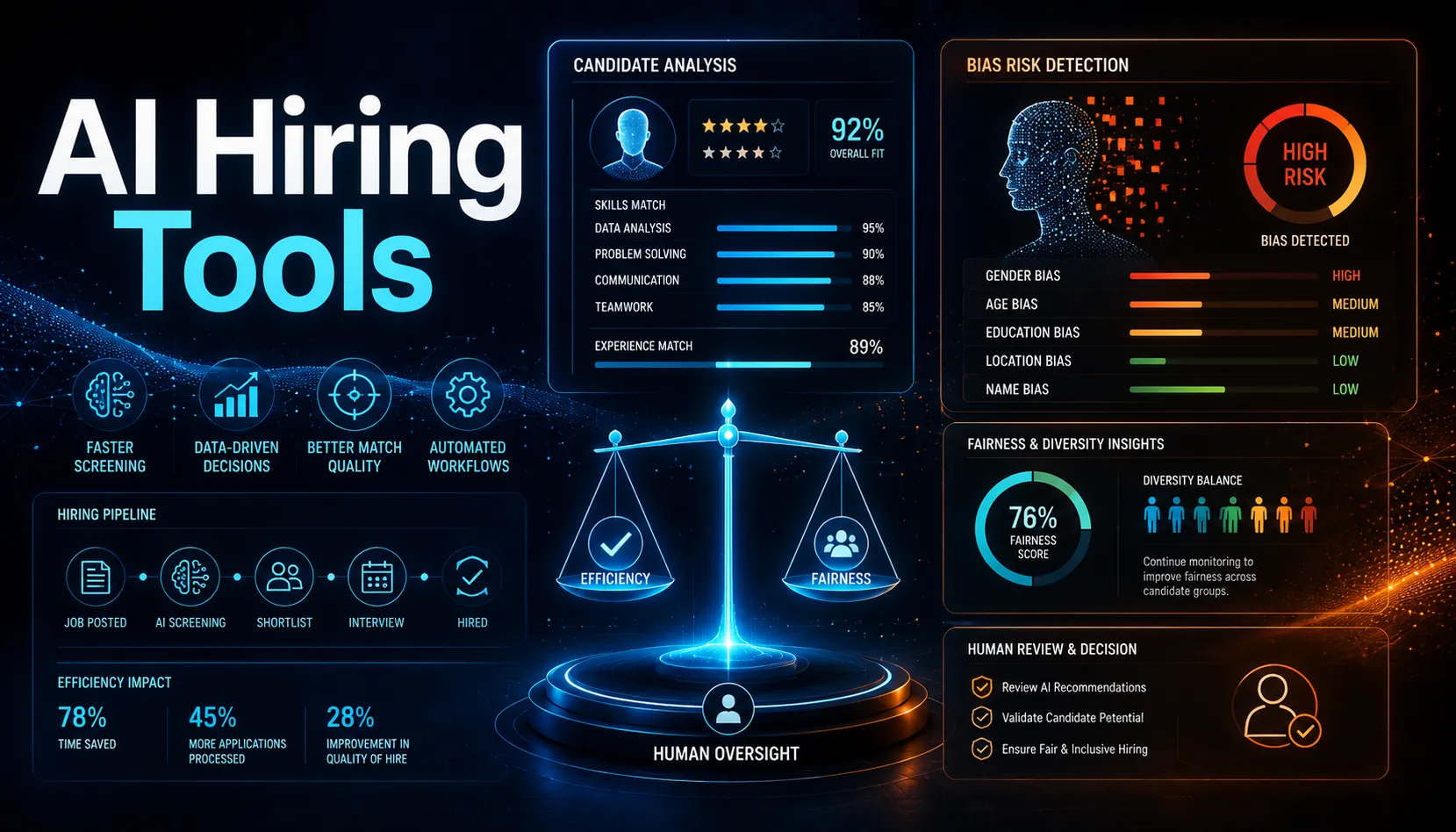
In 2026, 99% of Fortune 500 companies use AI somewhere in their hiring process. Nearly 98% of large firms automate initial screening. The premise is efficiency and objectivity: remove human prejudice, let data decide.
The reality is more complicated. A 2026 audit found a 40% increase in identified bias patterns in AI hiring tools compared to 2024 data. AI resume screeners favor white-associated names 85% of the time. They favor male names over female names at rates between 52% and 85%. They skew predictions by up to 17% based on protected characteristics.
The question is not whether AI bias in hiring exists. The evidence confirms it does. The question is whether the problem is fixable and whether AI can ultimately be fairer than the humans it replaces.
Where the Bias Comes From
The most common source is training data. When AI systems learn from historical hiring decisions, they learn the biases embedded in those decisions. If a company historically hired mostly white men for engineering roles, the model learns that profile correlates with success and screens for it, perpetuating the pattern.
Algorithmic design choices compound the problem. Features used as proxies for job performance, such as the university attended, zip code of residence, or gap years in employment history, all correlate with race, socioeconomic status, and gender without being labeled as such. The model uses them anyway.
Amazon’s AI recruiting tool, scrapped in 2018 after it was found to consistently penalize women’s CVs, remains the defining case study. It was trained on 10 years of historical resumes, nearly all from men, and learned accordingly. The lesson was not universally applied.
What the Data Actually Shows in 2026
| Bias Type | Finding | Source |
| Resume name bias | White-associated names favored 85% of the time over equivalent Black or Hispanic names | UW study, 550+ resumes |
| Gender bias | Male names preferred 52-85% over female equivalents in screener outputs | Multiple 2026 audit reports |
| Prediction skew | AI outcome predictions vary up to 17% based on protected characteristics | 2026 algorithmic bias audits |
| Compliance gap | Compliance preparedness improved only 15% despite 40% increase in identified bias patterns | 2026 audit findings |
The Legal Landscape Is Tightening
New York City’s local law has been in effect requiring annual bias audits for automated employment decision tools and public reporting of results. Companies with New York City employees must audit their AI hiring systems every year.
California finalized regulations in October 2025 that clarify how existing anti-discrimination laws apply to AI hiring tools. The Colorado AI Act, effective June 30, 2026, requires developers and users of AI hiring tools to use reasonable care to prevent algorithmic discrimination.
Courts are increasingly permitting plaintiffs to compel disclosure of proprietary algorithms in discrimination lawsuits. An organization that cannot produce transparent model documentation and continuous bias testing records has significant legal exposure.
Can AI Hiring Be Made Fairer?
The honest answer is: yes, with deliberate effort, but it requires more than deploying a tool and trusting it.
Five approaches that research and practitioners identify as most effective:
- Skills-first, structured assessment: design the hiring process around demonstrable competencies rather than proxies like educational prestige or employment history patterns
- Diverse and representative training data: audit the data used to train models for demographic imbalances before deployment, not after
- Regular fairness audits: calculate selection rates across demographic groups using impact ratio analysis, flagging when any protected group’s selection rate falls below 80% of the most favored group (the four-fifths rule)
- Human accountability with clear rubrics: AI scores should inform, not decide. Humans make the final call with documented reasoning
- Vendor scrutiny: before purchasing an AI hiring tool, require documentation of bias testing methodology, training data composition, and compliance with NYC, California, and Colorado regulations
The Honest Comparison: AI vs Human Recruiters
| AI Hiring Potential Advantage | AI Hiring Actual Risk |
| Scale: can review thousands of applications consistently | Training data encodes historical biases at scale |
| Applies consistent criteria across every candidate | Proxies (zip code, school name) serve as demographic signals |
| No in-the-moment fatigue or mood effects | Optimizes for historical success profiles, not future potential |
| Can be audited and tested systematically | Harder to audit than individual humans; black-box outputs |
| Removes some in-person biases (appearance, accent) | Introduces new proxy biases not present in human review |
Human recruiters have well-documented biases too. The difference is that AI bias operates at scale and with an air of objectivity that makes it harder to challenge. A rejected candidate told ‘the algorithm screened you out’ has less recourse than one told ‘the recruiter preferred someone else.’
What Job Seekers Should Know
If you suspect an AI system unfairly rejected your application, document the application, the position requirements, and your qualifications. In New York City and Colorado, you have legal rights regarding automated employment decision tools. The Colorado AI Act effective June 2026 provides explicit protections against algorithmic discrimination.
Practically: tailor resumes to match the exact language in job descriptions, since many ATS tools do keyword matching. Avoid formatting that ATS systems cannot parse (tables, headers, unusual fonts).
FAQ
Can AI hiring tools discriminate against job applicants?
Yes. Current evidence shows AI hiring tools systematically favor white-associated names, male names, and candidates from certain educational and geographic backgrounds. The bias comes primarily from training on historically biased data and the use of proxy variables that correlate with protected characteristics.
What laws regulate AI use in hiring in 2026?
New York City requires annual bias audits and public reporting. California regulations clarify existing anti-discrimination law applies to AI tools. The Colorado AI Act, effective June 30, 2026, requires reasonable care to prevent algorithmic discrimination. More states are developing regulations.
Is AI actually fairer than human recruiters?
Not automatically. AI can be more consistent, but its biases operate at scale and with false authority. With deliberate design, diverse training data, and regular auditing, AI can reduce some human biases. Without those safeguards, it can perpetuate historical discrimination faster and more systematically than any individual recruiter.
AI can improve efficiency, but fairness and transparency remain essential. WritoryBuzz creates research-driven technology and workplace content that helps readers understand emerging trends, risks, and opportunities.