
Every benchmark report you find this year gives you a different open rate number. MailerLite says 43.46%. Campaign Monitor says 21.5%. WebFX says 19.21%. None of them are wrong. They are measuring different things.
The problem is Apple Mail Privacy Protection (MPP). Introduced in iOS 15, it pre-loads tracking pixels on every email opened in Apple Mail, registering it as ‘opened’ whether a human ever looked at it. Open rates across the industry are inflated by an estimated 15 to 20 percentage points.
In 2026, open rate is a broken metric. Only 15% of marketers still use it as a primary performance indicator. Here is what to measure instead, and what the honest benchmarks look like.
The Benchmark Metrics That Still Reliably Measure What They Measure
| Metric | What It Measures | 2026 Benchmark |
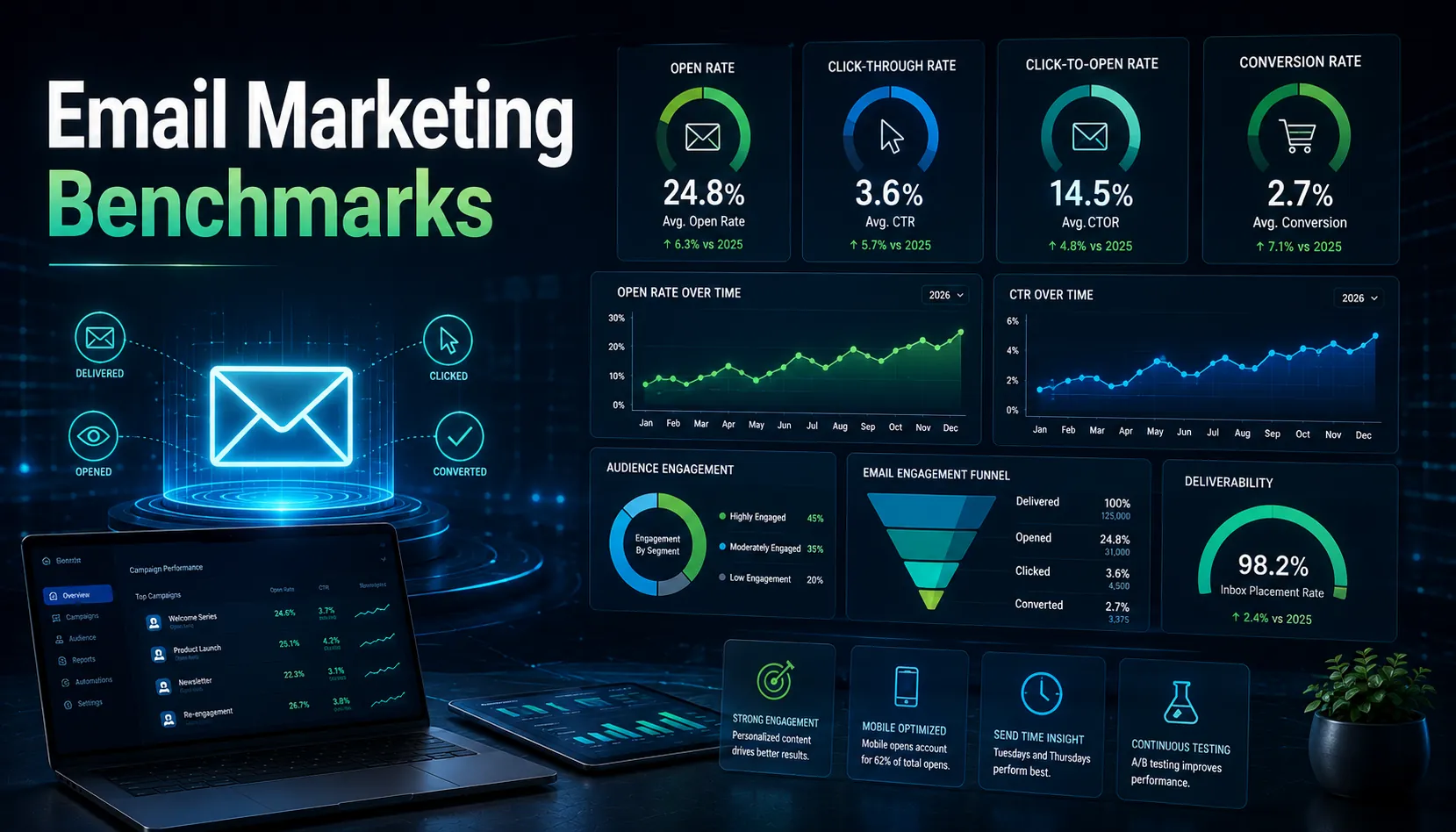
| CTR (Click-Through Rate) | % of total recipients who clicked a link | 2.44% avg across all industries (WebFX/Mailchimp 2026) |
| CTOR (Click-to-Open Rate) | % of openers who clicked | 6.81% avg (MailerLite 2026); inflated by MPP |
| Unsubscribe Rate | % who unsubscribed per campaign | 0.1-0.3% is healthy; above 0.5% signals a problem |
| Bounce Rate | Hard + soft bounces as % of sends | Under 2%; above 2% damages sender reputation with Gmail and Microsoft |
| Flow CTR | CTR on automated sequences vs broadcasts | 5.58% avg on flows vs 2.44% on campaigns |
CTR is now the primary benchmark metric for email marketing because it requires a deliberate human click. It cannot be faked by privacy protection features. Compare your CTR to the industry average, not your open rate.
CTR Benchmarks by Sector
| Sector | Benchmark |
| Government | 4.1% avg CTR (highly engaged specific audience) |
| Agriculture | 3.5% avg CTR |
| Legal | 4.90% CTR (highest per MailerLite data) |
| Media/Publishing | 3.2% CTR avg |
| B2B overall | 3.2% avg CTR |
| B2C overall | ~2.6% avg CTR |
| Beauty / Retail | 3.91% CTOR; lower absolute CTR |
| General ecommerce | 2.0-2.5% campaign CTR; flows 5%+ |
The ROI That Makes Email Hard to Ignore
Email marketing delivers $36 to $42 for every dollar spent, on average. Companies that A/B test see $42 per dollar; those that do not average $23. US ecommerce merchants at the top of the range see $76 per dollar.
Automated email flows consistently outperform broadcast campaigns. Klaviyo’s 2026 data puts flow CTR at 5.58% versus 2.44% for broadcast campaigns. Automated flows generate up to 320% more revenue than equivalent broadcast campaigns.
Welcome emails are the highest-performing single email type, achieving 83.63% open rates (with MPP caveat). Abandoned cart sequences convert at 3.33%.
What Moves CTR: The Levers That Actually Work
- Segmentation: segmented campaigns drive 760% more revenue than non-segmented sends, the single largest lever in email marketing
- Behavior-based triggers: sending based on what someone did (browsed a category, abandoned a cart) outperforms time-based sends significantly
- Personalization: AI-powered product recommendations in flows lift CTR to 3.75% on average and 8.79% for top performers
- Mobile optimization: responsive design increases mobile CTR by 15% and decreases unsubscribe rate by 27%; 55% of emails are opened on mobile
- Send time: Tuesday and Wednesday generally see highest engagement across industries
The Deliverability Floor That Now Sets the Rules
Gmail and Microsoft have set hard thresholds for spam complaint rates. Cross those thresholds and your emails get filtered or blocked regardless of how good your content is.
Gmail’s threshold: spam complaint rates above 0.10% trigger filtering. Above 0.30% triggers bulk sending suspension. Microsoft applies similar standards. These are not suggestions. They are enforcement thresholds.
Maintaining clean lists, easy unsubscribe options, and relevant content protects deliverability. Buying email lists and sending to people who never asked for your emails is the fastest way to destroy a domain’s sending reputation permanently.
Common Mistakes
- Optimizing for open rate in 2026 when the metric is inflated 15-20 points by Apple MPP
- Treating broadcast and flow benchmarks as the same standard; flows always outperform broadcasts
- Sending the same email to the entire list; segmentation is the highest-ROI email marketing improvement available
- Not A/B testing; companies that A/B test earn 83% more per email dollar than those that do not