
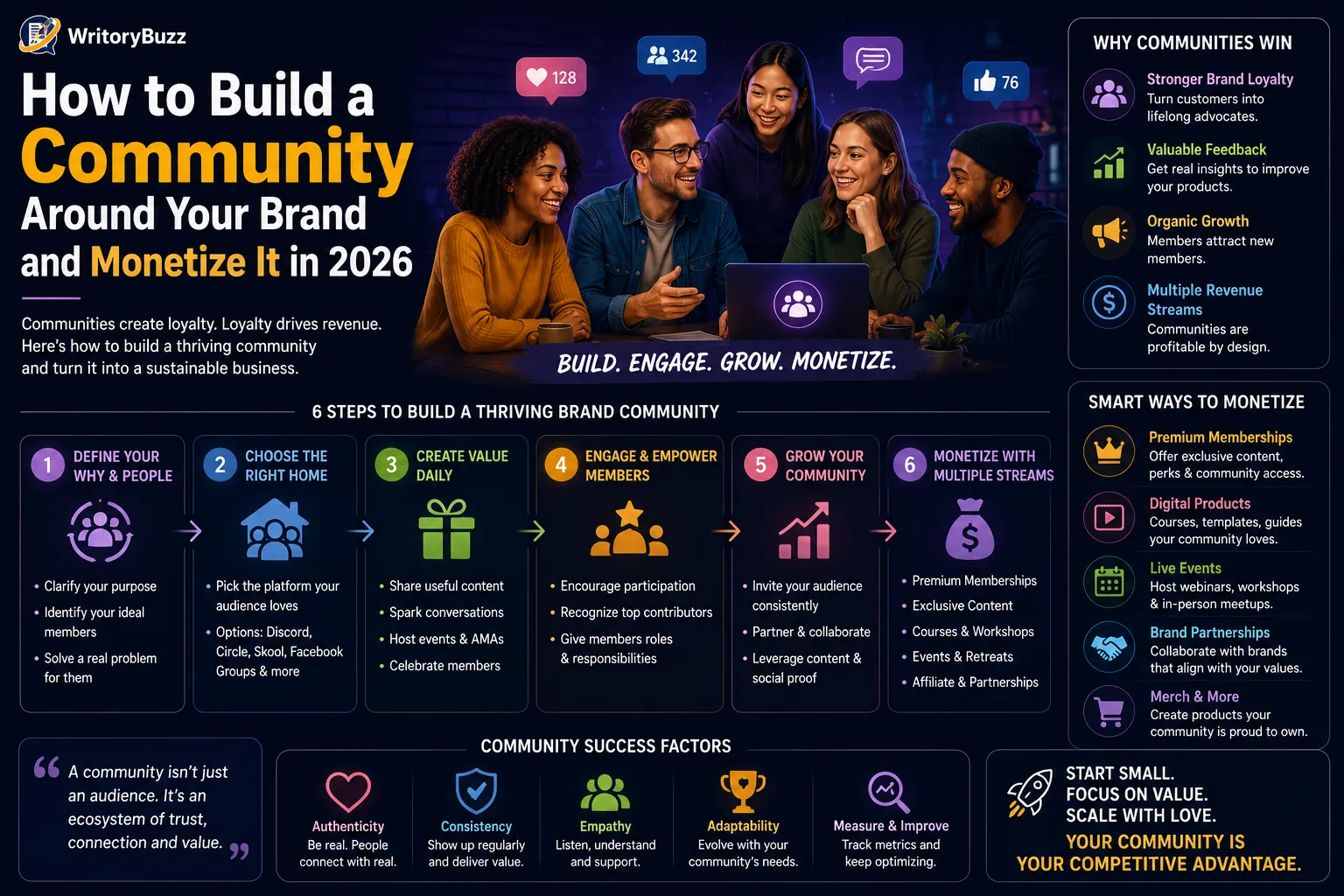
The online community market is expected to exceed $2 billion in 2026. Mighty Networks reports creators earning an average of $9,000 monthly from communities of 200 to 500 paying members. Discord has 200 million active users. Skool processes millions of dollars in monthly membership revenue. The community business model has moved from social media strategy to primary revenue stream.
A brand community is a group of people united by a shared interest in a topic, outcome, or identity that your brand facilitates. Communities generate revenue differently from products or services: they generate it through the value members provide to each other, which you facilitate and structure rather than deliver directly. This is the model’s most important economic property: community value scales with member quality and engagement, not primarily with your own content output.
Why Community Outperforms Content Alone
A content business (blog, YouTube, newsletter) creates all the value directly and distributes it to passive consumers. A community business creates the conditions for value exchange between members, then captures a fraction of that value through membership fees. The economics differ significantly at scale.
A content creator with 50,000 email subscribers earning $10 per month per subscriber through content needs 50,000 subscribers to generate $500,000 monthly. An impossible number for most creators. A community founder with 300 engaged paying members at $30 per month generates $9,000 monthly from a fraction of the email audience. Community requires less volume and produces higher average revenue per member.
Choosing the Right Community Platform
Circle: The most polished community platform. Spaces (channels), events, live streams, courses, and member directory in one tool. Used by creators like Tim Ferriss and major brands. Monthly plans from $89/month. Best for professional communities where design quality and feature depth matter.
Skool: Gamified learning community with courses, community, and classroom combined. Members earn points for engagement. Strong for educational or coaching communities. $99/month flat fee regardless of member count. Growing rapidly in 2026 as the preferred platform for course-plus-community.
Discord: Free base platform with optional subscriptions through Server Subscriptions. Best for younger audiences, tech communities, and gaming-adjacent niches. Community building features are strong. Monetisation tools are less developed than Circle or Skool.
Mighty Networks: Richest feature set for complex community architectures. Native courses, events, groups within communities, and apps. Pricing starts at $33/month. Best for multi-interest communities that need significant structural flexibility.
The Community Monetization Models
Paid membership: The foundation. Monthly or annual fee for access to the community. Typically $20 to $100/month depending on the value provided. Annual plans reduce churn significantly. The clearest and most scalable community revenue model.
Tiered access: Free tier for discovery and trust-building, paid tier for full access and interaction, premium tier for direct access to founders or exclusive content. The free tier grows the pool from which paid members emerge.
Events and workshops: Live events, expert sessions, and workshops sold to community members as add-ons or included in higher tiers. These provide time-bounded urgency that steady-state community access does not.
Community-developed products: Communities with strong member research identify product opportunities directly from member conversations. Products built from genuine community insight and launched to a warm community audience are the highest-conversion product launches available.
Sponsorships and partnerships: A community of 1,000 engaged professionals in a specific niche has advertising value to brands targeting that audience. Sponsorships, sponsored content, and brand partnerships provide additional revenue without charging members more.
The Community Building Framework
- Define the specific person. Communities that serve ‘anyone interested in personal development’ are too broad to feel like communities. A community for ‘first-generation wealth builders under 40 learning to invest’ is specific enough to create identity and belonging.
- Find the founding 20 members before building. Invite specific people you know or can reach who match the target member profile. Founding members set the culture and initial conversation quality. Fifty-plus unqualified members produce low-energy communities that do not retain.
- Create rituals and recurring touchpoints. Weekly themed discussion prompts, monthly expert calls, annual meetups. Rituals create anticipation and belonging that one-off content does not.
- Facilitate member-to-member connections. The community’s primary value proposition is peer access, not founder access. Facilitate introductions, create pairs for accountability, spotlight member wins, and design formats where members help each other directly.
- Charge from the beginning. Free communities attract free members who will not pay later. Charging from the first paid tier (even a low entry price) filters for members who value the community enough to invest in it.
How much can you earn from a brand community?
Mighty Networks data shows creators earning an average of $9,000 monthly from communities of 200 to 500 paying members. At $30/month per member with 300 members, that is $9,000 monthly. Established communities with higher-priced memberships earn significantly more. The economics are attractive relative to content businesses at equivalent audience sizes.
What is the best platform for building a paid community?
Circle for polished, professional communities requiring strong design and feature depth. Skool for educational and coaching communities at a flat $99/month fee regardless of member count. Mighty Networks for complex multi-interest communities. Discord for tech, gaming, and younger audiences. The best platform depends on your audience type and technical community architecture needs.
How do you start a paid community from scratch?
Start with 20 founding members before launching broadly. Invite specific people who match your ideal member profile. Charge from the beginning: free communities do not convert to paid. Create recurring rituals (weekly threads, monthly calls) that generate anticipation. Build the community around member-to-member value facilitated by you, not primarily around your own content.
How do you keep community members engaged long-term?
Recurring rituals that create anticipation and belonging. Consistent facilitation of member-to-member connections (not just member-to-founder). Clear community culture and norms that self-reinforce. Regular recognition of member contributions and wins. Seasonal events or challenges that punctuate the ongoing community experience.
What makes a brand community different from a social media following?
Community members have direct relationships with each other, not just with the brand. Value is generated peer-to-peer within the community rather than delivered top-down from the brand. Members have shared identity and belonging that a passive social media follower does not. Communities retain attention regardless of social media algorithm changes.
How do you price a paid community membership?
Start with where the value is: what specific outcome does membership produce for members? Price around that outcome, not around content volume. $20 to $50/month is appropriate for access and networking communities. $50 to $150/month for communities with active expert facilitation and high-value peer access. $200-plus for mastermind and high-accountability models.
The Community Is the Product
The shift in framing from ‘I deliver value to my community’ to ‘my community generates value that I facilitate’ is the mental model that unlocks scale. Creators who try to be the primary content source for their community have a workload problem at scale. Creators who design conditions for member-to-member value creation have an asset that appreciates as membership quality grows.
A thriving community is one of the most valuable assets a brand can build. Follow WritoryBuzz for expert insights on digital marketing, audience growth, brand strategy, and proven monetization techniques to grow a loyal community and sustainable business in 2026.