
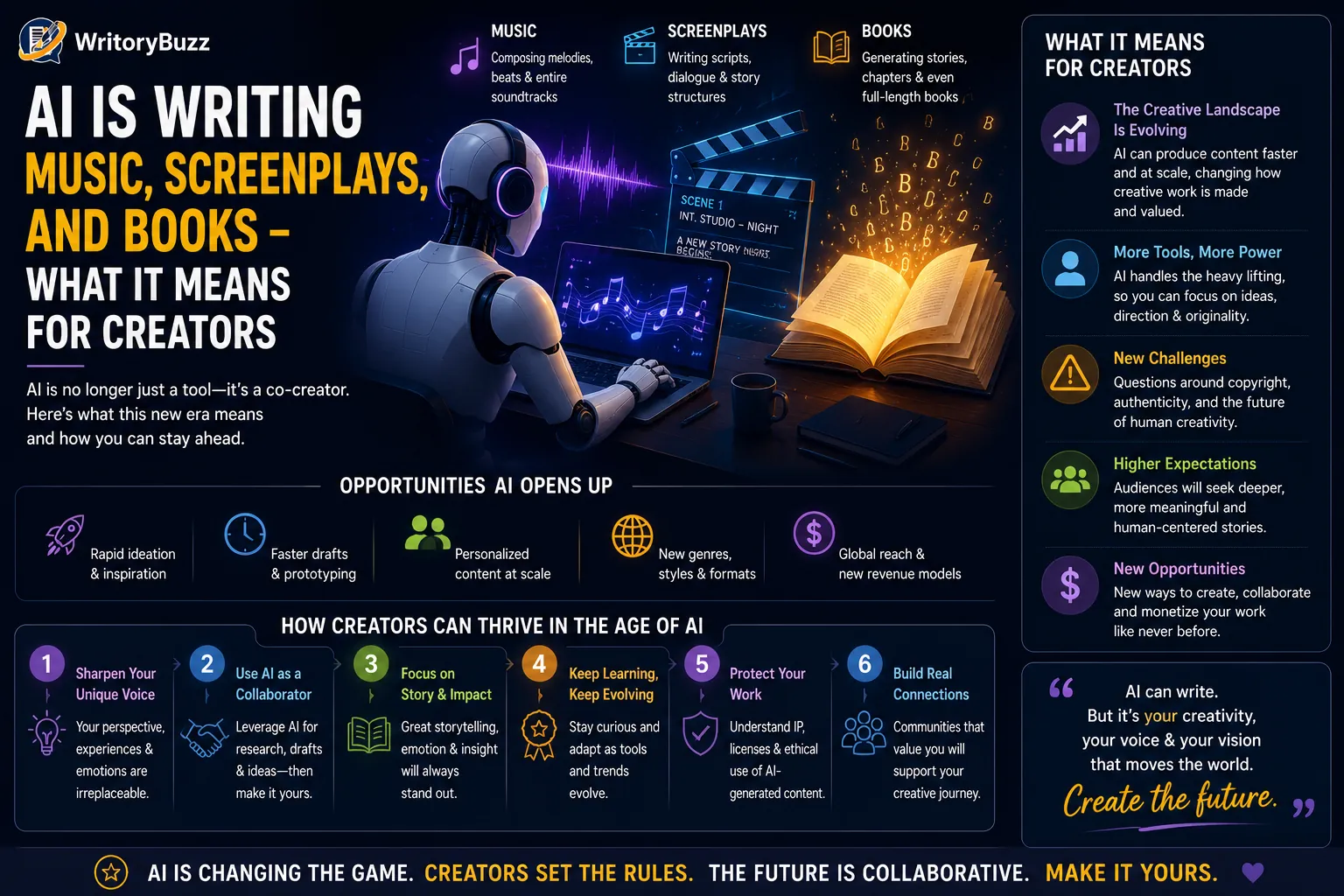
Suno generated over 100 million songs in its first year of operation. The Hollywood writers and actors strikes of 2023 were partly about AI replacing human creative workers. An AI-generated novel reached the Amazon bestseller list in 2023. In 2026, AI creative tools are not approaching the quality of human creative work at the highest levels. But they are disrupting the economics of creative industries at the volume end of the market.
The relationship between AI and human creativity in 2026 is more nuanced than either the techno-optimists or the alarmed creators describe. AI tools are transforming specific aspects of creative workflows dramatically, leaving others unchanged, and creating entirely new categories of creative work. The honest picture requires distinguishing which creative functions are genuinely threatened, which are being augmented, and which remain uniquely human.
AI Music: From Suno to Sync Licensing Disruption
Suno and Udio allow any user to generate a complete song – vocals, lyrics, instruments, mixing – from a text prompt in seconds. The quality for background, functional, and stock music has crossed the threshold where it is substituting for human-produced work. Sync licensing libraries (music licensed for TV, film, and advertising) are experiencing significant disruption as AI-generated music undercuts human producers on cost for lower-value applications.
Where AI music replaces human work: Background and ambient music, stock library music, jingle production, and functional music for apps and games. These markets have historically employed large numbers of working musicians who now face AI competition at a fraction of the cost.
Where human music remains irreplaceable: Original artistic expression with cultural context, live performance, artist-audience emotional connection, music that carries biographical and cultural meaning. The top 1 percent of creative music output is not threatened. The middle market of working musicians is.
The legal situation: The Recording Industry Association of America (RIAA) filed suit against Suno and Udio in 2024, alleging copyright infringement through training on copyrighted music without licensing. The cases are ongoing and their outcome will significantly shape the legal framework for AI creative tools across all media.
AI and Screenwriting
The WGA strike in 2023 secured protections against AI replacing human screenwriters. The agreement requires human writers for all scripted content, limits AI use to research and reference purposes, and prohibits studios from using AI to undercut writer pay. These protections exist within the union context for major studio productions.
Outside the studio system, AI screenwriting tools (ChatGPT, Claude, and dedicated tools like Scriptbook and Final Draft’s AI features) are widely used for first drafts, dialogue polishing, and story development. The most productive screenwriters describe AI as a development partner that handles structural drafting while human creativity handles voice, character depth, and thematic complexity.
What AI does well in screenwriting: Generating structural outlines rapidly, producing first-draft dialogue for revision, exploring multiple story directions quickly, and handling formulaic genre conventions competently.
What remains human: Original voice, thematic depth, cultural specificity, character psychology that resonates emotionally, and the particular quality of great dialogue that carries both meaning and sound simultaneously. The scripts that matter are the ones with these qualities. AI produces competent scaffolding; human writers produce the architecture.
AI and Novel Writing
Amazon’s self-publishing platform saw a surge in AI-generated books following ChatGPT’s release, prompting Amazon to impose submission limits. Publishers have established policies requiring disclosure of AI-generated content. Literary agents consistently report that AI-generated manuscripts are identifiable and not being accepted for representation.
At the same time, many published authors use AI tools for research, worldbuilding assistance, overcoming writer’s block, and structural feedback. The distinction the industry is drawing: AI as a writing assistant is acceptable and widespread; AI as the primary author is not, for now.
The quality ceiling: Current AI cannot produce the sustained originality, idiosyncratic voice, and thematic coherence of a great novel. It can produce competent commercial fiction. This is sufficient to flood certain market segments but insufficient to replace literary work.
The Copyright Question
The legal framework for AI-generated creative content is actively being determined in courts worldwide. Key unresolved questions: whether training on copyrighted works constitutes infringement, whether AI-generated works can be copyrighted (current US Copyright Office position: no, unless substantial human creativity is demonstrated), and how much human input is required for copyright protection.
For working creators, the practical advice is: document your creative process, maintain records of human creative decisions and choices, and treat AI as a tool whose outputs you direct and refine rather than as an autonomous author.
What This Means for Human Creators
The middle market is threatened: The market for functional, volume-oriented creative work (stock music, generic commercial content, formulaic genre fiction) is being compressed by AI. This affects working professionals who depend on this volume market more than it affects creators at the top or the emerging edge of their fields.
The collaboration model is growing: Creators who develop fluency with AI tools and use them to accelerate their human creative process are producing more work faster. The productivity gains for AI-assisted creative work are real and growing.
Authenticity and provenance become differentiators: As AI-generated content floods every channel, human creativity with authentic biographical experience, cultural specificity, and genuine artistic perspective commands increased value among audiences who can distinguish it.
Can AI write good music, screenplays, and books?
AI produces competent functional creative work across all three categories. For background music, stock content, and genre-formulaic output, quality has crossed substitution thresholds in several market segments. For original artistic work with distinctive voice, cultural depth, and emotional resonance, AI produces scaffolding that requires substantial human creative input to become genuinely good.
What is Suno and how does it work?
Suno is an AI music generation platform that produces complete songs (vocals, lyrics, melody, instrumentation) from text prompts in seconds. Users describe the desired genre, mood, and theme; Suno generates a finished track. It generated over 100 million songs in its first year. The RIAA filed copyright infringement suits against Suno and Udio in 2024 for training on copyrighted music without licensing.
What protections do screenwriters have against AI in 2026?
The WGA 2023 strike agreement requires human writers for all scripted content, limits AI to research uses, and prohibits using AI to undercut writer pay within the union’s jurisdiction (major studio productions). Outside the studio system, no equivalent protections exist.
Can AI-generated content be copyrighted?
The current US Copyright Office position is that AI-generated content is not copyrightable unless substantial human creative decision-making is demonstrated. Works where a human directed, selected, and arranged AI outputs with genuine creative choices may qualify for copyright protection. The precise threshold is being defined through pending legal cases.
What creative jobs are most at risk from AI in 2026?
The most disrupted roles are in functional and volume creative work: stock music production, commercial jingle writing, content marketing writing, stock illustration and design, and genre fiction in high-volume market categories. These roles provide volume-based income that AI can now replicate at a fraction of the cost.
How should human creators respond to AI creative tools?
Develop fluency with AI tools to accelerate your human creative process. Document your creative decisions to establish human authorship for copyright purposes. Invest in the qualities AI cannot replicate: distinctive voice, cultural specificity, biographical authenticity, and the artistic perspective that comes from lived experience. Position yourself in market segments that value these qualities.
The Creativity That Matters Is Still Human
The creative work that changes how people feel, understand the world, or see themselves has never been abundant. AI has not changed that scarcity. What AI has changed is the economics of the volume market for functional creative work that surrounded that scarce excellent work. The excellent human creators are not more threatened than they were. The working middle market is genuinely disrupted.
That disruption is real and its human consequences deserve acknowledgment rather than techno-optimist minimisation. The appropriate response is not fear or denial but clear-eyed adaptation: develop AI fluency, invest in the qualities that remain human, and find the market segments where authenticity is worth more than volume.
Generative AI is transforming the creative landscape faster than ever. Follow WritoryBuzz for expert insights on AI innovations, emerging technologies, copyright developments, and the future of content creation in 2026 and beyond.