
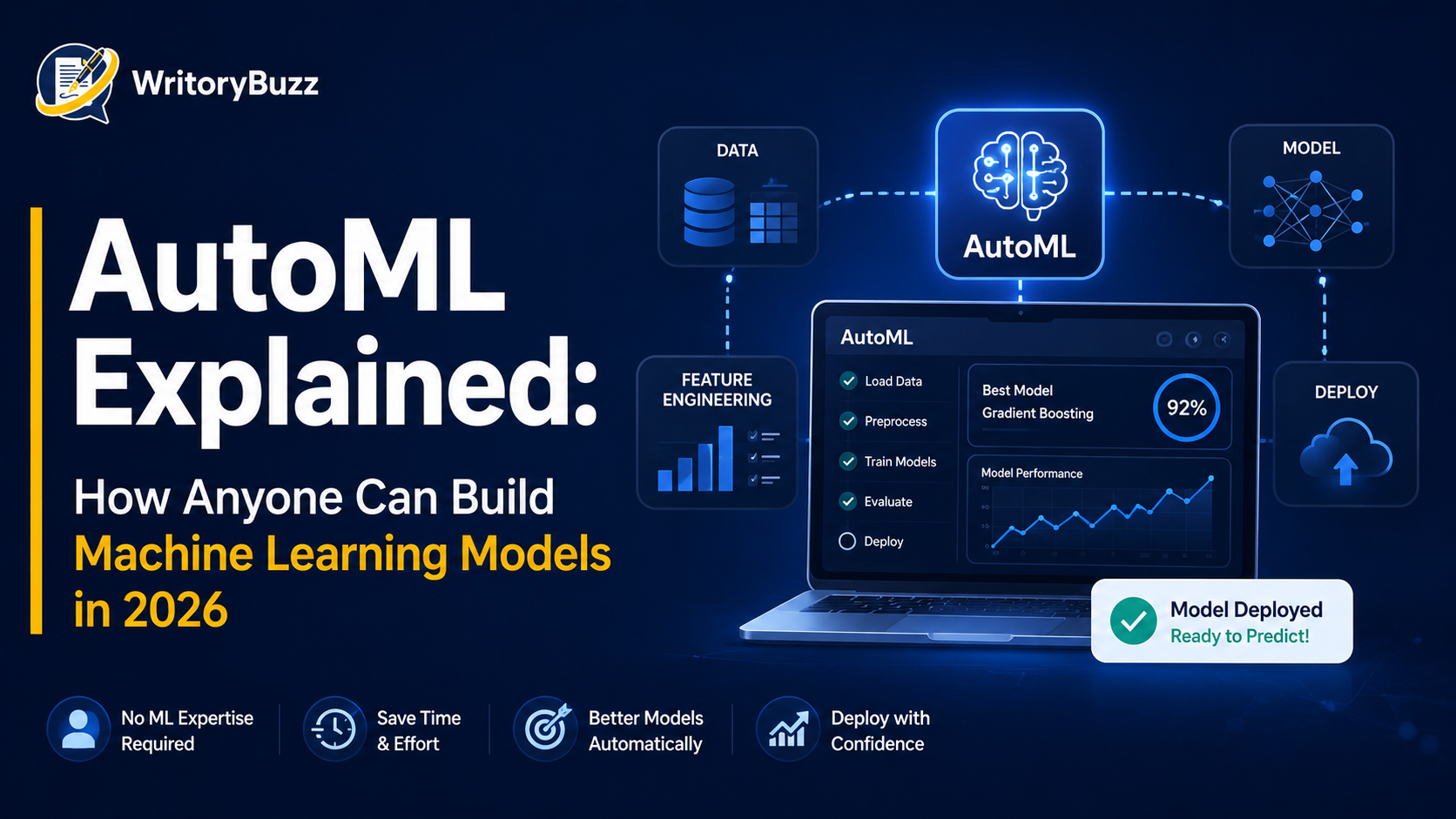
AutoML automated machine learning is a pipeline that handles the parts of ML that historically required deep expertise: cleaning and encoding features, searching across algorithm families, tuning hyperparameters, and validating the winning model. As of March 2026, AutoML is mature with production adoption growing. Startups are using it instead of hiring ML engineers.
AutoML in 2026 covers the entire machine learning lifecycle: data preparation, feature engineering, model selection, hyperparameter optimisation, and deployment. A decade ago, this required a team of data scientists. Today, a business analyst with structured data can train and deploy a predictive model in hours using the right platform.
What AutoML Actually Does
Traditional machine learning development consumes 80 percent of time on feature engineering: transforming raw data into variables a model can learn from. The remaining 20 percent is model selection and tuning. AutoML reverses this economics by automating both stages simultaneously.
Data preprocessing: AutoML platforms automatically handle missing values, encode categorical variables, detect and handle outliers, and normalise numerical features. What previously required manual decisions per variable is handled automatically.
Feature engineering: Generating new features from existing ones, creating interaction terms, and selecting the most predictive variable combinations from thousands of candidates.
Model selection and ensembling: Training and evaluating dozens of model architectures (linear models, decision trees, random forests, gradient boosted trees, neural networks) and combining the best performers into an ensemble.
Hyperparameter optimisation: Searching across thousands of parameter combinations to find the configuration that maximises performance on held-out validation data.
The Major AutoML Platforms in 2026
Google Vertex AutoML
Google’s cloud-native AutoML platform handles tabular data, images, and text through a no-code interface. Best for teams already in the Google Cloud Platform ecosystem. The visual interface allows model training without code. Per-node-hour pricing can surprise on large datasets but performance on image classification and NLP tasks is leading.
H2O.ai
H2O AutoML is open-source, fast, and produces competitive accuracy on tabular data, typically finishing in the top 2 in benchmark comparisons. Trains models in 5 to 10 minutes typically. The open-source version is free; the commercial Driverless AI platform adds enterprise governance and reaches approximately $390,000 for a three-year enterprise licence. Best for mid-market teams who want genuine capability without hyperscaler vendor lock-in.
DataRobot
DataRobot is the enterprise governance play. Model monitoring, challenger model comparison, compliance documentation, bias assessment, and automated retraining are first-class features. Annual subscriptions typically range from $50,000 to $250,000-plus. Best for large enterprises managing regulatory risk where model explainability and audit trails are non-negotiable requirements.
AutoGluon (AWS Open Source)
Amazon’s open-source AutoML framework consistently achieves top accuracy benchmarks, particularly on multimodal data combining text and tabular features. Requires Python knowledge but minimal ML expertise. Free. Generates deployable models without MLOps infrastructure requirements. Best for technically literate users who want highest accuracy at zero licensing cost.
Azure AutoML
Azure Machine Learning’s AutoML is tightly integrated with the Azure ecosystem. Strong for organisations using Microsoft data infrastructure (Azure SQL, Azure Data Lake). Visual Studio Code integration and Teams-native workflow make it accessible for non-data-scientist analysts already in the Microsoft stack.
| Platform | Code Required | Best Use Case | Cost | Strength |
| Google Vertex AutoML | No | Images, text, GCP users | Pay per use | Simplicity, vision tasks |
| H2O.ai (open source) | Minimal Python | Tabular data, mid-market | Free | Speed, accuracy, no lock-in |
| DataRobot | No | Enterprise, regulated industries | $50K-250K+/yr | Governance, monitoring |
| AutoGluon | Python | Highest accuracy, multimodal | Free | Benchmark-leading accuracy |
| Azure AutoML | No | Microsoft ecosystem users | Pay per use | Azure integration |
| RapidMiner | No | Visual no-code workflows | Mid-range | UI accessibility |
How to Build Your First AutoML Model: Step by Step
- Define the prediction target clearly. What specific outcome do you want to predict? Customer churn (yes/no), sales volume (number), product category (multi-class). The target variable definition is the most important decision in the entire process.
- Prepare your data. Collect a dataset where the target variable is known for historical records. Clean format: one row per record, columns as features. Minimum 1,000 rows for useful models; 10,000-plus for reliable results.
- Choose your platform. For no-code: Google Vertex AutoML or RapidMiner. For Python-capable users: H2O.ai or AutoGluon. For enterprise: DataRobot.
- Upload data and configure training. Specify the target column, the problem type (classification, regression), and training time constraints. Most platforms handle the rest automatically.
- Evaluate the model. Review accuracy metrics (AUC-ROC for classification, RMSE for regression), feature importance scores, and model fairness indicators before deployment.
- Deploy and monitor. Deploy the model to an API endpoint. Monitor predictions over time for drift (when real-world data drifts from training data, model accuracy degrades).
The Limits of AutoML
AutoML automates the model-building process, not the problem-definition process. The most consequential decisions in ML — what to predict, what data to collect, how to handle ethical implications of the model’s outputs — require human judgment that no automation replaces.
Feature engineering remains partially manual: Traditional AutoML tools like DataRobot and H2O automate model selection but still require data scientists for feature engineering, which consumes 80 percent of pipeline time. Next-generation platforms like Kumo.ai address this for relational databases but the limitation exists for most standard AutoML.
Post-deployment monitoring is required: AutoML models degrade over time as real-world data distributions shift from training data. Monitoring for drift and retraining when performance degrades is an ongoing operational requirement that most AutoML platforms support but none automate fully.
What is AutoML and how does it work?
AutoML (automated machine learning) automates the time-consuming parts of building ML models: data preprocessing, feature engineering, model selection across multiple algorithm families, hyperparameter optimisation, and validation. It allows business analysts and non-data-scientists to train production-quality models from structured data.
What is the best AutoML platform in 2026?
Depends on use case. Google Vertex AutoML for no-code image and text models in GCP. H2O.ai for tabular data with no licensing cost. DataRobot for enterprise governance and compliance. AutoGluon for highest accuracy with Python capability. Azure AutoML for Microsoft ecosystem organisations.
Do you need coding skills to use AutoML?
Most commercial platforms (Google Vertex AutoML, DataRobot, RapidMiner) require no coding. Open-source options (H2O.ai free version, AutoGluon) require minimal Python. The no-code platforms are sufficient for most standard prediction tasks on tabular, image, or text data.
How much data do you need for AutoML?
Minimum 1,000 rows for initial model development, though results may be limited. 10,000 rows produces reliably useful models for most business prediction tasks. 100,000-plus rows enables complex models with strong generalisation. Data quality matters more than volume: clean, consistently formatted data with accurate labels outperforms larger messy datasets.
What are the limitations of AutoML?
AutoML does not define the problem, decide what to predict, or address the ethical implications of model outputs. Post-deployment monitoring for model drift is an ongoing requirement. Feature engineering for complex relational data remains partially manual on most platforms. AutoML produces models but not the business intelligence to know whether a model is solving the right problem.
How long does AutoML model training take?
H2O AutoML trains competitive models in 5 to 10 minutes on mid-size datasets. Google Vertex AutoML takes 30 minutes to several hours depending on dataset size and training budget. DataRobot training runs are typically 30 to 90 minutes for comprehensive model evaluation. Longer training produces marginally better results but most business use cases do not require maximum training time.
AutoML Lowers the Floor, Not the Ceiling
AutoML has genuinely democratised access to machine learning. A business analyst who understands their domain and data can now produce models that previously required a data science team. The ceiling of what is possible with AutoML the most sophisticated models for the most complex problems still requires ML expertise. But the floor has dropped dramatically, and most business prediction problems live closer to the floor than the ceiling.