
Yoga is one of the most researched complementary health practices available, with consistent evidence for improved flexibility, reduced lower back pain, reduced anxiety, and better sleep quality across dozens of randomised controlled trials. The barrier for most beginners is not the physical poses. It is not knowing where to start and not knowing what to expect.
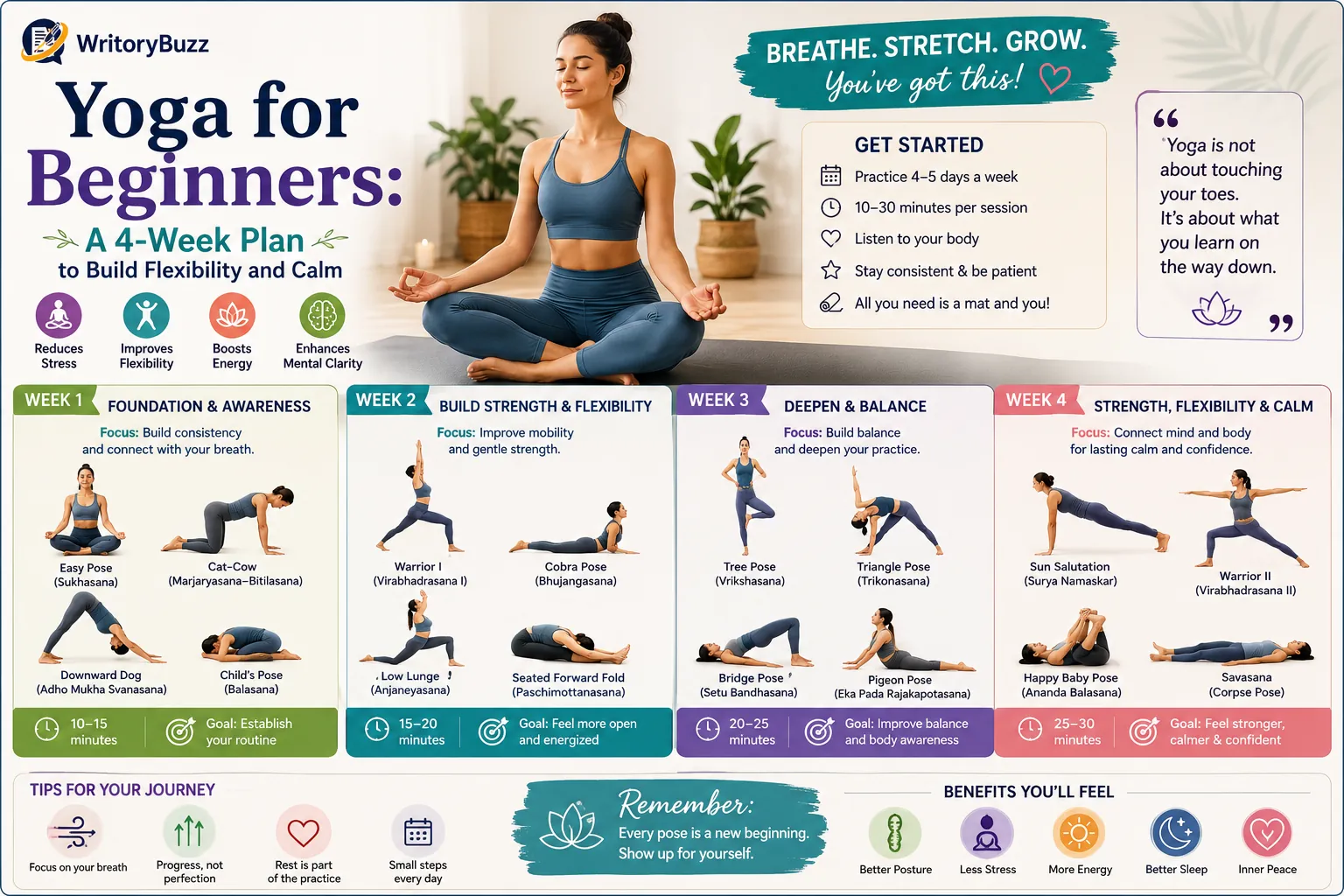
This 4-week plan starts with 20-minute sessions three times per week and builds to 30-minute sessions five times per week. It covers the foundational poses, the breathing practice that activates yoga’s stress-reduction effects, and realistic expectations for what improves and how quickly.
Before You Start: What You Actually Need
- A yoga mat (any non-slip mat works; you do not need an expensive one to start)
- Comfortable clothes that allow full range of movement
- A block or folded blanket for modifications (optional but useful)
- A quiet space for 20 to 30 minutes
Yoga does not require a class, a studio, or any specific equipment. YouTube channels Yoga with Adriene (33 million subscribers) and Breathe and Flow both offer structured beginner sequences that match this plan’s progression at no cost.
The Breathing Foundation: Ujjayi Breath
Ujjayi (ocean breath) is the breathing technique that runs through most yoga practice. Inhale through the nose. Exhale through the nose with a slight constriction at the back of the throat, producing a gentle ocean-sound. This breath pattern activates the parasympathetic nervous system (rest-and-digest) and is responsible for much of yoga’s stress-reduction effect.
Practise Ujjayi breath lying down before attempting poses. Five minutes of conscious Ujjayi breathing produces measurable reduction in cortisol and heart rate. This breathing is the most important skill in the plan.
Week 1: Foundation Poses (20 minutes, 3 times)
Mountain Pose (Tadasana): Stand with feet hip-width apart, arms at sides, weight evenly distributed. The foundational standing pose. Teaches body alignment awareness. Hold 5 breaths.
Downward Facing Dog (Adho Mukha Svanasana): From all-fours, lift hips toward the ceiling, creating an inverted V shape. Heels pressing toward (not necessarily reaching) the floor. Spine long. Hold 5 breaths. Modification: bend knees generously if hamstrings are tight.
Child’s Pose (Balasana): From all-fours, sit hips back to heels, forehead to floor, arms extended or by sides. The resting pose. Return here whenever you need to rest during practice. Hold as long as needed.
Warrior I (Virabhadrasana I): From standing, step one foot back, rear foot at 45 degrees. Front knee over ankle. Arms up. Square hips toward front. Hold 5 breaths each side. The foundational standing strength pose.
Legs Up the Wall (Viparita Karani): Lie on your back, legs up the wall. The single most accessible restorative yoga pose. Proven to reduce anxiety and improve circulation. Hold 5 minutes. End every Week 1 session with this.
Week 2: Build Sequences (20 minutes, 4 times)
Add these to Week 1 poses:
Cat-Cow (Marjaryasana-Bitilasana): On all-fours, alternate between arching the back (cow) and rounding the spine (cat) on the breath cycle. Excellent for spinal mobility and begins coordinating breath with movement. 10 rounds.
Warrior II (Virabhadrasana II): Wider stance than Warrior I, hips open to the side, arms extended front and back. Builds leg strength and hip opening. Hold 5 breaths each side.
Triangle Pose (Trikonasana): From wide stance, extend one arm to the floor (or shin) and the other toward the ceiling. Lateral stretch. Use a block under the lower hand if needed. Hold 5 breaths each side.
Seated Forward Fold (Paschimottanasana): Sit with legs extended. Fold forward from the hips, reaching toward feet. The goal is a lengthened spine, not touching toes. Modification: bend knees, strap around feet. Hold 10 breaths.
Week 3: Strength and Balance (25 minutes, 4 times)
Plank Pose: From all-fours, step feet back to a high push-up position. Core engaged, hips level. Hold 5 to 10 breaths. Modification: knees on the floor. This builds the core strength that prevents back pain in many yoga poses.
Tree Pose (Vrksasana): Standing on one foot, place the sole of the opposite foot on the inner thigh or calf (never the knee). Arms overhead or at heart. Hold 5 breaths each side. Builds proprioception and balance.
Bridge Pose (Setu Bandhasana): Lie on back, knees bent, feet flat. Lift hips toward ceiling. Strengthens glutes and stretches hip flexors. Hold 5 breaths. Release slowly.
Seated Twist (Ardha Matsyendrasana): Seated with legs extended, cross one foot over the opposite thigh. Twist toward the raised knee. Spinal rotation release. Hold 5 breaths each side.
Week 4: Full Practice (30 minutes, 5 times)
Week 4 combines all previous poses into a flowing sequence: Ujjayi breathing, Cat-Cow (warming), Downward Dog, Warrior I both sides, Warrior II both sides, Triangle both sides, balance (Tree), strength (Plank, Bridge), floor stretches (Seated Fold, Seated Twist), and close with Legs Up the Wall (5 minutes) followed by Savasana (lying still for 3 minutes).
What to Expect Realistically
| Week | Realistic Physical Change | Mental Change |
| Week 1 | Awareness of tight areas. Some DOMS from unfamiliar muscles. | Reduced stress in the 1-2 hours after practice |
| Week 2 | Slightly more range in forward folds. Better balance. | Improvement in sleep quality for many practitioners |
| Week 3 | Visible strength in core and legs. Deeper Downward Dog. | Consistent mood improvement post-practice |
| Week 4 | Measurable flexibility gains. Breathing more automatic. | Sustained anxiety reduction documented in research |
What yoga poses should beginners start with?
Mountain Pose, Child’s Pose, Downward Facing Dog, Warrior I, and Legs Up the Wall are the most accessible and valuable beginning poses. These establish alignment awareness, spinal flexibility, standing strength, and the restorative experience that motivates continued practice.
How long does it take to become flexible with yoga?
Measurable flexibility improvements typically appear within 4 to 8 weeks of consistent practice (3 to 5 sessions per week). The first signs are in forward folds and hip opening. Full flexibility development takes months to years. Consistency matters far more than session length.
What is Ujjayi breath and why is it important in yoga?
Ujjayi is a nasal breathing technique with a slight throat constriction that produces an ocean sound. It activates the parasympathetic nervous system, reduces cortisol and heart rate, and is responsible for much of yoga’s documented stress-reduction effect. Learning Ujjayi breath before poses is the most important preparation for yoga practice.
How many times per week should beginners practise yoga?
Three sessions per week produces measurable results and is sustainable for beginners. Four to five sessions accelerates flexibility and strength gains. Daily practice of even 15 to 20 minutes is more effective than longer sessions twice per week. Consistency across weeks matters more than intensity per session.
Do you need a yoga class or can you learn from YouTube?
YouTube is entirely adequate for learning foundational yoga. Yoga with Adriene offers structured beginner series specifically designed for home practice. The advantage of a class is real-time feedback on alignment from a teacher. For most beginners, YouTube provides sufficient guidance for safe and effective practice.
What are the health benefits of yoga supported by research?
Randomised controlled trials consistently show: improved flexibility and range of motion, reduced lower back pain intensity and frequency, reduced cortisol and anxiety measures, improved sleep quality, reduced blood pressure in hypertensive individuals, and improved balance and fall prevention in older adults. Most benefits are dose-dependent, improving with consistent practice.
Start Simple, Stay Consistent
The 4-week plan above is not the most ambitious beginner yoga programme available. It is the most completable one. Fifteen minutes of Ujjayi breathing, Downward Dog, Warrior I, and Legs Up the Wall three times per week will produce more results over four weeks than an elaborate programme that feels too demanding and is abandoned after week one.