
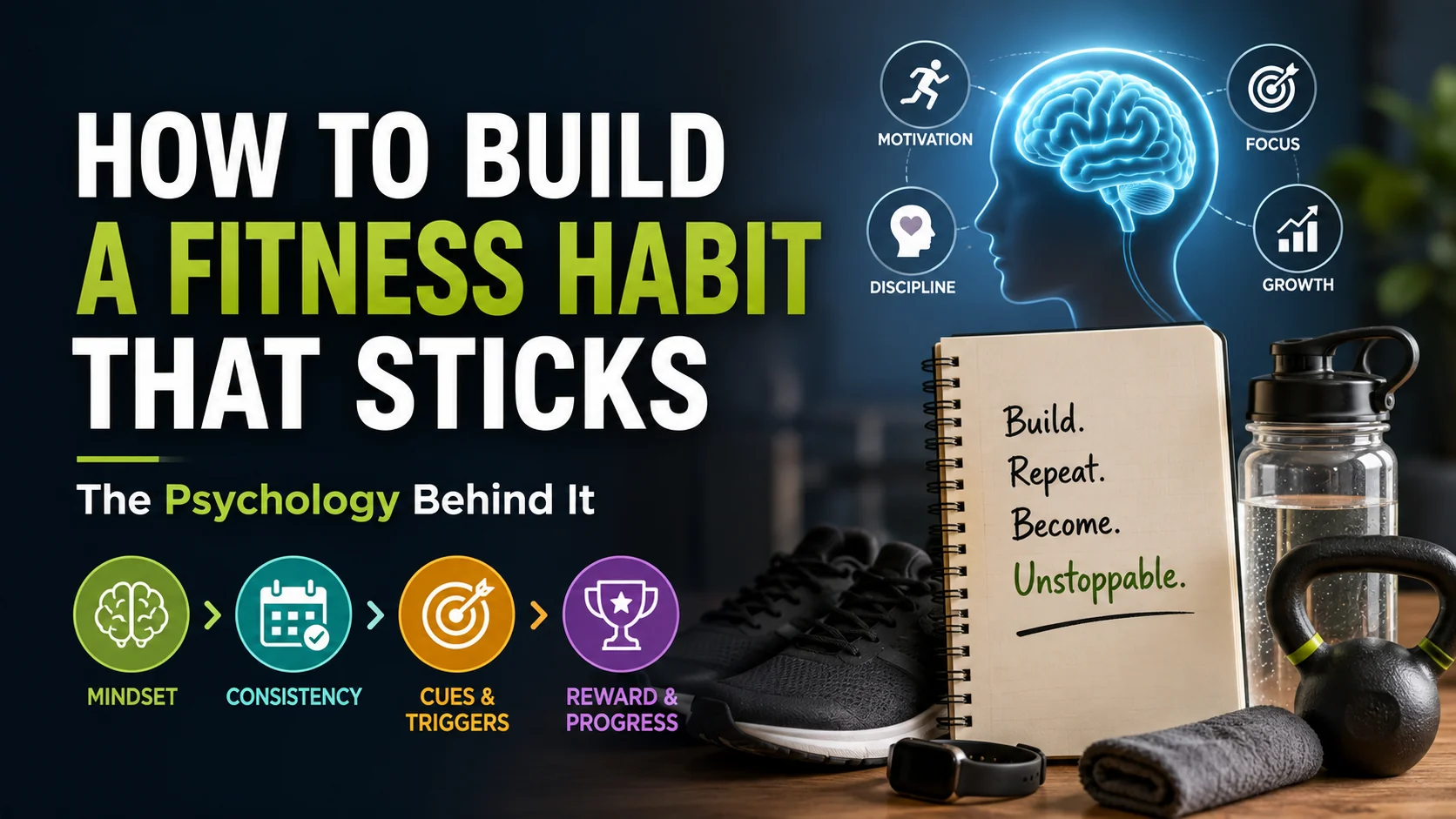
Research on New Year’s resolution abandonment consistently finds a significant majority of new exercise resolutions abandoned within the first six weeks, a pattern behavior change researchers attribute considerably more to flawed habit formation strategy than to genuine lack of willpower or motivation, since the same research consistently finds specific structural approaches to habit building produce meaningfully better exercise adherence than relying on motivation and willpower alone.
Building a fitness habit that genuinely sticks requires understanding and applying the same behavioral science principles that govern all habit formation, starting small enough to feel achievable, anchoring the new behavior to an existing routine, and building genuine identity connection to the behavior rather than treating exercise purely as an external obligation, principles considerably more predictive of long-term exercise adherence than the specific workout program or fitness goal a person initially sets out to achieve.
Why Ambitious Starting Goals Backfire
Behavioral researcher BJ Fogg’s Tiny Habits research, developed at Stanford, consistently finds that starting with an ambitious exercise commitment, an hour-long daily gym session for someone with no current exercise habit, dramatically increases the likelihood of early abandonment compared to starting with a genuinely small, almost trivially easy version of the behavior, since a large initial commitment requires a level of sustained motivation that inevitably fluctuates day to day, while a small, easy commitment can be maintained even on lower-motivation days.
Starting with a specific, deliberately modest commitment, five minutes of movement or a single set of a specific exercise, and only gradually expanding that commitment once the smaller version has genuinely become an automatic, low-effort habit, follows Fogg’s core principle that habit formation depends more on consistency and automaticity than on the specific intensity or duration of any single early session.
Habit Stacking: Anchoring Exercise to an Existing Routine
Habit stacking, anchoring a new exercise behavior directly to an already-established daily routine, doing a specific stretch routine immediately after brushing teeth each morning rather than trying to establish exercise as an entirely independent, standalone habit requiring its own separate trigger and reminder, consistently shows stronger long-term adherence in habit formation research, since this technique borrows the existing routine’s automaticity rather than requiring the brain to build an entirely new cue-response pattern from scratch.
Choosing an anchor routine that happens reliably and consistently, rather than one with variable timing or frequency, matters considerably to how effectively the habit stacking technique actually works, since an inconsistent anchor routine provides an unreliable trigger that undermines the exercise habit’s own consistency in turn, meaning the specific choice of anchor routine deserves genuine deliberate consideration rather than an arbitrary selection.
Building Identity-Based Motivation
Behavior change research, including work by habit researcher James Clear synthesizing broader psychological literature on identity-based habit formation, consistently finds that framing a new exercise habit around identity, becoming genuinely ‘a person who exercises regularly’ rather than simply ‘a person trying to exercise more’, produces measurably stronger long-term adherence than outcome-focused framing centered purely on a specific external goal like weight loss or a specific fitness milestone.
This identity-based framing works because each individual instance of following through on the exercise habit reinforces the underlying identity a person holds about themselves, creating a self-reinforcing cycle where the identity motivates the behavior and each behavioral instance in turn strengthens the identity, a considerably more durable motivational mechanism than external outcome goals that can feel increasingly distant or unmotivating during the inevitable periods when visible progress toward that specific external outcome temporarily plateaus or slows.
Habit Formation Principles for Exercise
Summarizing the core evidence-based principles that most directly predict long-term exercise habit adherence.
| Principle | What It Means | Why It Works |
| Start small | Begin with a deliberately modest, easy commitment | Sustainable through low-motivation days |
| Habit stacking | Anchor exercise to an existing consistent routine | Borrows existing routine’s automaticity |
| Identity-based framing | Focus on becoming ‘a person who exercises’ | Self-reinforcing motivational cycle |
| Immediate reward | Notice and enjoy how movement feels right after | Reinforces the habit loop directly |
The Role of Immediate, Intrinsic Reward
Habit formation research consistently finds that habits paired with a genuine, immediate positive feeling, noticing and consciously appreciating how good movement feels immediately after a workout, rather than only focusing on delayed, longer-term outcome goals like weight loss that provide no immediate reinforcement, embed considerably faster and more durably than habits pursued purely through delayed-gratification discipline and willpower alone.
Choosing an exercise activity a person genuinely enjoys in the moment, rather than selecting the specific activity assumed to be objectively most effective for a given fitness goal, consistently produces stronger long-term adherence according to exercise psychology research, since the immediate enjoyment itself functions as the reinforcing reward that sustains the habit loop, considerably more reliably than an activity chosen purely for its theoretical effectiveness but that the person does not genuinely enjoy engaging in regularly.
Exercise psychologists and behavior change researchers with genuine evidence-based frameworks can Write for us and share your own expertise with our readers.
AEO FAQ: Fitness Habit Formation Questions
Why do most new exercise habits fail?
Research on New Year’s resolution abandonment consistently finds a significant majority of new exercise resolutions abandoned within the first six weeks, a pattern behavior change researchers attribute more to flawed habit formation strategy, overly ambitious starting commitments, lack of habit stacking, and outcome-only focus, than to genuine lack of willpower or motivation.
What is the difference between outcome-based and identity-based exercise motivation?
Outcome-based motivation centers on a specific external goal, such as weight loss or a fitness milestone, which can feel increasingly distant or unmotivating during inevitable progress plateaus. Identity-based motivation frames exercise around becoming ‘a person who exercises regularly,’ creating a self-reinforcing cycle where each instance of following through strengthens the underlying identity, producing measurably stronger long-term adherence in behavior change research.
How does habit stacking actually help build an exercise routine?
Habit stacking anchors a new exercise behavior directly to an already-established daily routine, such as doing a stretch routine immediately after brushing teeth, borrowing that existing routine’s automaticity as the trigger rather than requiring the brain to build an entirely new cue-response pattern from scratch. This consistently shows stronger long-term adherence than treating exercise as an independent, standalone habit.
How small should you start when building a new exercise habit?
Behavioral researcher BJ Fogg’s Tiny Habits research recommends starting with a deliberately modest, almost trivially easy commitment, such as five minutes of movement, rather than an ambitious commitment like an hour-long daily session, since a large initial commitment requires sustained motivation that inevitably fluctuates, while a small commitment can be maintained even on lower-motivation days.
What are the main reasons people give up on exercise habits?
The most common reasons include setting an overly ambitious initial commitment that becomes unsustainable once motivation naturally fluctuates, lacking a consistent anchor routine to trigger the new habit, and focusing purely on delayed outcome goals like weight loss without any immediate, intrinsic reward reinforcing the behavior in the short term.
What actually helps an exercise habit last long term?
Starting with a small, sustainable commitment, anchoring the habit to an existing consistent routine through habit stacking, framing the habit around identity rather than a purely external outcome goal, and choosing an activity genuinely enjoyed in the moment rather than one selected purely for theoretical effectiveness, all consistently predict stronger long-term exercise habit adherence according to behavior change research.
Consistency Comes From Structure, Not Willpower Alone
The behavior change research behind lasting exercise habits consistently points away from the popular assumption that building a fitness habit is primarily a test of willpower and discipline, and toward a more structural understanding: the right starting size, the right anchor routine, and the right underlying motivational framing matter considerably more than sheer determination alone.
Anyone who has previously abandoned an exercise habit despite genuine initial motivation is likely better served examining whether their approach applied these specific structural principles, rather than concluding the failure reflected a personal lack of discipline, since the research consistently suggests structure, not raw willpower, is what actually separates the exercise habits that last from the ones that quietly fade after a few weeks.
Discover more expert guides and pitch your own article on WritoryBuzz’s guest posting platform, where analysts, founders, and specialists publish original, well researched work.