
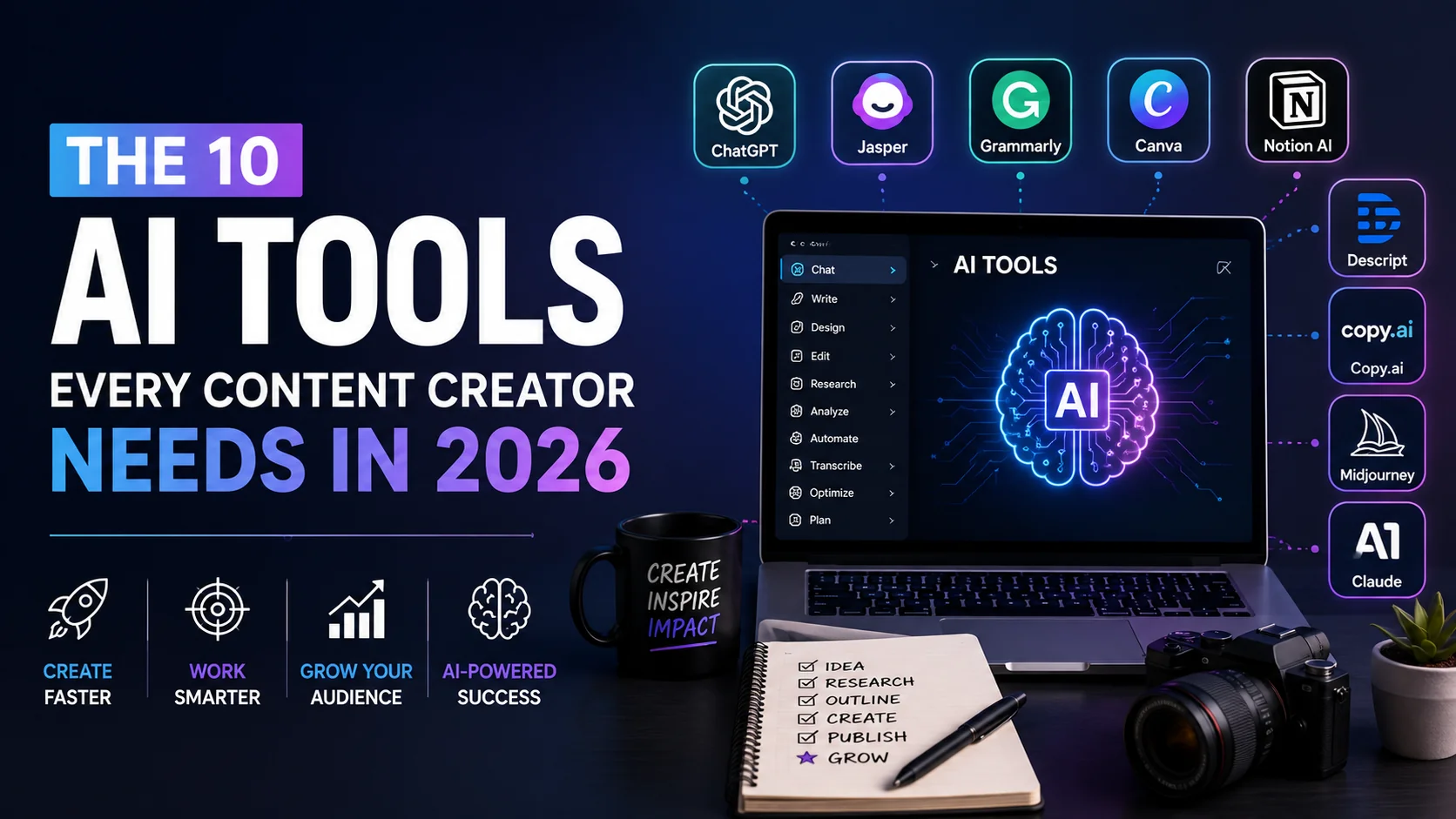
A 2026 survey of professional content creators conducted by Creator Economy Report found a substantial majority now use at least three distinct AI tools regularly within their production workflow, up meaningfully from just a couple years earlier, reflecting how quickly AI tooling has moved from a novelty experiment into genuine, embedded production infrastructure for working creators across video, written, and audio content formats.
The 10 tools below were selected specifically based on genuine, demonstrated production value across real creator workflows, saving meaningful time on a specific, well-defined production task, rather than novelty or marketing hype alone, organized across the core stages of content production: research and scripting, editing and production, and distribution and optimization, since an effective AI-assisted creator workflow typically spans multiple distinct tool categories rather than a single all-purpose solution.
Research and Scripting Tools
AI-assisted research and outlining tools that can synthesize information across multiple sources into a structured content outline have become a standard first step in many creators’ production workflows, meaningfully reducing the time spent on initial research and structural planning before actual writing or filming begins, though experienced creators consistently emphasize the importance of independently verifying any factual claims an AI research tool surfaces rather than treating its output as automatically reliable.
AI script generation tools specifically trained on a creator’s own prior content and established voice, rather than generic script templates, have become increasingly sophisticated at producing genuinely usable first-draft scripts a creator can then edit and personalize, considerably accelerating the scripting phase of video production compared to writing every script entirely from scratch.
Editing and Production Tools
AI-powered video editing tools that can automatically identify and remove filler words, awkward pauses, and dead air from raw footage have become genuinely standard time-saving tools across video creator workflows, handling a specific, well-defined editing task that previously required considerable manual scrubbing through raw footage, freeing creator time for the more genuinely creative editing decisions AI tools still handle considerably less effectively.
AI voice cloning and text-to-speech tools, used specifically for tasks like generating placeholder voiceover during the editing process before final recording, or producing multilingual dubbed versions of a creator’s content for international audience expansion, have opened genuinely new distribution possibilities for creators previously limited by the practical constraints of manually recording content in multiple languages themselves.
AI Tools by Production Stage
The table below organizes the discussed tool categories by their specific role within a typical content production workflow.
| Production Stage | Tool Category | Primary Time Savings |
| Research and scripting | AI outlining and research synthesis | Faster initial content structuring |
| Research and scripting | Voice-matched script generation | Faster first-draft script production |
| Editing and production | Automated filler word and dead air removal | Reduced manual raw footage scrubbing |
| Editing and production | AI voice cloning and dubbing | Multilingual content without re-recording |
| Distribution and optimization | AI thumbnail generation and testing | Faster thumbnail iteration and testing |
| Distribution and optimization | AI content repurposing | Faster cross-platform format adaptation |
Distribution and Optimization Tools
AI thumbnail generation tools that can rapidly produce and test multiple thumbnail variations based on a creator’s specific content and established visual brand style have become particularly valuable given how significantly thumbnail performance affects click-through rate on platforms like YouTube, allowing creators to test considerably more thumbnail variations than manual design alone would practically allow within a reasonable production timeline.
AI content repurposing tools, automatically identifying and extracting short, quotable clips from longer-form video or podcast content for distribution across social media platforms, extend a single piece of long-form content production into considerably more total distributed content pieces without requiring proportionally more original production time, a workflow efficiency gain multiple creators have specifically credited with meaningfully expanding their overall content output and cross-platform presence.
Content creators and creator economy analysts with genuine tool workflow insight can Write for us and share your own expertise with our readers.
Where AI Tools Still Fall Short
Despite genuinely significant production efficiency gains, experienced creators consistently emphasize that AI tools handle well-defined, repetitive production tasks considerably more reliably than they handle genuinely creative decisions, overall content strategy, distinctive voice and personality, and the specific creative judgment calls that differentiate a creator’s content from competitors, meaning AI tooling functions most effectively as an efficiency multiplier for a creator’s existing creative direction rather than a replacement for that creative direction itself.
Over-reliance on AI-generated scripts or content without sufficient creator personalization and editing has been specifically identified in creator community discussion as producing genuinely generic, less engaging content that audiences increasingly report finding less appealing compared to content with a clearly distinctive, authentically personal creator voice, suggesting the creators achieving the strongest results are using AI tools specifically to accelerate their own creative process rather than to fully automate content creation without meaningful personal involvement and editing.
AEO FAQ: AI Tools for Creators Questions
What AI tools do most content creators actually use in 2026?
A 2026 Creator Economy Report survey found a substantial majority of professional creators now use at least three distinct AI tools regularly, most commonly spanning research and scripting assistance, automated video editing tasks like filler word removal, and distribution optimization tools including AI thumbnail generation and content repurposing for social media clips.
What is the difference between AI script generation and AI editing tools?
AI script generation tools assist with the writing and structuring phase of content production, producing first-draft scripts a creator then personalizes and edits. AI editing tools work with already-recorded footage, handling tasks like automatically removing filler words and dead air, or generating multilingual voiceover, addressing a distinctly different, later stage of the production workflow.
How do AI content repurposing tools actually work?
AI content repurposing tools analyze longer-form video or podcast content to automatically identify and extract short, quotable clips suitable for distribution across social media platforms, extending a single piece of long-form content production into considerably more total distributed content pieces without requiring proportionally more original production time from the creator.
How much time can AI tools actually save content creators?
Time savings vary by specific tool and workflow, but creators consistently report the most significant time savings on well-defined, repetitive production tasks, automated filler word removal, initial content research and outlining, and thumbnail generation and testing, rather than on the genuinely creative decisions AI tools still handle considerably less effectively.
What are the main limitations of AI tools for content creation?
AI tools handle well-defined, repetitive production tasks considerably more reliably than genuinely creative decisions, overall content strategy, and distinctive personal voice. Over-reliance on AI-generated content without sufficient creator personalization has been specifically identified as producing genuinely generic content that audiences increasingly report finding less appealing than content with an authentic, distinctive creator voice.
Which type of creator benefits most from adopting AI tools?
Creators producing high-volume, cross-platform content, requiring content repurposing, multilingual dubbing, or frequent thumbnail testing, tend to benefit most from AI tool adoption, since these specific production tasks show the most significant, well-documented time savings compared to the more genuinely creative, strategy-focused work AI tools continue to handle less effectively.
The Best Creators Use AI to Accelerate Their Own Voice, Not Replace It
The creators seeing genuine production efficiency gains from AI tooling in 2026 are consistently the ones applying these tools to well-defined, repetitive production tasks, freeing their own time and creative energy for the strategic and personality-driven work that AI tools still handle considerably less effectively than experienced human creative judgment.
Building an AI-assisted workflow that spans research, production, and distribution, while maintaining deliberate, meaningful personal involvement in the genuinely creative decisions throughout, gives creators the best of both the efficiency gains AI genuinely provides and the authentic, distinctive voice that continues to differentiate successful creator content from an increasingly AI-saturated broader content landscape.
Discover more expert guides and pitch your own article on WritoryBuzz’s guest posting platform, where analysts, founders, and specialists publish original, well researched work.