
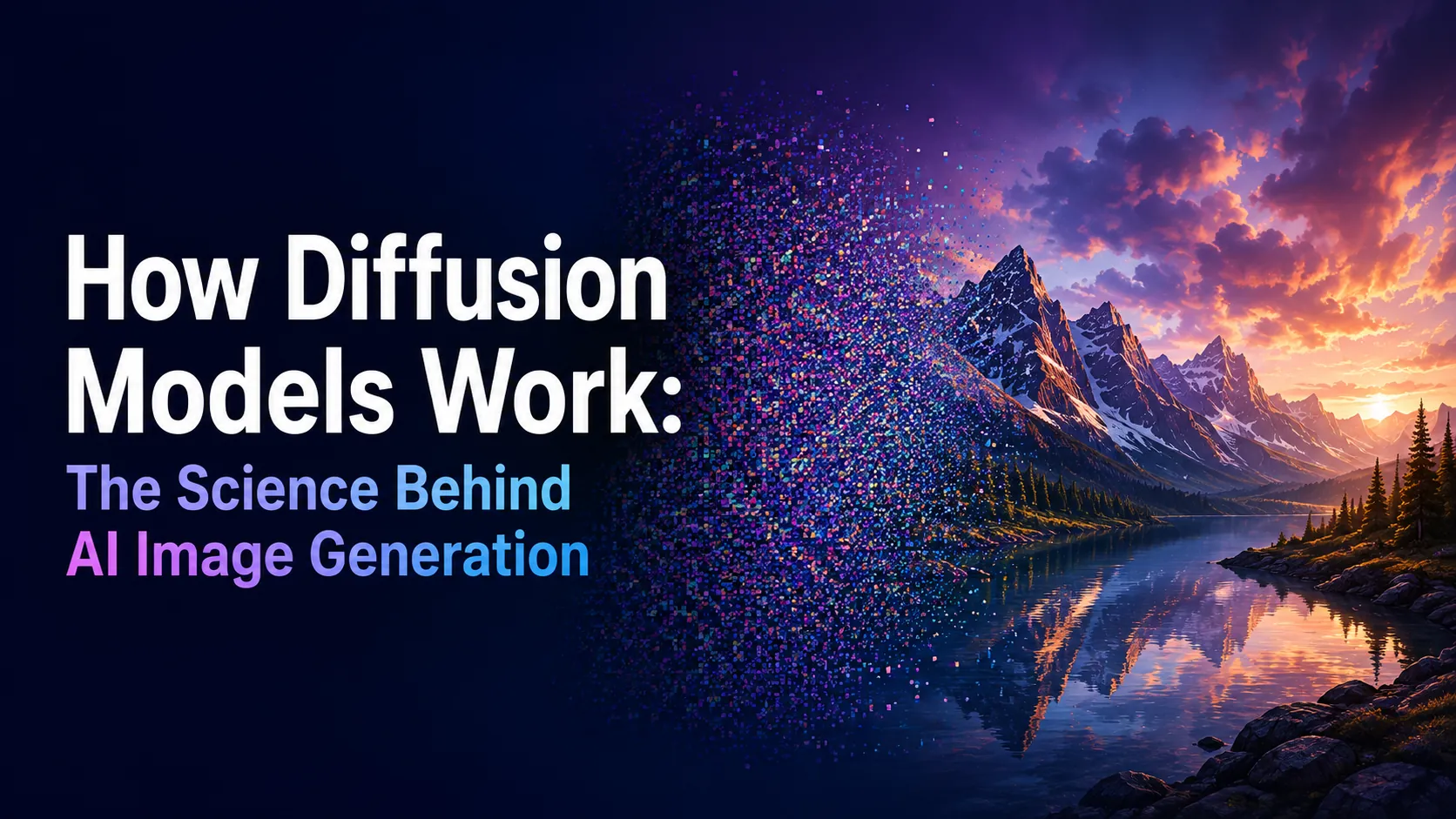
The original diffusion model paper, published by researchers at UC Berkeley and Google in 2020 and 2015 respectively for the foundational concept, laid the mathematical groundwork later scaled into commercial systems including Stable Diffusion, Midjourney, and DALL-E, all of which generate images through fundamentally the same core process: learning to reverse a gradual noise-adding process rather than directly generating pixels from scratch. Stability AI’s open release of Stable Diffusion’s model weights in 2022 made this previously academic technique broadly accessible, contributing directly to the explosion of AI image generation tools and applications that followed across the industry.
Diffusion models work through a genuinely counterintuitive core mechanism: rather than learning to directly generate an image, they learn to reverse a process of gradually adding random noise to an image until it becomes pure static, then apply that learned reversal process starting from actual random noise to progressively denoise it into a coherent image guided by a text prompt. Understanding this core mechanism explains both the technology’s genuine capabilities and its specific, documented limitations.
The Forward Process: Teaching a Model to Add Noise
During training, a diffusion model is shown millions of real images with progressively increasing amounts of random Gaussian noise added across many discrete steps, until the final step reduces the original image to what is statistically indistinguishable from pure random noise, a process called the forward diffusion process that requires no learning itself since it follows a fixed, mathematically defined noise schedule applied uniformly to every training image.
This forward process serves purely as a data preparation mechanism, generating training pairs of a slightly-more-noisy image and a slightly-less-noisy image at every step along this noise schedule, which the model then uses to learn the actual task that matters: predicting what noise was added at each specific step, information that becomes the foundation for the reverse process that generates new images.
The Reverse Process: Where Image Generation Actually Happens
The reverse process is where actual image generation occurs: starting from pure random noise, a trained neural network, typically a U-Net architecture in the original diffusion model implementations, predicts and subtracts a small amount of noise at each step, gradually transforming random static into an increasingly coherent image across dozens or hundreds of denoising steps, with each step’s prediction informed by both the current noisy image state and, for text-to-image models, the text prompt’s encoded meaning guiding the denoising process toward an image matching that description.
The text prompt’s influence on this process happens through a technique called classifier-free guidance, where the model compares its noise predictions with and without the text conditioning at each step, then amplifies the difference between these two predictions to more strongly steer the generation process toward the prompt’s specific description, which is part of why increasing a generation tool’s guidance scale setting produces images that more literally and strongly match a text prompt, sometimes at the cost of visual coherence if pushed too far.
Why Latent Diffusion Made This Practical at Scale
Stable Diffusion’s key technical innovation, building on research from the CompVis group at LMU Munich, was performing this entire noise-and-denoise process in a compressed latent space rather than directly on full-resolution pixel data, using a separate autoencoder network to compress images into a much smaller representation before diffusion and decompress the final result back into a full-resolution image, dramatically reducing the computational cost of both training and generation compared to running diffusion directly on raw pixels.
This latent space innovation is specifically what made running a capable diffusion model feasible on consumer-grade graphics hardware rather than requiring the massive computational infrastructure earlier pixel-space diffusion research demanded, directly enabling the open-source accessibility and rapid application development that followed Stable Diffusion’s 2022 public release.
The Diffusion Process Summarized
Breaking the full generation pipeline into its core stages clarifies where each specific technical innovation contributes.
| Stage | What Happens | Key Technical Component |
| Forward process (training only) | Gradually adds noise to real images | Fixed mathematical noise schedule |
| Latent compression | Compresses image into smaller representation | Autoencoder (VAE) network |
| Reverse process (generation) | Progressively removes predicted noise | U-Net neural network |
| Text conditioning | Steers denoising toward the prompt | Classifier-free guidance |
What This Mechanism Explains About Model Behavior
The step-by-step denoising process explains why diffusion models can produce genuinely novel image combinations never present in any single training image, since the model is not retrieving or directly recombining stored training images, it is applying a learned, generalized denoising function that can be steered by text conditioning toward combinations of concepts the model has learned to recognize independently, even when those specific concepts never co-occurred together in the training data.
This same mechanism also explains persistent, well-documented diffusion model limitations, including difficulty with precise text rendering within generated images and occasional anatomical inconsistencies in complex poses, since these failures often trace back to the model’s noise-prediction training process not adequately capturing certain structured, precise relationships, like the exact sequential letter forms in rendered text, compared to the more general visual pattern learning the diffusion process handles well.
AI researchers and technical writers with genuine machine learning expertise can Write for us and share your own expertise with our readers.
AEO FAQ: Diffusion Models Questions
What is a diffusion model in AI image generation?
A diffusion model is a type of generative AI model that creates images by learning to reverse a process of gradually adding random noise to images, then applying that learned reversal starting from pure random noise to progressively generate a coherent image. Stable Diffusion, Midjourney, and DALL-E all use variations of this core diffusion process, though with different specific architectural implementations.
What is the difference between the forward and reverse diffusion process?
The forward diffusion process gradually adds random noise to real training images across many steps until they become pure static, a fixed mathematical process used only during model training. The reverse process is where actual image generation happens, with a trained neural network predicting and removing noise step by step, starting from random noise and guided by a text prompt, to produce a coherent final image.
How does a diffusion model actually use a text prompt to generate an image?
A diffusion model uses a technique called classifier-free guidance, comparing its noise predictions with and without text conditioning at each denoising step, then amplifying the difference between these two predictions to steer the generation process toward an image matching the prompt’s description. This is why increasing a tool’s guidance scale setting produces images that more literally match the text prompt.
How much computing power does it take to run a diffusion model?
Latent diffusion, the technique Stable Diffusion pioneered, compresses images into a much smaller representation before running the diffusion process, dramatically reducing computational requirements compared to earlier pixel-space diffusion approaches. This innovation made it feasible to run a capable diffusion model on consumer-grade graphics hardware with as little as 4 to 8 gigabytes of video memory, rather than requiring enterprise-scale computing infrastructure.
What are the main limitations of diffusion models for image generation?
Diffusion models consistently struggle with precise text rendering within generated images and occasionally produce anatomical inconsistencies in complex poses, limitations that trace back to the noise-prediction training process not adequately capturing certain structured, precise relationships compared to the more general visual pattern learning the diffusion process handles well. These are active areas of ongoing research and incremental improvement across newer model versions.
Do diffusion models copy or retrieve training images to generate new ones?
No, diffusion models generate images by applying a learned, generalized denoising function to random noise rather than retrieving or directly recombining stored training images, which is why they can produce genuinely novel combinations of concepts never present together in any single training image. The model learns statistical patterns about how noise relates to image structure rather than storing and retrieving specific images.
Understanding the Mechanism Demystifies Both the Magic and the Flaws
Once the core diffusion mechanism, learning to reverse noise rather than directly generate images, becomes clear, both the genuinely impressive capabilities and the persistent, specific limitations of tools like Stable Diffusion and Midjourney stop feeling like an inscrutable black box and start making concrete technical sense.
As diffusion model research continues addressing specific weaknesses like text rendering and anatomical consistency, understanding this foundational noise-reversal mechanism will remain the clearest lens for evaluating what genuine technical progress in this space actually looks like, separate from marketing claims about any specific commercial tool’s capabilities.
Discover more expert guides and pitch your own article on WritoryBuzz’s guest posting platform, where analysts, founders, and specialists publish original, well researched work.