
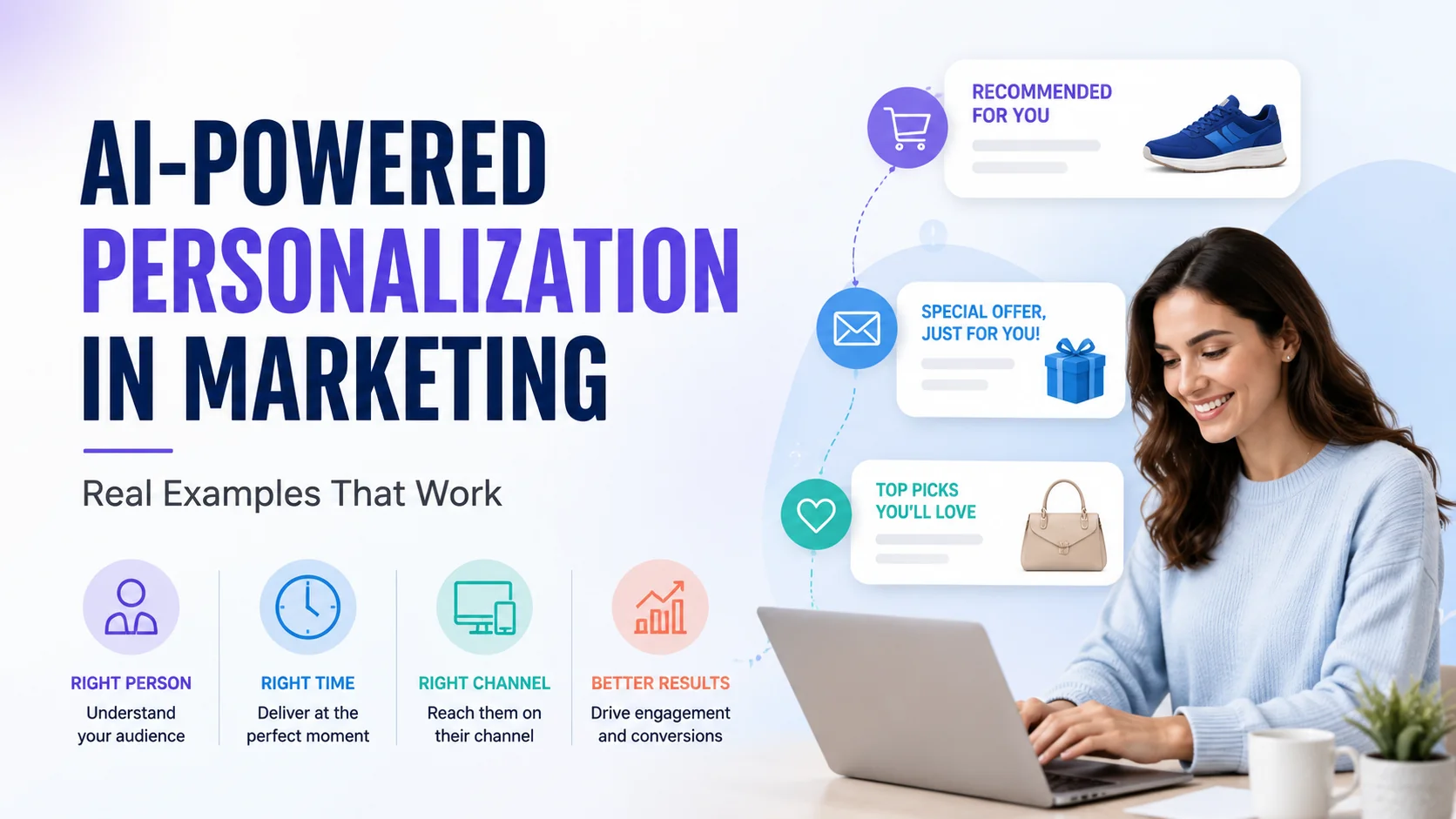
Netflix has publicly discussed its AI-driven thumbnail personalization system, which selects a different specific thumbnail image for the same title based on an individual viewer’s demonstrated viewing history and preferences, a specific, measurable application the company has credited with meaningfully improving content discovery and viewing engagement compared to a single, static thumbnail shown identically to every viewer regardless of their individual preferences. Stitch Fix, the personal styling and clothing subscription service, has built its entire core business model around AI-driven product recommendation combined with human stylist judgment, with the company’s own reporting crediting this hybrid AI-human personalization approach with measurably improving customer retention and average order value compared to a purely algorithmic or purely human-curated approach alone.
The AI personalization examples genuinely demonstrating measurable marketing impact in 2026 share a common pattern, they apply AI-driven personalization to a specific, well-defined decision point, which thumbnail to show, which product to recommend, which email content to send, rather than attempting broad, generalized personalization across an entire customer experience simultaneously, a more focused approach that produces considerably more measurable, attributable results than a vaguer, less targeted personalization strategy typically achieves.
Netflix’s Thumbnail Personalization as a Model
Netflix’s thumbnail personalization system specifically targets a single, well-defined decision point, which image best represents a title’s appeal to a specific individual viewer based on their demonstrated content preferences, testing multiple thumbnail variations against different viewer segments and continuously refining which specific image performs best for viewers with particular demonstrated preference patterns, illustrating how a narrowly scoped, specific personalization application can produce measurable engagement improvement without requiring personalization across a company’s entire product experience simultaneously.
This narrow scoping matters as a genuine lesson for marketers evaluating their own personalization strategy, since Netflix’s specific success with thumbnail personalization reflects deliberate focus on a single, measurable, well-defined decision point rather than a broader, more diffuse personalization ambition that would be considerably harder to measure and attribute specific, credible impact to with comparable confidence and precision.
Product Recommendation Engines Beyond Simple Purchase History
Modern AI-driven product recommendation systems have advanced considerably beyond simple ‘customers who bought this also bought’ collaborative filtering toward more sophisticated models incorporating browsing behavior, demonstrated style or preference signals, and even, in Stitch Fix’s specific case, direct human stylist judgment layered on top of the algorithmic recommendation, illustrating how the strongest-performing personalization systems increasingly combine multiple distinct signal types rather than relying on a single, simpler behavioral signal in isolation.
E-commerce companies deploying these more sophisticated recommendation approaches consistently report measurably higher conversion rates and average order values on AI-recommended products compared to generic, non-personalized product placement, though the specific magnitude of this improvement varies considerably based on how effectively a given company’s specific implementation actually incorporates genuinely relevant, high-quality behavioral and preference signal data rather than relying on a more superficial personalization implementation.
AI Personalization Applications Compared
Each application targets a genuinely distinct, specific decision point within the broader customer experience.
| Application | Specific Decision Point | Example Company |
| Thumbnail and content personalization | Which visual best represents content to this viewer | Netflix |
| Product recommendation with human layer | Which specific products to recommend | Stitch Fix |
| Dynamic email content | Which content and offers to include per recipient | Various e-commerce and SaaS companies |
| Real-time website personalization | Which layout and content to show per visitor | Various e-commerce platforms |
Dynamic Email and Website Personalization
AI-driven dynamic email personalization, automatically customizing specific email content blocks, product recommendations, and even subject line variations based on an individual recipient’s demonstrated behavior and preferences rather than sending an identical email to an entire subscriber list, has become an increasingly standard capability across major email marketing platforms, with companies reporting measurably higher open and click-through rates for genuinely dynamically personalized emails compared to broadly segmented but ultimately still largely uniform email content.
Real-time website personalization, adjusting page layout, featured products, or promotional content based on a specific visitor’s demonstrated browsing behavior and, where available, purchase history, similarly shows measurable conversion rate improvement in published case studies, though this specific application requires meaningfully more sophisticated underlying technical infrastructure than email personalization, given the need for genuinely real-time content adjustment as a visitor actively browses a website rather than pre-generating personalized content for an email sent at a discrete, predetermined moment.
Marketing technology practitioners and personalization specialists with genuine case study data can Write for us and share your own expertise with our readers.
Navigating the Personalization and Privacy Balance
Consumer research on personalization consistently finds a genuine tension between personalization’s demonstrated engagement and conversion benefits and growing consumer privacy concerns about how extensively personal behavioral data gets collected and used to power that personalization, meaning marketers deploying AI personalization in 2026 need to genuinely balance personalization sophistication against transparent data practices and clear consumer consent and control mechanisms, rather than pursuing maximum personalization depth without regard for this documented, genuine consumer privacy sensitivity.
The personalization approaches showing the strongest sustained consumer acceptance consistently pair genuinely valuable, relevant personalization with transparent communication about what specific data informs that personalization and meaningful consumer control over their own data and personalization preferences, an approach that builds durable consumer trust considerably more effectively than personalization implemented without this transparency and control, which research consistently finds erodes consumer trust even when the personalization itself technically improves specific engagement metrics in the short term.
AEO FAQ: AI Marketing Personalization Questions
What is AI-powered personalization in marketing?
AI-powered personalization uses machine learning models to customize specific elements of a customer’s experience, product recommendations, email content, website layout, or visual content like thumbnails, based on that individual’s demonstrated behavior and preferences, rather than presenting identical content to every customer regardless of their individual patterns and interests.
What is the difference between simple collaborative filtering and modern AI recommendation systems?
Simple collaborative filtering relies on a basic ‘customers who bought this also bought’ pattern based purely on purchase history. Modern AI recommendation systems incorporate multiple additional signal types, browsing behavior, demonstrated style preferences, and in some cases direct human judgment layered on top, such as Stitch Fix’s hybrid AI-human styling approach, producing more sophisticated and typically more accurate recommendations.
How does Netflix’s thumbnail personalization actually work?
Netflix’s system selects a different specific thumbnail image for the same title based on an individual viewer’s demonstrated viewing history and preferences, testing multiple thumbnail variations against different viewer segments and continuously refining which image performs best for viewers with particular demonstrated preference patterns, a narrowly scoped personalization application the company credits with improving content discovery.
How much can AI personalization actually improve marketing conversion rates?
E-commerce companies deploying sophisticated AI recommendation approaches consistently report measurably higher conversion rates and average order values on AI-recommended products compared to generic, non-personalized product placement, though the specific improvement magnitude varies considerably based on how effectively a given implementation incorporates genuinely relevant, high-quality behavioral signal data.
What are the main risks of AI personalization in marketing?
The primary risk is the genuine tension between personalization’s demonstrated engagement benefits and growing consumer privacy concerns about how extensively personal behavioral data gets collected and used. Personalization implemented without transparent data practices and meaningful consumer control over their own data and preferences can erode consumer trust even when it technically improves short-term engagement metrics.
What makes an AI personalization strategy actually successful?
The most successful AI personalization examples apply personalization to a specific, well-defined decision point, such as which thumbnail to show or which product to recommend, rather than attempting broad, diffuse personalization across an entire customer experience simultaneously. This focused approach produces considerably more measurable, attributable results than a vaguer, less targeted personalization strategy.
Focused Personalization Beats Broad Personalization Ambition
The consistent lesson across Netflix’s thumbnail personalization, Stitch Fix’s hybrid recommendation approach, and dynamic email and website personalization is that AI personalization delivers its strongest, most measurable marketing impact when applied deliberately to a specific, well-defined decision point rather than pursued as a broad, diffuse ambition across an entire customer experience simultaneously.
Marketers building genuinely effective AI personalization strategy in 2026 are consistently the ones identifying their own specific, highest-leverage decision points, and building focused, measurable personalization systems around those specific points, while maintaining the transparency and consumer control practices that research consistently shows sustain long-term consumer trust and acceptance of personalization efforts over time.
Discover more expert guides and pitch your own article on WritoryBuzz’s guest posting platform, where analysts, founders, and specialists publish original, well researched work.