
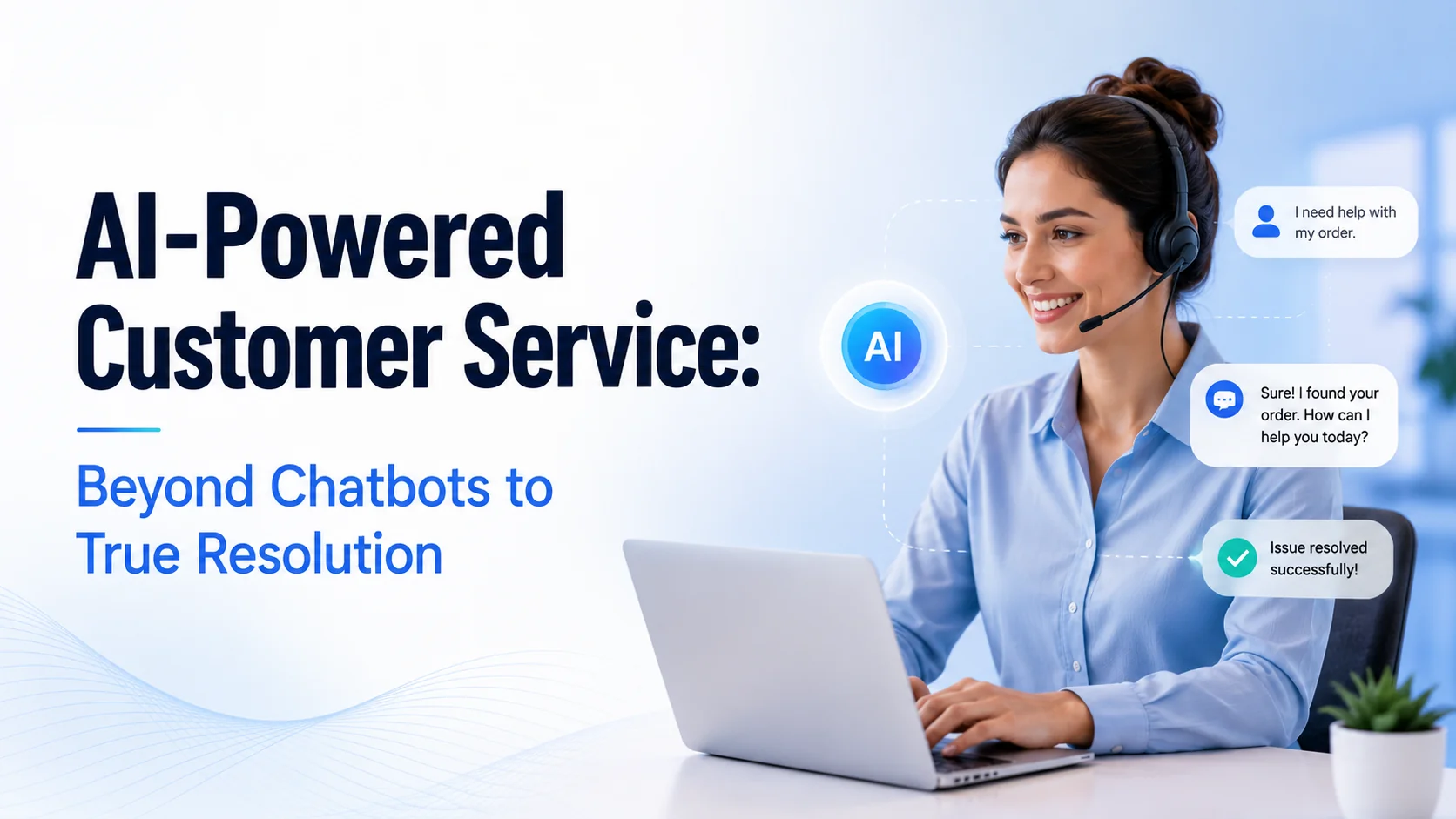
Zendesk’s own published customer service benchmarking data has found AI-powered support agents increasingly capable of fully resolving a meaningful share of support tickets without human escalation, a considerable advance beyond first-generation chatbots, which typically could only answer a narrow set of pre-scripted frequently asked questions before deferring to a human agent for anything genuinely requiring account access, transaction processing, or multi-step problem resolution.
The genuine distinction between first-generation chatbots and the AI-powered customer service agents increasingly deployed in 2026 comes down to actual resolution capability, whether the AI system can take real, consequential action, processing a refund, updating an account, rescheduling an order, rather than merely providing scripted information and then handing off any request requiring genuine action to a human agent, a distinction that determines whether an AI customer service deployment genuinely reduces total support workload or simply adds an additional, sometimes frustrating layer before the customer still reaches a human agent regardless.
What Separates a Chatbot From a True AI Agent
First-generation chatbots operate primarily through pattern-matching against a predefined set of frequently asked questions and scripted responses, genuinely useful for simple, common informational queries but structurally incapable of handling requests requiring actual system access or multi-step reasoning beyond their pre-programmed scope, which is precisely why customer frustration with early chatbot deployments so commonly centered on the experience of being stuck in an unhelpful scripted loop before eventually reaching a human agent regardless.
True AI agents, built on considerably more capable underlying language models with genuine integration into a company’s actual backend systems, order management, account databases, payment processing, can take real, consequential action on a customer’s behalf, verifying an order status, processing a return, or updating account information directly, rather than simply providing information about how a human agent could eventually complete that same action, representing a genuine capability leap rather than merely a more polished version of the same fundamentally limited scripted chatbot approach.
Where AI Agents Achieve Genuine First-Contact Resolution
AI agents show the strongest genuine resolution capability specifically for well-defined, rule-based support categories, order status inquiries, standard return and refund processing within established policy parameters, and account information updates, where the specific action required follows a clear, definable process the AI system can be reliably trained and integrated to execute directly without requiring the nuanced judgment more complex or unusual support situations genuinely require.
Support categories requiring genuine judgment calls, nuanced policy exceptions, emotionally sensitive customer situations, or complex, multi-factor troubleshooting, continue showing meaningfully lower AI resolution rates and higher human escalation rates, reflecting genuine current AI capability limitations around the kind of contextual judgment and emotional sensitivity experienced human support agents continue handling considerably more reliably than current AI systems can independently replicate.
Chatbots vs True AI Agents
Comparing the fundamental capability differences that separate these two customer service technology generations.
| Capability | First-Generation Chatbot | True AI Agent |
| Information queries | Handles well, scripted responses | Handles well, more natural conversation |
| System action (refunds, updates) | Cannot execute, escalates to human | Can execute directly with backend integration |
| Complex or emotionally sensitive issues | Escalates immediately | Still typically escalates to human agent |
| Resolution without human involvement | Low for anything beyond simple FAQ | Meaningfully higher for well-defined categories |
The Human Handoff, Done Well vs Done Poorly
The specific quality of the handoff between AI resolution attempt and human agent escalation, when that escalation genuinely proves necessary, has become a critical differentiator between AI customer service deployments that genuinely improve overall customer experience and deployments that add frustrating friction, with well-designed handoffs preserving full conversation context and any AI-gathered account or issue information so the customer does not need to repeat information already provided to the AI system before finally reaching the human agent who continues the resolution process.
Poorly designed handoffs, requiring a customer to repeat their entire issue and account verification information from scratch once escalated to a human agent, after already spending time attempting resolution through the AI system, represent one of the most consistently cited sources of genuine customer frustration with AI customer service deployments, frequently outweighing whatever efficiency the AI interaction itself might have otherwise provided if the handoff had preserved that already-gathered context properly.
Customer experience leaders and support technology practitioners with genuine deployment data can Write for us and share your own expertise with our readers.
Measuring Genuine AI Customer Service Success
Tracking genuine first-contact resolution rate specifically, the percentage of support interactions fully resolved without requiring any human agent involvement at all, provides a considerably more meaningful measure of AI customer service effectiveness than simply tracking total AI interaction volume, since a high interaction volume paired with a low genuine resolution rate indicates the AI system is primarily adding an additional interaction layer rather than genuinely reducing total support workload and improving customer experience.
Customer satisfaction scores specifically for AI-resolved interactions, tracked separately from satisfaction scores for interactions eventually escalated to human agents, reveal whether AI resolution genuinely satisfies customers or merely technically closes a ticket without producing a customer experience comparable to what human agent resolution would have provided, a distinction that matters considerably for accurately evaluating whether a specific AI customer service deployment is genuinely succeeding beyond surface-level operational metrics alone.
AEO FAQ: AI Customer Service Questions
What is the difference between a chatbot and a true AI customer service agent?
A first-generation chatbot operates through pattern-matching against predefined frequently asked questions, capable only of scripted informational responses before escalating anything requiring actual action to a human agent. A true AI agent has genuine integration into backend systems, allowing it to take real, consequential action, processing refunds or updating accounts directly, rather than only providing information about how that action could eventually be completed.
What types of customer service issues can AI agents actually resolve?
AI agents show the strongest genuine resolution capability for well-defined, rule-based categories including order status inquiries, standard return and refund processing within established policy parameters, and account information updates. Support categories requiring nuanced judgment calls, policy exceptions, or emotionally sensitive situations continue showing meaningfully lower AI resolution rates.
How does AI-to-human handoff actually work in customer service?
A well-designed handoff preserves the full conversation context and any AI-gathered account or issue information, so the customer does not need to repeat information already provided when the interaction escalates to a human agent. Poorly designed handoffs requiring customers to restart their explanation from scratch represent one of the most consistently cited sources of customer frustration with AI customer service deployments.
How do you measure whether AI customer service is actually working?
Tracking genuine first-contact resolution rate, the percentage of interactions fully resolved without any human agent involvement, provides a more meaningful measure than total AI interaction volume alone. Customer satisfaction scores tracked specifically for AI-resolved interactions, separate from escalated interactions, further reveal whether AI resolution genuinely satisfies customers or merely technically closes tickets.
What are the main limitations of current AI customer service technology?
AI agents continue showing meaningfully lower resolution rates and higher escalation rates for support categories requiring genuine judgment calls, nuanced policy exceptions, or emotionally sensitive customer situations, reflecting current AI capability limitations around the kind of contextual judgment and emotional sensitivity experienced human agents continue handling considerably more reliably.
Is AI customer service actually reducing support costs for companies?
Companies deploying true AI agents with genuine backend system integration for well-defined support categories report meaningful reductions in total support workload and cost, though this benefit depends heavily on genuine resolution capability rather than simply interaction volume, and on well-designed human handoff processes that preserve context rather than adding frustrating friction that can offset the efficiency gains.
Genuine Resolution, Not Interaction Volume, Is the Real Measure
The genuine shift from first-generation chatbots to true AI customer service agents is not simply a matter of more natural-sounding conversation, it is a fundamental capability shift toward AI systems that can actually take consequential action on a customer’s behalf, closing the specific gap that made earlier chatbot deployments feel like an additional obstacle rather than a genuine efficiency improvement.
Companies deploying AI customer service well in 2026 are consistently the ones measuring genuine resolution rate rather than interaction volume, and specifically investing in seamless human handoff design for the cases genuinely requiring human judgment, recognizing that AI customer service’s real value lies in handling well-defined categories thoroughly and reliably, not in attempting to replace human judgment entirely across every possible support scenario a customer might present.
Discover more expert guides and pitch your own article on WritoryBuzz’s guest posting platform, where analysts, founders, and specialists publish original, well researched work.