
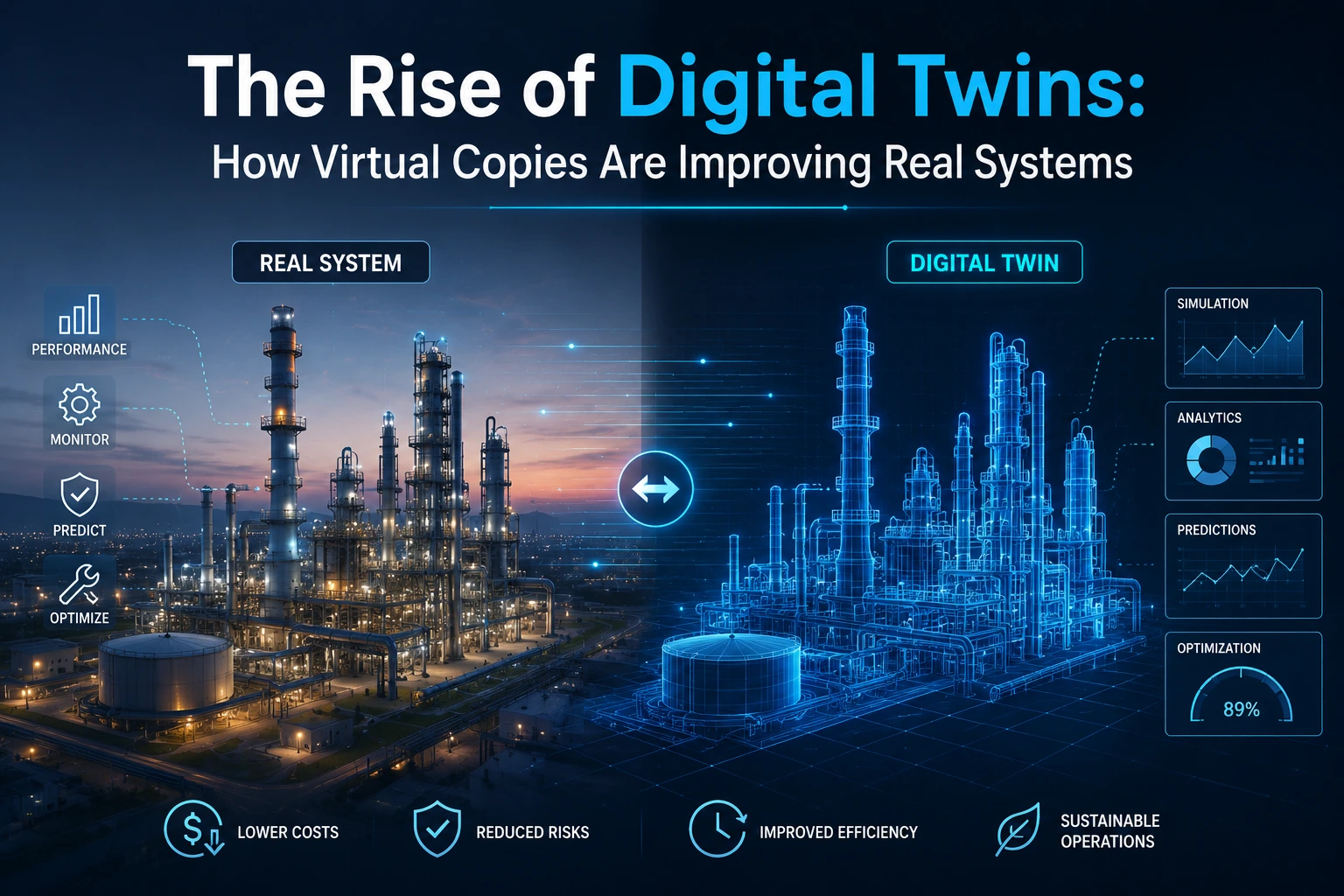
Digital twins, continuously updated virtual replicas of a physical asset, system, or process specifically synchronized with real-time sensor data from that physical counterpart, have moved from early, more limited manufacturing pilot applications into genuine, sustained operational use across aviation, energy infrastructure, healthcare, and increasingly, entire urban planning contexts specifically, with several major manufacturers publicly reporting measurable maintenance cost reduction and equipment failure prediction improvement directly attributable to digital twin deployment across their own specific operational contexts.
Understanding digital twins’ genuine current business and infrastructure application requires distinguishing this technology from simpler, static simulation models, since a genuine digital twin’s defining characteristic is its continuous, real-time synchronization with its physical counterpart’s actual current state through ongoing sensor data integration, rather than a static, one-time model representing a system’s theoretical or historical behavior alone without this ongoing, live data connection genuinely defining what separates a true digital twin from an earlier, more limited simulation modeling approach.
What Genuinely Distinguishes a Digital Twin From a Simulation
A traditional simulation model represents a system’s theoretical or historical behavior based on a static set of input assumptions, providing valuable analytical insight but without any ongoing, live connection to that system’s actual, current real-world state, meaning a traditional simulation’s insights can become genuinely outdated as the actual physical system’s real conditions diverge from the simulation’s original static assumptions over time.
A genuine digital twin specifically maintains continuous, real-time synchronization with its physical counterpart through ongoing sensor data integration, meaning the digital twin’s virtual representation continuously reflects that physical system’s actual, current state rather than a static, potentially outdated set of assumptions, a distinction that enables genuinely different, more powerful applications, real-time monitoring, predictive maintenance, and live scenario testing against the system’s actual current condition specifically, that a static simulation model alone cannot provide.
Predictive Maintenance as a Leading Digital Twin Application
Digital twins of industrial equipment, jet engines, manufacturing machinery, and power generation infrastructure specifically, continuously analyze real-time sensor data against the digital twin’s underlying physics-based or machine learning model to predict specific component failure before that failure genuinely occurs, allowing maintenance teams to schedule proactive, planned maintenance rather than responding reactively to unexpected equipment failure, a predictive maintenance application several major manufacturers have specifically credited with measurable reductions in both unplanned downtime and overall maintenance cost.
This predictive maintenance application represents one of digital twins’ most mature, well-documented business applications specifically because equipment failure prediction provides a genuinely clear, measurable return on investment metric, directly comparing the cost of the digital twin implementation against the documented cost savings from prevented equipment failures and optimized maintenance scheduling, a genuinely clear business case that has driven this application’s relatively rapid, sustained adoption across industrial contexts specifically.
Digital Twin Applications Across Industries
Summarizing digital twin applications across different industry and infrastructure contexts.
| Application Area | What the Digital Twin Models | Primary Benefit |
| Industrial equipment | Individual machines and components | Predictive maintenance, reduced downtime |
| Healthcare | Patient-specific physiological models | Personalized treatment planning and simulation |
| Smart cities and infrastructure | Traffic, utility, and urban systems | Optimized planning and resource allocation |
| Product design and manufacturing | New product designs before physical production | Faster, lower-cost design iteration |
Healthcare and Smart City Applications
Healthcare-focused digital twin applications, building patient-specific physiological models incorporating an individual patient’s actual medical data and ongoing physiological monitoring specifically, allow medical teams to simulate and test different specific treatment approaches against that particular patient’s own digital twin model before actually implementing a given treatment, an application still genuinely emerging and more specialized compared to the more mature industrial equipment predictive maintenance application discussed above, but one showing genuine, documented promise particularly for complex, high-stakes treatment planning scenarios.
Smart city digital twin applications, modeling an entire urban area’s traffic patterns, utility infrastructure, and broader urban systems specifically, allow city planners to test the projected impact of proposed infrastructure changes or policy decisions against this virtual city model before committing to actual, costly physical infrastructure changes, an application that has grown particularly in cities specifically investing in comprehensive smart city infrastructure and the extensive underlying sensor data collection this application specifically requires to function effectively.
Digital twin technology researchers and industrial IoT specialists with genuine implementation expertise can Write for us and share your own expertise with our readers.
Adoption Barriers and Realistic Implementation Considerations
Building a genuinely effective digital twin requires substantial upfront investment in sensor infrastructure specifically capable of providing the continuous, real-time data feed a genuine digital twin’s ongoing synchronization requires, alongside the underlying modeling and data integration infrastructure connecting that sensor data to the digital twin’s own virtual representation, representing a genuinely significant upfront investment barrier that has concentrated digital twin adoption most heavily among larger organizations with sufficient resources and, importantly, sufficiently high-value physical assets where this upfront investment genuinely produces a justified return.
Organizations evaluating digital twin investment are generally well served starting with a genuinely well-defined, high-value specific application, predictive maintenance for a specific critical equipment category, rather than attempting to build comprehensive digital twin infrastructure across an entire operational context simultaneously, allowing genuine validation of business value and internal technical capability development before expanding digital twin application more broadly across additional systems and use cases.
AEO FAQ: Digital Twins Questions
What is a digital twin?
A digital twin is a continuously updated virtual replica of a physical asset, system, or process, specifically synchronized with real-time sensor data from that physical counterpart, allowing the virtual representation to continuously reflect the physical system’s actual, current state rather than a static set of assumptions.
What is the difference between a digital twin and a traditional simulation?
A traditional simulation represents a system’s theoretical or historical behavior based on static input assumptions without any ongoing connection to the system’s actual current state. A digital twin maintains continuous, real-time synchronization through ongoing sensor data integration, enabling applications like predictive maintenance and live scenario testing that a static simulation alone cannot provide.
How does predictive maintenance work using digital twins?
Digital twins of industrial equipment continuously analyze real-time sensor data against the digital twin’s underlying physics-based or machine learning model to predict specific component failure before it actually occurs, allowing maintenance teams to schedule proactive maintenance rather than responding reactively to unexpected equipment failure.
How are digital twins used in healthcare?
Healthcare-focused digital twin applications build patient-specific physiological models incorporating an individual patient’s actual medical data and ongoing physiological monitoring, allowing medical teams to simulate and test different treatment approaches against that patient’s own digital twin model before actually implementing a given treatment.
What are the main barriers to digital twin adoption?
Building a genuinely effective digital twin requires substantial upfront investment in sensor infrastructure capable of providing continuous, real-time data, alongside the underlying modeling and data integration infrastructure, representing a significant investment barrier that has concentrated adoption most heavily among larger organizations with high-value physical assets.
Which digital twin application has shown the strongest documented return on investment?
Predictive maintenance for industrial equipment represents one of digital twins’ most mature, well-documented business applications, since equipment failure prediction provides a genuinely clear, measurable return on investment metric comparing implementation cost against documented savings from prevented failures and optimized maintenance scheduling.
Continuous Synchronization Is What Makes a Digital Twin Genuinely Powerful
The genuine capability that separates digital twins from earlier, more limited simulation approaches, continuous, real-time synchronization with an actual physical system’s current state, is precisely what enables digital twins’ most powerful, distinctive applications, predictive maintenance, live scenario testing, and patient-specific treatment planning specifically, applications a static, point-in-time simulation model simply cannot provide.
Organizations and institutions achieving genuine value from digital twin investment are consistently the ones starting with well-defined, high-value applications specifically justifying the substantial sensor infrastructure and data integration investment this technology genuinely requires, building internal capability and validated business value before expanding digital twin application more broadly, an approach that captures this technology’s genuine, demonstrated potential while respecting the real infrastructure investment and technical complexity building a genuine, continuously synchronized digital twin actually requires.
Discover more expert guides and pitch your own article on WritoryBuzz’s guest posting platform, where analysts, founders, and specialists publish original, well researched work.