

Harald Haas, a professor at the University of Edinburgh who coined the term Li-Fi at a 2011 TED talk, demonstrated data transmission through an LED light bulb at speeds that outstripped the Wi-Fi connections available at the time. His company pureLiFi has since shipped commercial Li-Fi products to enterprise customers across Europe, the US, and Asia. In 2023, the IEEE published the 802.11bb standard for Light Communications, providing the formal specification that positions Li-Fi as an official extension of the Wi-Fi standards family rather than a niche experimental technology.
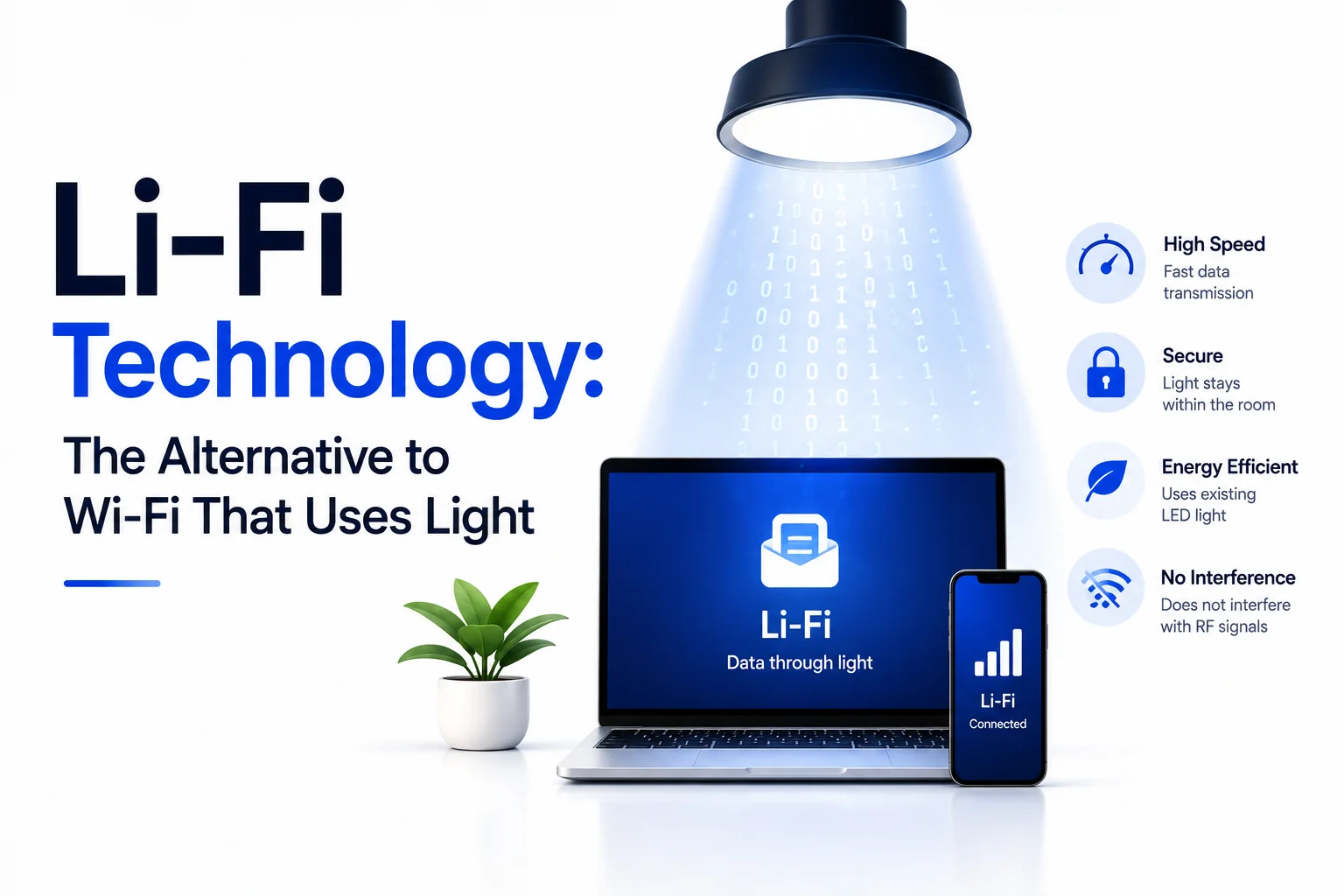
Li-Fi (Light Fidelity) transmits data using visible light, infrared, or ultraviolet wavelengths rather than radio waves. An LED light fitting equipped with a Li-Fi transmitter modulates its light output at frequencies imperceptible to the human eye, encoding data in the flickering. A photodetector in the receiving device decodes the modulation into a data stream. The principle is straightforward; the engineering precision required to achieve high reliability at speed is where most of the development challenge lies.
How Li-Fi Works
In a Li-Fi system, data is transmitted from a modified LED luminaire (ceiling light, desk lamp, or dedicated access point) by modulating the light intensity at very high speeds. The modulation is typically achieved through orthogonal frequency-division multiplexing (OFDM), the same technique used in Wi-Fi and 4G LTE, applied to the optical domain. The receiving device uses a photodetector or image sensor to capture the modulated light and decode the data stream.
The theoretical maximum speed of Li-Fi has been demonstrated at 224 Gbps in research settings by Harold Haas’s team at the University of Edinburgh. Commercial deployments in 2026 operate at 1 to 10 Gbps per access point, representing speeds significantly above typical Wi-Fi 6 deployments (typical real-world throughput of 1 to 2 Gbps) in environments where Li-Fi conditions are optimised.
The light cannot pass through walls, which is simultaneously Li-Fi’s most significant limitation and one of its most useful security features. A Li-Fi network is inherently contained to the room where the access point operates. Data cannot be intercepted outside the illuminated space without physical presence in the room.
Key Advantages Over Wi-Fi
Spectrum availability is the primary long-term advantage driving Li-Fi investment. The radio frequency spectrum used by Wi-Fi (2.4 GHz and 5 GHz bands) is increasingly congested in dense urban environments, office buildings, and any space with many simultaneous wireless devices. The visible light spectrum is approximately 2,600 times wider than the entire radio frequency spectrum, offering a resource that does not face the regulatory allocation constraints that limit Wi-Fi capacity expansion.
Security through physical containment means Li-Fi is inherently more secure against over-the-air eavesdropping than Wi-Fi. Radio waves penetrate walls and can be intercepted from outside a building with appropriate equipment. Li-Fi signals are contained to the illuminated space. This property makes Li-Fi particularly valuable in high-security environments: military facilities, financial trading floors, hospital wards handling sensitive patient data, and secure government communications.
Electromagnetic interference immunity makes Li-Fi viable in environments where radio frequency transmissions are prohibited or disruptive: aircraft cabins (during flight operations), hospital operating theatres (where RF emissions can interfere with medical equipment), and industrial settings where RF creates noise in sensitive measurement equipment.
Higher density support in specific environments is Li-Fi’s operational advantage over Wi-Fi in very dense deployments. A conference room with 50 people, each with multiple devices, exceeds the practical throughput capacity of a single Wi-Fi access point. Multiple Li-Fi access points (each ceiling light being an independent access point) partition the room into smaller coverage cells with dedicated bandwidth per cell, maintaining consistent throughput per user as density increases.
Current Deployment Contexts
Li-Fi is deployed commercially in 2026 primarily in four contexts:
Healthcare facilities use Li-Fi in intensive care units, operating theatres, and imaging rooms where radio frequency emissions are restricted. Signify (formerly Philips Lighting) and pureLiFi have deployments in hospitals across Europe and the Middle East where LED lighting infrastructure is retrofitted with Li-Fi capability, simultaneously upgrading lighting and providing wireless connectivity.
Defence and government installations where information security requirements prohibit standard Wi-Fi deployments have adopted Li-Fi for classified communications in specific rooms. The containment property provides physical layer security assurance that radio frequency wireless cannot.
Manufacturing and industrial environments where radio frequency noise from machinery interferes with Wi-Fi reliability use Li-Fi for machine monitoring, inventory tracking, and assembly line data connectivity.
Retail environments have trialled Li-Fi for hyper-precise indoor positioning (the accuracy of light-based positioning in retail spaces is centimetre-level compared to metre-level for Wi-Fi triangulation), enabling micro-location targeted customer offers and inventory tracking at shelf level.
Li-Fi Limitations
The inability to pass through walls or opaque surfaces is the fundamental operational constraint. A user moving between rooms loses connectivity, which requires a handoff mechanism to a complementary Wi-Fi network or a Li-Fi access point in the next room. This makes Li-Fi unsuitable as a standalone wireless infrastructure for environments with significant mobility across room boundaries.
Line-of-sight requirements in some implementations reduce reliability: if a device is pointed away from the access point’s light source or physically obstructed, the connection degrades or drops. More recent Li-Fi implementations use reflected light (the light bouncing off walls and surfaces) rather than requiring direct line-of-sight, which reduces but does not eliminate this limitation.
Device integration is the primary adoption barrier. Li-Fi requires a photodetector integrated into the receiving device. Currently, most consumer smartphones and laptops do not have integrated Li-Fi hardware. USB and M.2 Li-Fi dongles exist for laptops, and pureLiFi has announced partnerships with device manufacturers, but the absence of native device integration limits consumer market adoption compared to Wi-Fi, which is universally integrated into virtually every consumer device.
Li-Fi and Wi-Fi: Complementary, Not Competing
The practical deployment model in 2026 is Li-Fi and Wi-Fi as complementary layers rather than alternatives. Li-Fi provides high-bandwidth, high-security, interference-free connectivity in specific zones within a facility. Wi-Fi provides mobility across the wider facility, corridor coverage, and outdoor connectivity. Devices switch between the two networks based on availability and application requirements, with the hybrid approach delivering the benefits of both.
| Feature | Li-Fi | Wi-Fi 6 |
|---|---|---|
| Max speed (commercial) | 1-10 Gbps per AP | 1-2 Gbps (typical) |
| Penetrates walls | No | Yes |
| Security | High (room-contained) | Lower (signal leaks) |
| Spectrum | Optical (uncongested) | RF (congested in dense areas) |
| Device support | Limited (dongle required) | Universal |
| Interference immunity | High | Moderate |
| Mobility across rooms | Poor (without handoff) | Excellent |
| Cost of deployment | Higher (LED retrofit) | Lower (established ecosystem) |