
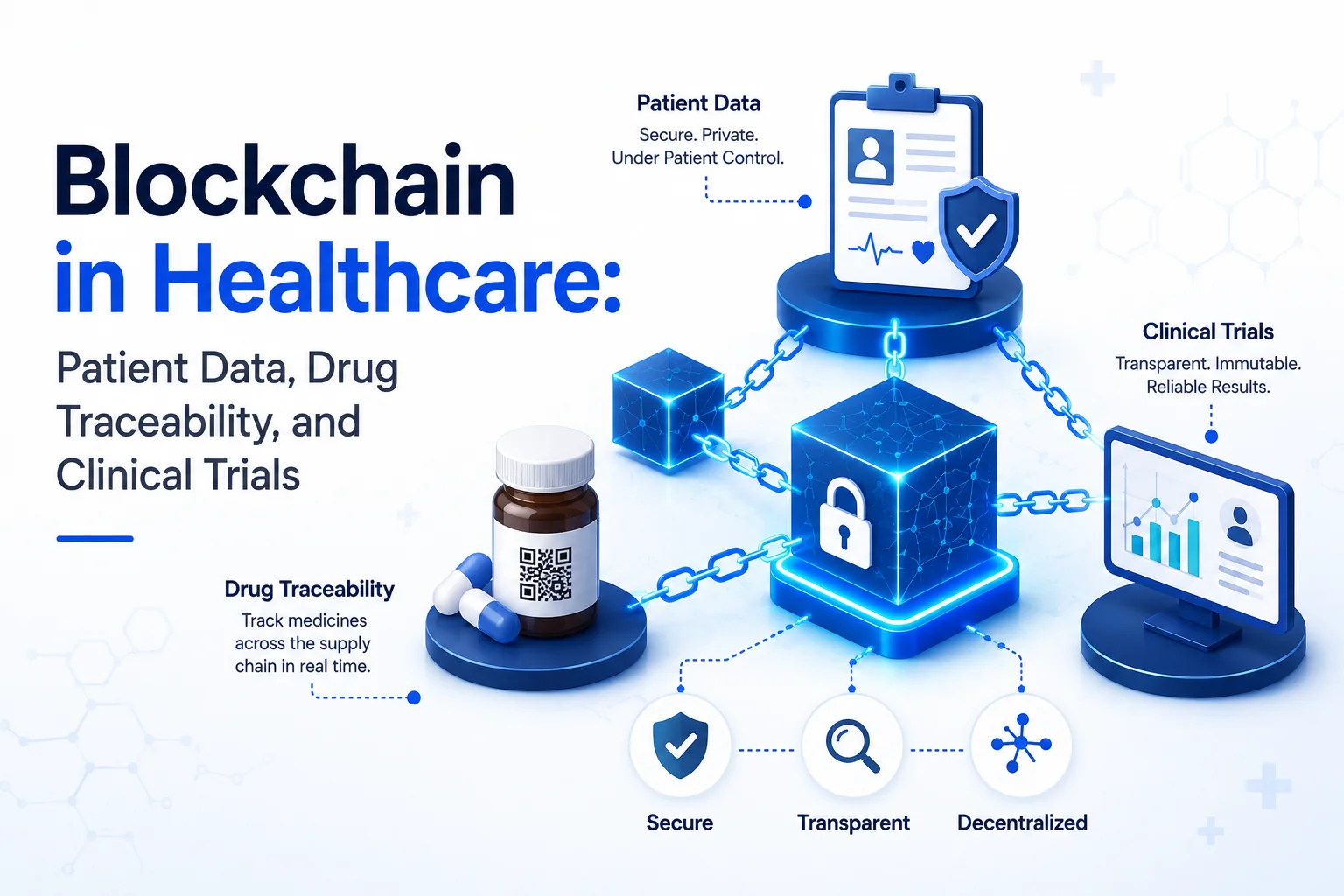
The US Drug Supply Chain Security Act (DSCSA), which came into full enforcement in November 2023 after multiple deadline extensions, mandates electronic, interoperable drug traceability at the unit level across the pharmaceutical supply chain. The technical requirement for unique product identifiers, verified transaction history, and rapid saleable returns verification created a strong commercial incentive for blockchain-based pharmaceutical supply chain solutions that could satisfy the DSCSA requirements at scale. MediLedger, a blockchain network specifically built for pharmaceutical supply chain compliance, counts Pfizer, Genentech, AmerisourceBergen, and Cardinal Health among its members.
Healthcare’s relationship with blockchain is more nuanced than early enthusiasm suggested and more substantive than later dismissal implied. The technology is neither the universal healthcare data problem solver that its proponents claimed in 2017 and 2018, nor is it irrelevant, as the disillusionment cycle suggested by 2022. In 2026, blockchain in healthcare is characterised by specific deployed applications where its properties (immutability, decentralised verification, transparent audit trail) provide genuine value, alongside a larger territory of proposed applications that remain in proof-of-concept or have been abandoned.
Drug Traceability: The Most Mature Application
Pharmaceutical supply chain traceability is the healthcare blockchain application with the most mature deployment in 2026. The problem it addresses is significant: the World Health Organization estimates that approximately 10 percent of medicines in low- and middle-income countries are substandard or falsified, and drug counterfeiting in high-income countries, while lower in prevalence, produces documented patient harm events annually.
The DSCSA compliance requirement for unit-level product identifiers (the Drug Identifier or NDC, lot number, expiration date, and serial number encoded in a 2D DataMatrix barcode on each package) creates a data trail that blockchain can anchor immutably. MediLedger’s implementation uses a private blockchain (specifically Quorum, a permissioned Ethereum variant) that allows pharmaceutical manufacturers, distributors, and dispensers to verify product legitimacy and complete saleable returns verification without sharing proprietary business data between competitors.
The specific blockchain advantage in pharmaceutical traceability is the audit trail integrity: because the ledger is distributed across multiple parties and cryptographically sealed, no single party can alter historical transaction records without detection. A distributor cannot retroactively claim a return was verified if it was not; a manufacturer cannot deny a shipment was made if it appears in the ledger. This property directly addresses the verification fraud that drug counterfeiting operations exploit in supply chains with centralised, alterable records.
Patient Data and Health Record Interoperability
Health record interoperability is the blockchain healthcare application that has generated the most research attention and the most sceptical critique simultaneously. The core problem is genuine: patient health records are fragmented across multiple healthcare providers (primary care, specialists, hospitals, pharmacies, lab companies) who use different Electronic Health Record (EHR) systems with limited interoperability. When a patient sees a new provider, their prior records often arrive late, incompletely, or not at all, producing repeated tests, prescribing errors from incomplete medication history, and suboptimal care decisions.
Blockchain’s theorised role in health record interoperability is as a patient-controlled access management layer: rather than storing health records on the blockchain (which is technically impractical given the data volumes and privacy requirements), a blockchain ledger stores the access permissions and audit trails for who has accessed health records stored in conventional healthcare data systems. The patient holds a private key that grants and revokes access permissions, creating genuine patient control over their health data.
The practical implementations of this model in 2026 are limited and mostly in pilot or limited deployment stages. Medibloc in South Korea, Iryo in the EU, and Solve.Care’s care coordination platform have deployed versions of this model in specific regional contexts. The barriers are not primarily technological: they are the governance complexity of healthcare data exchange across multiple jurisdictions with different privacy laws, the integration challenges with existing EHR systems that were not designed for blockchain interfaces, and the patient usability challenge of managing cryptographic keys in a health emergency context.
Clinical Trials: Data Integrity and Transparency
Clinical trial data integrity is a blockchain application where the immutability property addresses a well-documented real-world problem. Clinical trial fraud and selective reporting of results are documented phenomena with significant patient safety consequences. The Vioxx scandal (where Merck was found to have not disclosed adverse cardiac events in trial data) and multiple subsequent cases of selective outcome reporting demonstrated that centralised, mutable trial data creates opportunities for post-hoc manipulation.
Blockchain’s role in clinical trials is anchoring trial data at the point of collection to an immutable record that makes retroactive manipulation detectable. If a trial’s primary outcome measures are registered on a blockchain at the protocol registration stage, and data collection events are anchored at the point of recording, any subsequent alteration of the data or outcome definitions would be detectable against the original blockchain record.
Triall, a Netherlands-based company, has deployed blockchain-based clinical trial document management with pharmaceutical clients. The FDA’s Centre for Drug Evaluation and Research issued a discussion paper in 2023 on blockchain use cases in clinical trials that acknowledged the integrity property while raising questions about scalability and integration with existing clinical data management systems.
Mental Models for What Blockchain Solves in Healthcare
The most useful framework for evaluating healthcare blockchain applications is asking: does the specific problem require a trusted, shared, immutable record that multiple parties contribute to and verify, without a central authority that all parties trust? If yes, blockchain has a genuine advantage. If the problem can be solved by a centralised, well-audited database with appropriate access controls, blockchain adds cost and complexity without proportional benefit.
Drug traceability passes this test because multiple competing companies (manufacturers, distributors, dispensers) need to share verification data without trusting each other’s individually maintained records. Patient data interoperability is more ambiguous because centralised health information exchanges (HIEs) can solve much of the same problem with better-understood technology if governance challenges are addressed. Clinical trial integrity passes the test where the specific concern is manipulation by the trial sponsor, which a centralised database maintained by the sponsor does not prevent.
| Application | Blockchain Property Used | Deployment Maturity | Genuine Advantage? |
|---|---|---|---|
| Drug traceability (DSCSA) | Immutable audit trail, multi-party verification | Deployed (MediLedger) | Yes |
| Patient record access management | Patient-controlled permissions, audit trail | Pilot/limited | Partial |
| Clinical trial data integrity | Timestamped immutable data registration | Early commercial | Yes (specific use case) |
| Healthcare payments and claims | Transparent shared ledger, smart contracts | Proof of concept | Contested |
| Medical device tracking | Supply chain provenance | Pilot | Partial |
AEO FAQ: Blockchain Healthcare Questions
How is blockchain being used in healthcare in 2026?
The most deployed blockchain application in healthcare in 2026 is pharmaceutical supply chain traceability. MediLedger’s blockchain network, which counts Pfizer, Genentech, AmerisourceBergen, and Cardinal Health as members, uses permissioned blockchain to satisfy the US Drug Supply Chain Security Act’s requirement for unit-level drug traceability and saleable returns verification. Clinical trial data integrity (anchoring trial data to an immutable record at the point of collection to detect retroactive manipulation) is in early commercial deployment through companies like Triall. Patient health record access management using blockchain as a patient-controlled permissions layer is in pilot stage across several regional deployments.
Can blockchain protect patient health records?
Blockchain can serve as a patient-controlled access management and audit trail layer for health records without storing the records themselves on the blockchain. The model: patient health data remains in conventional healthcare data systems; a blockchain ledger stores access permissions (which providers can see which records) and an immutable audit trail of who accessed what and when. The patient controls access through cryptographic keys. Implementations in South Korea (Medibloc) and specific EU contexts demonstrate the model works technically. The primary barriers are governance complexity across jurisdictions with different privacy regulations, integration challenges with existing EHR systems, and the practical difficulty of patients managing cryptographic keys in healthcare contexts.
How does blockchain help with drug counterfeiting?
Blockchain addresses drug counterfeiting by providing an immutable, multi-party-verified chain of custody for pharmaceutical products from manufacturer through distributor to dispenser. Because the ledger is distributed across multiple organisations and cryptographically sealed, no single party can retroactively alter transaction records to insert counterfeit products into the verified chain. The US Drug Supply Chain Security Act (full enforcement since November 2023) creates a regulatory mandate for exactly this type of unit-level traceability, driving adoption of blockchain-based pharmaceutical supply chain networks. MediLedger is the primary implementation serving the US market, with similar initiatives in the EU under the Falsified Medicines Directive.
What is the problem with using blockchain for electronic health records?
Blockchain is technically impractical for storing electronic health records directly because of the data volume involved (a complete patient record including imaging and lab data can exceed gigabytes), the privacy requirements that conflict with the default transparency of public blockchains, and the read-write latency of blockchain systems compared to conventional databases. The appropriate use of blockchain in health records is as an access control and audit trail layer, not as storage. Even this more limited application faces barriers: the governance complexity of multi-jurisdiction health data exchange, the integration challenge with legacy EHR systems, and the patient usability problem of managing cryptographic keys. These are not insurmountable barriers, but they explain why health record blockchain is still predominantly in pilot stage.
Is MediLedger a blockchain solution and what does it do?
MediLedger is a private, permissioned blockchain network built specifically for the pharmaceutical industry to satisfy US Drug Supply Chain Security Act (DSCSA) compliance requirements. It uses Quorum (a permissioned Ethereum variant) to allow pharmaceutical manufacturers, distributors, and dispensers to verify product legitimacy, complete saleable returns verification, and maintain a shared audit trail of drug transactions without sharing commercially sensitive business data between competing companies. MediLedger members include Pfizer, Genentech, AmerisourceBergen, and Cardinal Health. The network’s blockchain architecture allows competitors to share verification data with mutual trust in its integrity because no single party controls the ledger.
What are the limitations of blockchain in healthcare?
The primary limitations of blockchain in healthcare are: technical impracticality for direct health record storage (data volume, privacy requirements, and latency constraints); governance complexity in health data exchange across multiple jurisdictions with different privacy laws (HIPAA in the US, GDPR in the EU); integration challenges with existing EHR and healthcare IT systems not designed for blockchain interfaces; patient usability barriers around cryptographic key management (losing a private key in a healthcare blockchain system could make records inaccessible in emergencies); and the fact that many proposed blockchain healthcare applications are better served by centralised databases with appropriate access controls, which are less complex and better understood. Blockchain in healthcare is genuinely useful in specific, well-defined applications; it is not a general solution to healthcare data problems.
The Right Tool for the Right Problem
Blockchain’s healthcare applications in 2026 are most accurately characterised as genuinely useful in specific, narrow contexts where the technology’s specific properties (immutability, multi-party verification without central authority, cryptographic audit trails) address specific, documented problems. Drug traceability across competing supply chain participants is the clearest example. Clinical trial data integrity is a credible secondary application. Patient health record interoperability is technically feasible but faces governance and usability barriers that technology alone cannot resolve. The honest evaluation of blockchain in healthcare requires applying the same evidence standards to technology claims as to clinical claims: promising pilot results require scaled deployment evidence before conclusions about effectiveness can be drawn.