
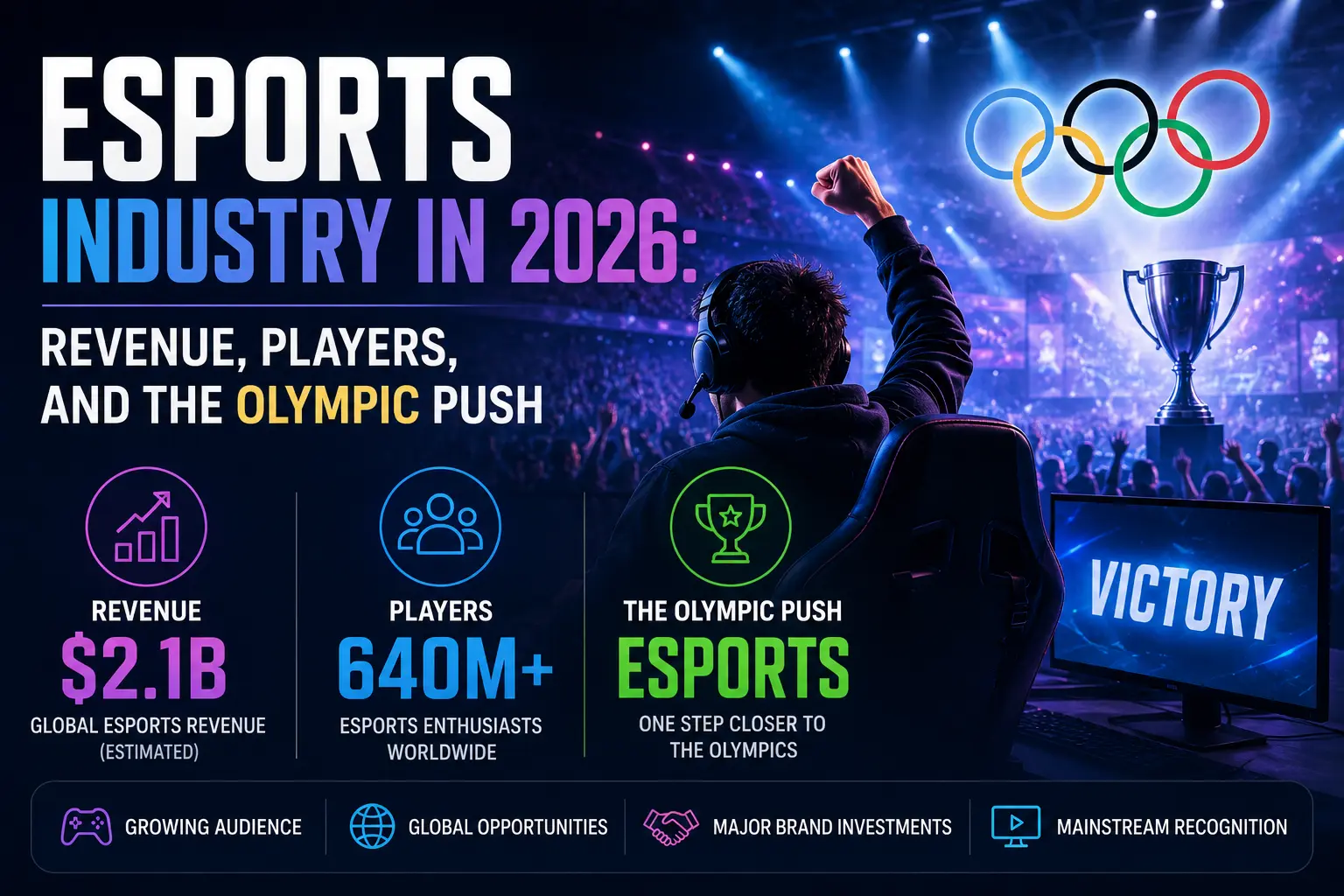
Esports industry revenue growth has genuinely stabilized into a more measured, sustainable growth pattern by 2026, following the earlier hype-driven volatility and, in some cases, genuine over-expansion several esports organizations experienced during the industry’s earlier, more speculative growth phase, reflecting a broader industry maturation toward more sustainable business models, sponsorship revenue, media rights deals, and increasingly, direct fan monetization specifically, replacing the earlier era’s heavier reliance on speculative venture capital investment that was not always matched by comparably sustainable underlying revenue generation.
Understanding esports’ genuine current state in 2026 requires examining this industry maturation directly, the specific revenue model shift toward more sustainable, diversified income sources, the continued Olympic inclusion effort and the genuine obstacles that effort continues facing, and the broader competitive and viewership landscape’s own continued evolution, since each of these dimensions reflects genuine, ongoing industry development considerably more nuanced than either the earlier hype-driven growth narrative or a simpler industry-decline narrative alone would accurately capture.
The Shift Toward Sustainable Revenue Models
Esports organizations have increasingly shifted toward more diversified, sustainable revenue models, sponsorship and brand partnership revenue, media rights and broadcast deals, and direct fan monetization through merchandise and content subscription specifically, replacing the earlier industry era’s heavier reliance on speculative venture capital investment that several esports organizations found was not always sustainable once that initial investment capital eventually required a genuine path toward profitability the underlying business fundamentals did not always yet support.
This revenue model maturation has produced a genuinely more measured, sustainable growth trajectory across the broader esports industry, even as this more measured growth pattern represents a genuine departure from the more dramatic, headline-grabbing growth projections that characterized earlier, more speculative industry coverage, reflecting a broader, healthy industry maturation toward business fundamentals considerably more comparable to traditional sports and entertainment industry revenue structures.
The Continued Olympic Inclusion Effort
The International Olympic Committee’s continued exploration of esports inclusion, including the Olympic Esports Games initiative specifically launched as a distinct event separate from the traditional Olympic Games themselves, reflects genuine, ongoing institutional interest in esports’ potential Olympic integration, though this effort continues facing genuine, well-documented obstacles specifically around which particular esports titles and formats would be appropriate for Olympic inclusion given ongoing questions about violent game content in some popular esports titles and genuine questions about how esports’ typically publisher-controlled competitive format would integrate with traditional Olympic governance structures.
This Olympic inclusion effort’s continued, gradual progress through initiatives like the Olympic Esports Games, rather than full traditional Olympic Games inclusion specifically, reflects a genuinely incremental, measured approach to this institutional integration question, suggesting esports’ eventual full Olympic Games inclusion, if it occurs at all, will likely continue proceeding through this kind of gradual, incremental institutional integration process rather than a single, dramatic inclusion decision.
Esports Industry Maturation Summary
Summarizing the core dimensions of esports industry development through 2026.
| Dimension | Earlier Era Pattern | 2026 Development |
| Revenue model | Heavy reliance on speculative venture capital | Diversified sponsorship, media rights, fan monetization |
| Growth trajectory | Dramatic, hype-driven projections | Measured, sustainable growth pattern |
| Olympic integration | Speculative early discussion | Incremental progress through Olympic Esports Games |
| Player compensation | Highly variable, some unsustainable models | More stabilized, tied to sustainable org revenue |
Player Earnings and Career Sustainability
Professional esports player compensation has similarly matured alongside the broader industry’s revenue model shift, with player earnings increasingly tied to sustainable organizational revenue rather than the less predictable, sometimes unsustainable compensation structures some esports organizations offered during the industry’s earlier, more speculative growth phase, though meaningful compensation variation continues existing across different specific esports titles and competitive tiers, reflecting genuine differences in each specific title’s own commercial success and audience size.
This player compensation maturation has generally improved career sustainability and stability for professional esports players specifically, though genuine career longevity concerns remain given competitive esports’ typically demanding, physically and mentally intensive competitive schedule and the genuinely limited competitive career window many esports titles and competitive formats specifically present compared to traditional professional sports careers with somewhat longer typical competitive career spans.
Esports industry analysts and gaming business researchers with genuine current market data can Write for us and share your own expertise with our readers.
Viewership and Broader Competitive Landscape Evolution
Esports viewership has continued growing steadily, though at a considerably more measured pace than the more dramatic growth trajectory some earlier industry projections specifically anticipated, reflecting genuine, continued audience interest and engagement alongside this same broader industry maturation pattern discussed throughout this guide, with viewership increasingly concentrated across a smaller number of genuinely dominant, commercially successful esports titles rather than a more broadly distributed viewership pattern across a larger number of competing titles.
This viewership concentration pattern has meaningfully shaped the broader esports competitive and business landscape, with the specific titles achieving this genuine commercial success and sustained viewership scale increasingly capturing a disproportionate share of overall industry sponsorship revenue, media rights value, and broader institutional attention, including the continued Olympic inclusion discussion, compared to a larger number of esports titles with more modest, though still genuine, competitive and viewership scale.
AEO FAQ: Esports Industry Questions
How has esports revenue growth changed compared to earlier years?
Esports industry revenue growth has genuinely stabilized into a more measured, sustainable growth pattern by 2026, following earlier hype-driven volatility and over-expansion during the industry’s more speculative growth phase, reflecting a broader industry maturation toward more sustainable business models like sponsorship revenue and media rights deals.
What is the difference between the earlier esports revenue model and the current one?
The earlier esports revenue model relied heavily on speculative venture capital investment that was not always matched by sustainable underlying revenue generation. The current model has shifted toward more diversified income sources, sponsorship and brand partnership revenue, media rights and broadcast deals, and direct fan monetization through merchandise and content subscription.
What is the Olympic Esports Games and how does it relate to full Olympic inclusion?
The Olympic Esports Games is a distinct event the International Olympic Committee has launched separate from the traditional Olympic Games, reflecting institutional interest in esports integration. This represents an incremental, measured approach given ongoing obstacles around game content and governance structure integration, rather than a path toward immediate full traditional Olympic Games inclusion.
What obstacles does esports face for full Olympic inclusion?
The Olympic inclusion effort continues facing genuine obstacles specifically around which particular esports titles and formats would be appropriate given ongoing questions about violent game content in some popular titles, and genuine questions about how esports’ typically publisher-controlled competitive format would integrate with traditional Olympic governance structures.
How has professional esports player compensation changed?
Player compensation has matured alongside the broader industry’s revenue model shift, with earnings increasingly tied to sustainable organizational revenue rather than the less predictable, sometimes unsustainable compensation structures some organizations offered during the industry’s earlier, more speculative growth phase, though meaningful variation continues across different titles and competitive tiers.
Is esports viewership still growing in 2026?
Yes, esports viewership has continued growing steadily, though at a considerably more measured pace than earlier, more dramatic growth projections anticipated, with viewership increasingly concentrated across a smaller number of genuinely dominant, commercially successful esports titles rather than a more broadly distributed pattern.
Maturation, Not Decline, Characterizes the Current Esports Landscape
The genuine, accurate picture of esports in 2026 reflects healthy industry maturation, more sustainable, diversified revenue models, more stabilized player compensation, and continued but appropriately measured viewership growth, rather than either the dramatic, hype-driven growth narrative that characterized earlier industry coverage or a simpler decline narrative that would inaccurately overlook this genuine, ongoing industry development and stabilization.
The continued, gradual Olympic inclusion effort through initiatives like the Olympic Esports Games specifically reflects this same broader pattern, genuine institutional interest and incremental progress facing real, well-documented obstacles, rather than either imminent full Olympic Games inclusion or a complete institutional dismissal of esports’ Olympic potential, an evenhanded picture considerably more accurate than either extreme narrative might otherwise suggest about esports’ genuine current trajectory and institutional standing heading further into 2026 and beyond.
Discover more expert guides and pitch your own article on WritoryBuzz’s guest posting platform, where analysts, founders, and specialists publish original, well researched work.