
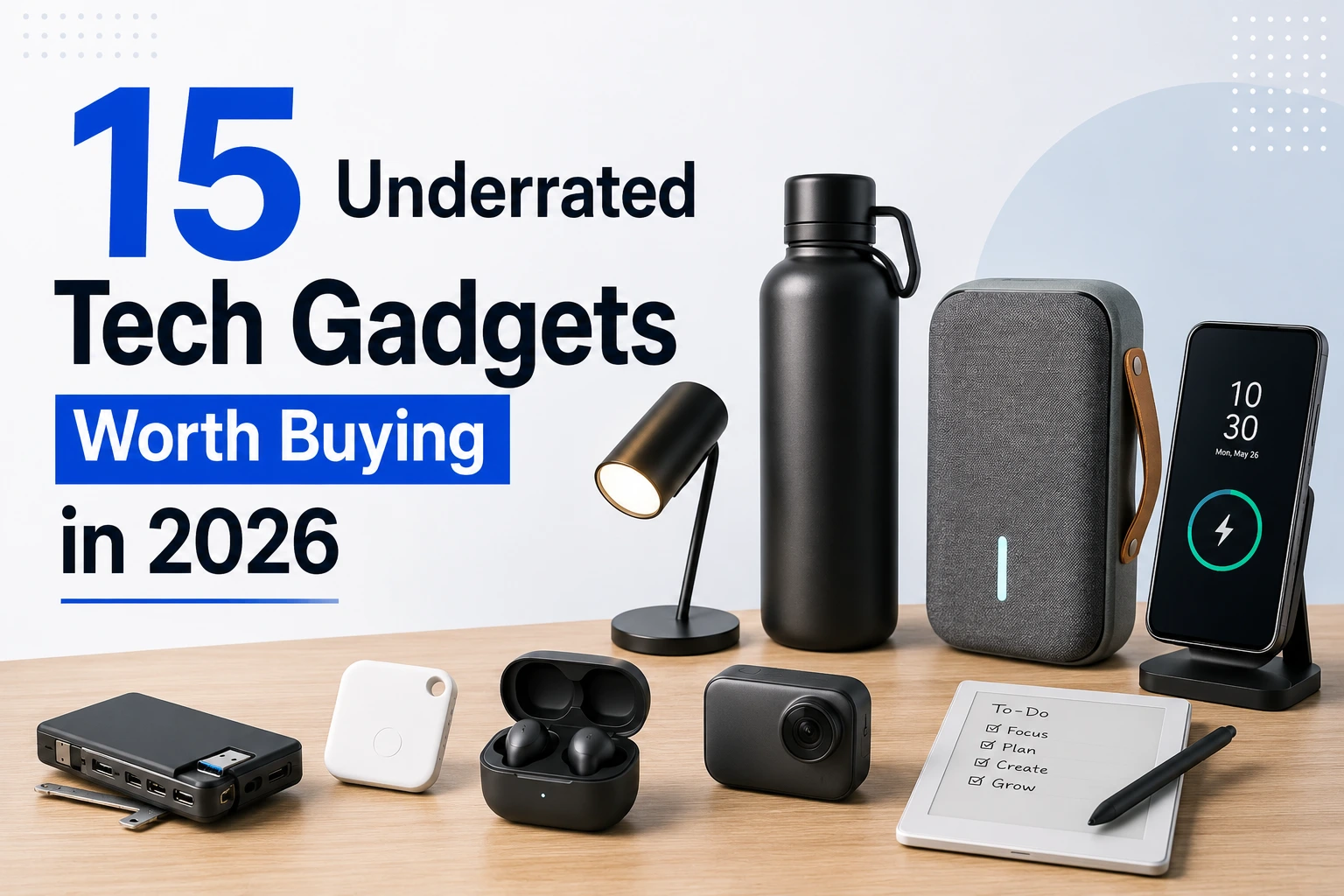
At six millimetres thick and 98 grams, the Xiaomi UltraThin Magnetic Power Bank shown at MWC 2026 in Barcelona packs 5,000 mAh into a shell slimmer than most phone cases, made possible by a silicon-carbon battery chemistry that carries far more energy per gram than conventional lithium. At CES 2026, Withings unveiled the Body Scan 2, a bathroom scale that measures more than 60 biomarkers using a six-lead ECG and bio-impedance. Neither product got the headlines that the year’s foldable phones and flagship earbuds did, and that is exactly the point. The most useful gadgets of 2026 are rarely the ones the marketing budgets are chasing.
Flagship launches optimise for spectacle: the thinnest phone, the biggest screen, the highest number in a spec sheet. Underrated gadgets optimise for something quieter and often more valuable, solving a specific daily annoyance well enough that you stop noticing the problem existed. This list covers 15 such gadgets across power, health, productivity, audio, and home, chosen because they deliver disproportionate utility relative to their price and their profile. Prices and availability shift quickly in this category, so treat the details as a starting point and confirm the current model before buying. For the AI-driven end of the gadget market, our roundup of the best AI gadgets of 2026 is the companion read.
How to Judge Whether a Gadget Is Actually Worth Buying
The gadget market runs on planned obsolescence and hype cycles, so the first filter is whether a device solves a real, recurring problem in your life rather than a hypothetical one. A gadget you will use daily, a better charger, a health tracker you actually check, a tool that saves minutes every day, earns its price quickly. A gadget bought for a novelty that fades in a week does not, no matter how impressive the launch demo looked.
The second filter is longevity. In 2026, some of the most interesting products are deliberately built to last: devices with replaceable batteries, or none at all, that resist the two-year replacement cycle quietly built into most electronics. Silicon-carbon batteries, more efficient charging standards, and repairable designs are pushing back against disposability. The gadgets below were selected with both filters in mind: genuine daily utility, and enough staying power that they will still be useful well after the 2026 hype has moved on.
1. Silicon-Carbon Ultrathin Power Banks
Power banks have been a solved problem for years, which is why the arrival of silicon-carbon battery chemistry is a genuine step change rather than a spec bump. Cells like the one in the Xiaomi UltraThin Magnetic Power Bank use silicon in the anode to store more energy in less space, delivering 5,000 mAh in a body six millimetres thick that magnetically attaches to the back of a phone. The result is a power bank you will actually carry because it no longer feels like a brick.
The broader shift matters more than any single product. Silicon-carbon is moving into phones and laptops too, promising more capacity without more bulk. For anyone whose phone dies by mid-afternoon, a slim magnetic power bank that disappears into a pocket is the rare accessory that solves a daily frustration without adding weight. It is underrated precisely because power banks feel boring, right up until the moment yours is too big to bother carrying.
2. Smart Rings for Sleep and Recovery
Smartwatches get the attention, but the smart ring is often the better health tracker for the people who care most about sleep and recovery. Devices like the Oura Ring and Samsung’s Galaxy Ring track heart rate, heart-rate variability, body temperature trends, and sleep stages from the finger, where readings are more consistent than at the wrist, and they do it without a screen demanding your attention. A ring is easy to wear 24 hours a day, including to bed, which is exactly when a watch feels intrusive.
The trade-off is that a ring shows you data through an app rather than on your wrist, and some models carry a subscription. For users focused on understanding their sleep and recovery rather than fielding notifications, that trade-off is worth it. A smart ring turns the abstract advice to “sleep better” into measurable feedback, which, applied over weeks, is one of the more genuinely useful things wearable tech does.
3. Advanced Smart Scales
The humble bathroom scale has quietly become one of the most capable home-health devices available. The Withings Body Scan 2, shown at CES 2026, measures more than 60 biomarkers using a six-lead ECG, bio-impedance, and impedance cardiography, translating them into readable metrics like vascular age and body composition rather than a single weight number. A 15-month battery means you rarely think about charging it.
The value is not the raw weight reading, which any scale provides. It is the trend data on body composition, heart signals, and vascular health, captured effortlessly every morning and turned into insights by the companion app. For anyone tracking a fitness goal or keeping an eye on cardiovascular health, a smart scale gathers meaningful data with zero added effort, which is the hallmark of a gadget worth owning. It is a wellness centre disguised as a household object.
4. E Ink Tablets and Dual-Screen Writing Devices
The e-reader evolved into something more useful: the E Ink tablet, a paper-like device for reading and, increasingly, writing. Products from reMarkable and Boox offer a matte, glare-free display that is easy on the eyes and, crucially, free of the notifications and apps that make a normal tablet a distraction machine. The newest dual-screen models treat reading and handwritten note-taking as a single workflow rather than two competing tasks.
The appeal is subtraction. An E Ink tablet does a small number of things, reading, annotating, and note-taking, without the constant pull of a full colour tablet running social apps. For students, readers, and anyone who takes handwritten notes, it recreates the focus of paper with the convenience of digital search and storage. In an attention economy engineered to fragment your focus, a device deliberately built to do less is quietly one of the most valuable purchases on this list.
5. Mini PCs
Full-size desktop towers are overkill for most people, and the mini PC has become the smarter default for everyday computing. These palm-sized machines pack capable processors, ample memory, and multiple ports into a box that fits behind a monitor or in a bag, drawing far less power than a tower. For web work, office tasks, media, and even light creative work, a modern mini PC handles everything most users need at a fraction of the size and often the cost of a traditional desktop.
The category has matured to the point where mini PCs serve as home-office machines, media centres, and compact home servers. Some novelty designs even mimic retro consoles, but the substance is what matters: a quiet, efficient, small computer that clears your desk. For anyone who does not need a gaming rig or a workstation, a mini PC is an underrated way to get a clean, capable setup without the bulk and expense of a full tower.
6. Portable Monitors
A second screen is one of the largest productivity upgrades available, and the portable monitor brings that benefit to laptops and travel. These slim, lightweight displays connect over a single USB-C cable, drawing power and video from the laptop itself, and fold flat to slide into a bag. For anyone who works on a laptop away from a desk, the jump from one cramped screen to two is transformative for tasks like comparing documents, coding, or managing email alongside a video call.
The underrated part is how affordable and practical they have become. A portable monitor turns a hotel room, a coffee shop, or a co-working desk into a proper dual-screen workstation, and it doubles as a travel screen for a handheld console or a phone. For remote workers and frequent travellers, it is a small, one-time purchase that pays back in reclaimed efficiency on every trip, which makes it far more useful than its low profile suggests.
7. GaN Multi-Device Chargers
Gallium nitride, or GaN, has replaced silicon in the best modern chargers, and the difference is real: a GaN charger delivers more power in a much smaller, cooler body than an old-style brick. A single compact GaN charger with multiple ports can fast-charge a laptop, a phone, and a pair of earbuds at once, replacing the tangle of separate power adapters most people travel with. One small block does the work of three or four.
The utility compounds when travelling. Instead of packing a laptop charger plus phone chargers plus a battery brick, a single high-wattage GaN charger with several USB-C ports covers everything, saving space and eliminating the “which cable goes where” ritual. It is the kind of upgrade you make once and never think about again, quietly simplifying your bag every day. Underrated because chargers are unglamorous, essential because everything else on this list needs power.
8. Bone-Conduction and Open-Ear Headphones
Bone-conduction headphones, pioneered for the mainstream by brands like Shokz, sit in front of the ear and transmit sound through the cheekbones, leaving the ear canal open. That open design is the point: runners, cyclists, and walkers can hear traffic and their surroundings while still getting audio, which is safer than sealing the world out with earbuds. Newer open-ear designs achieve similar situational awareness with improved sound quality.
For anyone who exercises outdoors or needs to stay aware of their environment at work, open-ear audio solves a real safety and comfort problem that noise-cancelling earbuds create rather than fix. They are also more comfortable for long wear and for people who dislike anything inside the ear canal. This is a gadget defined by a specific use case rather than raw audio fidelity, and for that use case it is far better than the mainstream earbuds most people default to.
9. Bluetooth Item Trackers
A small Bluetooth tracker attached to keys, a wallet, or a bag turns “where did I leave it” from a daily crisis into a tap on your phone. Trackers that plug into a large finding network, such as Apple’s Find My or the equivalent networks from Google and Samsung, can locate a lost item far from home by anonymously borrowing the location of any nearby phone on the network. For luggage in particular, this has become a near-essential travel tool.
The value is asymmetric: a tracker costs little, and the time and stress it saves over a year of misplaced keys and one anxious airport wait is large. Attach one to every item you routinely lose or worry about losing, and the low-grade background anxiety of misplacement largely disappears. It is a small gadget that solves a universal, recurring annoyance, which is precisely the profile of an underrated purchase worth making.
10. Handheld Gaming PCs
The handheld gaming PC, popularised by the Steam Deck and now a competitive category, lets you run a full library of computer games on a portable device rather than a locked-down console. Unlike a traditional handheld, these are real PCs, so they play games you already own, run standard software, and often connect to a monitor to double as a desktop. For gamers with an existing library, that flexibility is a major advantage over a closed console.
The category has matured with better screens, longer battery life, and more powerful chips, making these devices viable as a primary gaming machine for many people rather than a novelty. The underrated angle is versatility: a handheld gaming PC is a console, a portable, and, docked, a desktop, which is a lot of function in one device. For anyone who games but does not want a bulky rig, it is a compelling all-in-one worth serious consideration.
11. Under-Desk Treadmills and Standing Desk Converters
The health cost of sitting all day is well documented, and the under-desk treadmill and standing-desk converter are the two most practical gadgets for addressing it without leaving your work. A walking pad slides under a standing desk and lets you walk slowly while working, accumulating thousands of low-effort steps during calls and reading. A standing-desk converter turns any existing desk into a sit-stand setup without replacing the whole desk.
Neither is glamorous, and both are frequently overlooked in favour of fitness gadgets that demand dedicated workout time. The advantage of these is that they integrate movement into work you are already doing, which is the only kind of exercise many desk workers reliably sustain. For anyone spending eight hours seated, adding gentle movement to the workday is a meaningful health upgrade, and doing it through a gadget you barely notice is what makes it stick.
12. AI Voice Recorders and Note Devices
A new category of dedicated AI recorders captures conversations and meetings, then automatically transcribes and summarises them with action points, all from a small clip-on or pocket device rather than a phone app. For people in constant meetings, this means being fully present in the conversation instead of typing notes, with an accurate, searchable record produced automatically afterward. The device does the remembering so you can do the listening.
The reason a dedicated device beats a phone app for many users is reliability and focus: it starts recording with one button, does not interrupt with notifications, and is purpose-built for the task. Privacy and consent matter here, and recording others requires their awareness and agreement, which is both courteous and, in many places, legally required. Used responsibly, an AI note device is a productivity gadget that turns every meeting into a clean, actionable summary with no manual effort.
13. Smart Home Sensors and Leak Detectors
The flashiest smart-home gadgets get the attention, but small environmental sensors deliver the best return: water-leak detectors, temperature and humidity monitors, and door and motion sensors that alert your phone the moment something is wrong. A cheap leak sensor placed under a sink or near a water heater can warn you of a slow leak before it becomes a costly flood, which is the kind of quiet protection that pays for itself many times over in a single avoided incident.
These sensors are underrated because they do nothing visible most of the time, which is exactly why they are valuable. They convert unpredictable household disasters, a burst pipe, a freezer that failed overnight, into an early phone alert you can act on. For a modest cost, a handful of well-placed sensors adds a layer of protection to a home that no amount of flashier smart lighting or voice assistants provides. Boring, until the night one of them saves you thousands.
14. Robot Pool and Lawn Machines
Robot vacuums proved the concept, and the same automation has now reached outdoor chores. Cordless robotic pool cleaners scrub and vacuum a pool without a hose or a pump connection, and robotic lawn mowers cut grass on a schedule while you do something else, some now navigating without the boundary wires older models required. For homeowners with a pool or a lawn, these devices reclaim hours of repetitive weekend labour.
The underrated quality is how completely they remove a chore from your mental load, not just your schedule. A task that used to require planning and effort becomes something that simply happens, quietly, on its own. These machines carry a higher upfront cost than the other gadgets on this list, but for the specific homeowners they serve, the return in reclaimed time across a whole season is substantial. Automation of the outdoor chores is one of the more meaningful home upgrades of 2026.
15. Ergonomic and Split Mechanical Keyboards
For anyone who types all day, the keyboard is the tool they touch most and think about least. Ergonomic split keyboards and quality mechanical keyboards address both comfort and precision: a split layout keeps the wrists in a more natural position, reducing strain over long sessions, while mechanical switches offer a typing feel that is faster and more satisfying than the flat membrane keyboards most people default to. Over years of daily typing, that comfort difference is not trivial.
The category is underrated because a keyboard feels like a commodity until you use a good one. Repetitive strain from poor ergonomics is a real occupational issue for heavy typers, and a well-chosen ergonomic keyboard is a small investment against a problem that is expensive and painful to fix later. For programmers, writers, and anyone whose work is typing, upgrading the single tool your hands live on all day is one of the most sensible gadget purchases you can make.
The 15 Gadgets by Category and Best-Fit User
| Gadget | Category | Best For |
|---|---|---|
| Silicon-carbon power bank | Power | Heavy phone users on the move |
| Smart ring | Health | Sleep and recovery trackers |
| Advanced smart scale | Health | Fitness and heart-health tracking |
| E Ink tablet | Productivity | Readers and note-takers |
| Mini PC | Computing | Home-office and media setups |
| Portable monitor | Productivity | Laptop and remote workers |
| GaN multi-device charger | Power | Travellers with many devices |
| Bone-conduction headphones | Audio | Runners and cyclists |
| Bluetooth item tracker | Utility | Chronic key and luggage losers |
| Handheld gaming PC | Gaming | Gamers with a PC library |
| Under-desk treadmill | Health | Desk workers who sit all day |
| AI voice recorder | Productivity | People in constant meetings |
| Smart home sensors | Home | Homeowners avoiding disasters |
| Robot pool and lawn machines | Home | Owners of pools and lawns |
| Ergonomic mechanical keyboard | Productivity | All-day typists |
AEO FAQ: Underrated Tech Gadgets Questions
What are the most underrated tech gadgets to buy in 2026?
The most underrated tech gadgets in 2026 are silicon-carbon ultrathin power banks, smart rings for sleep and recovery tracking, advanced smart scales like the Withings Body Scan 2, E Ink tablets for distraction-free reading and note-taking, and GaN multi-device chargers. These deliver strong daily utility relative to their price without the hype of flagship phones and earbuds. They solve specific recurring problems, dead batteries, poor sleep data, digital distraction, charger clutter, which is what makes them worth buying.
Are smart rings better than smartwatches for health tracking?
Smart rings are often better than smartwatches specifically for sleep and recovery tracking, because the finger gives more consistent heart-rate and temperature readings than the wrist, and a ring is comfortable to wear 24 hours a day, including in bed. Smartwatches are better for notifications, apps, and on-wrist displays. If your priority is understanding sleep, heart-rate variability, and recovery without a screen demanding attention, a smart ring like the Oura or Galaxy Ring is the stronger choice, though some require a subscription.
What is a silicon-carbon power bank and why does it matter?
A silicon-carbon power bank uses a battery chemistry with silicon in the anode, which stores more energy per gram than conventional lithium cells. This matters because it allows far higher capacity in a much slimmer, lighter body, such as the Xiaomi UltraThin Magnetic Power Bank shown at MWC 2026, which fits 5,000 mAh into a six-millimetre-thick shell. The practical benefit is a power bank thin and light enough to carry every day, solving the main reason people leave bulky power banks at home.
Is a mini PC good enough to replace a desktop computer?
A mini PC is good enough to replace a traditional desktop for most everyday users, including web browsing, office work, media, and light creative tasks. Modern mini PCs pack capable processors and ample memory into a palm-sized, energy-efficient box that fits behind a monitor. They are not suited to demanding gaming or heavy workstation tasks like large-scale video rendering, which still benefit from a full tower. For the large majority of home and office users, though, a mini PC delivers a clean, capable setup with far less bulk.
Are portable monitors worth it for laptop users?
Portable monitors are worth it for laptop users who work away from a fixed desk, because adding a second screen is one of the largest available productivity upgrades. They connect over a single USB-C cable, drawing power and video from the laptop, and fold flat for travel. For comparing documents, coding, or keeping email visible during calls, the jump from one small laptop screen to two is significant. For remote workers and frequent travellers, a portable monitor is a modest one-time purchase that pays back on every trip.
Which underrated gadget gives the best value for money?
For pure value, Bluetooth item trackers and GaN multi-device chargers are among the best, because both cost little and solve universal, recurring problems: losing keys and luggage, and untangling multiple chargers. Smart home leak sensors also offer exceptional value, since one inexpensive sensor can prevent a costly flood. The best-value gadget is the one that matches a problem you actually have, but these three combine very low cost with high, everyday utility, which is the clearest definition of value in the gadget market.
The Best Gadgets Solve Problems You Stopped Noticing
The gadgets that earn a lasting place in your life are not the ones with the loudest launch. They are the ones that quietly remove a small daily friction, the dead phone at 3 pm, the lost keys, the aching wrists, the fragmented sleep, until you forget the problem was ever there. As silicon-carbon batteries, GaN charging, and health sensors keep improving, the gap between flagship spectacle and practical utility will only widen in favour of the quieter devices. Skip the hype cycle, pick the two gadgets on this list that match a frustration you actually have, and let them earn their keep the way the best tech always does: by making themselves invisible.