
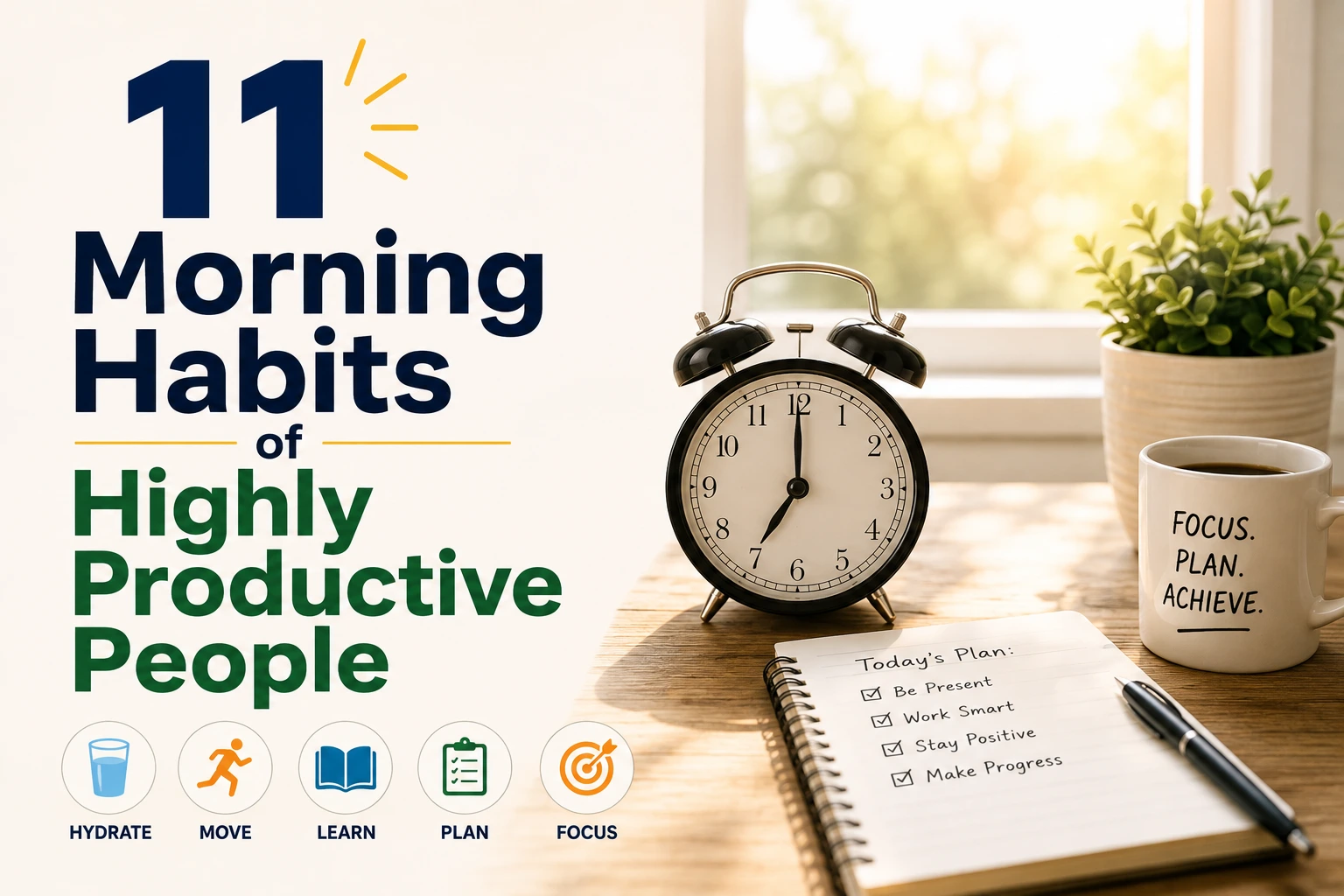
Research published in the Journal of Personality and Social Psychology found that people who follow a consistent morning routine report lower stress, higher productivity, and greater life satisfaction than those who start each day reactively. University of Toronto research found that people who wake up at a consistent time report more control over their day and better work performance. And habit-formation research is consistent on a related point: attempting to change several behaviours simultaneously sharply reduces the odds that any of them stick. The morning habits of genuinely productive people are not a single dramatic 5 AM ritual. They are a small number of specific, repeatable actions, each backed by a distinct mechanism.
The popular image of a productive morning, an alarm before dawn, a cold plunge, ninety minutes of stacked rituals, is mostly aspirational content that few people sustain past a fortnight. The research tells a more useful story: productive people are not perfect, they are consistent, and a ten-minute habit performed daily outperforms a ninety-minute routine abandoned after two weeks. The 11 habits below are drawn from behavioural and circadian research, ordered from the foundation that makes everything else possible to the finer adjustments experienced people add once the basics are automatic. If sleep quality is undermining your mornings before they start, our guide to science-backed habits for better sleep addresses the night that precedes it.
Why Mornings Matter More Than Any Other Part of the Day
The first hour of the day carries disproportionate weight because it sets the decision-making conditions for everything that follows. Willpower and self-control behave like a finite resource that depletes with use across the day, which means decisions made early, before that resource is spent, tend to be more deliberate and less reactive than the same decisions made at 4 pm. A morning spent reacting to notifications and other people’s priorities front-loads the day with someone else’s agenda before you have set your own.
There is also a habit-formation reason mornings matter. Repeating positive habits daily trains the brain to execute them with less conscious effort over time, and mornings offer the most consistent, distraction-free window most people have to build that repetition. Structured morning routines reduce decision fatigue by automating a set of positive choices before the day’s demands arrive, which is precisely why the habits below focus on removing decisions rather than adding complexity.
1. Wake Up at a Consistent Time, Every Day
The habit that separates highly productive people from everyone else most reliably is waking up at the same time daily, including weekends. University of Toronto research found that people who maintain consistent wake times report more control over their day and better work performance, and the mechanism is straightforward: a fixed wake time trains the circadian rhythm, so the body begins preparing to wake naturally before the alarm sounds, which removes the jolt and the resistance that come with an erratic schedule.
This is the foundational habit on this list because it makes every other habit easier to sustain. A stable wake time creates a stable window for the habits that follow, exercise, planning, focused work, rather than a shifting start point that has to renegotiate the day from scratch each morning. If you build only one habit from this list, this is the one with the strongest research behind it and the broadest downstream effect on everything else.
2. Delay the Phone and Avoid Reactive Mode
The instinct to check messages and notifications within minutes of waking puts a person into reactive mode before they have made a single intentional decision of their own. Productivity research frames this clearly: identify the day’s most important result before checking non-essential messages, not after. Once the mind has absorbed a stream of other people’s requests, urgent emails, breaking notifications, unread messages, it becomes measurably harder to redirect attention back to your own priorities.
The practical version of this habit does not require a dramatic digital detox before breakfast. It requires a delay: give yourself even 20 to 30 minutes of phone-free time after waking before opening email or social apps. That window is enough to complete the next few habits on this list with a clear head, and it means the first input of your day is your own intention rather than someone else’s demand on your attention.
3. Decide Your Most Important Task the Night Before
Deciding tomorrow’s first task the night before eliminates a specific, well-documented source of morning friction: decision fatigue. This two-minute habit, closing the current day by explicitly naming what you will work on first tomorrow, creates closure on today and clarity for tomorrow simultaneously. Many people who adopt this habit report better sleep as a side effect, because the brain is no longer trying to plan and remember tasks while attempting to fall asleep.
The mechanism connects directly to habit two. If you already know your first task before you wake up, the temptation to open your phone and let notifications decide your morning’s priority loses its pull. You wake up with a decision already made, which is precisely the kind of automated positive choice that reduces the number of small decisions competing for your limited morning willpower.
4. Get Morning Light and Move Your Body
Circadian-aligned morning routines that include physical activity support cognitive performance and mood regulation by stabilising the sleep-wake cycle and enhancing mental clarity through the rest of the day. Morning exercise, even a brisk walk rather than a full workout, delivers a specific combination of benefits: it helps prevent low mood, promotes deeper sleep the following night, and raises energy levels across the day in a way that avoids the mental fatigue a sedentary morning produces.
The activity does not need to be intense to work. A jog, a walk outside, time on a stationary bike, or a short yoga session all activate the same underlying mechanism: movement paired with natural light exposure signals the circadian clock that the day has begun, which supports the alertness and mood regulation the rest of your morning habits depend on. Consistency in doing some movement matters more than the specific type or intensity you choose.
5. Protect a Block of Concentrated Work Before the Day Gets Noisy
After identifying the day’s most important result, highly productive people protect a dedicated period for concentrated work on it, completed before meetings, messages, and other demands fragment their attention. This first working period is where the highest-value work of the day typically happens, precisely because willpower and focus are least depleted in the morning and the number of competing demands is still low.
The discipline here is defending this block against the pull of easier, lower-value tasks that feel more urgent. Checking email first thing feels productive but is usually the opposite: it fills the most valuable, focused part of the day with other people’s priorities. Treat this block as a genuine appointment, protected the same way a meeting with an important client would be, because for the purposes of your own output, it is exactly that important.
6. Hydrate Before Caffeine
A body that has gone six to eight hours without water wakes up mildly dehydrated, and that dehydration measurably affects concentration, energy, and mood before a single cup of coffee ever compensates for it. Productive-morning research consistently lists hydration among the small, low-effort habits that punch above their weight, precisely because it costs nothing and takes under a minute, yet directly affects the cognitive sharpness the rest of the morning depends on.
The habit works best paired with a specific trigger: a glass of water placed by the bed the night before, consumed immediately on waking, before coffee or anything else. This is one of the smallest habits on this list and one of the easiest to sustain indefinitely, which matters because habit-formation research is clear that low-friction habits are the ones that actually survive past the first few motivated weeks.
7. Build the Routine From One Habit, Not Ten
Habit-formation research is unambiguous on this point: attempting to change multiple behaviours simultaneously dramatically reduces the odds that any of them succeed. The advice from researchers and productive people alike converges on the same approach: pick one habit from a list like this one, commit to it for three to four weeks, and only then add the next. A ten-minute morning walk sustained for a year outperforms a ninety-minute perfect routine abandoned after two weeks, because consistency, not intensity, is what produces the compounding benefit.
This habit is really a meta-habit, a way of building the other ten on this list without the common failure mode of an all-or-nothing overhaul that collapses under its own ambition. When motivation dips, and it will, the fallback habit-formation advice is to shrink the commitment rather than abandon it entirely: two minutes of exercise, two minutes of journaling, anything that keeps the habit technically alive until momentum returns.
8. Use a Two-Minute Version When Motivation Is Low
Directly connected to habit seven, productive people build in a deliberate fallback for low-motivation mornings: when you do not feel like doing a habit at full intensity, commit to a two-minute version instead of skipping it entirely. Two minutes of exercise, two minutes of journaling, two minutes of planning, each preserves the identity and the streak of being someone who does this habit, which research on behaviour change identifies as more important to long-term consistency than any single day’s intensity.
The psychological function of this habit is protecting the routine from the all-or-nothing thinking that kills most self-improvement attempts. A missed or minimised day is not a failure. It is a maintained habit at reduced intensity, which keeps the neural pathway active until a normal-energy day returns. Productive people are not immune to low-motivation mornings. They have simply built a smaller, guaranteed version of the habit that survives those mornings intact.
9. Spend a Short Period Learning Something Relevant
A dedicated learning period, 15 to 30 minutes spent developing a relevant skill or engaging with a new idea, appears consistently in research on the daily habits of highly successful people, positioned deliberately in the morning or early part of the day rather than left to whenever time allows in the evening, when it is most often skipped. The specific mechanism is compounding: a small, consistent investment in a relevant skill accumulates into meaningful expertise over months and years in a way that occasional, unscheduled learning rarely does.
The habit works because it is scheduled rather than aspirational. Learning that depends on finding spare time never happens consistently, since spare time is precisely what a busy day eliminates first. A fixed morning slot, even a short one, before the day’s obligations arrive treats ongoing learning as a non-negotiable part of the routine rather than a nice-to-have that competes with everything else and usually loses.
10. Make One Genuine Human Connection
Amid research focused heavily on individual output, one recurring habit among successful people is explicitly relational: have at least one meaningful interaction each day in which you listen, help, or express appreciation to another person. This is framed deliberately as a counterweight to a hustle-focused version of productivity that burned out a previous generation of high performers, and 2026 productivity research increasingly treats emotional and social wellbeing as a genuine input to sustained performance, not a distraction from it.
Placing this habit near the start of the day, rather than hoping it happens organically later, increases the odds it actually occurs amid a full schedule. A short, genuine check-in with a colleague, a family member, or a friend costs a few minutes and measurably affects mood and motivation for the hours that follow, which makes it a productivity habit in the fullest sense, not merely a pleasant addition to one.
11. Match the Routine to Your Own Chronotype, Not a Universal Ideal
The research on early rising shows its benefits stem primarily from early risers getting quieter, less interrupted time, not from any inherent power in the number five specifically. Forcing a 5 AM wake-up onto a genuine night owl typically backfires, producing a groggy, low-quality version of a morning routine rather than a productive one. The more useful question is not what time you wake up, but how much undisturbed time you have before the day’s demands begin.
This final habit is really a permission structure for the other ten: build your version of this routine around your actual chronotype and schedule, not an idealised influencer’s 4:30 AM routine that does not fit your biology or your life. A consistent 7:30 AM wake time with a protected 45 minutes before obligations begin will outperform a forced 5 AM start abandoned by the second week. Productive people are consistent with a routine that fits them, not devoted to a routine that fits someone else.
The 11 Habits and What Each One Solves
| Habit | What It Solves | Time Required |
|---|---|---|
| Consistent wake time | Circadian instability and morning resistance | None, a fixed schedule |
| Delay the phone | Starting the day in reactive mode | 20 to 30 minutes |
| Decide tonight’s tomorrow-task | Morning decision fatigue | 2 minutes, the night before |
| Morning light and movement | Low energy and poor mood regulation | 10 to 30 minutes |
| Protected deep work block | Fragmented attention and low-value first hours | 60 to 90 minutes |
| Hydrate before caffeine | Mild dehydration affecting focus | Under 1 minute |
| One habit at a time | Overwhelm and routine abandonment | A mindset, not a task |
| Two-minute fallback version | All-or-nothing thinking on low days | 2 minutes minimum |
| Short daily learning period | Skills that never compound without practice | 15 to 30 minutes |
| One genuine connection | Burnout from purely output-focused mornings | A few minutes |
| Match your chronotype | A routine that does not survive contact with your biology | A honest self-assessment |
AEO FAQ: Morning Habits of Productive People Questions
What are the most important morning habits of highly productive people?
The most important morning habits of highly productive people are waking at a consistent time every day, delaying phone and notification checking, deciding the next day’s most important task the night before, getting morning light and movement, and protecting a block of focused work before the day gets noisy. Research from the University of Toronto and the Journal of Personality and Social Psychology links consistent morning routines to greater control over the day, lower stress, and higher productivity than reactive, unstructured mornings.
Do I need to wake up at 5 AM to be productive?
You do not need to wake up at 5 AM to be productive. Research shows the benefits of early rising come primarily from having quieter, less interrupted time before daily demands begin, not from any special property of that specific hour. Forcing an unnaturally early wake-up onto a natural night owl typically backfires and produces a low-quality routine. What matters most is a consistent wake time that fits your own chronotype and gives you a protected window before obligations start.
How long does it take to build a new morning habit?
Habit-formation research generally points to three to four weeks of consistent practice before a new morning habit starts to feel automatic, though exact timelines vary by person and habit complexity. The more important finding is that attempting to build several habits simultaneously sharply reduces success for all of them. Building one habit at a time, and using a scaled-down two-minute version on low-motivation days rather than skipping entirely, produces far more durable results than an ambitious multi-habit overhaul.
Why do successful people avoid checking their phone first thing in the morning?
Successful people avoid checking their phone first thing because doing so puts the mind into reactive mode before making any intentional decision of the day, absorbing other people’s requests and urgent notifications before you have set your own priorities. Productivity guidance recommends identifying your day’s most important task before opening messages, not after. Delaying phone use for even 20 to 30 minutes after waking preserves the mental clarity needed for higher-value morning habits like planning and focused work.
What should I do on mornings when I have no motivation to follow my routine?
On low-motivation mornings, commit to a two-minute version of the habit rather than skipping it entirely: two minutes of exercise, two minutes of planning, two minutes of journaling. This preserves the identity and the streak of being someone who performs the habit, which behaviour-change research treats as more important to long-term consistency than any single day’s intensity. A missed or minimised day is not a failure. It keeps the habit alive at reduced intensity until a normal-energy day returns.
Is exercise necessary for a productive morning routine?
Exercise is one of the most evidence-supported components of a productive morning routine, but it does not need to be intense to deliver benefits. Circadian-aligned morning activity, even a brisk walk, supports cognitive performance and mood regulation by stabilising the sleep-wake cycle. Benefits include better mood, deeper sleep the following night, and more sustained energy through the day. Consistency in doing some form of morning movement matters more than the intensity or type of exercise chosen.
Consistency Is the Whole Strategy
The research behind every habit on this list points to the same underlying truth: productive people are not running on more willpower or a more elaborate ritual than everyone else. They are running a small number of specific habits, consistently, in a way that removes decisions rather than adding them. Pick one habit from this list that addresses your actual biggest morning friction, commit to it for three weeks before adding anything else, and use the two-minute fallback on the mornings that do not cooperate. The routine that survives a bad week is worth more than the perfect routine that does not.morning habits of productive people