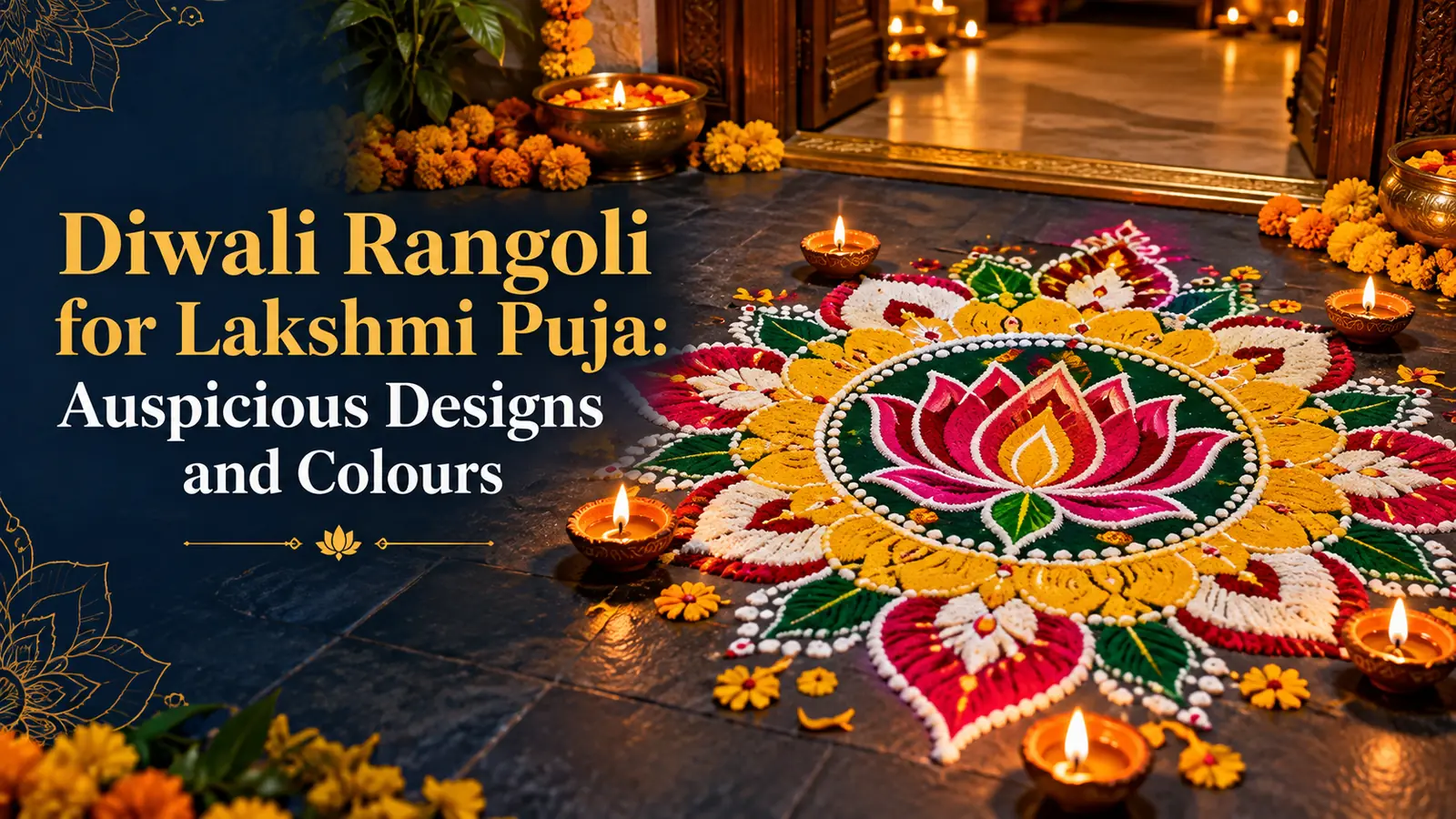
Britannica describes rangoli as intricate floor art made at doorways, in home worship spaces and for festivals using powders, flowers or chalk, and says Lakshmi’s footprints are drawn to invite the goddess of wealth. For Diwali, it notes, elaborate rangolis are combined with lit lamps. The article is credited to Charles Preston.
This guide uses Britannica for meaning and materials, Drik Panchang for regional names and HinduTone’s Dhanteras guide for the role of rangoli at the door. I did not find an authoritative source on what each colour means, so colour pairings below are our own suggestions, and designs are described in words, not copied from any gallery. Lakshmi Puja is on Sunday, 8 November 2026.
What Rangoli Means
Britannica says rangoli welcomes deities, signals auspiciousness, invites good fortune and marks purity, and that rice-flour designs also feed ants and birds. It lists occasions such as Diwali, Pongal, Makar Sankranti and Navratri. It also notes that the practice is traditionally omitted during mourning in some families.
| Region | Name (Britannica and Drik Panchang) |
|---|---|
| Maharashtra, Rajasthan, Uttar Pradesh, Karnataka | Rangoli |
| Tamil Nadu | Kolam |
| Andhra Pradesh, Telangana | Muggu |
| West Bengal | Alpana |
| Rajasthan | Mandana |
| Bihar | Aripana |
| Punjab, Haryana, Madhya Pradesh, Uttar Pradesh | Chowkpurana |
| Gujarat | Sathiya |
Auspicious Motifs
Britannica names lotuses, figures of gods, animals and plants as common subjects, Lakshmi’s footprints to invite the goddess of wealth, and the swastika and ‘om’ as symbols of auspiciousness. Southern styles often favour geometric patterns of lines and dots, usually in white. Customs vary.
| Motif | Meaning (Britannica) | Where to place it (ours) |
|---|---|---|
| Lotus | A common figurative subject | Near the puja area |
| Lakshmi’s footprints | Invite the goddess of wealth | Facing inward at the entrance |
| Swastika | Auspiciousness | Near the door |
| Om | Auspiciousness | Near the altar |
| Geometric dots and lines | Southern style, usually white | Courtyard or entrance |
| Diya | Lit lamps accompany Diwali rangoli | Around the design |
Materials and Eco-Friendly Choices
Britannica lists rice flour, coloured powders, chalk, flower petals and coloured sand, plus stencils, sieves and piping tools for shaping designs. Our suggestion is to use rice flour and petals for the least waste and the easiest cleanup.
| Material | Pros (ours) | Cautions (ours) |
|---|---|---|
| Rice flour | Natural; feeds small creatures (Britannica) | Can slip when wet |
| Flower petals | Fragrant, colourful, compostable | Wilt in hours |
| Coloured powder | Bright, easy to apply | Check it is safe and does not stain floors |
| Coloured sand | Lasts | Hard to sweep |
| Stencils | Neat lines | Look less hand-drawn |
Colour Pairings (Our Suggestions)
I found no authoritative source for colour symbolism, so these pairings are ours and focus on contrast and visibility, not meaning.
| Pairing (ours) | Effect |
|---|---|
| White base with red and yellow | Classic and clear |
| Marigold orange with green leaves | Warm and natural |
| Pink lotus with white outline | Soft and festive |
| Gold or yellow with deep blue | Bold contrast |
Placement and Safety
HinduTone’s Dhanteras method includes making a rangoli at the door and decorating the entrance before the puja. Our own safety notes: do not place diyas on dry flowers or loose powder where a cloth or sleeve could catch, leave a clear path for guests and keep the design dry if it will be walked past. For home safety habits, see our guide to smart home tech.