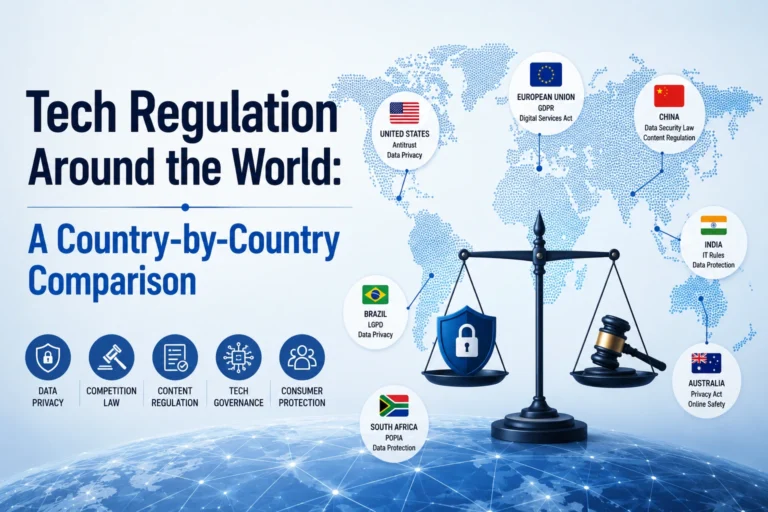

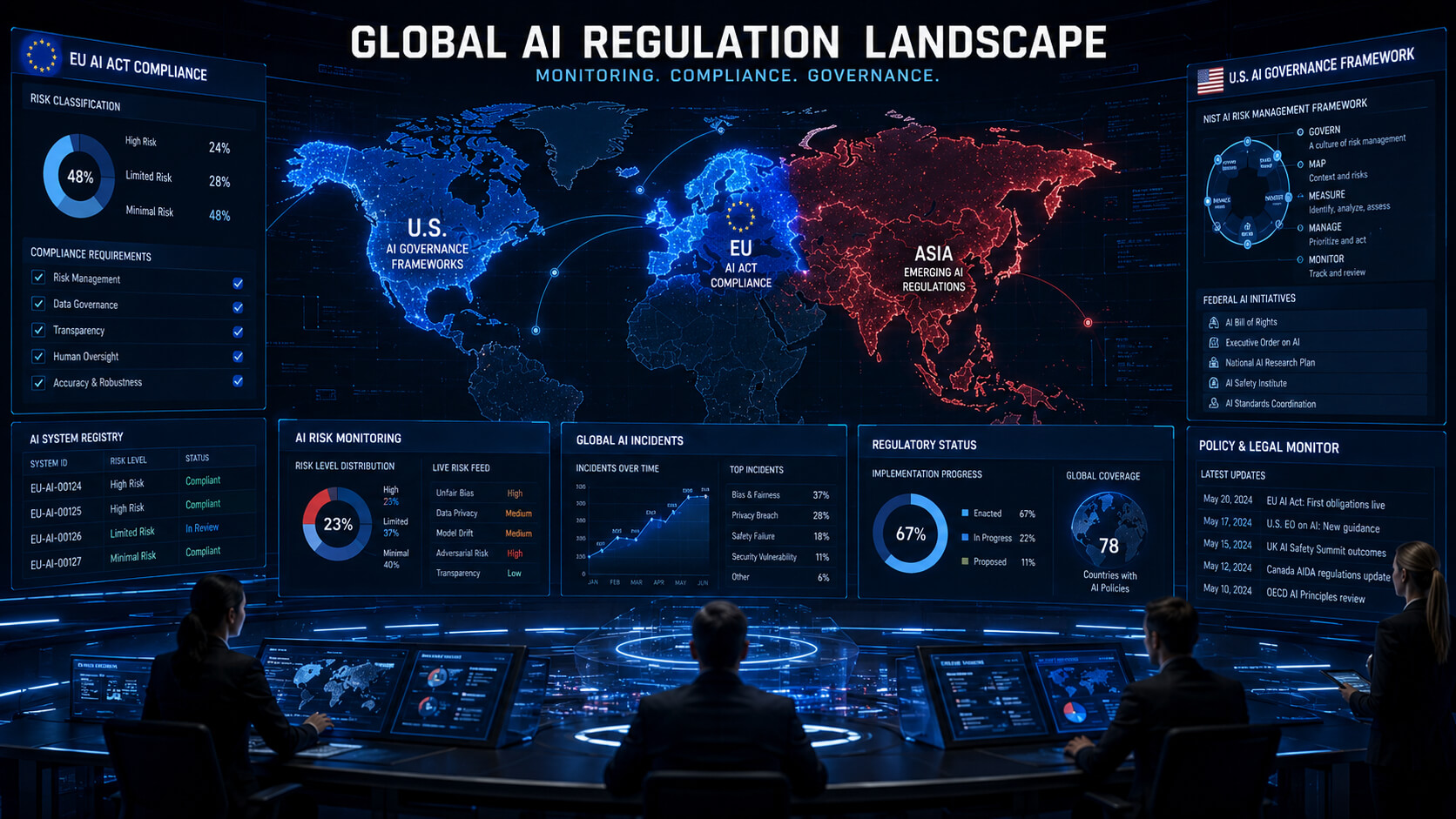
AI regulation is no longer a policy debate. It is an operational reality. The EU AI Act becomes fully applicable in August 2026. U.S. states are passing AI-specific legislation. China is actively enforcing algorithm regulations. And the global patchwork of requirements is creating compliance complexity that every technology company must address.
The companies that understand this landscape early will build compliant products faster, avoid costly penalties, and earn the trust of customers and regulators alike. Those that treat regulation as a future problem will face expensive retrofitting, enforcement actions, and competitive disadvantage.
This guide provides a practical, jurisdiction-by-jurisdiction analysis of AI regulation as it stands in 2026, with specific focus on what tech companies need to do before 2027.
The EU AI Act: The Global Standard-Setter
The EU AI Act is the most comprehensive AI law in the world. It entered into force on August 1, 2024, with phased enforcement. Full applicability arrives August 2, 2026.
The Act classifies AI systems into four risk tiers: unacceptable (banned), high-risk (strict requirements), limited risk (transparency obligations), and minimal risk (voluntary codes). Penalties reach up to 40 million euros or 7% of global annual turnover.
What is already enforceable (since February 2025)
Prohibited AI practices including social scoring, real-time biometric surveillance in public spaces, and manipulation of vulnerable groups. AI literacy requirements for all staff interacting with AI systems.
What becomes enforceable August 2026
Full high-risk AI system requirements including conformity assessments, risk management systems, data governance, transparency, human oversight, accuracy testing, and registration in the EU database. All GPAI model provider obligations.
Critical for non-EU companies
The Act applies extraterritorially. Any company whose AI system is placed on the EU market or whose output is used within the EU must comply. A U.S. SaaS company serving European customers is subject to the same obligations as an EU-headquartered company.
United States: The Patchwork Approach

The U.S. lacks a comprehensive federal AI law comparable to the EU AI Act. Instead, AI governance operates through a combination of executive orders, agency guidance, and state legislation.
Federal Level
Executive Order on AI Safety (October 2023)
Established reporting requirements for large AI model developers, safety testing mandates for dual-use foundation models, and standards development through NIST.
NIST AI Risk Management Framework
A voluntary but widely adopted governance framework organizing AI risk management around four functions: Govern, Map, Measure, and Manage. Increasingly referenced in federal procurement requirements.
Agency enforcement
The FTC enforces against deceptive AI practices under existing consumer protection authority. The CFPB applies fair lending standards to AI credit decisions. The EEOC addresses AI in hiring discrimination. No new legislation required, because existing laws apply to AI applications.
State Level
Colorado AI Act
Requires developers and deployers of high-risk AI systems to use reasonable care to prevent algorithmic discrimination. Effective February 2026, it is the most comprehensive state AI law.
Illinois AI Video Interview Act
Requires notice and consent when AI analyzes video interviews for hiring decisions. One of the earliest AI-specific employment laws.
California and New York
Both states have proposed comprehensive AI legislation. California’s proposals focus on algorithmic accountability and AI safety. New York’s focus on automated employment decision tools.
The state-level trend is clear: absent federal action, states are building their own AI regulatory frameworks. Companies operating nationally must track and comply with an increasing number of state-specific requirements.
United Kingdom: Pro-Innovation, Sector-Specific
The UK has adopted a deliberately different approach from the EU. Rather than comprehensive legislation, the UK relies on existing sector regulators (FCA for finance, Ofcom for communications, ICO for data protection) to apply AI-specific guidance within their existing mandates.
The UK’s AI Safety Institute conducts safety evaluations of frontier AI models and publishes guidance for developers. The approach prioritizes innovation-friendliness while maintaining safety standards through existing regulatory infrastructure.
For companies operating in both the UK and EU: the regulatory gap between the two jurisdictions is widening. Compliance with the EU AI Act does not automatically satisfy UK requirements, and vice versa.
China: Algorithm-Specific, Content-Focused
China has taken the most targeted approach, regulating specific AI applications rather than AI as a category.
Algorithm Recommendation Regulation (2022)
Requires algorithm transparency, user opt-out mechanisms, and prohibits addictive design patterns.
Deep Synthesis (Deepfake) Regulation (2023)
Mandates watermarking of AI-generated content, consent requirements for synthetic media, and platform responsibility for deepfake distribution.
Generative AI Regulation (2023)
Requires government approval before launching generative AI services, content safety reviews, and training data compliance with Chinese law.
China’s enforcement is active and swift. Companies operating in or serving the Chinese market face the most stringent content-related AI requirements globally.
Other Key Jurisdictions
| Jurisdiction | Approach | Key Requirements | Status in 2026 |
|---|---|---|---|
| Canada | AIDA (proposed legislation) | Risk-based, similar to EU approach | Pending parliamentary approval |
| Brazil | AI regulatory framework | Risk classification, transparency, accountability | Legislation advancing through Congress |
| Singapore | AI Verify + Model Framework | Self-assessment, industry-led governance | Voluntary adoption expanding |
| Japan | Social Principles of Human-Centric AI | Principles-based, non-binding guidance | Industry self-regulation |
| India | Emerging framework | Focus on responsible AI development | Advisory guidelines; legislation in development |
| Australia | Voluntary AI Ethics Framework | 8 AI ethics principles, sector guidance | Mandatory measures under consideration |
Practical Compliance Roadmap for Tech Companies
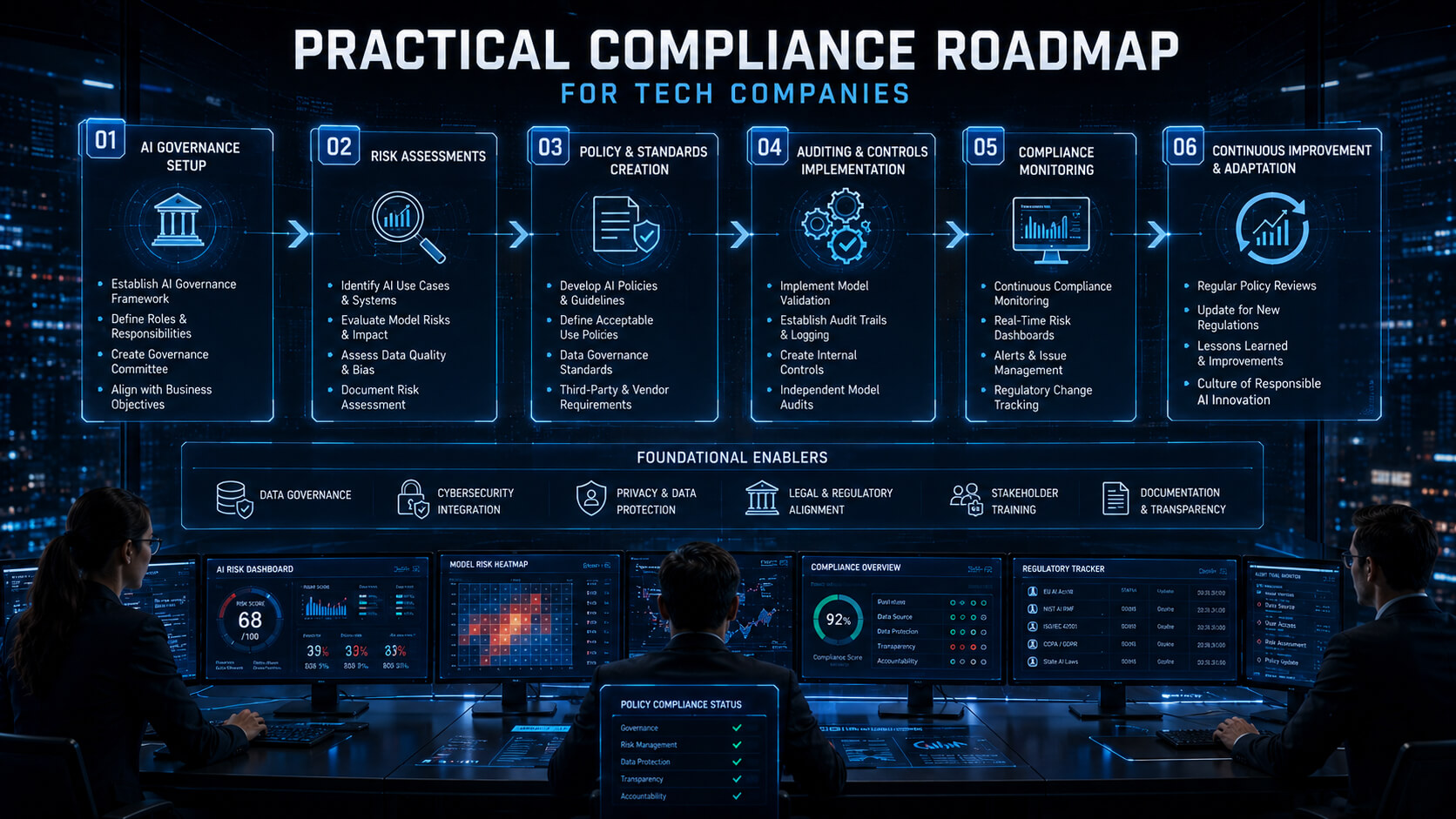
Step 1: Map Your AI Systems (Now)
Create a comprehensive inventory of every AI system your company develops, deploys, or procures. For each system, document: what it does, what data it processes, who it affects, which jurisdictions it operates in, and what risk classification it falls under in each applicable regulatory framework.
Step 2: Classify Risk Under EU AI Act (By Q3 2026)
For each AI system that touches the EU market, determine its risk tier. High-risk systems require conformity assessments, risk management documentation, data governance protocols, transparency measures, and human oversight mechanisms. Start this process immediately if you have not already.
Step 3: Build Cross-Functional Governance (By Q4 2026)
Establish an AI governance committee with representation from legal, engineering, product, compliance, and ethics. Draft and adopt governance policies covering acceptable AI use, risk assessment methodology, incident response, and regulatory reporting.
Step 4: Implement Technical Controls (By Q1 2027)
Deploy bias testing, accuracy monitoring, and transparency mechanisms for all high-risk AI systems. Build or adopt automated testing pipelines that run continuously. Implement human-in-the-loop mechanisms for consequential AI decisions.
Step 5: Prepare for Ongoing Compliance (Continuous)
AI regulation is evolving rapidly. Monitor regulatory developments across all jurisdictions where you operate. Participate in industry consultations. Build governance infrastructure that is flexible enough to adapt to new requirements without fundamental restructuring.
Expert Tips for Regulatory Compliance
1. Design for the strictest jurisdiction
If you serve EU customers, build to EU AI Act standards even for products deployed elsewhere. Designing for the highest regulatory bar simplifies compliance across all jurisdictions.
2. Invest in AI literacy across your organization
The EU AI Act requires AI literacy for all personnel interacting with AI systems. This is not a one-time training exercise. It is an ongoing competency requirement that affects hiring, onboarding, and professional development.
3. Documentation is not optional. It is enforceable
High-risk AI systems under the EU AI Act require extensive technical documentation, risk assessments, and conformity records. Build documentation processes into your development lifecycle now. Retroactive documentation is always more expensive and less reliable.
4. Engage with regulators proactively
EU member states are establishing AI regulatory sandboxes. The NIST provides regular opportunities for industry input. Proactive engagement shapes regulation in your favor and demonstrates good faith that regulators value.
5. Plan for regulatory convergence
The EU AI Act is influencing regulatory design globally. Canada, Brazil, and other jurisdictions are developing similar frameworks. Building EU-compliant systems now positions you for emerging regulations elsewhere.
Common Regulatory Compliance Mistakes
Assuming U.S. companies are exempt from the EU AI Act
Extraterritorial application means any company whose AI output reaches EU users must comply. Geographic distance does not equal regulatory distance.
Treating compliance as a one-time project
AI regulation is evolving continuously. Compliance requires ongoing monitoring, testing, and adaptation. Annual audits are the minimum, not the maximum.
Under-scoping the definition of “AI system”
Many companies discover they have more AI systems than expected. Automated decision tools, ML-powered features in third-party software, and algorithmic recommendation engines all potentially fall under AI regulations.
Ignoring state-level U.S. requirements
Companies focused on federal regulation miss the growing body of state AI laws. Colorado, Illinois, and emerging legislation in California and New York create specific compliance obligations.
Frequently Asked Questions
How will AI regulation affect tech companies in 2026?
The most immediate impact comes from the EU AI Act’s full enforcement in August 2026. Companies deploying high-risk AI systems must complete conformity assessments, implement risk management systems, ensure transparency and human oversight, and register in the EU database. Non-compliance carries fines up to 7% of global turnover. In the U.S., state-level AI laws (particularly Colorado’s) create additional compliance requirements. Companies must budget for governance infrastructure, compliance personnel, and ongoing monitoring.
Does my company need to comply with the EU AI Act?
If your AI system is used by anyone in the EU, or if its output affects EU residents, yes. The Act applies regardless of where your company is headquartered. This mirrors GDPR’s extraterritorial approach. If you sell software, provide SaaS services, or deploy AI features that reach EU users, you should assess your obligations under the Act.
What are the penalties for non-compliance with AI regulations?
Under the EU AI Act: up to 40 million euros or 7% of global annual turnover for prohibited practices, up to 20 million euros or 4% for high-risk system violations, and up to 10 million euros or 1% for providing incorrect information. In the U.S., FTC enforcement actions can result in significant fines and mandatory compliance programs. State-level penalties vary but are generally lower than EU levels.
Your Next Step
AI regulation is happening now, across multiple jurisdictions, with real enforcement and real penalties. The window for voluntary preparation is closing.
Start with your AI system inventory. Know what you have, where it operates, and who it affects. Then classify your highest-risk systems under the EU AI Act framework. Those two exercises will reveal your compliance gaps and prioritize your actions.
The companies that invest in regulatory compliance now will deploy AI with confidence, earn stakeholder trust, and avoid the costly penalties and reputation damage that catch unprepared organizations off guard.