
Moneyball proved that data could outsmart talent budgets. Two decades later, AI is making Moneyball look like a calculator compared to a supercomputer.
Every major sports league now uses AI-powered analytics. The NBA tracks every player movement 25 times per second using optical cameras. Formula 1 teams process 1.5 terabytes of data per race weekend. Premier League clubs deploy computer vision to analyze training sessions in real time. And the insights extracted from this data are changing how teams draft, train, strategize, and engage fans.
This is not analytics as a supplementary tool. It is analytics as a competitive requirement. Teams that ignore AI-powered analysis are competing with one hand tied behind their back.
How AI Is Transforming Player Performance
Biomechanical Analysis and Injury Prevention
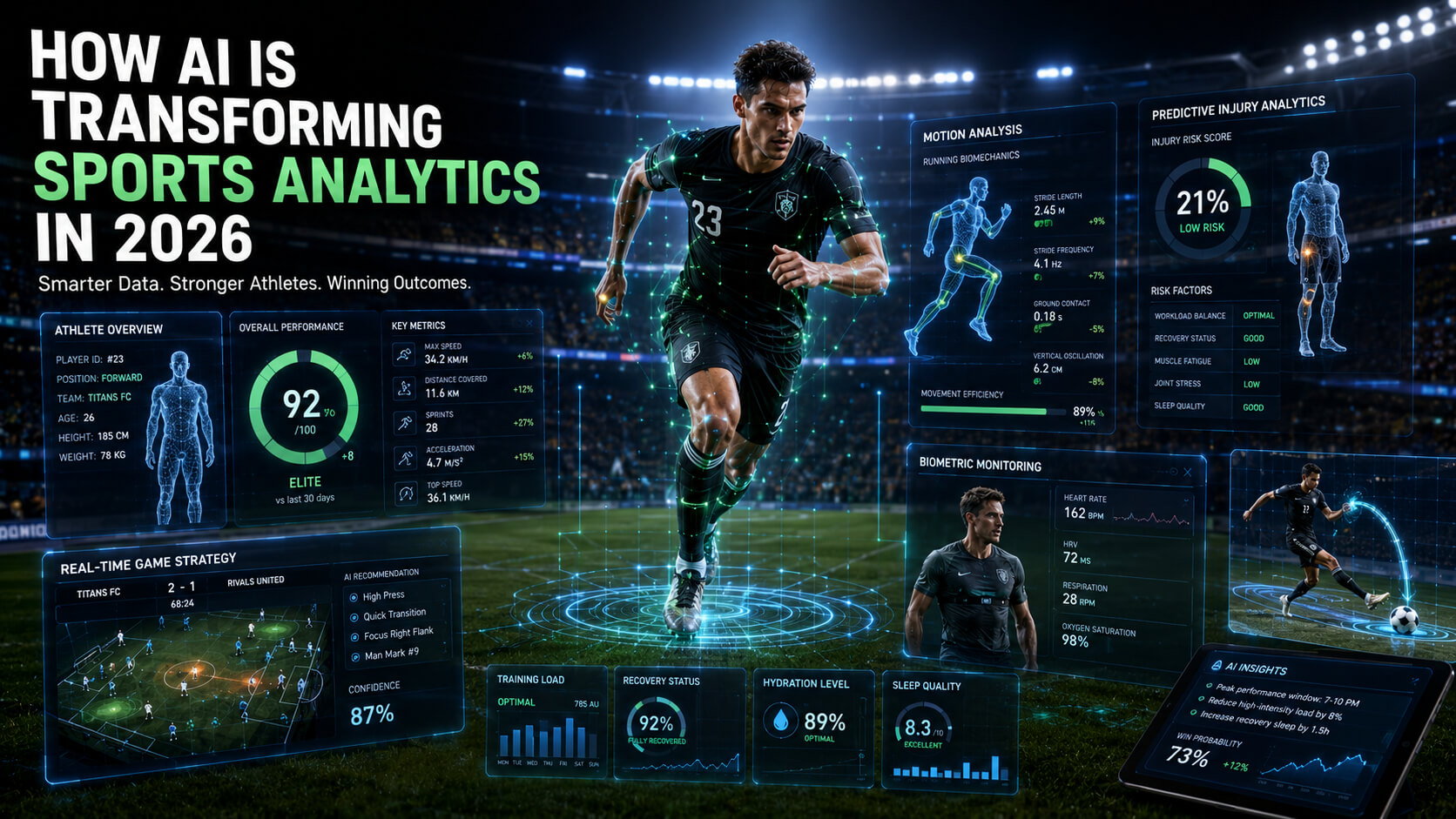
AI-powered motion capture and biomechanical analysis systems track joint angles, force distribution, stride patterns, and movement asymmetries during training and competition. The data feeds predictive models that identify injury risk before symptoms appear.
In baseball, AI systems analyze pitching mechanics to detect the arm stress patterns that precede UCL tears (the injury requiring Tommy John surgery). The model flags pitchers whose mechanics are drifting into high-risk patterns weeks before an injury would occur. Teams that act on these predictions reduce pitching injuries significantly.
In soccer, wearable GPS and accelerometer data combined with AI analysis tracks cumulative fatigue across a season. The system recommends rest days, reduced training loads, and substitution timing based on individual physiological models. Liverpool FC and Manchester City have been early adopters, crediting AI-driven load management with reduced muscle injuries.
Personalized Training Programs
AI creates individualized training plans based on performance data, recovery status, and competitive schedule. Instead of one-size-fits-all team programs, each athlete receives a customized regimen optimized for their physiology and role.
NBA teams use AI to customize shooting programs based on individual shot mechanics. The system analyzes release point, arc angle, and body position for each player, then generates drills that target their specific weaknesses. A player who misses pull-up jumpers at high rates receives different training than one who struggles with corner threes, even if their overall shooting percentages are similar.
Real-Time Performance Feedback
Wearable sensors and on-court tracking systems now deliver AI-analyzed feedback during practice sessions. A sprinter receives real-time data on acceleration phases and stride efficiency. A tennis player gets immediate analysis of serve speed, spin rate, and placement accuracy after every point.
This immediate feedback loop accelerates skill development. Instead of reviewing video hours after practice, athletes adjust in real time based on quantified performance data.
How AI Is Revolutionizing Scouting and Recruitment
Computer Vision for Talent Identification
AI-powered video analysis can evaluate player performance from standard broadcast footage, without requiring expensive camera installations. Scouts upload game film, and computer vision algorithms extract player tracking data, tactical positioning, and performance metrics automatically.
This is especially transformative for lower-league and international scouting, where traditional camera tracking systems are not installed. A Premier League club can now analyze a player from a Brazilian second division match using nothing more than the broadcast video. The AI extracts the same quality of positional and performance data that previously required dedicated tracking infrastructure.
Predictive Performance Modeling
AI models project how young players will develop over 3 to 5 years based on their current performance trajectory, physical development data, and comparison with historical player archetypes.
In baseball, teams use AI models that predict how a minor league prospect’s hit tool, power, and plate discipline will translate to the major leagues. The models account for ballpark factors, pitcher quality, and developmental curves that scouts historically evaluated through subjective judgment.
In soccer, clubs model how a 19-year-old midfielder’s passing range, positioning intelligence, and physical maturation compare with successful players at the same developmental stage. These projections inform transfer valuations and contract decisions worth millions.
Draft and Transfer Optimization
AI helps teams optimize their draft picks and transfer spending by modeling the expected value of each acquisition. The system calculates the probability that a player will meet performance benchmarks, adjusts for contract cost and opportunity cost, and ranks options by expected return on investment.
NBA teams with advanced analytics departments consistently outperform their draft position expectations. They select players whose AI-identified skills (off-ball movement, defensive versatility, shot creation) are undervalued by traditional scouting methods.
How AI Is Changing Game Strategy

Tactical Analysis and Opponent Modeling
AI systems analyze opponent tendencies across hundreds of games, identifying patterns that human coaches would need weeks to extract manually.
In basketball, defensive coverage models predict which offensive sets will exploit an opponent’s weak-side rotations. In soccer, pressing trigger analysis identifies when and where opponents are most vulnerable to ball recovery. In football, route-combination analysis reveals which defensive coverages are most susceptible to specific receiver groupings.
The coaching staff receives this analysis as visual playbooks: animated diagrams showing the highest-probability scoring opportunities against the upcoming opponent.
In-Game Decision Support
Real-time AI analysis is entering the sideline. Systems provide coaches with probability-weighted recommendations during games: when to call timeouts, which substitution patterns maximize win probability, whether to go for it on fourth down, and which play calls have the highest expected value given the current game state.
The most sophisticated systems in the NFL and NBA update these recommendations continuously, adjusting for fatigue levels, foul trouble, pitch count, and game flow.
AI and the Fan Experience
Personalized Content and Highlights
AI-powered highlight generation creates personalized content packages for fans. Instead of watching generic highlights, a fan whose favorite player is Luka Doncic receives a Doncic-focused highlight reel after every game, complete with AI-generated commentary and statistical context.
The NBA, NHL, and Formula 1 have all deployed AI-generated highlight systems that produce thousands of personalized video clips per game, distributed through apps and social media.
Enhanced Broadcast Analytics
AI overlays during broadcasts now provide real-time analytics that enrich the viewing experience. Shot probability in basketball (“that shot had a 34% chance of going in”), expected goals in soccer, win probability graphs, and speed/acceleration data in racing are all generated by AI models and displayed live.
Amazon’s Thursday Night Football broadcasts pioneered AI-enhanced viewing with real-time player speed tracking, defensive coverage visualizations, and next-play predictions. These features are becoming standard across major sports broadcasts.
Predictive Engagement and Betting Integration
Sports betting platforms use AI to generate live odds, prop bets, and micro-betting opportunities in real time. AI models process game data and generate thousands of betting markets per game, updating probabilities every few seconds.
For fans, AI-powered engagement features (prediction games, fantasy sports optimization, interactive second-screen experiences) are transforming passive viewing into active participation.
AI Applications Across Major Sports
| Sport | Top AI Application | Data Source | Impact |
|---|---|---|---|
| NBA | Player tracking, shot analytics, lineup optimization | Second Spectrum optical tracking (25 fps) | Every team has analytics department |
| Soccer/Football | Tactical analysis, injury prediction, scouting | Opta, StatsBomb, wearable GPS | Transfer market valuations transformed |
| Baseball/MLB | Pitch design, defensive shifts, prospect modeling | Statcast (radar + camera tracking) | Pitching strategy revolution |
| NFL | Route analysis, injury risk, draft modeling | Next Gen Stats (RFID tracking) | Fourth-down decision making overhauled |
| Formula 1 | Tire strategy, race simulation, car setup | 300+ sensors per car, 1.5TB per weekend | Pit stop timing optimized to milliseconds |
| Tennis | Serve analysis, opponent modeling, coaching | Hawk-Eye, IMU wearables | Real-time tactical adjustments |
Expert Tips for Understanding AI in Sports
1. AI informs decisions but does not make them
The best teams use AI as a decision-support tool, not a decision-making authority. Coaches and GMs who combine AI insights with experience and intuition outperform those who rely solely on either.
2. Data quality matters more than data volume
A team with clean, well-structured data from 50 games outperforms a team with messy data from 500 games. Invest in data infrastructure before investing in AI models.
3. The human element remains irreplaceable
AI cannot measure leadership, locker room chemistry, mental toughness under pressure, or a player’s ability to perform in hostile road environments. These intangibles remain the domain of experienced scouts and coaches.
4. Democratization is changing competitive balance
As AI tools become more affordable and accessible, smaller-market teams can compete with larger organizations analytically. The competitive advantage shifts from having AI to using AI better.
5. Ethical considerations are emerging
Player surveillance through wearables, genetic data analysis, and AI-driven career projections raise privacy and consent questions that the sports industry is only beginning to address.
Frequently Asked Questions
How is AI used in sports analytics?
AI is used across four major domains: player performance optimization (biomechanical analysis, injury prediction, personalized training), scouting and recruitment (computer vision talent identification, predictive performance modeling, draft optimization), game strategy (tactical analysis, opponent modeling, real-time decision support), and fan experience (personalized highlights, enhanced broadcasts, betting integration). Every major professional sports league uses AI analytics.
Which sports use AI the most?
Basketball (NBA) and baseball (MLB) lead in analytical adoption, with every team maintaining dedicated analytics departments. Soccer is the fastest-growing adopter, with AI-powered scouting transforming the global transfer market. Formula 1 is the most data-intensive sport, processing 1.5 terabytes per race weekend. The NFL has rapidly expanded AI usage for injury prediction and draft analysis.
Can AI predict game outcomes?
AI models predict game outcomes with roughly 60% to 70% accuracy for major sports, better than random chance but far from certain. The models account for team strength, home advantage, rest patterns, injuries, and historical matchup data. Sports betting markets incorporate these predictions, but the inherent uncertainty of athletic competition limits prediction accuracy for any single game.
Your Next Step
AI in sports analytics is no longer a competitive edge reserved for wealthy franchises. The tools are becoming accessible, the data is becoming available, and the insights are becoming standard operating procedure at every level of competition.
Whether you are a sports professional, an analyst, a fan, or a business building sports technology, understanding how AI transforms athletic competition is essential. The teams and companies that leverage these capabilities most effectively will define the next era of sports.
Start by exploring the publicly available data in your sport of interest. MLB’s Statcast data, NBA’s tracking stats, and soccer’s open data initiatives provide enough raw material to understand what AI-powered analysis can reveal.
Want to grow your sports, AI, or technology brand online? Publish high-authority guest posts through WritoryBuzz and improve your SEO, digital visibility, and industry credibility with strategic placements on trusted business and technology websites.