
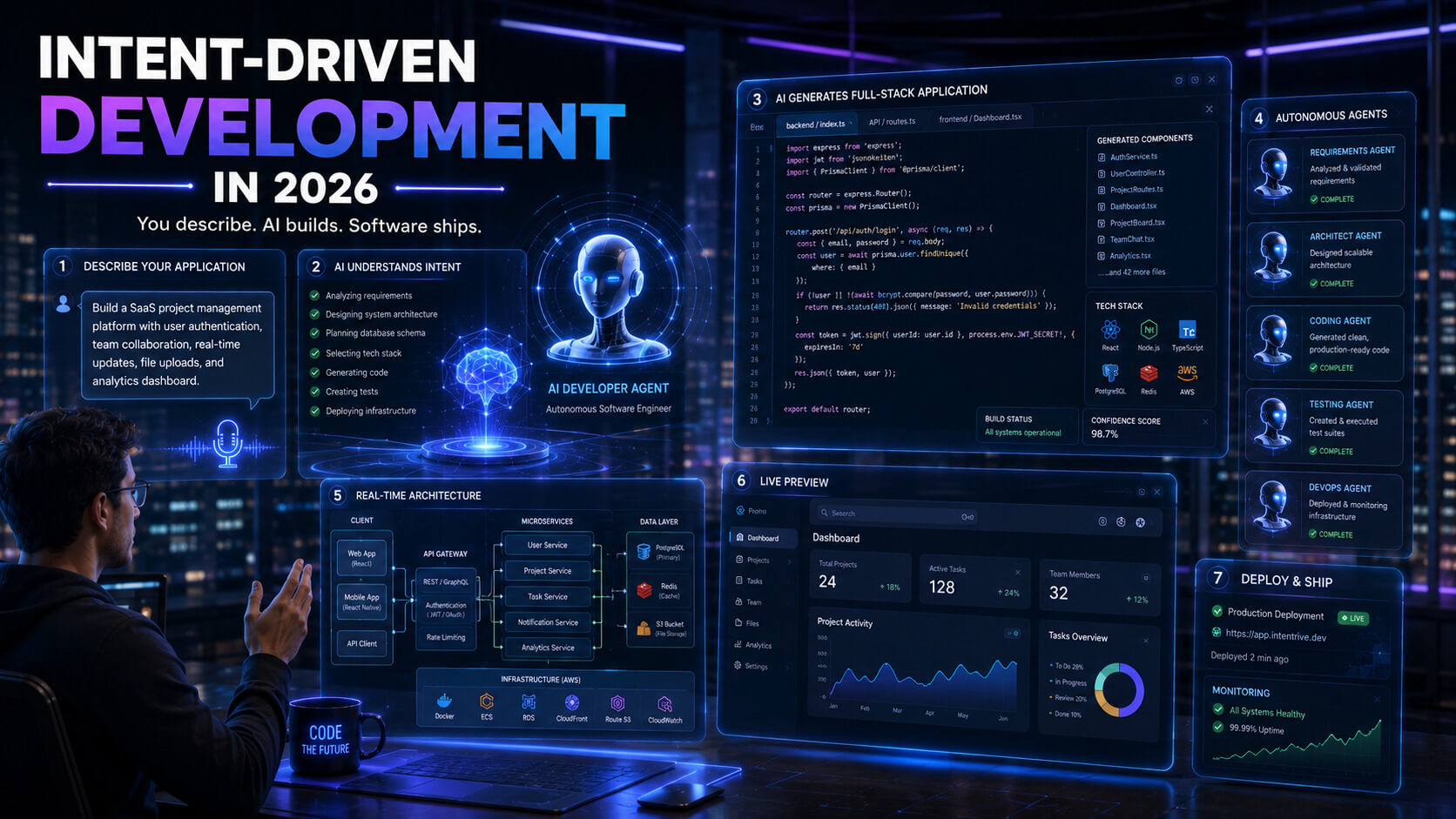
For sixty years, software development has followed the same basic pattern: a human translates a business requirement into code, line by line, file by file, function by function. The languages have changed. The tools have improved. But the core workflow has remained the same: human intent goes in, human-written code comes out.
Intent-driven development breaks that pattern. Instead of writing code that implements a requirement, developers describe what they want the software to do, and AI systems generate the implementation. The developer expresses intent. The AI handles execution.
This is not autocomplete on steroids. It is a fundamentally different relationship between humans and software creation. And in 2026, it is moving from research concept to production reality.
What Is Intent-Driven Development?
Intent-driven development (IDD) is a software development paradigm where developers specify desired outcomes in natural language or high-level abstractions, and AI systems generate the code, tests, infrastructure, and deployment configurations needed to achieve those outcomes.
In traditional development, the developer is both architect and builder. In intent-driven development, the developer is the architect. The AI is the builder.
The distinction is critical. IDD does not remove the developer from the process. It removes the mechanical translation step between “I know what this should do” and “Here is the code that does it.”
How IDD Differs from Previous Approaches
| Approach | Developer Role | AI Role | Output Quality |
|---|---|---|---|
| Traditional Coding | Writes every line of code | None | Depends on developer skill |
| Autocomplete (Copilot-era) | Writes code with suggestions | Predicts next line or block | Faster traditional coding |
| Agentic Coding (2025) | Directs multi-file tasks | Executes complex coding tasks | Good for defined tasks |
| Intent-Driven Dev (2026) | Describes desired outcomes | Generates full implementations | Approaching human parity for standard patterns |
The progression is clear. Each generation shifts more of the mechanical execution to AI while keeping the strategic decisions with humans.
The Five Principles of Intent-Driven Development
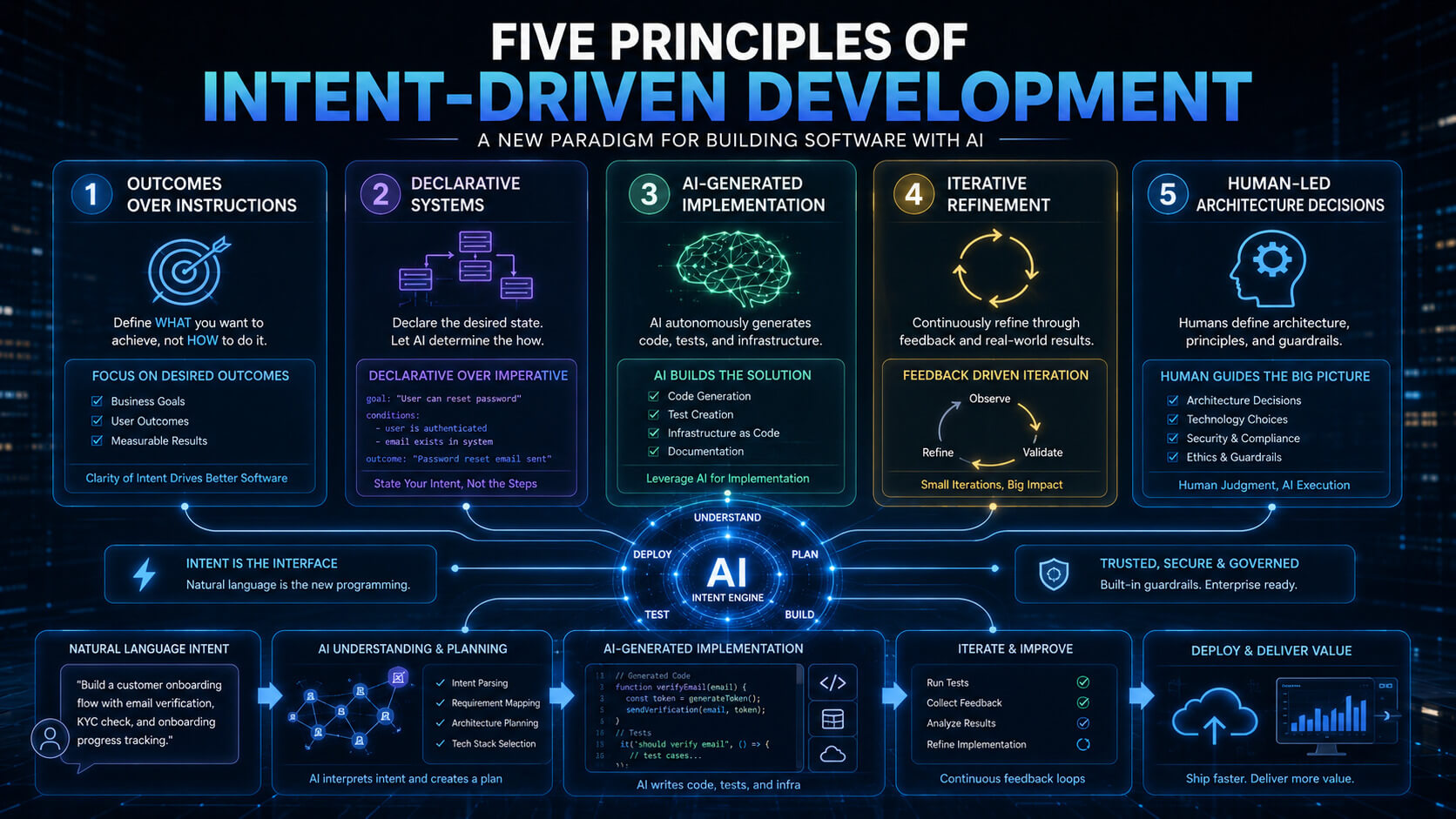
1. Outcomes Over Instructions
In traditional development, you tell the computer how to do something. In IDD, you tell it what to accomplish. The AI determines the how.
Instead of writing a sorting algorithm, you specify: “Sort this list by relevance score, with ties broken by recency.” Instead of building a database migration, you specify: “Add a user preferences table that supports versioned settings per user.”
The shift from instruction to outcome is the defining characteristic of IDD.
2. Declarative Specifications Replace Imperative Code
IDD leans heavily on declarative approaches. Developers describe the desired state of the system, not the step-by-step procedure to reach it.
This is not entirely new. Infrastructure-as-code tools like Terraform already work declaratively. IDD extends this principle to application logic, UI components, data transformations, and business rules.
3. Tests as First-Class Intent Expressions
In IDD workflows, tests are not an afterthought. They are the primary way developers express intent. Write the tests that define correct behavior, and the AI generates the implementation that passes them.
This inverts the traditional test-driven development (TDD) cycle. In TDD, the developer writes the test and then writes the code. In IDD, the developer writes the test and the AI writes the code. The developer’s job is to ensure the tests capture the right requirements.
4. Iterative Refinement Over One-Shot Generation
IDD is not “describe it once and get perfect code.” It is an iterative conversation. The developer describes intent, reviews the AI’s implementation, provides feedback (“this handles the happy path but misses the error case where the API returns a 429”), and the AI refines.
Each iteration gets closer to the desired outcome. The developer’s skill lies in evaluating output quality and providing precise feedback, not in writing the code themselves.
5. Architecture Remains a Human Responsibility
IDD automates implementation. It does not automate design decisions. Choosing between a monolithic and microservices architecture, selecting database technology, designing API contracts, and managing technical debt remain firmly in the developer’s domain.
The AI can suggest architectural patterns. But the decision to adopt, reject, or modify those patterns requires business context, organizational knowledge, and strategic judgment that AI does not possess.
IDD in Practice: What the Workflow Looks Like
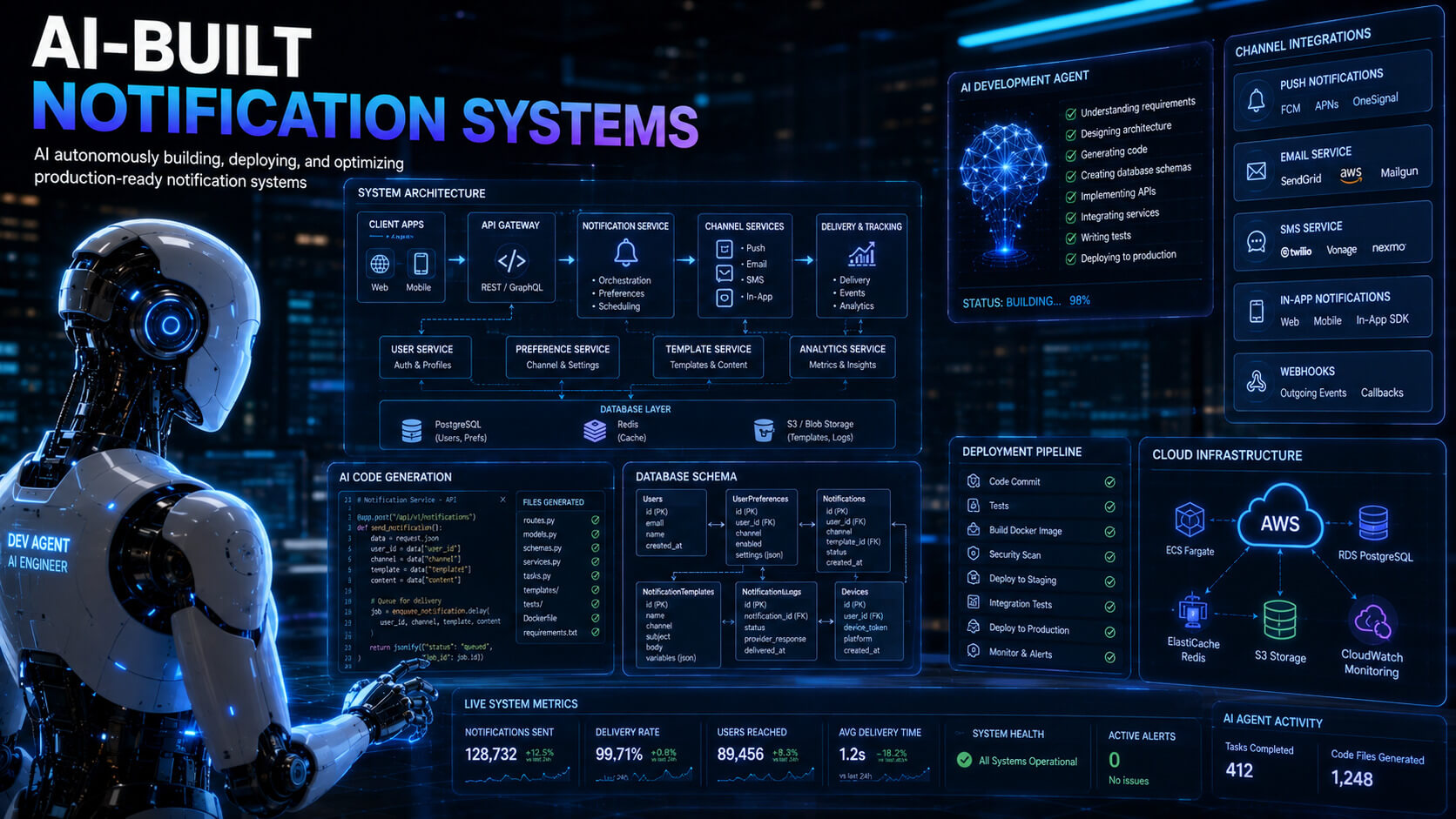
Scenario: Building a User Notification System
Traditional approach: The developer researches notification patterns, designs the database schema, writes the notification service, builds the API endpoints, creates the email and push notification integrations, writes tests, and deploys. Estimated time: 2 to 3 days for an experienced developer.
IDD approach: The developer describes the intent: “Build a notification system that supports email, push, and in-app notifications. Users can set preferences for notification types and frequency. Notifications should be queued and processed asynchronously. Include retry logic for failed deliveries.” The AI generates the full implementation: database schema, service code, API endpoints, integration code, tests, and deployment configuration. The developer reviews, provides feedback on edge cases, and the AI refines. Estimated time: 2 to 4 hours.
The time savings are real, but the quality depends entirely on the developer’s ability to specify intent precisely and evaluate the output critically.
Tools Enabling Intent-Driven Development in 2026
Claude Code
Anthropic’s terminal-native agent is the closest to a pure IDD tool in production today. Its 1-million-token context window allows it to understand entire codebases, and its agentic capabilities handle multi-file implementations from natural language specifications.
Cursor Composer
Cursor’s multi-file editing mode lets developers describe changes in natural language and see the resulting diff across all affected files. The visual confirmation loop supports the iterative refinement principle of IDD.
Devin
Cognition’s autonomous agent takes IDD to its logical extreme: fully autonomous implementation from task descriptions. The tradeoff is reduced developer oversight during the execution phase.
Vercel v0
For frontend development, v0 generates React components from text descriptions. Developers describe the desired UI and behavior, and v0 produces working components with styling.
GitHub Copilot Workspace
GitHub’s approach to IDD starts with an issue description, generates a plan, and implements the solution. The developer reviews and approves at each stage.
Where IDD Works Well (and Where It Does Not)
IDD Excels At
Standard CRUD applications
The majority of business software follows established patterns: create records, read data, update fields, delete entries. IDD handles these patterns with high accuracy because they are well-represented in training data.
API integrations
Connecting to third-party services (payment processors, email providers, analytics platforms) follows documented patterns. IDD generates integration code from API documentation references.
UI component generation
Describing a user interface and getting a working component is one of the most mature IDD use cases, especially for React, Vue, and standard web frameworks.
Data transformation pipelines
ETL processes, data cleaning scripts, and format conversions are highly amenable to intent-based specification.
IDD Struggles With
Novel algorithms
When the problem requires a genuinely new algorithmic approach (not a variation of known patterns), IDD tools generate plausible but often incorrect solutions.
Performance-critical code
AI-generated code is functionally correct more often than it is performant. For systems where latency or throughput matters at the microsecond level, human optimization is still required.
Complex state management
Applications with intricate state machines, distributed consensus requirements, or complex concurrency patterns often produce subtle bugs when generated by AI.
Legacy system integration
Connecting to old, poorly documented systems requires contextual knowledge that AI tools often lack. The intent is easy to express. The implementation details are buried in tribal knowledge.
The Impact on Software Teams
IDD does not shrink engineering teams. It changes what they do.
Senior developers become architects and reviewers
Their primary output shifts from code to specifications, architecture decisions, and quality evaluation. The most valuable senior developers in an IDD world are those who can express precise intent and catch subtle errors in AI output.
Junior developers need stronger fundamentals
Paradoxically, IDD raises the bar for entry-level developers. Understanding what the AI generates, evaluating its correctness, and debugging its mistakes requires deeper knowledge than following tutorials.
Product and engineering alignment tightens
When implementation speed is no longer the bottleneck, the bottleneck shifts to requirement clarity. Teams that invest in precise specification of business requirements get dramatically better AI output.
Quality assurance becomes more critical
Faster code generation means more code to review. Testing, security auditing, and performance verification become proportionally more important as the volume of AI-generated code increases.
Expert Tips for Adopting Intent-Driven Development
1. Start with well-defined, repeatable tasks
IDD works best when the intent is clear and the pattern is established. API endpoints, database migrations, and UI components are ideal starting points. Save novel architecture work for human developers.
2. Invest in specification quality
The quality of AI output directly correlates with the quality of your intent specification. Vague descriptions produce vague code. Precise specifications (including edge cases, error handling requirements, and performance constraints) produce dramatically better results.
3. Use tests as your primary intent mechanism
Writing comprehensive tests before engaging AI tools is the most reliable way to express intent. The tests serve as both specification and validation in a single artifact.
4. Review AI output with the same rigor as human code
Code review discipline must increase, not decrease, in an IDD workflow. AI-generated code can contain subtle bugs, security vulnerabilities, and architectural misalignments that pass superficial review.
5. Track AI-generated code separately
Know which parts of your codebase were AI-generated. This helps you prioritize review effort, identify patterns in AI errors, and make informed decisions about where to use IDD and where to write code manually.
Common Mistakes with Intent-Driven Development
Treating IDD as “no-code” for developers
IDD requires deep technical knowledge to specify intent correctly, evaluate output, and debug problems. It is not a shortcut around learning software engineering.
Under-specifying edge cases
AI tools handle happy paths well. Edge cases, error conditions, and unusual inputs require explicit specification. If you do not mention it, the AI will not handle it.
Skipping architecture for speed
The speed of IDD makes it tempting to skip design phases and jump straight to implementation. This produces fragmented, inconsistent codebases that become unmaintainable.
Over-relying on a single AI tool
Different IDD tools have different strengths. Using one tool for everything produces suboptimal results. Match the tool to the task type.
Frequently Asked Questions
What is intent-driven software development?
Intent-driven development is a software development paradigm where developers describe desired outcomes in natural language or high-level specifications, and AI systems generate the implementation code. The developer focuses on what the software should accomplish, while AI handles how to implement it. This differs from traditional development (humans write all code) and AI-assisted development (AI suggests code that humans accept or reject).
Will intent-driven development replace traditional coding?
IDD will replace traditional coding for standard patterns (CRUD operations, API integrations, UI components, data transformations) where the intent is clear and the patterns are well-established. It will not replace traditional coding for novel algorithms, performance-critical systems, complex state management, or architectural design. Most teams in 2026 use a hybrid approach: IDD for routine implementation and traditional coding for complex, novel challenges.
What skills do developers need for intent-driven development?
The most important skills are precise specification writing (expressing intent clearly), architecture and system design (making the decisions AI cannot), code review and quality evaluation (verifying AI output), testing strategy (using tests as intent expressions), and debugging AI-generated code. These skills require deeper software engineering knowledge than traditional coding, not less.
Your Next Step
Intent-driven development is not coming. It is here. The tools are production-ready. The workflows are proven. The question is not whether IDD will change how software is built, but how quickly your team adapts.
Start with a small experiment. Take a well-defined feature from your backlog. Write the tests that define its correct behavior. Then describe the intent to an AI coding tool and evaluate the output. That single experiment will teach you more about IDD’s potential and limitations than any article can.
The developers who master intent-driven development will build software faster, with fewer bugs, and with more time for the creative, strategic work that makes great software great.
Want to grow your AI, developer tools, or technology brand online? Publish high-authority guest posts through WritoryBuzz and improve your SEO, digital visibility, and industry credibility with strategic placements on trusted business and technology websites.