
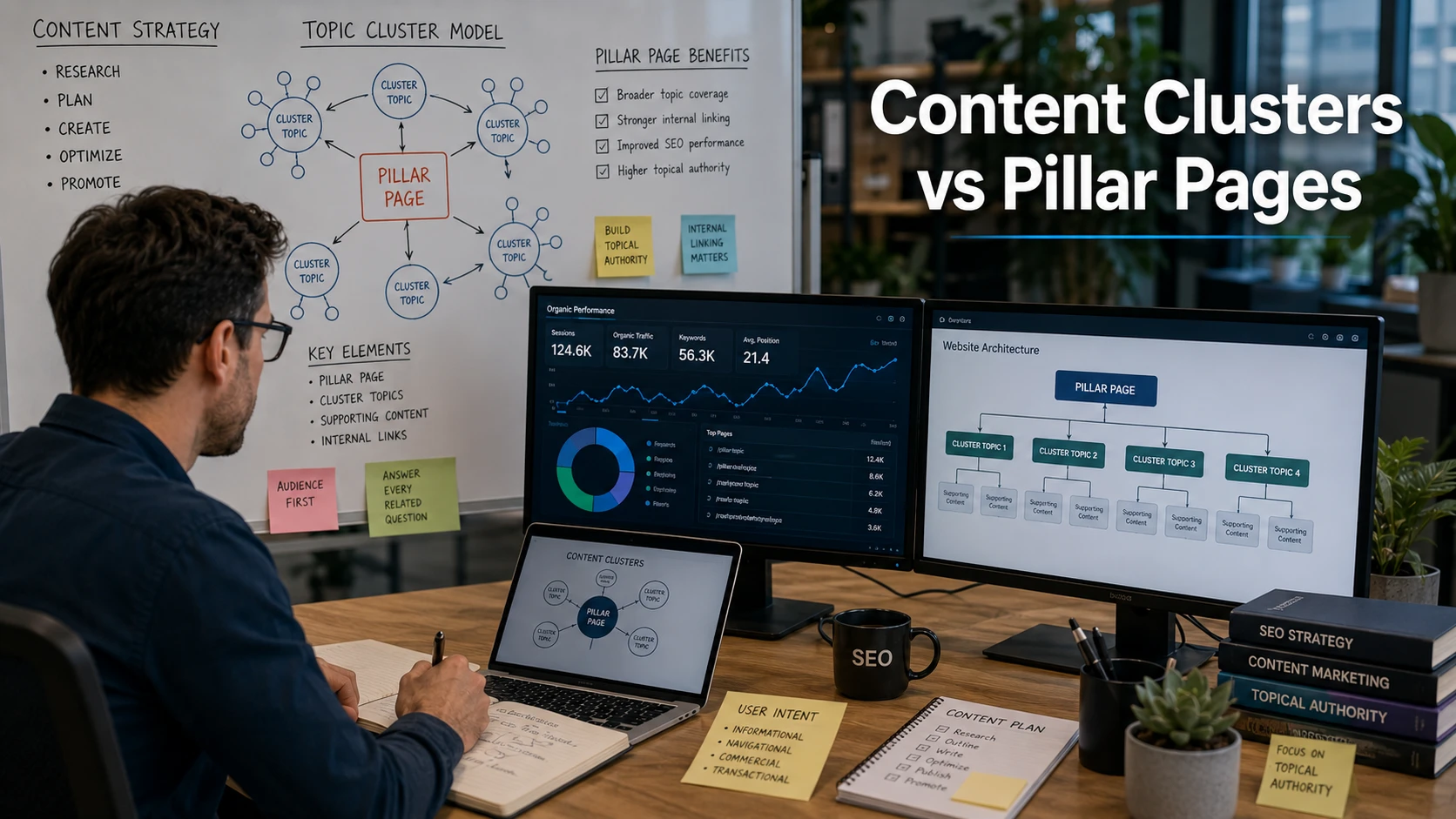
Imagine two websites. Both publish blog content consistently. Both target similar keywords. One grows its organic traffic month over month. The other flatlines despite doubling its publishing output.
The difference is almost never the writing quality. It’s the structure.
One site publishes pages that talk to each other. The other publishes pages that compete with each other or quietly disappear into crawl darkness. This is the central problem that the content cluster model was built to fix, and in 2026, getting this architecture right has become the single biggest lever separating sites that rank from sites that don’t.
This guide covers everything you need to build clusters that actually work: the architecture, the process, the internal linking logic, and the specific mistakes that quietly undo cluster strategies that looked good on paper.
Why Publishing More Blog Posts Stopped Working
Most content teams still operate with a simple logic: publish more, rank more. It made some sense years ago when Google evaluated pages mostly in isolation. A single well-written article could rank for its target keyword without needing to prove anything about the site it lived on.
That is no longer how Google works.
The Isolated-Page Problem Most Sites Still Have
When a site publishes 80 blog posts across 40 loosely related topics, each page signals almost nothing to Google about that site’s authority on any specific subject. You end up with thin topical coverage spread across a wide surface area.
Google crawls your site, sees 3 articles that touch on email marketing, 4 that touch on social media, 5 that touch on SEO, and none of them linking to each other in a meaningful way. The site looks like a generalist blog, not a subject-matter resource.
That pattern earns generalist treatment in rankings. Generalists get outranked by specialists every time on anything that matters.
What Google Actually Measures in 2026
Google’s Helpful Content system, updated multiple times since 2022, rewards sites that demonstrate depth and coherence on a topic. The algorithm looks at whether your coverage of a subject is thorough, whether your pages signal genuine knowledge through semantic completeness, and whether your internal link structure actually reflects the relationships between your content.
When Google crawls a pillar page and follows 12 internal links to 12 cluster pages that each go deep on a specific subtopic, the signal is clear: this site understands this subject area from multiple angles. That’s topical authority, and it now determines whether you rank on Page 1 or Page 5 for the terms that drive real traffic.
Content Clusters and Pillar Pages: What They Are and How They Work Together
The content cluster model has three working parts. Understanding what each part does, and why, changes how you approach building one.
What a Pillar Page Actually Does
A pillar page is a long-form piece that covers a broad topic at a strategic level. It introduces every major angle of the subject, goes deep enough to be genuinely useful on each, and links out to dedicated cluster pages for readers who want more on any specific subtopic.
Think of it as the trunk of a tree. It does not go to the tips of the branches. That is what the branches are for.
A pillar page on email marketing would cover what email marketing is, why it matters, the main strategy areas (list building, segmentation, automation, deliverability, analytics), the tools available, and what good results look like. Each of those sections would be informative but point toward deeper reading on each subtopic. It runs 3,000 to 5,000 words for most competitive topics.
What Cluster Pages Are Responsible For
Cluster pages are the supporting articles that each go deep on one specific angle the pillar introduced.
Where the pillar covered email deliverability in 400 words, the cluster page on deliverability goes 2,000 words. It covers SPF, DKIM, and DMARC setup, sender reputation, bounce management, list hygiene, and the specific tools practitioners use. It answers the question exhaustively.
Each cluster page targets a long-tail keyword related to the pillar’s head term. Each one links back to the pillar page. Each one may also link to one or two related cluster pages where relevant. The cluster pages do two things: they capture long-tail search traffic on their own, and they feed topical authority back up to the pillar through their internal links.
The Internal Link Layer That Ties It Together
The links between the pillar and cluster pages are not administrative formality. They are the mechanism through which authority flows through the cluster.
The pillar accumulates external backlinks because it covers a broad, frequently linked-to topic. Those links pass PageRank to the pillar. The pillar’s internal links distribute that PageRank to the cluster pages. The cluster pages’ links back to the pillar reinforce the topical signal in both directions.
Take away the internal links and you no longer have a cluster. You have a group of related pages that happen to live on the same site.
How to Build a Content Cluster in 5 Steps
Most guides describe the cluster model well but give vague implementation advice. Here is the actual process.
Step 1: Choose a Core Topic Worth Building Around
Your pillar topic needs to satisfy three criteria simultaneously: broad enough to support 8 to 15 cluster articles without overlap, genuinely searched by your target audience with measurable volume, and a topic area where you can credibly produce real depth.
“Marketing” is too broad. “Email marketing” is right. “Email subject line testing” is too narrow for a pillar. Use keyword research tools (Ahrefs, Semrush, or Ubersuggest) to validate that your core topic has a high-volume head term and that the surrounding subtopics have their own measurable search demand.
If the subtopics do not have search volume, you are building a cluster nobody is looking for.
Step 2: Map Every Subtopic Searchers Are Looking For
Pull every keyword related to your core topic from your research tool and group them by intent and angle. Look for questions (how to, what is, why does), comparisons (X vs Y), tool-specific searches (best tools for X), and process-specific searches (how to do Y). Each group with distinct intent and meaningful volume warrants its own cluster page.
For email marketing, you would find clusters forming around automation, deliverability, list segmentation, subject lines, A/B testing, metrics and KPIs, B2B approaches, and compliance. Those become your 8 to 10 cluster articles. Document the target keyword for each cluster article before writing anything. The research informs the content, not the other way around.
Step 3: Audit What You Already Have
Before writing a single new article, check your existing content. Most sites that have published consistently for 12 or more months already have articles that belong in a cluster. Those articles may underperform because they are not connected to a pillar or linked to related cluster pages.
Pull your Google Search Console data. Look for articles ranking on Page 2 or 3 for relevant keywords. Those are often salvageable cluster candidates. Updating them, adding internal links, and connecting them to a pillar frequently moves them to Page 1 faster than writing brand-new content.
Step 4: Write the Pillar Page First
This is the step most teams skip. They write cluster articles first because individual articles feel like faster progress. Writing the pillar first is structurally critical.
The pillar page creates the hub that cluster articles link back to from day one. If you publish cluster articles before the pillar exists, those articles have nowhere to point, and you lose the authority-building benefit of the return links for months. Write the pillar, publish it, then begin the cluster articles.
Step 5: Publish Clusters and Maintain the Structure
Publish cluster articles methodically. Two to three per week is a realistic pace for most teams. As each cluster article goes live, update the pillar to include an internal link to it within the relevant section. The pillar should always reflect the full current state of the cluster.
Set a calendar reminder to review your pillar page every six months. Update statistics, add sections for new subtopics, refresh the internal links, and add new cluster articles as new subtopics emerge in search data. A cluster left to stagnate slowly loses its authority signal as competitors build and maintain theirs.
What a High-Performing Pillar Page Looks Like in 2026
Knowing what a pillar page should do is different from knowing what it should look like. Here is the anatomy.
Length, Depth, and What to Cover
The right length for a pillar page is the minimum needed to cover the topic comprehensively. In practice, for most competitive topics, that lands between 3,000 and 5,000 words.
Every major subtopic in the cluster should appear as its own section in the pillar. The section should give enough information to be genuinely useful on its own, then explicitly point to the cluster article for readers who want to go deeper. Avoid going so deep on any one subtopic in the pillar that the cluster article covering the same subtopic becomes redundant.
The pillar gives the strategic overview. The cluster article gives the tactical depth. If the pillar already answers every question the cluster article would answer, you have created a cannibalization problem, not a cluster.
How to Use Internal Links Inside the Pillar
Every cluster page gets linked from the pillar, from within the section that covers that cluster’s subtopic. Use descriptive anchor text. The anchor text should describe what the reader will find on the linked page and include the cluster page’s target keyword or a close variation.
“For a complete breakdown of email deliverability, see our deliverability guide” is correct. “Click here” is not.
Do not use the same anchor text for multiple different cluster page links. Vary the phrasing naturally. Google reads anchor text as a signal about the destination page’s topic. Identical anchors for different pages send conflicting signals.
The Conversion Layer Most Pillar Pages Skip
Pillar pages attract visitors at the top of the awareness cycle. They arrive knowing very little and leave knowing considerably more. Most pillar pages stop there and miss the conversion opportunity entirely.
A well-built pillar page includes a clear primary call to action placed above the fold for visitors with high commercial intent. A secondary call to action mid-page works for readers still in research mode. A final call to action at the close of the article captures those who reach the end.
The calls to action do not need to be aggressive. A relevant lead magnet (a downloadable checklist, a template, a free audit offer) converts research-mode visitors better than a direct sales ask.
Cluster Page Strategy: Going Deep Without Going Thin
The quality bar for cluster pages is higher than most content calendars acknowledge.
How to Choose the Right Subtopics
The best cluster topics come directly from keyword research. But there is a filter to apply before committing to any subtopic: ask whether you can genuinely write 1,500 to 2,500 words on this specific angle that adds real depth beyond what the pillar already covers. If the answer is no, that subtopic belongs in the pillar as a section, not in the cluster as a standalone page.
The subtopics with the clearest cluster potential are those where searchers have a distinct, specific question. “What is email marketing” is a pillar-level question. “How to set up DKIM for email deliverability” is a cluster-level question. The more specific the question, the better the cluster candidate.
Word Count Thresholds and Quality Requirements
Cluster pages should cover their specific subtopic more thoroughly than any competing page currently ranking for that keyword. A general guideline: 1,500 to 2,500 words for most informational cluster articles. Tool comparisons and step-by-step tutorials typically run 2,000 to 3,000 words because the subject matter requires it.
Every cluster page should include something the pillar does not: original data, specific examples, step-by-step walkthroughs, tool-specific instructions, or real case scenarios. That is what makes the cluster page worth the reader’s time and worth Google’s trust.
Cluster Page Types by Search Intent
| Cluster Page Type | Target Intent | Recommended Length | Priority |
| How-to tutorial | Informational | 1,800 – 2,500 words | High |
| Best practices guide | Informational | 1,500 – 2,000 words | High |
| Tool or platform comparison | Commercial | 2,000 – 3,000 words | High |
| Definition or concept explainer | Informational | 1,200 – 1,800 words | Medium |
| Statistics and data roundup | Informational | 1,500 – 2,000 words | Medium |
| Case study or real example | Mixed intent | 1,500 – 2,500 words | Medium |
| Checklist or template | Navigational | 1,200 – 1,800 words | Medium |
Internal Linking Architecture That Actually Passes Authority
Internal linking is where most content cluster implementations quietly fail. The concept is understood. The execution is inconsistent.
The Bidirectional Linking Rule
Every cluster page links to the pillar. The pillar links to every cluster page. That is the bidirectional structure, and both directions carry weight.
The pillar page, which typically earns the most external backlinks, distributes that link equity to cluster pages through outbound internal links. The cluster pages, through their return links to the pillar, reinforce the topical signal and feed equity back up the hierarchy. Remove either direction and the cluster architecture becomes structurally incomplete.
Anchor Text That Sends the Right Signals
The anchor text of your internal links is a direct signal to Google about the topic and intent of the destination page. Using the destination page’s target keyword as anchor text, or a close semantic variation, tells Google what that page is about in a way that matters for rankings.
Practical rules for anchor text in content clusters:
- Use descriptive phrases, not generic words. “Email list segmentation guide” beats “read more.”
- Include the cluster page’s target keyword or a variation in the anchor text.
- Vary the phrasing of anchors pointing to the same page from different locations. Three pages all linking to the deliverability article should not all use identical anchor text.
- Keep anchors natural within the surrounding sentence. Forced keyword insertion into anchor text reads as manipulation.
How Many Cluster Pages Per Pillar?
The practical range is 8 to 15 cluster pages per pillar for most topics. Fewer than 8 and the cluster lacks enough topical coverage to signal genuine authority. More than 15 suggests either a topic that is too broad for one pillar (and should be split into two clusters) or subtopics being forced into cluster pages when they belong as sections in the pillar.
The test for whether a subtopic warrants its own cluster page: does it have its own measurable search volume, distinct from the pillar’s head term? If yes, it is a cluster candidate. If searchers are not specifically looking for that subtopic on its own, it belongs in the pillar as a section.
Content Gap Analysis: Finding What Your Cluster Is Missing
Building a cluster and maintaining it are two different activities. Content gap analysis is how you find what to add next.
The Three-Step Competitor Gap Process
- Map what your top three organic competitors have built for your pillar topic. Use a tool like Ahrefs Site Explorer or Semrush Organic Research to pull every page on those competitor sites that ranks for keywords related to your cluster’s core topic. Export the keyword list.
- Compare their keyword coverage against yours. The keywords your competitors rank for that you have no content targeting are your gaps. These represent subtopics that searchers are looking for in your topic area that your cluster currently does not address.
- Prioritize gaps by traffic potential and your ability to write with genuine depth. Focus first on subtopics with meaningful search volume and clear relevance to your audience. A cluster gap addressed before a competitor addresses it earns you first-mover ranking advantage on that subtopic’s long-tail traffic.
Using PAA and FAQ Data as Cluster Signals
Google’s People Also Ask (PAA) boxes are a direct window into what searchers actually want to know about your cluster’s topic. Search your pillar’s head term and your main subtopic keywords. Collect the PAA questions that appear.
Any PAA question you do not already have a cluster page or pillar section answering is a potential cluster addition. Longer, more specific PAA questions often indicate a dedicated cluster page is worth writing. Shorter, definitional questions are often better handled as FAQ sections within an existing page. Running this PAA audit quarterly keeps your cluster aligned with what your audience is actually searching for as those questions evolve.
Do Content Clusters Still Work in 2026?
The honest answer is yes, and the mechanism has become more important, not less.
How Clusters Feed AI Overview Citations
Google’s AI Overviews now appear for a large share of informational queries. They pull their responses from sources Google considers authoritative and well-structured on the topic being searched.
Sites with clear topical authority, built through cluster architecture, appear in AI Overview citations at a disproportionately high rate compared to sites with isolated pages. A site that has published 15 interconnected pieces covering every angle of a topic demonstrates the kind of genuine expertise that AI Overview sourcing rewards. Building a strong cluster is now both a traditional ranking strategy and an AI Overview visibility strategy.
The Zero-Click Reality Check
Zero-click searches, where the user gets their answer directly in the search result without clicking, have grown for simple informational queries. But zero-click searches are not uniformly distributed across all query types.
Navigational queries, commercial intent queries, and complex informational queries still produce high click-through rates. The subtopics most worth building cluster pages around are those with commercial or research-mode intent, where users need more than a quick answer. A cluster built with attention to which subtopics drive real clicks versus which ones feed AI Overview citations gives you both traffic and visibility.
When You Should NOT Build a Content Cluster
| This section appears in almost no guide on the topic. It belongs here.
The cluster model is a tool, not a mandatory format. Knowing when not to use it saves months of effort going in the wrong direction. |
Do not build a cluster around a topic your site has no real expertise in. A cybersecurity company building a cluster on “healthy breakfast recipes” because the keywords have high volume will not benefit. Google’s topical authority signal is context-sensitive. The cluster needs to make sense given what your site is actually about.
Do not build a cluster if you cannot sustain it. A pillar page with 3 cluster articles and 11 planned articles that never get written is worse than no cluster at all. It signals to Google that the coverage is incomplete. Build clusters at a pace you can actually maintain.
Do not build a cluster when a single page would serve the topic better. Some topics are genuinely narrow. A focused 2,500-word guide on a specific process does not need a pillar page and eight supporting articles. Forcing the cluster model onto topics where it does not fit creates thin, redundant pages that quietly compete with each other.
Expert Tips: What SEO Practitioners Do That Most Guides Skip
- They track cluster-level performance, not just individual page performance. Total organic traffic to all pages within a cluster, tracked month over month, shows whether the cluster is compounding as intended. Individual page metrics alone miss the picture.
- They write the pillar page with gap-filling in mind from the start. Rather than writing the pillar as a finished piece, experienced practitioners write it as a document that will grow. They leave deliberate openings where new cluster articles can later be linked without the pillar requiring a full rewrite.
- They refresh their pillar page on a quarterly or semi-annual schedule. A pillar page written in 2024 and left untouched in 2026 sends a freshness signal that quietly erodes the cluster’s authority. Freshness updates are one of the fastest ways to recover cluster-level rankings that have softened.
- They build cluster pages in thematic batches. Rather than publishing one cluster article per month across multiple clusters, they complete one cluster (all 8 to 12 articles) before starting another. This concentrates the topical authority signal and produces faster ranking results.
- They use their own data, not generic data. A cluster article that cites original survey results, proprietary data, or firsthand testing earns backlinks and AI Overview citations that a rehashed generic article does not. The bar for cluster page quality has risen sharply in 2026.
Common Mistakes That Kill Cluster Performance
Building the cluster from the wrong end. Publishing cluster articles before the pillar exists means months of cluster pages that cannot link back to anything, losing the authority-building benefit of return links from the start.
Letting cluster pages become thinner versions of the pillar. If your cluster page on email deliverability is just a shorter version of the deliverability section in your pillar, you have created cannibalization, not a cluster. Each cluster page needs original depth that the pillar does not cover.
Using generic anchor text on all internal links. “Read our guide here” and “click here” are not anchor text. They pass PageRank but send no topical signal. Descriptive anchor text is a requirement, not a nice-to-have.
Ignoring orphan pages. An orphan page has no internal links pointing to it. Google treats orphan pages as low-priority for indexing and ranking. Every cluster page must be linked from the pillar and ideally from one or two related cluster pages. Check for orphan pages quarterly using a crawl tool like Screaming Frog.
Treating the cluster as a one-time project. The sites that see sustained cluster results are the ones that actively maintain their clusters. Content that was accurate in 2024 may be outdated in 2026. Outdated cluster pages silently undermine the pillar’s authority signal.
Building clusters around vanity topics, not audience intent topics. A cluster built around what your marketing team finds interesting rather than what your target audience actually searches for produces beautiful architecture that attracts very little traffic. Search demand validation is not optional.
Frequently Asked Questions
How many cluster pages do I need per pillar page?
The practical range is 8 to 15 for most topics. The right number is whatever it takes to cover the full range of subtopics searchers are actively looking for in your core topic area. Start with 8 and add more as content gap analysis reveals gaps your cluster is not addressing.
What is the difference between a pillar page and cornerstone content?
Cornerstone content (a term popularized by Yoast) refers to your most important, authoritative articles. A pillar page specifically anchors a content cluster as its hub. In most practical implementations, a well-built pillar page is also your cornerstone content. The cluster architecture is the more strategically useful frame for SEO purposes in 2026.
How long should a pillar page be?
Between 3,000 and 5,000 words for most competitive topics. The actual driver of length is comprehensive coverage of the full topic scope, not a word count target. A pillar page that covers its topic fully at 2,800 words is better than one padded to 5,000 words with filler sections.
Do content clusters still work now that AI Overviews change how search results appear?
Yes. Google’s AI Overviews pull from sites with demonstrated topical authority. A site with 12 interconnected articles covering a topic from multiple angles is far more likely to be cited in AI-generated answers than a site with one standalone article. Clusters are now both a ranking strategy and an AI visibility strategy.
How long before a content cluster produces results?
Most clusters begin showing meaningful organic traffic growth between 3 and 6 months after the pillar page and first cluster articles are indexed. Full compounding authority typically takes 9 to 12 months. Sites that maintain and expand their clusters past the 12-month mark consistently see 30 to 40 percent higher organic traffic compared to sites using standalone content strategies.
Can I build a content cluster on a brand-new website?
Yes, but with adjusted expectations. New sites have no existing domain authority, so the cluster’s authority signal builds more slowly. Building a cluster is still the right approach because it sets the architecture correctly from day one. Pair the cluster build with a backlink acquisition strategy from the start, because external links are the fuel that accelerates the cluster’s authority accumulation.