
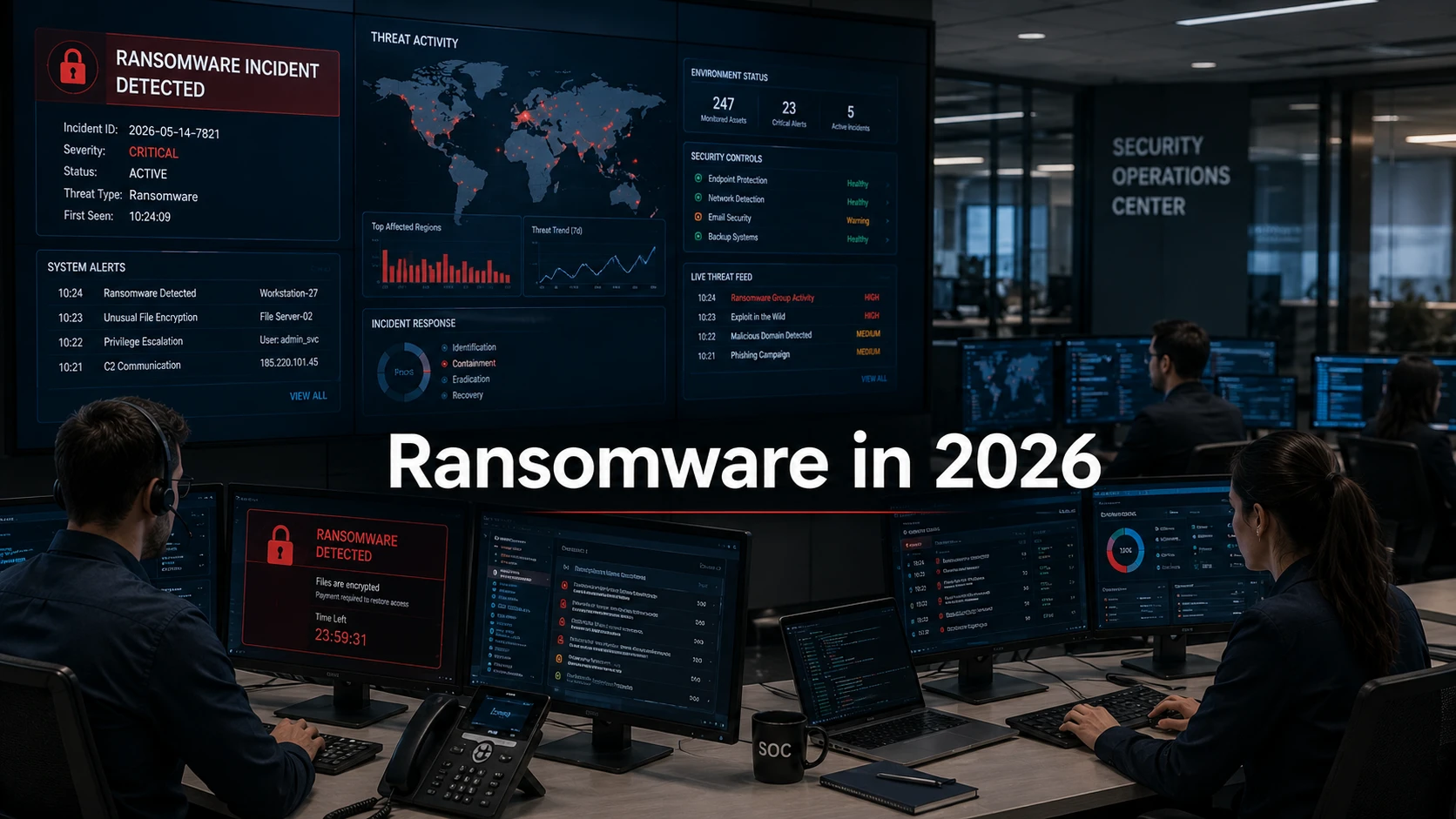
A small accounting firm in Ohio. A regional hospital in Germany. A school district in Texas. A manufacturing plant in Malaysia. These aren’t headlines from years past. They’re the kinds of targets ransomware groups hit on an average week in 2026.
No organization is too small. No sector is considered off-limits.
Ransomware in 2026 Is Not What It Was in 2020
Six years ago, ransomware was largely a volume game. Criminal groups sent millions of phishing emails and hoped some percentage of victims would click. Most attacks were opportunistic. The ransoms were modest.
What matters now is the professional, targeted attack. These groups research their targets before attacking. They know the company’s revenue. They set the ransom demand accordingly.
From Spray-and-Pray to Surgical Targeting
Today’s high-impact ransomware groups spend weeks inside a target network before triggering encryption. They map the organization, identify the most valuable data, disable backup systems, and exfiltrate sensitive files. Only then do they encrypt.
This means that by the time a victim sees a ransom note, the damage is already done in multiple dimensions.
Ransomware-as-a-Service Has Changed Everything
Ransomware-as-a-Service (RaaS) is the dominant business model behind most major attacks in 2026. Developers build and maintain the ransomware platform. Affiliates pay to use it, conduct the actual attacks, and split the ransom with the developers.
The barrier to entry for attackers has dropped significantly. Someone with no coding ability can become a ransomware affiliate by paying a fee and following instructions. Some RaaS groups even have customer service portals where victims can chat with attackers to negotiate payment terms.
How a Modern Ransomware Attack Actually Unfolds
Stage 1: Initial Access
The most common paths in 2026 include: phishing emails with malicious attachments or links (still the top vector), exposed RDP ports that are brute-forced or credential-stuffed, unpatched VPN or firewall vulnerabilities, supply chain compromise through a trusted vendor, and purchased access from initial access brokers.
Stage 2: Lateral Movement and Data Exfiltration
Once inside, the attacker is quiet. They use legitimate tools already on the system to move through the network without triggering alerts. They look for domain admin credentials, identify backup systems, and find the data most likely to cause pain if exposed. That data gets exfiltrated.
This stage can last days, weeks, or in sophisticated attacks, months.
Stage 3: Encryption and Extortion
When ready, the attacker deploys encryption across as many systems as possible simultaneously. Ransom notes appear. Victims discover that backups were quietly deleted or corrupted during the reconnaissance phase.
The attacker now has two levers: the decryption key and the threat to publish the stolen data. This double extortion is standard practice in 2026.
The Real Cost of Ransomware in 2026
Beyond Ransom Payment: The Hidden Costs
| Cost Category | Description |
| Ransom payment | If paid, typically $500K to $5M+ for mid-market companies |
| Incident response | Forensic investigation, containment, legal notification |
| System restoration | Rebuilding servers, endpoints, cloud infrastructure |
| Business downtime | Revenue lost during outage (often the largest single cost) |
| Regulatory fines | GDPR, HIPAA, state privacy law penalties if data was exposed |
| Reputation damage | Customer churn, lost bids, increased insurance premiums |
Industry analysis suggests the average total cost of a ransomware incident for a mid-sized business is now well above $1 million when all factors are included.
Industries Hit Hardest
Healthcare remains the most targeted sector globally. Financial services, manufacturing, education, and government are all heavily hit. In 2026, critical infrastructure attacks have drawn the most attention.
Ransomware Prevention That Actually Works
Technical Controls Every Business Needs
- Patching within 30 days of a critical disclosure, 7 days for internet-facing systems — blocks the majority of opportunistic attacks.
- Multi-factor authentication (MFA) on email, VPN, and RDP. Authenticator apps or hardware keys preferred over SMS.
- Network segmentation — limits lateral movement if an attacker gets in.
- Endpoint detection and response (EDR) — detects behavioral patterns before encryption starts.
- Immutable backups stored offline, air-gapped, or in write-once cloud storage. Test restore quarterly.
- Email security with link-analysis at click-time, not just at delivery.
Human Controls: The Layer Most Companies Underinvest In
Realistic phishing simulations run at least quarterly. Immediate feedback when an employee clicks. Clear reporting channels so people aren’t embarrassed to report a potential mistake.
What to Do If Your Business Gets Hit
The First 24 Hours: A Practical Checklist
- Isolate affected systems immediately. Disconnect from the network. Do not shut down or reboot.
- Alert your incident response team or provider immediately.
- Contact your cyber insurance provider. They have strict notification timelines.
- Preserve evidence before beginning recovery. Forensic imaging must come first.
- Notify legal counsel. Data breach notification laws have strict timelines.
- Communicate internally with discipline. Prevent panic and counterproductive actions.
- Assess what data was accessed to determine regulatory exposure.
Should You Pay the Ransom? The Honest Answer
This is a business decision, not a technical one. Arguments against paying: it funds criminal enterprises, there’s no guarantee you get working decryption keys, and in some jurisdictions payments to sanctioned groups are illegal. Arguments for: when backups are compromised and operations are halted, payment may be the fastest path to recovery. Consult legal counsel before any decision.
Expert Tips: Ransomware Resilience in 2026
- Companies with tested incident response plans recover significantly faster than those with only written ones.
- Tabletop exercises prepare teams for exactly who calls whom and what decisions each person can make.
- Immutable backup coverage tested in the last 90 days is the single biggest recovery accelerator.
- Pre-negotiated IR firm retainers eliminate the 48-hour scramble to find help.
- Cyber insurance that includes IR services, not just financial coverage, activates response faster.
Common Mistakes Businesses Make
- Treating backups as set-and-forget. Backups not tested aren’t backups.
- Allowing MFA exceptions ‘temporarily.’ Temporary exceptions become permanent.
- Focusing only on prevention, not detection and response.
- Not segmenting the network — a flat network is a gift to attackers.
- Skipping incident response planning until after an attack.
Protect Your Business Before You Need To
Ransomware response is expensive. Ransomware preparation is far cheaper. Start with an honest audit of your backup integrity and MFA coverage. The companies that handle ransomware incidents best in 2026 are the ones that are prepared.