

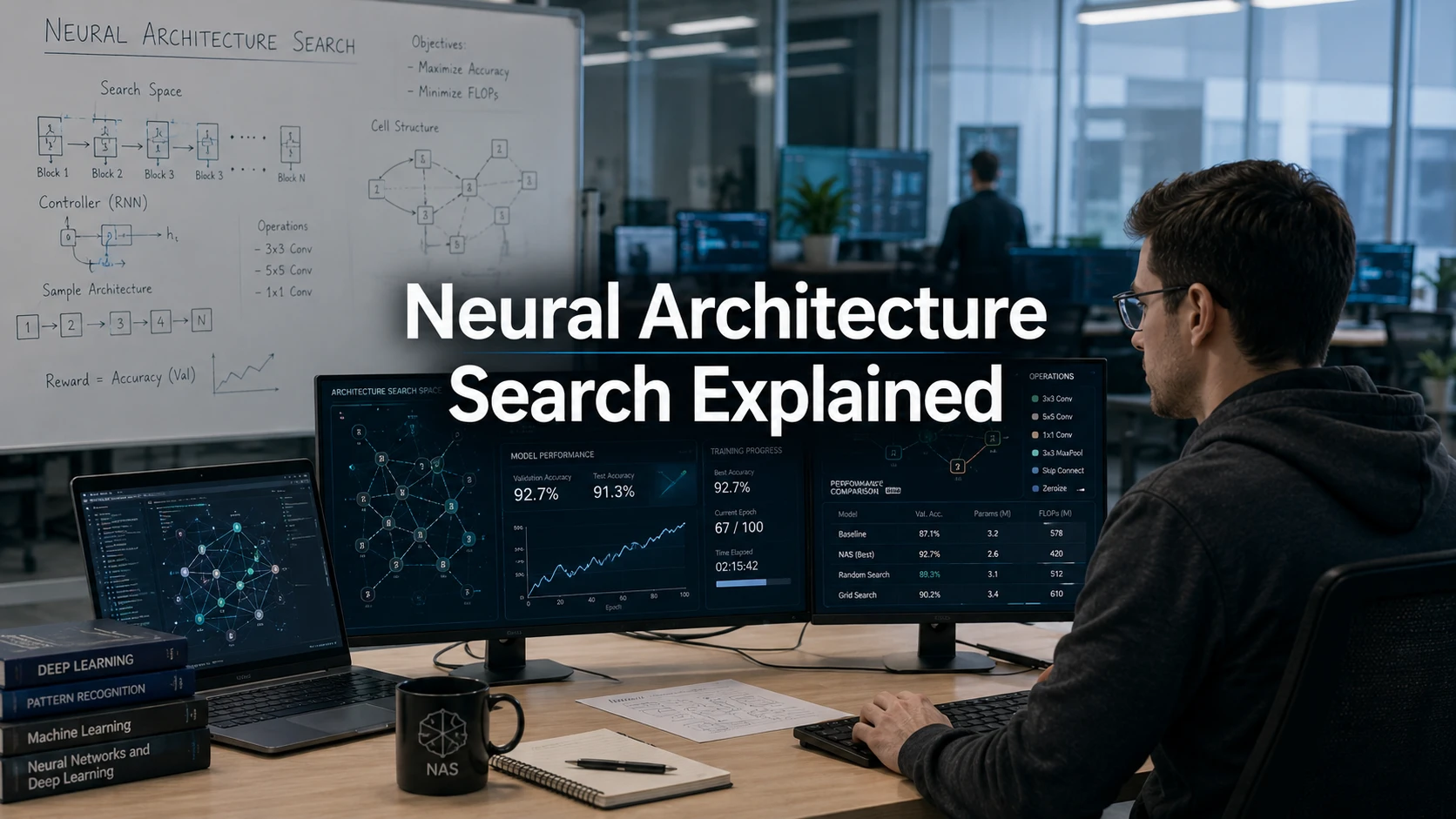
Building a good neural network used to take months. A team of researchers would sketch layers on whiteboards, run experiments, tweak hyperparameters, and repeat. The process was slow, expensive, and heavily dependent on who happened to be in the room.
Neural Architecture Search changed that. And in 2026, it’s become one of the most important techniques in applied AI.
What Is Neural Architecture Search?
Neural Architecture Search (NAS) is the process of using algorithms to automatically find the best neural network design for a specific task. Instead of a human choosing how many layers to stack, what kind of activation functions to use, or how to connect components, the system searches through thousands of possible configurations to find what works.
The result is often a model that outperforms anything a team could design by hand, in a fraction of the time.
The Manual Design Problem NAS Solves
Manually designing neural networks requires deep expertise and significant time. A practitioner needs to understand convolutional architectures, attention mechanisms, normalization strategies, and more. Then they need to run experiments, wait for results, and iterate.
For most teams in 2026, that’s simply not viable. Data science talent is expensive. Training runs on GPUs cost money. And the competitive pressure to ship faster keeps growing.
NAS addresses this by treating architecture design as an optimization problem. The algorithm becomes the engineer.
A Quick History: From Hand-Crafted Layers to Algorithmic Search
The concept originated in a 2017 Google paper where researchers used reinforcement learning to design convolutional layers for image classification. The resulting architecture, NASNet, matched or exceeded handcrafted state-of-the-art models on ImageNet benchmarks.
That was expensive. The original NASNet search required 800 GPUs running for 28 days. Since then, the community has worked hard to bring those costs down by orders of magnitude.
By 2026, many NAS jobs that once required a data center can run on a single workstation or a modest cloud instance over a weekend.
How NAS Actually Works
Every NAS system has three moving parts: the search space, the search strategy, and the performance estimator. Understanding each one helps you make sense of why different frameworks behave so differently.
Search Space, Search Strategy, and Performance Estimation
Search space is the set of all possible architectures that the algorithm can consider.
A wide search space can find more creative solutions, but takes longer to explore. Narrow spaces are faster but might miss good options.
Search strategy is how the algorithm moves through that space.
Options include reinforcement learning (an agent learns which choices lead to good models), evolutionary algorithms (populations of architectures compete and reproduce), and gradient-based methods (the architecture itself becomes a differentiable parameter).
Performance estimation is how the system evaluates each candidate without fully training it from scratch.
Early methods simply trained each candidate to convergence, which is why those original NAS jobs needed 800 GPUs. Modern methods use proxy tasks, weight sharing, or early stopping to estimate performance in minutes rather than days.
Types of NAS: RL-Based, Evolutionary, and Gradient-Based
RL-based NAS uses a controller network that samples architectures and receives accuracy as a reward signal. It’s powerful but sample-inefficient. Early Google papers used this approach.
Evolutionary NAS works like biological evolution. A population of architectures is created, the weakest are removed, and the strongest are mutated and combined to create new candidates. This approach handles non-differentiable search spaces well.
Gradient-based NAS (DARTS and its variants) is the most computationally efficient. The key idea is to make the architecture parameters differentiable so that standard gradient descent can optimize them alongside the network weights. DARTS can find competitive architectures in a single GPU day.
NAS vs AutoML: They’re Not the Same Thing
This is the most common confusion point in the field. AutoML and NAS both automate parts of the machine learning pipeline, but they operate at different levels.
Where Each Approach Wins
| Feature | AutoML | NAS |
| Scope | Full pipeline (features, algorithms, hyperparameters) | Architecture structure only |
| Ease of use | Easier, more abstracted | Requires ML knowledge |
| Output | A configured model | A new model architecture |
| Best for | Business analysts, rapid prototyping | Research teams, production ML |
| Tools | H2O.ai, AutoGluon, Google AutoML | DARTS, Microsoft NNI, NASNet |
AutoML picks from a library of existing model families and tunes their settings. NAS actually invents new model structures. In practice, the two are increasingly used together.
Hybrid NAS-AutoML Workflows in 2026
Most articles still treat NAS and AutoML as separate tools. In production environments in 2026, the more common pattern is a staged pipeline. Teams use AutoML first to identify the best base algorithm type. Then they run a constrained NAS pass to refine the architecture. Finally, AutoML’s hyperparameter tuning polishes the result.
This hybrid approach cuts search time while still benefiting from NAS-level architectural exploration. Microsoft’s NNI framework explicitly supports this workflow.
Best Neural Architecture Search Frameworks in 2026
Google’s NASNet and Its Successors
Google’s original NASNet work seeded an entire ecosystem. EfficientNet, which used NAS to jointly optimize network width, depth, and resolution, became the go-to architecture for production vision models for several years.
In 2026, Google’s focus has shifted toward NAS for transformer-based models and multimodal architectures. For teams that use Vertex AI or Google Cloud TPUs, the NAS components are increasingly built into the platform.
Microsoft NNI, DARTS, and the Open-Source Landscape
Microsoft NNI (Neural Network Intelligence) remains the most widely adopted open-source NAS toolkit. It supports multiple search strategies, integrates with PyTorch and TensorFlow, and includes tools for experiment tracking and hyperparameter tuning.
DARTS and its variants (PC-DARTS, SNAS, DrNAS) are the research community’s preferred gradient-based methods. They’re faster to run but require more understanding to configure correctly.
Once-for-All (OFA) from MIT is gaining traction for edge deployment. It trains a single large supernet and then extracts sub-networks of different sizes without retraining.
Who Should Be Using NAS Right Now?
The Real Compute Cost Conversation
Running DARTS on a single image classification task today can complete in 4 to 8 GPU-hours on a consumer-grade GPU. On cloud infrastructure, that translates to $10 to $40 per search run.
For language tasks, the costs are higher. Architecture search on transformer models for NLP can still run into hundreds of dollars per experiment. The key insight is that even a modest investment in NAS can pay off if the resulting model is used at scale.
Expert Tips: What Practitioners Recommend
- Define your constraints first. Know your inference budget (latency, memory, FLOPs) before you search.
- Start with DARTS or PC-DARTS. They’re the fastest way to get a result.
- Use a validated search space. Building a custom space from scratch is a research project.
- Track every experiment. Use MLflow or Weights & Biases.
- Don’t skip ablation studies. Knowing why a found architecture works helps you trust and extend it.
Common Mistakes Teams Make With Neural Architecture Search
- Searching without a deployment target — the most accurate architecture may be too large for production.
- Using NAS as a one-time activity — treat architecture search as an ongoing process.
- Overlooking transferability — validate on representative data before committing.
- Skipping the proxy task validation — validate the estimator before a full search run.