
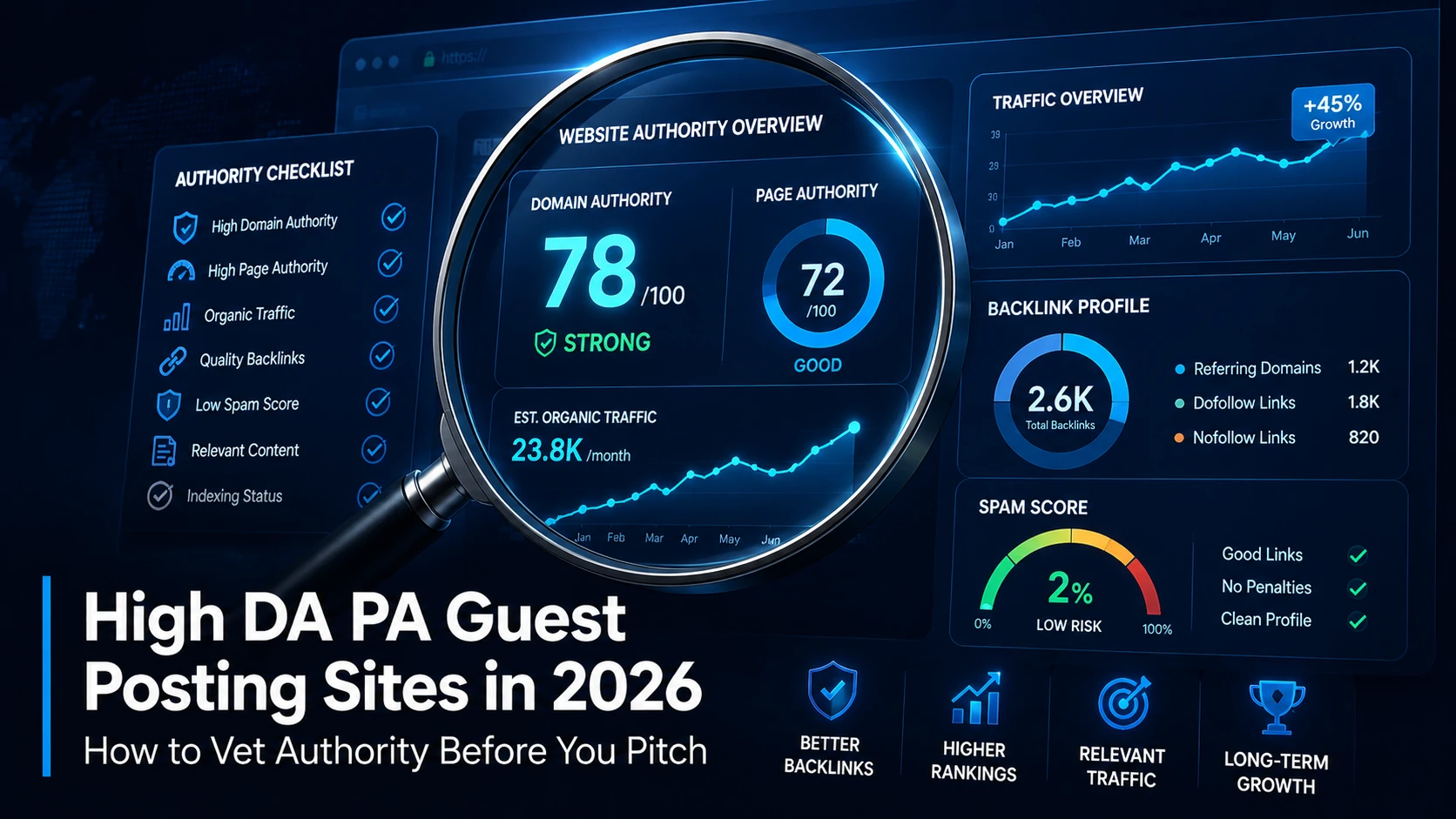
A site showing Domain Authority 70 can still be worth less than a Domain Authority 40 site, and RankZ’s 2026 data explains why: sites with artificially inflated authority but low real traffic are increasingly common, while clean sites with matching traffic and authority command a premium. Moz’s Domain Authority and Page Authority scores remain the most commonly cited shorthand for guest posting site quality, but treating either metric as a standalone quality signal is one of the most expensive mistakes a link building campaign can make in 2026.
This guide breaks down what DA and PA actually measure, why they can be manipulated, and the additional signals that separate a genuinely valuable high authority guest posting site from an inflated one.
What Domain Authority and Page Authority Actually Measure
Domain Authority is Moz’s proprietary score, from 1 to 100, predicting how likely a whole domain is to rank in search results based on its backlink profile. Page Authority measures the same prediction for a single page rather than the entire domain, which matters because a high DA site can still have individual pages, including its guest post section, with much lower PA if that section is poorly linked internally. Neither score is used directly by Google’s own ranking algorithm; both are third-party approximations built from crawled link data, which is exactly why they can be gamed.
How Sites Inflate Their Authority Scores
Common inflation tactics include buying large volumes of low-quality links to boost the raw backlink count Moz’s crawler sees, redirecting an old, previously authoritative domain to a new guest-posting-focused site, and building private blog networks that cross-link to artificially raise DA across a cluster of owned sites. A 2026 buyer can usually spot this by comparing DA against real organic traffic in Ahrefs or Semrush: a DR 60 site pulling under 1,000 monthly organic visitors is a strong signal of manipulation rather than genuine authority.
The Four-Signal Check Before You Pitch
T-RANKS’ 2026 guest post pricing research recommends checking four signals together rather than relying on any single number: real and stable organic traffic from credible countries, topical relevance to your industry, a visible editorial process rather than automatic publishing, and a spam score under roughly 5 percent. A site that passes all four is very likely worth the pitch even at a moderate DA; a site that fails two or more is worth skipping even at a high DA.
| Signal | What to Check | Red Flag |
| Organic traffic | Ahrefs or Semrush estimated monthly visits | DA/DR far exceeds visible traffic |
| Topical relevance | Recent published articles match your industry | Generic, unrelated content mix |
| Editorial process | Visible contributor guidelines, named editors | Instant or guaranteed publication for a fee |
| Spam score | Moz spam score under approximately 5 percent | Spam score above 10 percent, thin backlink profile |
Why Relevance Often Beats Raw DA
A DR 45 fintech publication linking to a fintech company sends a far stronger topical signal than a DR 75 general lifestyle site linking to the same company, even though the raw authority number favors the lifestyle site. Google’s algorithm and AI-assisted search systems increasingly weight topical relevance alongside authority, which is part of why niche-specific editorial sites have become more valuable relative to their DA score in 2026 than they were even two years ago.
Verified authority and genuine topical fit both matter more in 2026 than a headline DA number alone. WritoryBuzz maintains a real, checkable readership across technology, fintech, AI, and business content, and applies editorial review to every contributor pitch rather than accepting placements automatically.
Trust the Combination, Not the Single Score
No single metric, not DA, not PA, not spam score, tells the full story of a guest posting site’s real value. The sites worth building a long-term relationship with in 2026 are the ones that pass every check at once: real traffic, real relevance, real editorial standards, and a spam profile that stays clean over time.
Vetting Is the Actual Skill
Anyone can filter a spreadsheet by DA. The teams getting real ranking movement from guest posting in 2026 are the ones who slow down long enough to check traffic, relevance, and editorial standards before a single pitch goes out, because that discipline is what turns a link list into a link-building strategy.
FAQs: High DA PA Guest Posting Sites Questions
What does high DA PA mean for guest posting sites?
High DA PA refers to a guest posting site with a strong Moz Domain Authority score, usually 50 and above, and Page Authority score on the specific section accepting guest content. Both are third-party metrics predicting how likely a site or page is to rank in search, and higher scores generally correlate with stronger link value, though they can be artificially inflated.
How do I check the DA and PA of a guest posting site?
Use Moz’s free Link Explorer tool or a Moz-integrated browser extension to check both scores directly on any domain or specific page. Cross-reference the result with real organic traffic data from Ahrefs or Semrush, since DA and PA alone do not confirm the site has a genuine, engaged audience.
What is the difference between DA and PA in guest posting?
Domain Authority measures the ranking potential of an entire website, while Page Authority measures the ranking potential of one specific page. A guest posting site can show a high DA overall while the actual guest post section carries a much lower PA if that section receives fewer internal links than the site’s core content.
How much does it cost to get a guest post on a high DA site?
Guest posts on Domain Rating 60 to 70 sites typically cost 400 to 700 US dollars in competitive niches, according to Serpzilla’s 2026 marketplace data, while premium DA 70 plus editorial placements can exceed 900 US dollars per RankZ and Vefogix pricing research. Costs rise further in high-competition niches like finance, legal, and iGaming.
What are the risks of chasing high DA guest posting sites without checking traffic?
Chasing DA alone risks paying premium prices for links on sites with artificially inflated authority but minimal real organic traffic, a pattern RankZ’s 2026 research found increasingly common. These links deliver weak SEO value and can appear unnatural to Google’s algorithm if the site’s backlink profile shows clear manipulation signals.
Which guest posting site metrics matter most in 2026?
The four metrics that matter most together are real organic traffic, topical relevance to your industry, a visible editorial review process, and a spam score under roughly 5 percent. DA and PA remain useful shorthand but should never be the only factor, since Google’s own systems and AI-assisted search increasingly reward genuine relevance and editorial quality over raw authority scores.