
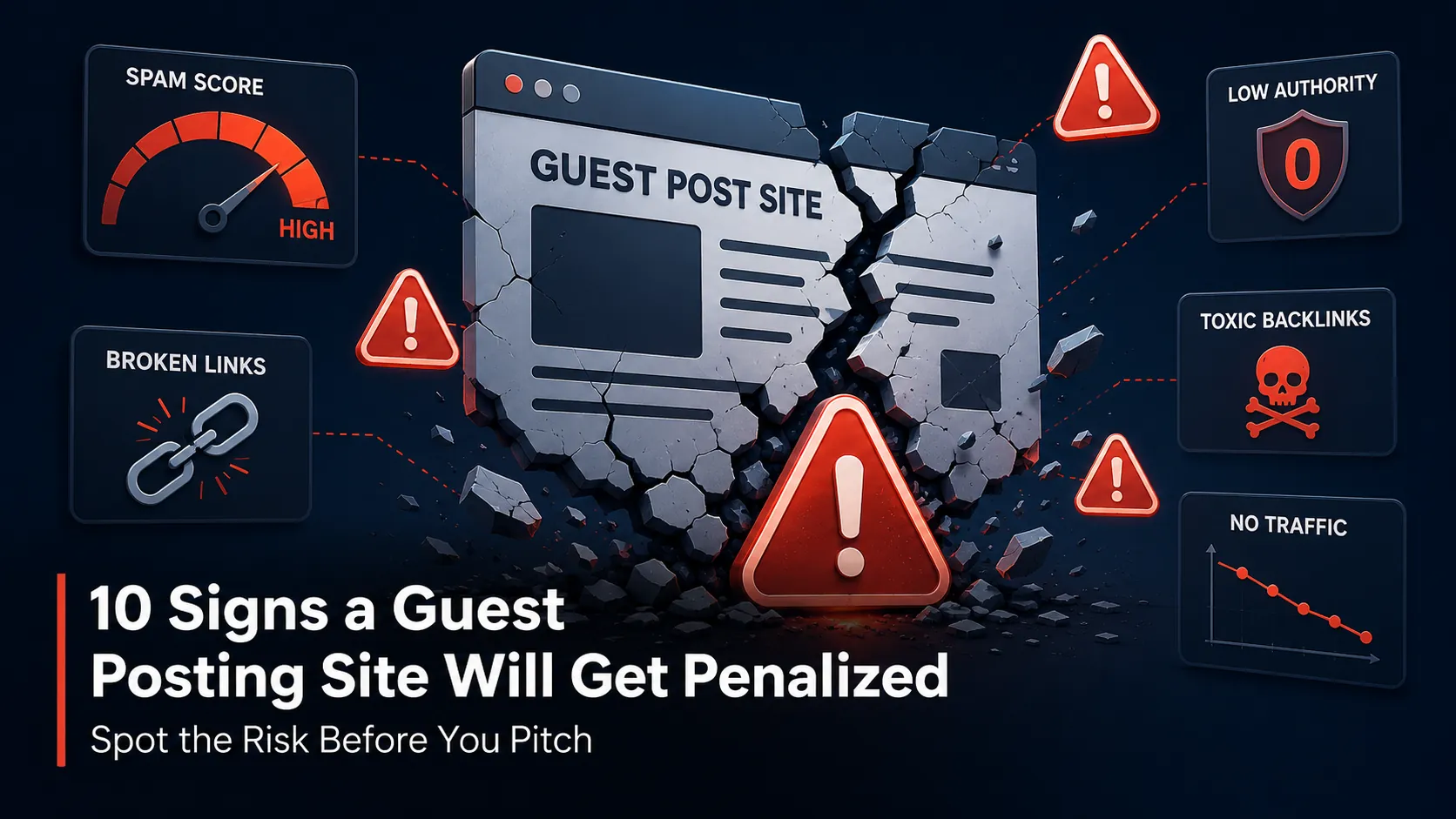
A site that gets hit with a Google manual action does not just lose its own rankings, it can drag down the SEO value of every link it ever gave out, including any guest post your business placed there. Spotting the warning signs before they trigger enforcement protects your own backlink profile from being caught up in a site’s collapse. These 10 signs, drawn from consistent patterns across sites that have been penalized or deindexed, give an early warning that a site is heading toward trouble, along with the specific tool or method to check for each one.
None of these signs alone guarantees a penalty is imminent, but a site showing three or more should be treated as a real risk regardless of how attractive its Domain Authority number looks.
Avoiding these risk patterns is exactly why editorial review matters before a site accepts a single guest post. WritoryBuzz applies genuine editorial standards to every contributor submission, which is the structural difference between a site built to last and one heading toward the patterns below.
The 10 Warning Signs
- Domain Authority far exceeds real organic traffic. A site showing DR 60 plus while pulling under 1,000 monthly visitors, checkable in Ahrefs’ free backlink checker or Ubersuggest, is one of the clearest signals of link manipulation rather than genuine authority. The gap itself is the signal: a genuinely popular site’s traffic and authority tend to move together over time, so a wide, persistent divergence between the two almost always means the authority score was built artificially rather than earned through real audience growth.
- The site publishes unrelated topics daily with no clear editorial focus. A pattern of covering everything from finance to travel to gambling within the same week, visible by simply browsing the site’s recent posts or category archive, signals content accepted purely for payment rather than genuine editorial direction. A legitimate publication, even a broad one, maintains some coherent thread connecting its content to a defined audience; the complete absence of that thread is a strong tell.
- Guaranteed publication for any topic in exchange for a fee. Legitimate editorial sites reject a meaningful share of pitches, often 90 percent or more at higher-authority sites; a site advertising a near-100 percent acceptance rate for paying buyers, common language on marketplace listing pages, is functioning as a link marketplace rather than a publication regardless of what its About page claims.
- Heavy use of exact-match commercial anchor text across outbound links. A backlink profile dominated by keyword-stuffed, commercial anchor text, checkable by reviewing a site’s outbound links in Ahrefs’ or Semrush’s link reports, is one of the clearest signals Google’s link scheme detection systems are built to catch. A natural site’s outbound anchor text is typically varied, branded names, generic phrases like click here, and natural sentence fragments rather than repeated exact-match commercial keywords.
- A high Moz spam score combined with thin, unedited content. A spam score above roughly 10 percent, checkable through Moz Link Explorer, paired with recently published articles that read as unedited or AI-generated with no meaningful human review is a strong compound risk signal. Either factor alone is a caution; the combination of both is close to a confirmed pattern of a site operating primarily as link inventory rather than genuine publishing.
- No visible author bios, editor names, or real team behind the site. Sites with no identifiable human presence, only a generic contact form or marketplace listing page, are more likely operating primarily as link inventory. Check the site’s About page and recent article bylines directly; a legitimate publication generally has named writers or at minimum a named editorial contact, while a link-selling operation frequently does not.
- A recent, unexplained ownership change or domain repurposing. A previously legitimate site with real content history suddenly shifting to a guest-post-for-hire model after a domain sale is a common pattern preceding a Google reassessment. The Wayback Machine’s historical snapshots can reveal this pattern clearly, showing a site’s content focus and quality shifting abruptly at a specific point in time, often coinciding with a change in the site’s WHOIS registration data.
- Rapid, unnatural backlink growth in a short window. A sudden spike in the number of sites linking out from a single domain, visible in Ahrefs’ or Semrush’s link growth charts over a 6 to 12 month view, often signals a site that recently pivoted to bulk link selling. A natural site’s outbound link growth tends to track roughly with its own publishing frequency; a sharp, disconnected spike is a strong tell.
- The site appears prominently across multiple bulk guest-posting marketplaces at steeply discounted rates. Sites that show up cheaply, well below the 220 to 609 US dollar typical guest post range, across several different bulk marketplaces simultaneously are typically being sold at volume rather than curated for genuine editorial fit. A quick search of the site’s own domain name alongside terms like guest post price or buy backlink often surfaces these marketplace listings directly.
- Other sites in the same apparent network show a historical traffic cliff. If a site shares template design, hosting patterns, or ownership signals with other sites that have already lost most of their traffic, checkable by comparing several suspected network sites’ traffic history in Ahrefs’ free tool, it is likely part of a network heading toward the same fate. Private blog networks often share identical WordPress themes, similar About page language, or overlapping contact email domains, all of which are researchable with basic manual investigation.
What to Do if a Site You Have Used Shows These Signs
If a site you previously placed a guest post on begins showing several of these signs, check whether the link is still live and consider requesting removal if the relationship with the site feels increasingly risky. Monitor your own backlink profile in Ahrefs or Semrush periodically, roughly quarterly is a reasonable cadence for most businesses, for links from sites that have since been deindexed or show a dramatic traffic collapse, since removing or disavowing those links can protect your own site from any residual association risk. Google’s disavow tool remains available specifically for this purpose, though it should be used selectively rather than broadly, since disavowing genuinely healthy links provides no benefit and can occasionally remove value unnecessarily.
FAQs: Guest Posting Site Penalty Risk Questions
What are the warning signs a guest posting site will be penalized by Google?
Key warning signs include Domain Authority far exceeding real organic traffic, guaranteed publication for any topic regardless of relevance, heavy use of exact-match commercial anchor text, a high spam score combined with thin or AI-generated content, and no visible editorial team or author bios on the site.
Can a penalized guest posting site hurt my own website’s SEO?
A penalized guest posting site can reduce or eliminate the value of any link you received from it, and in some cases, association with a site that receives a manual action for unnatural links can draw additional scrutiny to your own backlink profile. Monitoring and removing links from clearly penalized sites is a reasonable precaution.
How do I check if a guest posting site has already been penalized?
Check whether the site still appears in Google search results for its own brand name, since deindexing is a common penalty outcome. A sudden, sharp drop in a site’s estimated organic traffic visible in Ahrefs or Semrush is also a strong indicator of a recent penalty or algorithmic devaluation.
What is a private blog network and why is it risky for guest posting?
A private blog network is a group of websites, often sharing hidden ownership or hosting patterns, built primarily to sell or exchange backlinks rather than serve genuine readers. Guest posting on a site that is part of a private blog network carries significant risk, since Google actively works to detect and devalue these networks.
Should I remove a guest post link from a site showing penalty warning signs?
Yes, if a site you have a guest post on begins showing multiple warning signs, such as a sudden ownership change or a sharp traffic collapse, requesting link removal or using Google’s disavow tool for that specific domain is a reasonable protective step for your own backlink profile.
How many warning signs indicate a guest posting site is genuinely at risk?
A site showing three or more of the ten warning signs in this list should be treated as a real risk, even if its Domain Authority number still looks attractive. A single warning sign alone is not necessarily disqualifying, but a combination of several is a strong signal to avoid or reconsider the placement.
Prevention Is Cheaper Than Cleanup
Spotting these signs before pitching or paying for a placement takes a few extra minutes of research using free tools already covered elsewhere in this cluster. Cleaning up a backlink profile after a site has already been penalized, or worse, discovering your own site drew scrutiny by association, costs far more time and risk than the vetting would have in the first place.