
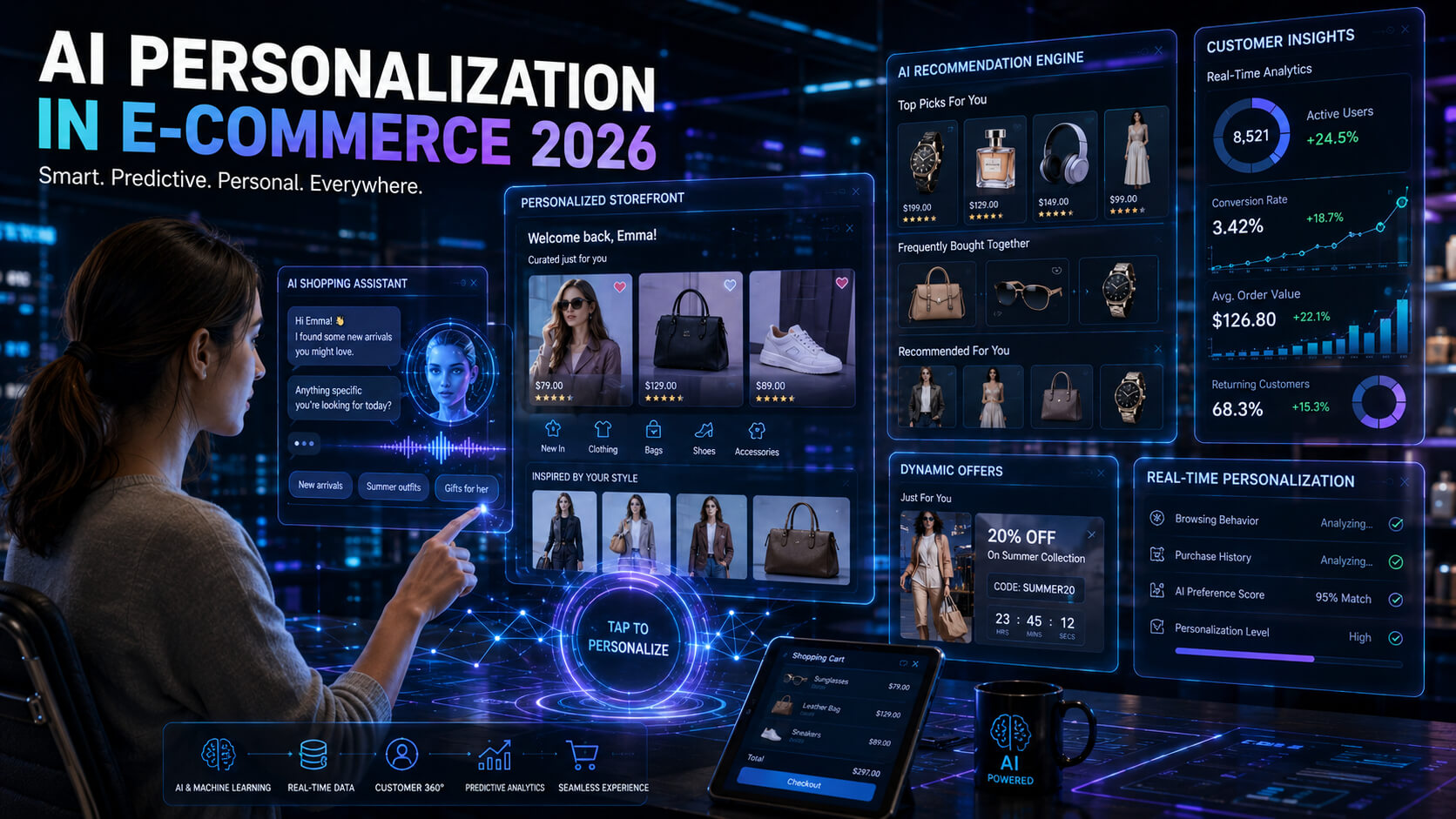
“Customers who bought this also bought” was revolutionary in 2005. In 2026, it is table stakes. Every e-commerce platform runs collaborative filtering. Every product page shows related items. The baseline level of personalization has become invisible because everyone does it.
The next wave of AI-powered personalization goes far beyond product recommendations. It predicts what customers need before they search for it. It generates personalized storefronts in real time. It adjusts pricing, messaging, and even product imagery based on individual behavior patterns. It creates conversational shopping experiences where customers describe what they want in natural language and AI curates the options.
This guide covers where e-commerce personalization actually stands in 2026, what the leading technologies can do, and how to implement them without the enterprise-grade budgets that only Amazon and Walmart can afford.
The Evolution of E-Commerce Personalization
| Era | Technology | Capability | Limitation |
|---|---|---|---|
| 2005 to 2015 | Collaborative filtering | “People who bought X also bought Y” | Cold start problem; ignores context |
| 2015 to 2020 | Machine learning models | Behavioral targeting, dynamic pricing | Requires large datasets; black box decisions |
| 2020 to 2024 | Deep learning and NLP | Visual search, semantic understanding | Expensive compute; limited to large retailers |
| 2025 to 2026 | Generative AI + real-time personalization | Predictive shopping, conversational commerce, dynamic content | Privacy concerns; implementation complexity |
The Five Frontiers of AI Personalization in 2026
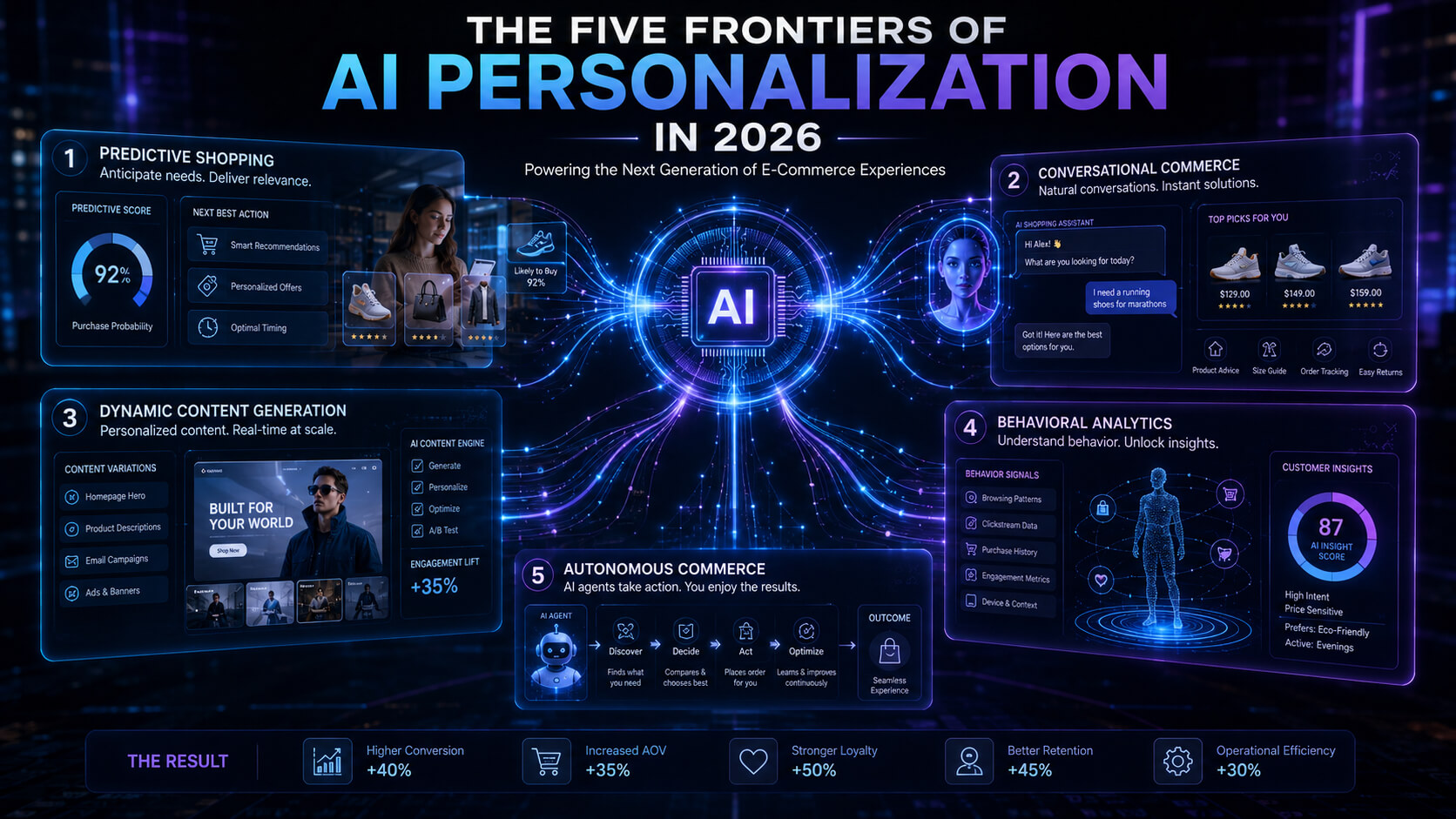
1. Predictive Shopping: Knowing What Customers Need Before They Search
Predictive shopping uses AI to anticipate purchase needs based on consumption patterns, seasonal behavior, life events, and contextual signals. The goal is to surface relevant products before the customer actively searches.
A pet food retailer knows your dog eats a 30-pound bag every 6 weeks. Three days before the predicted reorder date, the AI sends a replenishment reminder with a one-click purchase option. A fashion retailer notices you browse winter coats every October. In late September, it curates a personalized winter collection based on your style preferences and size history.
Amazon has done this for years with Subscribe & Save. The difference in 2026 is that AI makes predictive shopping viable for mid-market retailers who lack Amazon’s data volume. Modern platforms infer patterns from smaller datasets using transfer learning and contextual models.
2. Conversational Commerce: Shopping Through Dialogue
Conversational commerce replaces browsing with dialogue. Instead of filtering through category pages and product grids, customers describe what they want: “I need a gift for my sister, she is 28, likes hiking, and my budget is $75.”
The AI understands the intent, applies product knowledge, and presents a curated shortlist. It asks follow-up questions when needed: “Does she already have a good water bottle?” or “Would she prefer clothing or gear?” The interaction feels like talking to a knowledgeable sales associate.
Shopify, Klarna, and several DTC brands have deployed conversational shopping assistants in 2025 and 2026. Early data shows conversion rates 2x to 4x higher than traditional browse-and-filter shopping for considered purchases (items over $50 where the customer benefits from guidance).
3. Dynamic Content Generation: Personalized Storefronts at Scale
Generative AI enables real-time creation of personalized product descriptions, hero images, email subject lines, and landing pages tailored to individual customer segments.
A customer who has previously purchased athletic wear sees product descriptions emphasizing performance features and technical specifications. A customer who browses casually sees descriptions focused on style, comfort, and social proof. The product is the same. The presentation adapts to the buyer.
This extends to email marketing, where AI generates personalized subject lines and content blocks that increase open rates by 15% to 25% compared to one-size-fits-all campaigns.
4. Visual and Multimodal Search
Visual search lets customers photograph an item they like (a friend’s jacket, a piece of furniture in a magazine) and find similar products instantly. In 2026, this has expanded to multimodal search: combining images with text refinements.
A customer photographs a blue dress, then types “but in red and knee-length.” The AI interprets both the visual reference and the text modifications to surface precisely matched products. Pinterest Lens, Google Lens, and dedicated e-commerce visual search tools have made this capability accessible to retailers of all sizes.
5. AI-Optimized Pricing and Promotions
Dynamic pricing has existed for years in travel and hospitality. AI-powered pricing now extends to general retail, adjusting prices based on demand signals, competitive pricing, inventory levels, customer segment, and conversion probability.
The sensitive part: personalized pricing risks alienating customers who discover different prices for the same product. The best implementations focus on personalized promotions (offering discounts to price-sensitive segments or lapsed customers) rather than differential base pricing. Transparency matters. Customers who feel manipulated by hidden pricing algorithms leave and do not return.
Implementing AI Personalization: A Practical Guide
For Shopify and WooCommerce Stores
Product recommendations
Nosto (starts at $99/month), Rebuy ($99/month), and LimeSpot ($18/month) offer plug-and-play AI recommendation engines that integrate with Shopify in minutes. No coding required.
Conversational commerce
Tidio ($29/month with AI features) and Gorgias ($10/month + AI add-on) provide chatbot functionality with product recommendation capabilities.
Email personalization
Klaviyo ($20/month at entry level) uses AI to generate personalized email content, subject lines, and send-time optimization.
For Mid-Market E-Commerce ($1M to $50M Revenue)
Full personalization suite
Dynamic Yield (acquired by Mastercard), Bloomreach, and Algolia provide comprehensive personalization platforms covering search, recommendations, content, and merchandising. Pricing typically starts at $1,000 to $5,000/month.
Predictive analytics
Retention Science and Optimove offer AI-powered customer lifecycle management with predictive purchasing models.
For Enterprise E-Commerce ($50M+ Revenue)
Custom AI models
At enterprise scale, custom models trained on proprietary data outperform off-the-shelf solutions. AWS Personalize, Google Recommendations AI, and Azure Personalizer provide managed ML infrastructure for building custom recommendation and personalization systems.
Conversational commerce at scale
Enterprise chatbot platforms with commerce integration, custom LLM fine-tuning, and omnichannel deployment.
Measuring Personalization ROI
Revenue per visitor (RPV)
The primary metric. Compare RPV for personalized vs. non-personalized experiences. Well-implemented AI personalization typically increases RPV by 10% to 30%.
Conversion rate lift
Measure conversion rates for sessions that include personalized elements vs. those that do not. Isolate the impact through A/B testing.
Average order value (AOV)
AI-powered cross-selling and upselling typically increase AOV by 5% to 15%.
Customer lifetime value (CLV)
Personalization’s biggest impact is on repeat purchase rates. Track 90-day and 180-day CLV for cohorts exposed to different personalization levels.
Email engagement
AI-personalized emails show 15% to 25% higher open rates and 20% to 35% higher click-through rates compared to generic campaigns.
Expert Tips for E-Commerce Personalization
1. Start with search and recommendations before advanced personalization
AI-powered site search and product recommendations deliver the highest ROI for the lowest implementation complexity. Get these right before investing in conversational commerce or dynamic content.
2. Personalize based on behavior, not demographics
What a customer does on your site (browse patterns, cart additions, search queries) is far more predictive than who they are (age, gender, location). Behavioral personalization outperforms demographic targeting consistently.
3. Test aggressively, but measure correctly
A/B test every personalization element. But ensure your tests run long enough to capture statistical significance. Personalization effects compound over time, so short tests underestimate long-term impact.
4. Respect privacy and be transparent
Customers appreciate relevant recommendations. They resent feeling surveilled. Be transparent about what data you collect and how you use it. Offer clear opt-out options. Privacy-respecting personalization builds trust.
5. Do not over-personalize
When every element on the page is personalized, the experience can feel uncanny or manipulative. Leave room for discovery and serendipity. The best shopping experiences balance relevance with surprise.
Frequently Asked Questions
How is AI changing e-commerce personalization?
AI is moving e-commerce personalization beyond basic product recommendations to predictive shopping (anticipating needs before customers search), conversational commerce (dialogue-based shopping), dynamic content generation (personalized descriptions and imagery), visual and multimodal search (photo-based product discovery), and AI-optimized pricing. These capabilities increase conversion rates by 2x to 4x for considered purchases and revenue per visitor by 10% to 30%.
How much does AI personalization cost for small e-commerce stores?
Entry-level AI personalization tools for Shopify and WooCommerce start at $18 to $99/month for product recommendations. Adding AI chatbot functionality costs $29 to $100/month. Email personalization tools start at $20/month. A comprehensive small business personalization stack costs $100 to $300/month. Enterprise solutions range from $1,000 to $50,000+ monthly.
Does AI personalization actually increase sales?
Yes, when implemented correctly. Industry data shows AI personalization increases revenue per visitor by 10% to 30%, conversion rates by 15% to 25%, average order values by 5% to 15%, and email engagement by 15% to 35%. The impact compounds over time as models learn from more data. However, poorly implemented personalization (irrelevant recommendations, privacy violations, over-personalization) can hurt rather than help.
Your Next Step
AI-powered personalization is no longer a luxury reserved for Amazon and Walmart. Tools at every price point make it accessible to any e-commerce business willing to invest the effort.
Start with your site search. If customers are searching and not finding, you are losing revenue that personalization can recover. Add AI-powered recommendations to product pages and cart. Then expand into email personalization and conversational commerce as your data and capabilities grow.
The e-commerce businesses that win in 2026 will not be the ones with the largest inventories. They will be the ones that show each customer exactly what they need, exactly when they need it.
Want to grow your e-commerce, AI, or technology brand online? Publish high-authority guest posts through WritoryBuzz and improve your SEO, digital visibility, and industry credibility with strategic placements on trusted business and technology websites.