Here is the problem with most blockchain transactions: everyone can see everything. Every wallet balance, every transfer, every smart contract interaction is visible on a public ledger. That transparency is great for accountability, but terrible for privacy.
Zero-knowledge proofs (ZKPs) solve this by letting one party prove something is true without revealing the underlying information. You can prove you have enough funds without showing your balance. You can verify your identity without exposing personal data. You can validate a computation without re-running it.
With over $11.7 billion in ZK project market cap and production rollups processing millions of transactions, zero-knowledge proofs have moved from academic research to critical infrastructure for Web3. They are the technology behind faster Layer 2 scaling, compliant privacy in DeFi, and the next generation of decentralized identity systems.
This guide explains how zero-knowledge proofs work, why they matter, and where they are being used across blockchain, finance, and identity in 2026.
What Are Zero-Knowledge Proofs?
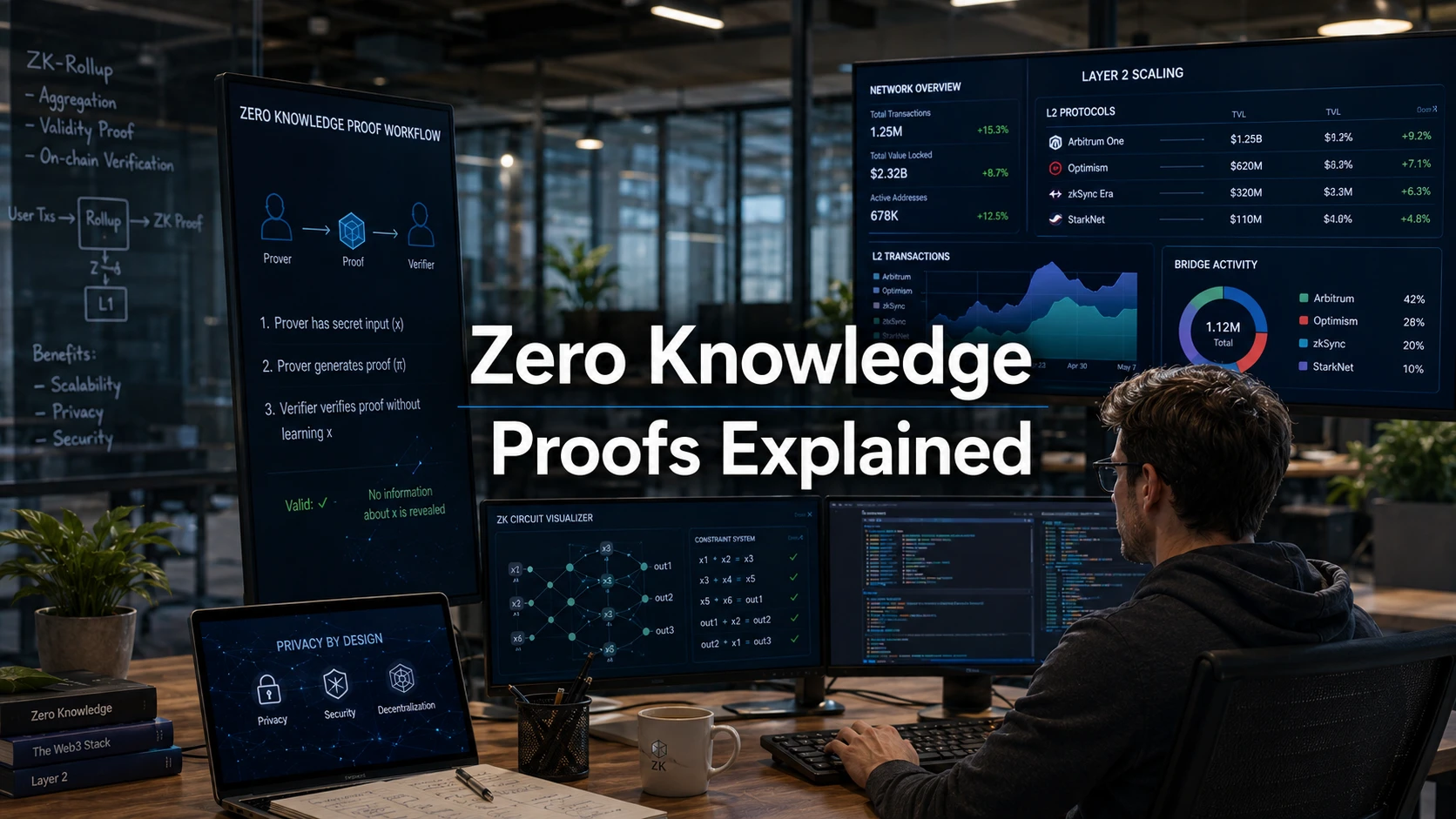
A zero-knowledge proof is a cryptographic method that allows one party (the prover) to convince another party (the verifier) that a specific statement is true without revealing any additional information beyond the truth of that statement.
The concept sounds abstract, so here is a simple analogy. Imagine you want to prove to someone that you know the password to a locked room. In a traditional verification, you would tell them the password and they would check it. With a zero-knowledge proof, you would walk into the room and come back out, proving you know the password without ever revealing what it is.
In blockchain terms, ZKPs allow users to prove they own certain assets, meet certain criteria, or completed certain computations without exposing the actual data involved. The verifier learns nothing except that the statement is valid.
Three Properties Every ZKP Must Satisfy
| Property | What It Means | Why It Matters |
| Completeness | If the statement is true, an honest prover can always convince an honest verifier | Guarantees that valid proofs always work |
| Soundness | If the statement is false, no cheating prover can convince the verifier it is true | Prevents fraud and false claims |
| Zero-Knowledge | The verifier learns nothing beyond whether the statement is true or false | Protects privacy of the underlying data |
Types of Zero-Knowledge Proofs
Not all zero-knowledge proofs work the same way. Two major families dominate the blockchain landscape, each with distinct trade-offs.
ZK-SNARKs (Succinct Non-Interactive Arguments of Knowledge)
ZK-SNARKs produce very small proofs that are fast to verify, making them ideal for blockchain applications where on-chain verification costs gas. They require a one-time trusted setup ceremony to generate initial parameters. Zcash pioneered the use of ZK-SNARKs for private cryptocurrency transactions, and they remain the most widely deployed ZKP type.
ZK-STARKs (Scalable Transparent Arguments of Knowledge)
ZK-STARKs do not require a trusted setup, making them more decentralized and resistant to certain attack vectors. Their proofs are larger than SNARKs but they offer better scalability for complex computations. StarkWare’s StarkNet uses ZK-STARKs to power one of the leading Layer 2 scaling solutions on Ethereum.
| Feature | ZK-SNARKs | ZK-STARKs |
| Proof size | Very small (hundreds of bytes) | Larger (tens of kilobytes) |
| Verification speed | Very fast | Fast but slightly slower |
| Trusted setup | Required (one-time ceremony) | Not required (transparent) |
| Quantum resistance | Vulnerable to quantum computers | Resistant to quantum attacks |
| Computation scalability | Good for smaller computations | Better for large, complex computations |
| Notable users | Zcash, zkSync, Polygon zkEVM | StarkNet, StarkEx |
How ZK Rollups Are Scaling Blockchain
The biggest practical application of zero-knowledge proofs today is ZK rollups, a Layer 2 scaling solution that bundles hundreds or thousands of transactions off-chain, generates a compact proof of their validity, and posts that proof to the main blockchain.
Instead of the main chain processing every single transaction individually, it only needs to verify one small proof that confirms all transactions in the batch are valid. This dramatically reduces gas costs and increases throughput while inheriting the security of the underlying Layer 1 blockchain.
Speed advantage: ZK rollups provide near-instant finality. Unlike optimistic rollups that require a 7-day dispute period for withdrawals, ZK rollups verify proofs immediately. Users can withdraw funds to Layer 1 in minutes rather than waiting a week.
Cost reduction: By batching transactions and compressing data, ZK rollups reduce per-transaction gas costs by 10x to 100x compared to transacting directly on Ethereum mainnet.
Security guarantee: Every batch is mathematically proven correct before being accepted by the main chain. There is no assumption of honesty, no fraud proofs needed, and no dispute resolution required.
Leading ZK Rollup Platforms in 2026
| Platform | ZKP Type | Key Features | Use Cases |
| zkSync Era | ZK-SNARKs | EVM compatible, account abstraction, low fees | DeFi, payments, NFTs |
| StarkNet | ZK-STARKs | Cairo language, high throughput, no trusted setup | Gaming, DeFi, complex dApps |
| Polygon zkEVM | ZK-SNARKs | Full EVM equivalence, Ethereum-native tooling | Enterprise, existing dApp migration |
| Scroll | ZK-SNARKs | Bytecode-level EVM compatibility, community focus | General purpose Ethereum scaling |
| Linea | ZK-SNARKs | ConsenSys backed, MetaMask integration | Consumer applications, Web3 onboarding |
Privacy Applications Beyond Scaling
While ZK rollups get the most attention, zero-knowledge proofs enable privacy capabilities that go far beyond transaction throughput.
Compliance-Friendly Privacy in DeFi
One of the most important trends in 2026 is the use of ZKPs for compliance-friendly privacy. Regulators demand transparency while users demand confidentiality. Zero-knowledge proofs allow both to coexist. A user can prove they are not on a sanctions list, that their funds come from legitimate sources, or that they meet KYC requirements without revealing personal or transactional data publicly.
DeFi protocols are adopting ZKPs to protect trading strategies, limit front-running, and enable private liquidity positions. This combination of privacy and compliance is opening DeFi to institutional participation for the first time.
Decentralized Identity and Verifiable Credentials
ZKPs power the next generation of digital identity. Instead of sharing your full passport, driver’s license, or government ID to prove your age, you can generate a zero-knowledge proof that confirms you are over 18 without revealing your exact date of birth, name, or address. This selective disclosure model gives users control over their personal data while satisfying verification requirements.
Private Voting and Governance
On-chain governance voting is public by default, which creates social pressure and enables vote buying. ZKPs enable private voting where the system can verify that each vote is valid and from an eligible participant without revealing how any individual voted. This brings the privacy of a ballot box to decentralized governance.
ZK-ML: Where Zero-Knowledge Meets Artificial Intelligence
The emerging field of ZK-ML enables verification of AI model outputs without exposing the model itself or its training data. A company could prove that an AI model produced a specific result without revealing the proprietary model architecture. As AI and blockchain converge in 2026, ZK-ML is positioning itself as the bridge for verifiable AI computation on-chain.
Challenges and Limitations of ZKPs
| Challenge | Current State | Outlook for 2026-2027 |
| Computational cost | Generating ZK proofs is resource-intensive and requires specialized hardware | Hardware acceleration (ZK ASICs) and algorithmic improvements are reducing costs rapidly |
| Developer complexity | Writing ZK circuits requires specialized knowledge beyond typical blockchain development | Higher-level languages and frameworks are making ZK development more accessible |
| Trusted setup concerns | ZK-SNARKs require trusted setup ceremonies that introduce a trust assumption | Migration toward STARKs and universal setup schemes is reducing this concern |
| Proof generation time | Complex proofs can take seconds to minutes to generate | Recursive proofs and parallel computation are shrinking generation times |
| Ecosystem fragmentation | Multiple competing ZK proving systems and standards | Standardization efforts are converging around common proof formats and interfaces |
Expert Tips for Understanding and Evaluating ZK Projects
Look at the proof system, not the marketing. Many projects claim ZK capabilities but use different underlying proof systems with varying security assumptions. Understand whether a project uses SNARKs, STARKs, or a hybrid, and what that means for trust assumptions and quantum resistance.
Check for EVM compatibility. For Ethereum-based applications, full EVM compatibility means existing smart contracts and tools work without modification. This dramatically reduces migration effort and developer friction.
Evaluate the trusted setup. If a project uses ZK-SNARKs, verify how the trusted setup was conducted, how many participants were involved, and whether the parameters can be verified publicly. A compromised trusted setup can undermine the entire system’s security.
Watch for hardware acceleration. The companies building ZK-specific hardware (ASICs, FPGAs) are reducing the computational bottleneck that has limited ZKP adoption. Projects that integrate with hardware acceleration will offer better performance and lower costs.
Follow the developer ecosystem. The ZK platforms attracting the most developers typically have the best tooling, documentation, and community support. Developer activity is one of the strongest predictors of long-term platform success.
Privacy and Scalability Are No Longer Trade-Offs
Zero-knowledge proofs prove that you do not have to choose between transparency and privacy, or between security and scalability. As ZK technology matures and becomes more accessible, it will underpin the infrastructure that makes Web3 viable for mainstream adoption.
For more on blockchain, Web3, and the technologies shaping the decentralized future, explore WritoryBuzz.com.
Frequently Asked Questions
What are zero-knowledge proofs in simple terms?
Zero-knowledge proofs are a cryptographic method that lets you prove something is true without revealing the underlying information. For example, you can prove you have enough money to make a purchase without showing your account balance. The verifier learns only that the statement is true, nothing else.
How do ZK rollups reduce blockchain transaction costs?
ZK rollups batch hundreds or thousands of transactions together off-chain, generate a small cryptographic proof that all transactions are valid, and post only that proof to the main blockchain. The main chain verifies one proof instead of processing each transaction individually, reducing gas costs by 10x to 100x.
What is the difference between ZK-SNARKs and ZK-STARKs?
ZK-SNARKs produce smaller proofs and verify faster but require a trusted setup ceremony. ZK-STARKs do not need a trusted setup, offer better quantum resistance, and scale better for complex computations, but produce larger proofs. Both achieve the same privacy guarantees through different mathematical approaches.
Are zero-knowledge proofs quantum-resistant?
It depends on the type. ZK-STARKs are designed to be resistant to quantum computer attacks because they rely on hash functions rather than elliptic curve cryptography. ZK-SNARKs are vulnerable to quantum computers, which is driving research into post-quantum SNARK constructions and increased interest in STARK-based systems.
Can ZKPs be used for identity verification?
Yes. Zero-knowledge proofs enable selective disclosure, where users can prove specific attributes about themselves (age, citizenship, qualification) without revealing the full underlying document. This is powering decentralized identity systems that give users control over their personal data while satisfying regulatory verification requirements.
What is ZK-ML?
ZK-ML combines zero-knowledge proofs with machine learning to verify that an AI model produced a specific output without exposing the model architecture or training data. This emerging field enables verifiable AI on blockchain, where users can trust that an AI result is genuine without needing access to the proprietary model that generated it.