
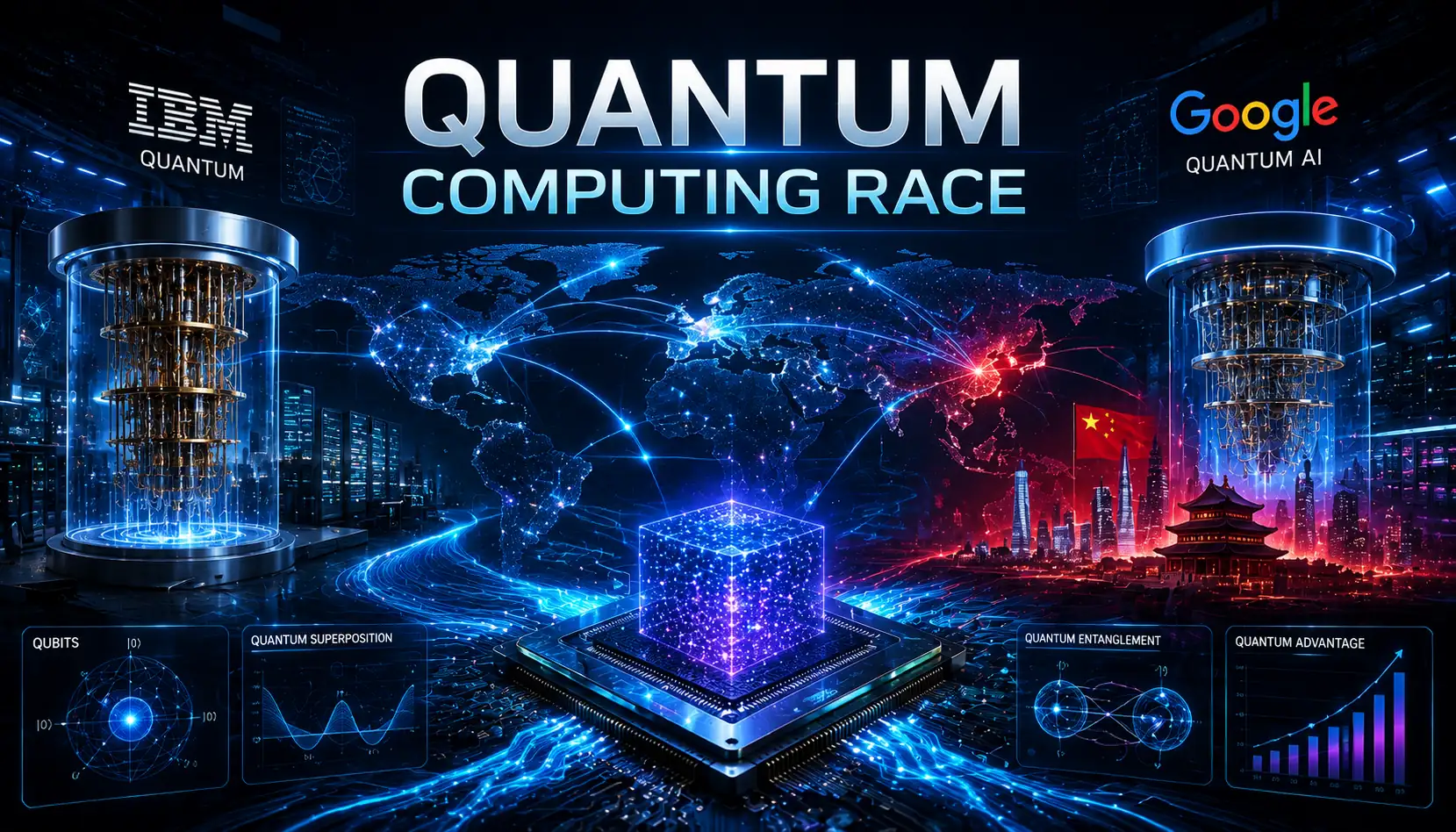
Quantum computing has spent two decades as technology’s most impressive unfulfilled promise. Not anymore.
In 2025 and 2026, something shifted. Multiple organizations hit specific, verifiable milestones simultaneously. Quantum systems delivered documented practical advantages over classical computers in real applications. The phrase ‘quantum advantage’ moved from marketing language toward something you can actually point at.
Here is where the major players stand, what they have actually demonstrated, and what the realistic timeline looks like.
What Quantum Computing Is (And Why Classical Computers Hit a Wall)
Classical computers store information as bits: 0 or 1. Quantum computers use qubits, which can exist as 0, 1, or both simultaneously (superposition). They also exploit entanglement, where qubits become correlated in ways that let quantum systems process certain types of problems exponentially faster.
For most everyday tasks, classical computers remain better. Quantum computing wins in specific domains: simulating molecular behavior for drug discovery, optimizing complex logistics networks, breaking and building encryption, and running certain machine learning workloads.
The practical implication: if your business touches chemistry, materials science, finance, logistics, or cryptography, quantum computing matters to your planning horizon. For everyone else, it is a technology to watch rather than act on immediately.
IBM: The Industrial Anchor
IBM has the most consistent and transparent roadmap in the industry. At the Quantum Developer Conference in November 2025, the company announced fundamental progress toward quantum advantage by end of 2026 and fault-tolerant quantum computing by 2029.
IBM’s approach is built on modular superconducting architectures. Their IBM Quantum System Two supports configurations scaling beyond 16,000 qubits across linked modules. The 2026 goal is not to build the biggest machine but to demonstrate utility: proving quantum systems can solve specific scientific problems cheaper or more accurately than classical alternatives.
Their advantage is ecosystem depth. IBM has built the largest quantum cloud network, published metric-driven roadmaps that have consistently hit milestones, and led development of quantum-safe cryptography standards. The company functions as the industrial anchor for the superconducting approach to quantum computing.
Google: Scientific Breakthroughs, Longer Commercial Horizon
Google’s 105-qubit Willow processor achieved a significant milestone: running the Quantum Echoes algorithm 13,000 times faster than classical supercomputers on a specific molecular simulation task. This is widely viewed as the first real-world quantum application demonstrating genuine advantage.
Google targets error-corrected quantum computers by 2029. Their approach emphasizes scientific firsts over commercial deployment pace. The Willow result matters because it was a useful task, not a synthetic benchmark designed to make quantum hardware look impressive.
The gap between Google’s scientific progress and IBM’s commercial ecosystem means both companies matter for different reasons. Google is advancing the science. IBM is building the platform.
China: Rapid State-Backed Acceleration
China has invested heavily in quantum computing through state funding, producing hardware and software across multiple approaches simultaneously. 2026 marks the start of China’s 15th Five-Year Plan, with quantum technology positioned as a ‘new economic growth point.’ The quantum industry is accelerating its transition from laboratory verification to industrial deployment.
At the infrastructure level, China is exploring integration of quantum computing into its national computing power network through the East-West Computing project. This level of state coordination creates a different development model than the corporate-led approach in the US.
Chinese institutions have demonstrated competitive results in photonic quantum computing, and the combination of state funding, manufacturing scale, and talent pipeline means China’s quantum program cannot be dismissed as a follower.
The Realistic Timeline for Business
| Period | What to Expect | Who Is Leading | What Businesses Should Do |
| Now (2026) | Narrow practical advantages in chemistry, optimization, cryptography research | IBM, Google, IonQ demonstrating specific use cases | Evaluate if your sector is on this list |
| 2027-2029 | First fault-tolerant quantum modules | IBM targets 2027-2029; Google 2029 | Start assessing cryptography exposure |
| 2030-2033 | Quantum-centric supercomputing at scale | IBM roadmap targets 1 billion gates on 2,000 qubits | Plan migration to quantum-safe encryption now |
| Post-2033 | Broad commercial quantum advantage | Industry consensus for transformative applications | Long-horizon strategic planning territory |
The One Thing Businesses Need to Do Right Now
Quantum computing’s most immediate business impact is not optimization or simulation. It is cryptography. Quantum computers will eventually break current RSA and elliptic curve encryption standards. The US National Institute of Standards and Technology finalized the first post-quantum cryptography standards in 2024. Organizations with long-lived sensitive data need to start planning migration now.
This is not a 2030 problem. Data stolen today and decrypted with quantum computers in five years is a risk that exists in 2026. Security teams and CISOs should have quantum-safe cryptography on their roadmap.
Common Mistakes
- Dismissing quantum computing as still purely theoretical, when specific practical advantages are now documented
- Assuming the biggest qubit count means the most useful system, qubits are meaningless without error correction
- Ignoring the quantum cryptography threat because quantum computers are not yet commercially available
- Treating all quantum computing news as equally credible when vendor hype and genuine milestones look similar in press releases
FAQ
What is quantum advantage and has it been achieved?
Quantum advantage means a quantum computer solving a problem faster or more accurately than any classical computer. Google’s Willow processor demonstrated this on a molecular simulation task in 2025. IBM is targeting scientific quantum advantage across broader categories by end of 2026.
When will quantum computers affect everyday business?
For most businesses, the direct impact is 5 to 10 years away. The immediate exception is cryptography: organizations should begin transitioning to post-quantum encryption standards now, before fault-tolerant quantum computers make current encryption vulnerable.
Is China ahead of the US in quantum computing?
Different approaches, different strengths. The US leads in superconducting quantum hardware (IBM, Google) and ecosystem development. China has advantages in state coordination and specific photonic approaches. Neither has a decisive overall lead.
Quantum computing is moving from research labs to real-world applications. WritoryBuzz helps brands turn complex technology topics into engaging, authoritative content that attracts readers and builds industry credibility.