
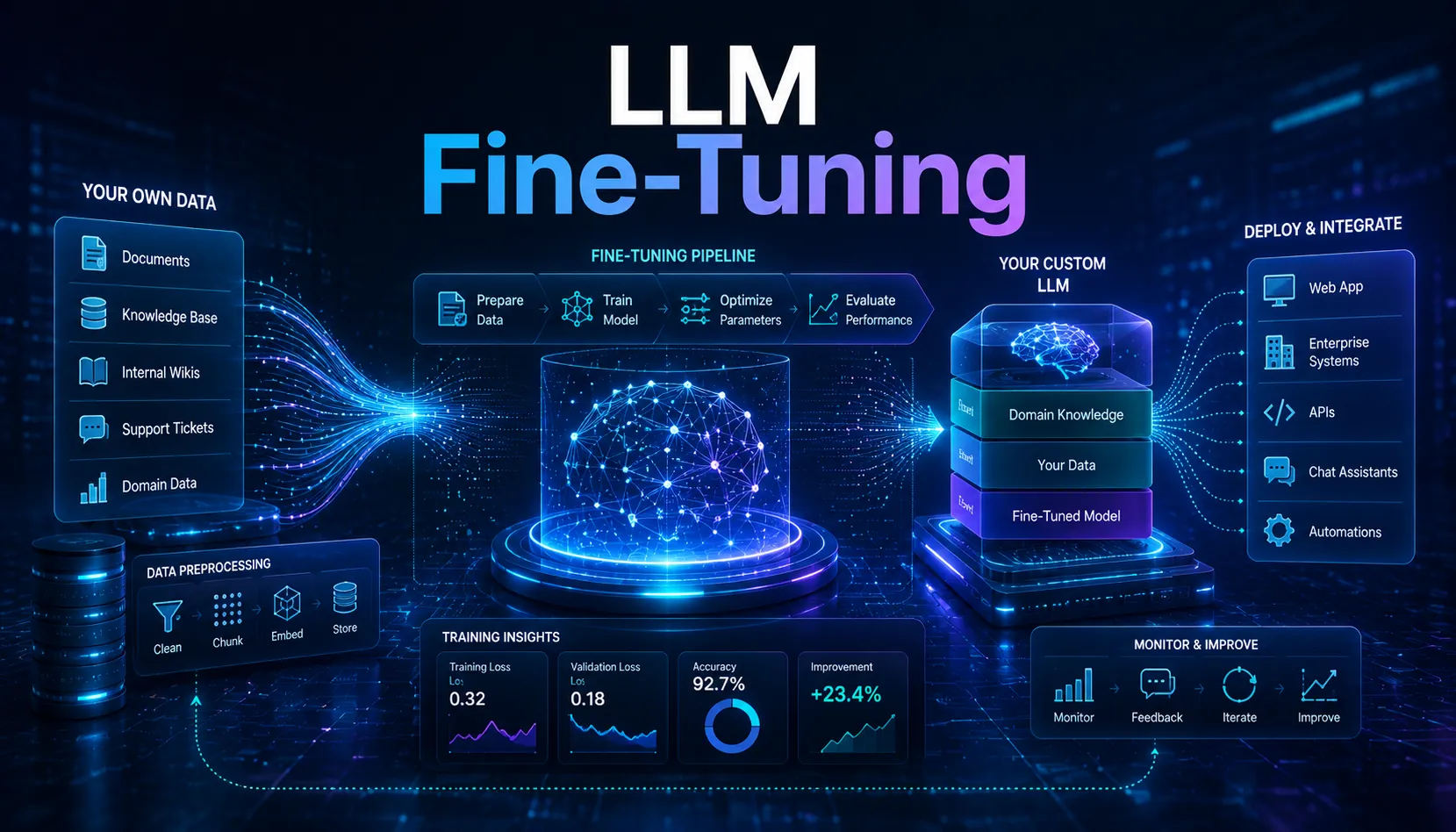
Two years ago, fine-tuning a large language model required a rack of A100 GPUs, a machine learning team, and a five-figure cloud bill. In 2026, a single consumer GPU can specialize a 7 billion parameter model on your domain data in an afternoon.
That shift happened because of two techniques: LoRA (Low-Rank Adaptation) and QLoRA (Quantized LoRA). Together they make fine-tuning accessible without sacrificing meaningful quality. This guide explains when fine-tuning is actually the right solution, how LoRA works in plain terms, and how to get started without a PhD.
First: Fine-Tuning vs RAG vs Prompt Engineering
These three approaches solve different problems. Choosing the wrong one wastes time and money.
| Approach | How It Works | When to Use It |
| Prompt Engineering | General-purpose model, guiding it with detailed instructions | No training needed; fast to iterate; breaks down for very specialized tasks or long context needs |
| RAG (Retrieval-Augmented Generation) | Your documents get retrieved at query time and injected into the prompt | Best for factual grounding, dynamic data, or large knowledge bases; model never ‘learns’ your data |
| Fine-Tuning | The model’s weights are adjusted to learn your domain, tone, or task pattern | Best for consistent behavior, brand voice, specialized output format, or when prompts become unmanageable |
Fine-tune when: your prompts are getting long and fragile, you need highly consistent tone or format, or you are working in a specialized domain where the base model performs poorly. Use RAG when: your data changes frequently, you need source attribution, or you want to search across large documents at runtime.
How LoRA Works (Without the Math)
Traditional full fine-tuning updates all of a model’s billions of parameters. For a 7B model, that means adjusting 7 billion numbers, which requires enormous memory and compute.
LoRA takes a different approach. Instead of updating the original weights, it freezes them and adds small trainable adapter matrices alongside specific layers. Only these compact adapters get trained, representing roughly 0.1% of the total parameters. Think of it like adding annotations to a book rather than rewriting the entire text.
QLoRA (Quantized LoRA) goes further by compressing the frozen base model to 4-bit integers before adding the LoRA adapters. This dramatically reduces memory requirements. The quality loss from quantization is minimal, and the 2026 consensus from Unsloth’s documentation is that QLoRA quality is nearly indistinguishable from full LoRA for most use cases.
What Hardware You Actually Need
| Model Size | Hardware Needed | Note |
| 7B model (e.g. Llama 3.2) | RTX 4070 Ti (12GB) or cloud T4 | Most accessible entry point in 2026 |
| 13B model | RTX 3090/4090 (24GB) or cloud L4 | Good balance of capability and cost |
| 70B model | 4x A100 or cloud A100 instance | Requires serious investment; cloud is practical |
| No local GPU | Google Colab Free/Pro, vast.ai, RunPod | QLoRA on free Colab T4 works for 7B models |
For most beginners in 2026, a 7B model on consumer hardware or a free Colab session is the right starting point. The 10,000x cost reduction from 2022 to 2026 means meaningful fine-tuning is now genuinely accessible.
Preparing Your Data
Data quality matters far more than data volume. 100 high-quality examples often outperform 10,000 mediocre ones.
For most instruction-following fine-tunes, format your data as JSONL with input-output pairs:
{“input”: “Summarize this contract clause in plain English”, “output”: “Your desired clean plain-English response here”}
Minimum dataset sizes by task: behavior modification (tone, style) needs 50 to 200 examples; domain specialization needs 500 to 2,000 examples; complex instruction following needs 1,000 to 5,000 examples. These are starting points, not hard rules.
Clean your data: remove duplicates, fix formatting inconsistencies, and ensure output quality is high throughout. Garbage in, garbage out applies more to fine-tuning than to almost any other ML task.
The Tools to Use in 2026
- Unsloth: the fastest and most memory-efficient fine-tuning framework in 2026; 2x faster than standard implementations with 70% less VRAM; supports Llama 3, Mistral, Phi, and Gemma families
- Axolotl: YAML-driven configuration; excellent for teams wanting reproducible runs; slightly less optimized than Unsloth but highly flexible
- Hugging Face PEFT: the foundational library; more manual but gives maximum control
- LM Studio: for running and testing your fine-tuned model locally after training
Key Hyperparameters to Start With
The 2026 Unsloth recommendation for beginners: start with r=16 (LoRA rank), alpha=16, target all linear layers, and train for 1 to 3 epochs. Do not overthink hyperparameters on your first run. Get a baseline working, then tune.
Watch for overfitting: if your training loss drops sharply but validation loss rises, the model is memorizing your examples rather than learning patterns. Reduce epochs or increase data diversity.
Evaluating Whether Your Fine-Tune Worked
There is no universal metric. Test your fine-tuned model against the base model on a held-out set of examples from your actual use case. Ask: does it produce the format you wanted? Does it stay in character or domain? Does it hallucinate less on your specific topic?
For anything going to production, have a human review at least 100 outputs from both the base model and your fine-tune. Benchmarks rarely capture what you actually care about.
Common Mistakes
- Fine-tuning when RAG would solve the problem faster and more flexibly
- Using low-quality training data and blaming the technique when results disappoint
- Training for too many epochs and overfitting to your examples
- Not keeping the base model for comparison; always test fine-tuned vs base side-by-side
FAQ
What is the difference between fine-tuning and RAG?
RAG retrieves your documents at query time and adds them to the prompt. The model never changes. Fine-tuning adjusts the model’s weights so it learns patterns from your data permanently. RAG is better for dynamic data and source attribution. Fine-tuning is better for consistent behavior, tone, and specialized task performance.
Do I need expensive hardware to fine-tune an LLM?
Not anymore. QLoRA on a free Google Colab T4 can fine-tune a 7B model in 2026. A consumer RTX 4070 Ti handles 7B models comfortably. Cloud options like vast.ai and RunPod make even 13B and 70B models accessible at reasonable cost.
How much data do I need to fine-tune an LLM?
For behavior and tone changes: 50 to 200 high-quality examples. For domain specialization: 500 to 2,000. Quality consistently beats quantity. 200 carefully curated examples produce better results than 2,000 mediocre ones.
Choosing the right approach prompt engineering, RAG, or fine-tuning can dramatically improve AI performance. WritoryBuzz creates expert technology content that helps readers understand complex AI concepts and stay ahead of industry trends.