
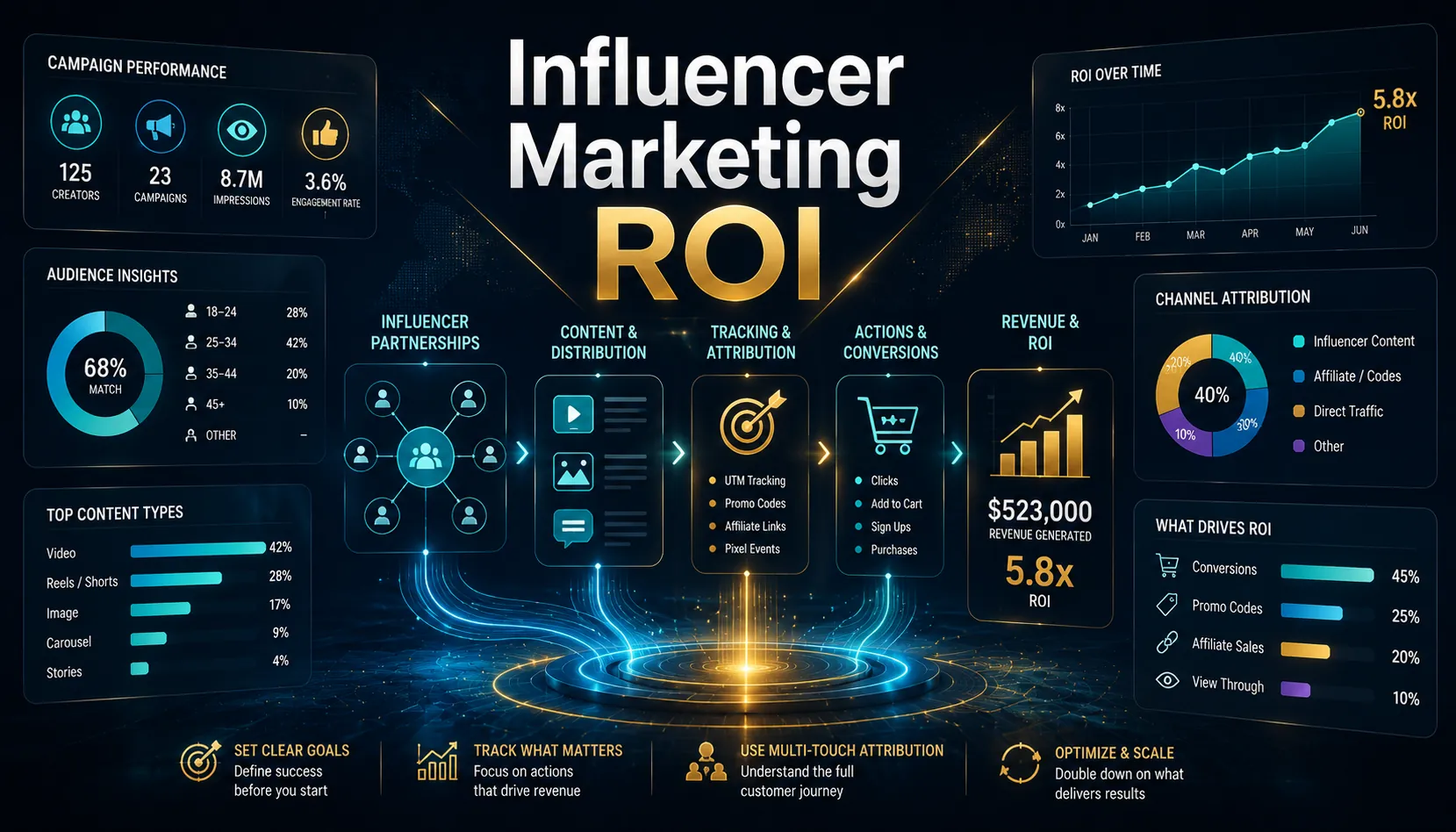
The influencer marketing industry hit $32.55 billion in 2026. Brands earn an average $5.78 for every dollar spent. And yet, between 26% and 60% of marketers — depending on the study — still identify ROI measurement as their biggest challenge.
The gap is not in the channel. It is in the model. Here is how to close it.
Keyword Research
| Keyword | Monthly Searches | Difficulty | Intent |
| influencer marketing ROI 2026 | 11,000 | Medium | Informational |
| how to measure influencer marketing | 8,400 | Low | Informational |
| influencer marketing benchmarks | 6,200 | Medium | Commercial |
| micro influencer vs macro ROI | 4,100 | Low | Informational |
| influencer attribution models | 3,800 | Low | Commercial |
The Numbers You Should Know
- Industry size: $32.55 billion globally in 2026, growing at 33.11% CAGR.
- Average ROI: $5.20-$5.78 returned for every $1 spent.
- Consumer trust: 86% of consumers made at least one influencer-inspired purchase in the past year.
- Budget commitment: 74% of brands plan to increase influencer marketing budgets in 2026.
- Nano-influencers: 75.9% of Instagram’s influencer base, achieving 2.71% engagement rates — 50% higher than micro-influencers.
- Authenticity premium: Gifted partnerships deliver 12.9% higher engagement rates than paid collaborations.
Why ROI Measurement Is Still Broken
Influencer content operates at the top and middle of the funnel. It seeds intent and brand affinity before a consumer ever reaches a paid search ad.
The problem: most attribution models credit the last touchpoint before purchase. The creator post that started the consideration journey gets zero credit. The retargeting ad that closed the sale gets all of it.
This is a model problem, not a measurement problem. Once you fix the model, you can defend and grow the budget.
The Signal Stack: A Better Measurement Framework
High-performing brands in 2026 build a Signal Stack — layered measurement across four levels:
Layer 1: Awareness
Brand Lift Surveys measure shifts in aided and unaided awareness among exposed audiences. This establishes baseline proof that a campaign moved the needle before anyone clicked.
Layer 2: Engagement
Track reach, impressions, video completion rates, saves, and shares. Saves are particularly valuable — they signal intent to return, not just passive viewing.
Layer 3: Traffic and Intent
Monitor UTM-tagged link clicks, website traffic from creator referrals, dwell time, and newsletter signups. These bridge the gap between awareness and action.
Layer 4: Conversion
Promo code usage, direct conversions through tagged links, and attribution modeling that weights top-of-funnel exposure. 74% of brands now track sales directly from influencer campaigns — up sharply from previous years.
Influencer Tier Comparison
| Tier | Follower Range | Avg Engagement | Best For | Avg Cost Per Post |
| Nano | 1K-10K | 2.71% | Hyperlocal, niche communities | $10-$200 |
| Micro | 10K-100K | 1.8% | Targeted reach + credibility | $200-$2,500 |
| Macro | 100K-1M | 1.2% | Scale with some authenticity | $2,500-$25,000 |
| Mega | 1M+ | 0.8% | Mass awareness campaigns | $25,000+ |
Micro-influencers deliver 3.2x the engagement of mega-influencers per dollar spent. For most brands, the math favors a network of micro and nano creators over a single celebrity deal.
Platform-by-Platform ROI Reality
| Platform | Strengths | Avg Engagement Rate | Best Content Type |
| Visual storytelling, shopping integration | 1.8-2.7% | Reels, carousels, stories | |
| TikTok | Viral reach, discovery engine | 2.9-4.1% | Short-form video, trends |
| YouTube | Long-form trust, high purchase intent | 0.4-0.9% but high view depth | Reviews, tutorials, vlogs |
| B2B trust, professional audiences | 0.5-1.2% | Thought leadership, case studies | |
| Podcast | Intimate, high conversion for niche products | Varies; promo codes track well | Host-read ads, interviews |
5 Measurement Mistakes Brands Keep Making
- Chasing vanity metrics: Impressions without benchmarking against CPM alternatives. If a creator post costs the same as a display ad and delivers 4x the engagement, the creator wins.
- Ignoring earned media value: Creator content that generates organic shares and reposts has compounding value beyond the initial post.
- No content usage rights: Brands that own creator content can amplify it through paid ads over 6-12 months — multiplying the original investment.
- One-size attribution: The attribution model for a niche B2B software product needs more last-touch weight. The model for a fashion brand should weight awareness heavily.
- Measurement without benchmarks: Raw numbers mean nothing without context. Your engagement rate only matters compared to category averages.
Fraud: The 12.73% Problem
Fake engagement and authenticity issues remain top-tier operational concerns. Fake followers inflate reach metrics. Engagement pods inflate interaction rates. Both waste budget.
Practical fixes:
- Use third-party audit tools: HypeAuditor, Modash, or Creator.co provide follower quality scores.
- Check the follower-to-engagement ratio: An account with 500K followers averaging 100 likes per post has a problem.
- Prefer gifted-first relationships: Creators who accept gifted product before paid deals tend to produce more authentic content.
The most successful campaigns are built on data, not assumptions. WritoryBuzz creates practical marketing content that helps brands measure performance, improve ROI, and make smarter growth decisions.
FAQ
What ROI should I expect from influencer marketing?
Industry average is $5.78 per $1 spent, but this varies widely by tier, platform, product category, and measurement sophistication. High-performing brands regularly exceed $10-15 per dollar with tight targeting and proper attribution.
How do I prove influencer ROI to stakeholders?
Build the Signal Stack, own your measurement definitions in-house, and present cross-funnel evidence: awareness lift, traffic increase, and conversion data together.
Should I work with one big influencer or many small ones?
For most budgets, many small beats one big. Nano and micro-influencers deliver higher engagement, more authentic content, and lower cost per engaged user.