
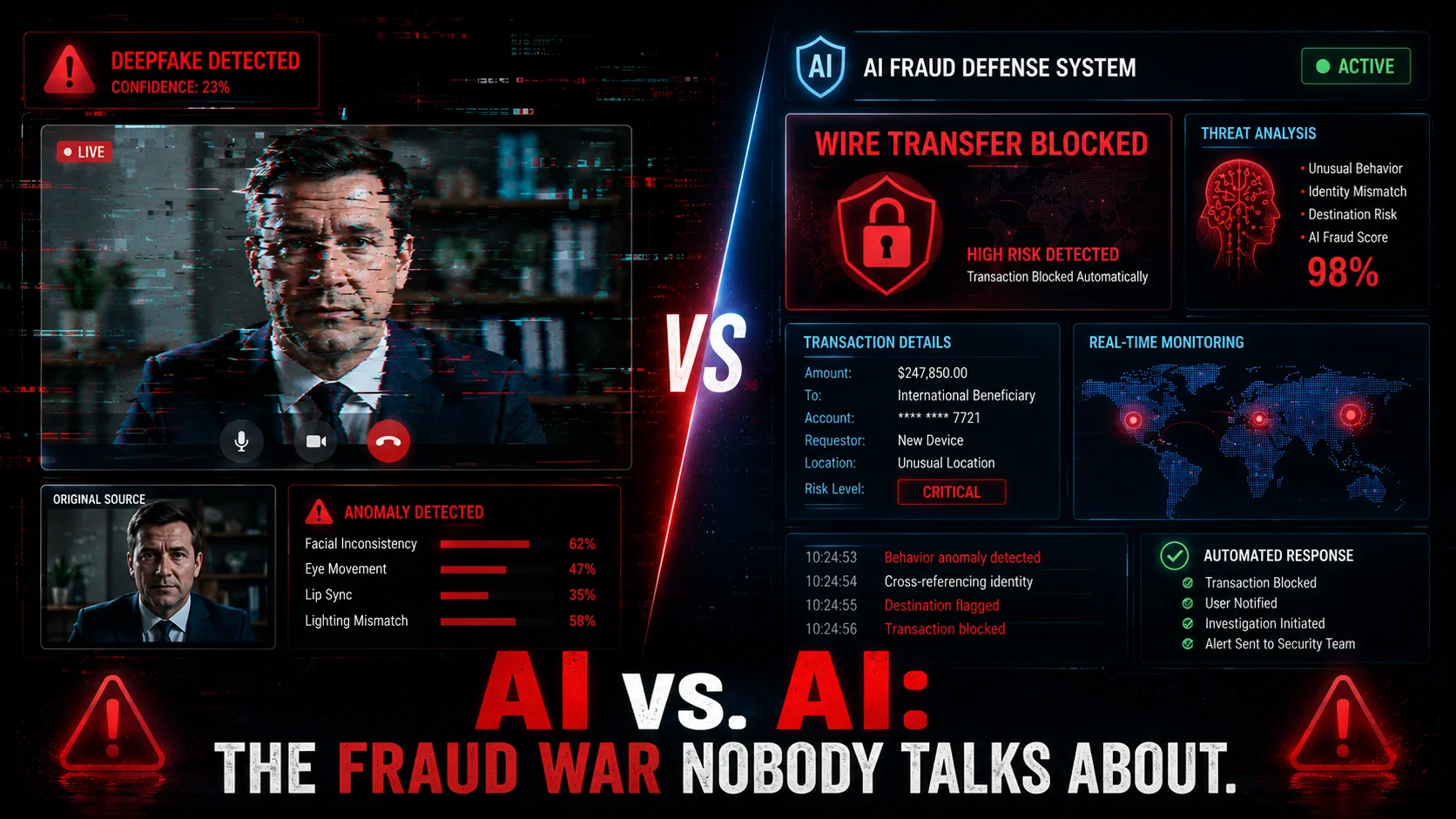
A CFO at an engineering firm joins a video call. The faces look real. The voices sound familiar. By the time it ends, $25.6 million has been wired to accounts the company will never recover.
That was Arup in 2024. It happened via deepfake. And it is no longer an edge case.
Financial fraud in 2026 is faster, more convincing, and more automated than anything rule-based systems were designed to stop. Here is how AI is fighting back, and where it is still losing.
The Scale of Financial Fraud in 2026
- The FBI IC3 recorded $16.6 billion in US cybercrime losses in 2024 – a 33% year-over-year increase.
- The European Banking Authority reported payment fraud losses reached €4.2 billion in 2024, up from €3.5 billion the previous year.
- Consumers worldwide lost $442 billion to scams in 2024, according to the Global Anti-Scams Alliance.
- Deepfake fraud increased by 900% over the past two years.
- Synthetic identity fraud, the fastest-growing financial crime, now costs institutions more than $5 billion annually.
- Cyber-enabled fraud has overtaken ransomware as the top concern for CEOs in the World Economic Forum’s 2026 Cybersecurity Outlook.
Traditional rule-based systems averaged only 37.8% accuracy in real-world fraud detection. AI models achieve 87-96.8% accuracy, a gap that results in billions of dollars in losses.
How AI Fraud Detection Works
Real-Time Transaction Monitoring
Modern AI transaction monitoring analyzes each payment within milliseconds. The model scores it against behavioral baselines: typical transaction size, frequency, location, device, time of day, and merchant category. A $4 coffee in your home city scores low risk. The same card used for a $2,000 electronics purchase in a different country, 20 minutes later, scores high.
Anomaly Detection
Isolation forests, local outlier factor algorithms, and k-nearest neighbor models identify statistical outliers across high-dimensional data. These approaches catch fraud patterns that human analysts would never spot in transaction logs.
Graph AI
Fraud does not happen in isolation. Graph neural networks map the relationships between accounts, devices, IP addresses, and merchants. A single account that looks clean might connect through three hops to a known fraud network. Graph AI surfaces those connections.
Natural Language Processing
NLP models screen communications for social engineering patterns, urgency cues, unusual payment requests, and impersonation indicators. This layer catches business email compromise before the wire transfer happens.
The Deepfake Problem
AI detection tools currently flag 85-93% of deepfake attempts. The remaining 7-15% are the problem.
Deepfake video calls are now sophisticated enough to fool employees in real time. The Arup case used deepfakes of known executives to authorize a transfer. No password was stolen. No system was breached. The attack went through the humans.
The countermeasure that works: pre-shared code phrases. Establish a verbal or written code known only to trusted parties. Any payment request above a threshold requires the code. AI cannot generate code it does not know.
Agentic AI: The Next Frontier
The most significant shift in 2026 is the move from AI that detects to AI that acts.
Agentic fraud detection systems do not just flag suspicious transactions, they initiate workflows, request supporting documentation, escalate cases based on risk thresholds, and continuously refine their detection logic without manual retraining.
In practice, this means AI functions as a continuous compliance auditor. High-risk activity gets escalated before the month-end reconciliation. Policy exceptions surface automatically. Human investigators focus on the highest-risk cases instead of screening routine alerts.
AI Fraud Detection: Performance vs. Limitations
| Capability | Performance | Limitation |
| Transaction anomaly detection | 95%+ precision, 80% fewer false positives | Requires historical behavioral data to baseline |
| Deepfake detection | 85-93% accuracy | 7-15% false negatives can cost millions |
| Synthetic identity fraud | High recall on known patterns | New synthetic patterns require retraining |
| Social engineering detection | Strong on text-based attacks | Real-time voice deepfakes still challenging |
| Investigation speed | 3-5x faster than human review | Still requires human sign-off for large transactions |
The Fraud Paradox
Experian’s 2026 Future of Fraud Forecast found that nearly 60% of companies saw fraud losses rise last year — even as AI adoption accelerated.
The reason: attackers use the same AI tools. Synthetic identities are generated with AI. Phishing emails written by AI now achieve click-through rates more than four times higher than human-crafted versions.
AI-enhanced fraud detection is not a solved problem. It is an arms race where both sides use the same weapons.
What Finance Leaders Need to Do Now
- Layer verification: Dual-approval financial controls, out-of-band verification, and pre-shared code phrases reduce risk when any single communication channel can be synthetically replicated.
- Audit your AI models: Drift detection matters. A fraud model trained on 2023 patterns will miss 2026 synthetic identity techniques.
- Map your exposure: Know which transaction types and amounts are highest risk. Concentrate on detection investment first.
- Train humans alongside AI: The most expensive fraud attacks target people, not systems. Regular simulation exercises build the muscle memory that prevents Arup-style losses.
FAQ
Can AI completely prevent financial fraud?
No. The goal is detection speed and precision, not prevention of every attack. The faster fraud is flagged, the lower the loss. Zero fraud is not achievable; minimized losses are.
How long does it take AI to flag a suspicious transaction?
Modern real-time scoring models operate within milliseconds, fast enough to intervene before authorization completes.
Is AI fraud detection affordable for small businesses?
Yes. Most payment processors and banking-as-a-service platforms embed AI fraud detection by default. Small businesses access it through their existing payment infrastructure, not separate enterprise contracts.