
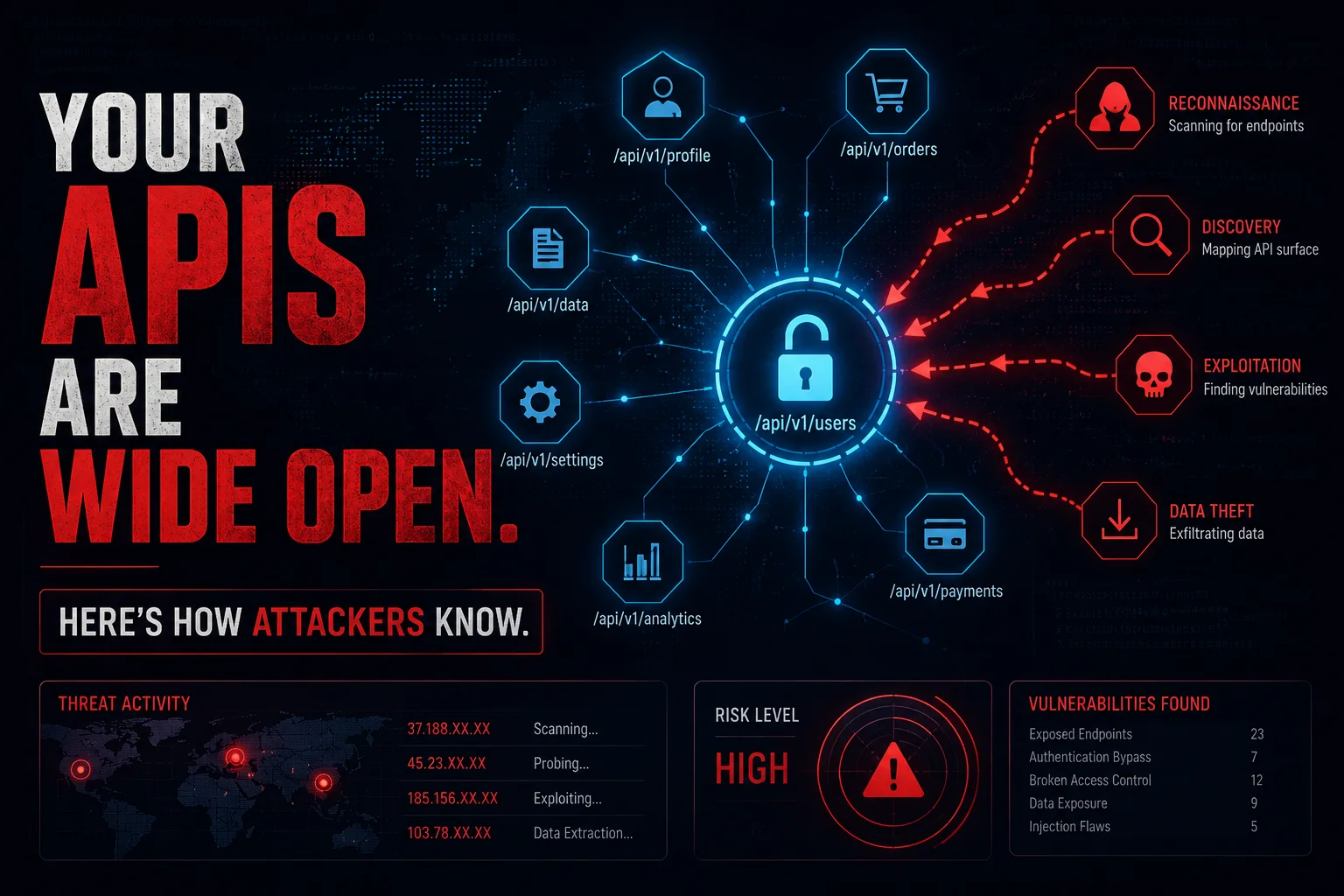
Your firewall is configured. Your endpoints have SSL. Your passwords are hashed. And yet attackers are walking straight into your systems.
Often through your APIs.
API incidents now account for over 30% of all data breaches, up from less than 20% two years ago. And 63% of security teams say APIs are their biggest data exposure risk. Here is why that number keeps climbing, and what to do about it.
The Scale of the Problem
APIs are everywhere. Every mobile app, SaaS product, and cloud integration runs on them. The number of active APIs is expected to reach 1.7 billion by 2030.
That surface area is enormous. And attackers know it.
- 99% of organizations experienced at least one API security issue in the past year.
- API attack traffic has surged by over 600% in recent years.
- Only 21% of organizations report strong API attack detection capabilities.
- Just 13% can prevent over half of API attacks.
- 43% of CISA’s Known Exploited Vulnerabilities list in 2025 involved API attack surfaces.
The gap between how fast APIs are being deployed and how well they are being secured has never been wider.
The Top API Vulnerabilities in 2026
The 42Crunch State of API Security 2026 report analyzed 200 real-world production vulnerabilities. Here is what the data shows:
| Vulnerability | Share of Incidents | What It Means |
| Broken authentication | 23.5% | Missing auth, weak credentials, or bypass flaws |
| Broken object-level authorization (BOLA) | 18.2% | Attacker accesses other users’ objects by changing an ID |
| Injection attacks | 15.1% | SQL, command, or NoSQL injection through API params |
| Security misconfiguration | 14.3% | Exposed debug endpoints, default credentials, open CORS |
| DoS/resource abuse | 10.9% | Rate limiting absent; attackers drain compute or data |
| Mass assignment | 7.3% | Improper input validation lets attackers modify fields they shouldn’t |
Why AI Made This Worse
AI did not create API security problems. It amplified them.
In 2025, 2,185 AI-related vulnerabilities were disclosed. Of those, 36% were also API vulnerabilities. As AI agents make autonomous API calls on behalf of users, attackers gain a new tool: bots that learn from API responses in real time, rapidly identifying misconfigurations and exposed endpoints.
Model Context Protocol (MCP) emerged as a new attack surface in 2025, with 315 MCP-related vulnerabilities identified – a 270% surge from Q2 to Q3 alone.
Bottom line: Every AI transformation runs through APIs. Secure your APIs or your AI adoption creates new risk faster than it creates value.
Shadow APIs: The Threat You Cannot See
Shadow APIs are the APIs within your organization that nobody manages or monitors. They get introduced by developers during rapid iteration, forgotten after a project ends, or inherited through acquisitions.
You cannot secure what you do not know exists. Shadow API risks include:
- Backdoors installed through malware injections.
- Endpoints without authentication requirements.
- Stale APIs with unpatched vulnerabilities that nobody is tracking.
The fix starts with API discovery. You need a complete, continuously updated inventory of every endpoint your organization exposes internally and externally.
What Attackers Actually Do
‘Abuse beats bugs’ is the clearest finding from the 2026 API ThreatStats report. Attackers favor logic abuse, trust failures, and resource consumption over traditional code exploits.
Practical examples:
- Credential stuffing through residential proxies: Standard IP-based rate limiting fails. Attackers rotate through thousands of clean-looking IPs. The fix requires IP reputation checks before rate limiting.
- BOLA in practice: An endpoint returns /orders/1234. The attacker changes it to /orders/1235. If object-level authorization is missing, they see another customer’s order.
- Mass assignment: A signup form sends {name, email}. The attacker adds {role: admin} to the request body. If the API binds all fields without filtering, the privilege escalation succeeds.
API Security Best Practices for 2026
| Layer | Best Practice | Why It Matters |
| Authentication | Use OAuth 2.0 / JWT with short expiry | Eliminates long-lived stolen token risk |
| Authorization | Enforce object-level checks server-side per endpoint | Stops BOLA — the most common breach vector |
| Input validation | Whitelist allowed fields on every request body | Prevents mass assignment and injection |
| Rate limiting | Layer IP reputation checks before rate limiters | Defeats residential proxy credential stuffing |
| Discovery | Maintain a live API inventory with security tags | Shadow APIs cannot be secured if unknown |
| Monitoring | Log all API traffic; alert on anomalous patterns | Abuse detection requires behavioral baselines |
Tools Worth Knowing
- 42Crunch: API security testing and contract compliance.
- Salt Security: Behavioral API threat detection.
- Wallarm: API attack detection and blocking.
- Postman: API testing with security test collections.
- OWASP API Security Top 10: Free baseline framework for any team.
FAQ
Is HTTPS enough to secure an API?
No. HTTPS encrypts data in transit. It does nothing to stop an authenticated attacker from abusing your business logic or accessing objects they should not reach.
What is the fastest win an API security team can achieve?
Build and maintain a complete API inventory. You cannot prioritize what you cannot see.
How often should API security audits happen?
Continuously for production APIs. Point-in-time audits miss the period between them. Automated scanning and behavioral monitoring should run all the time.
Want to build authority in AI, machine learning, SaaS, or enterprise technology? Publish high-quality guest posts through WritoryBuzz and get featured on trusted technology websites that improve rankings, visibility, and industry credibility.