
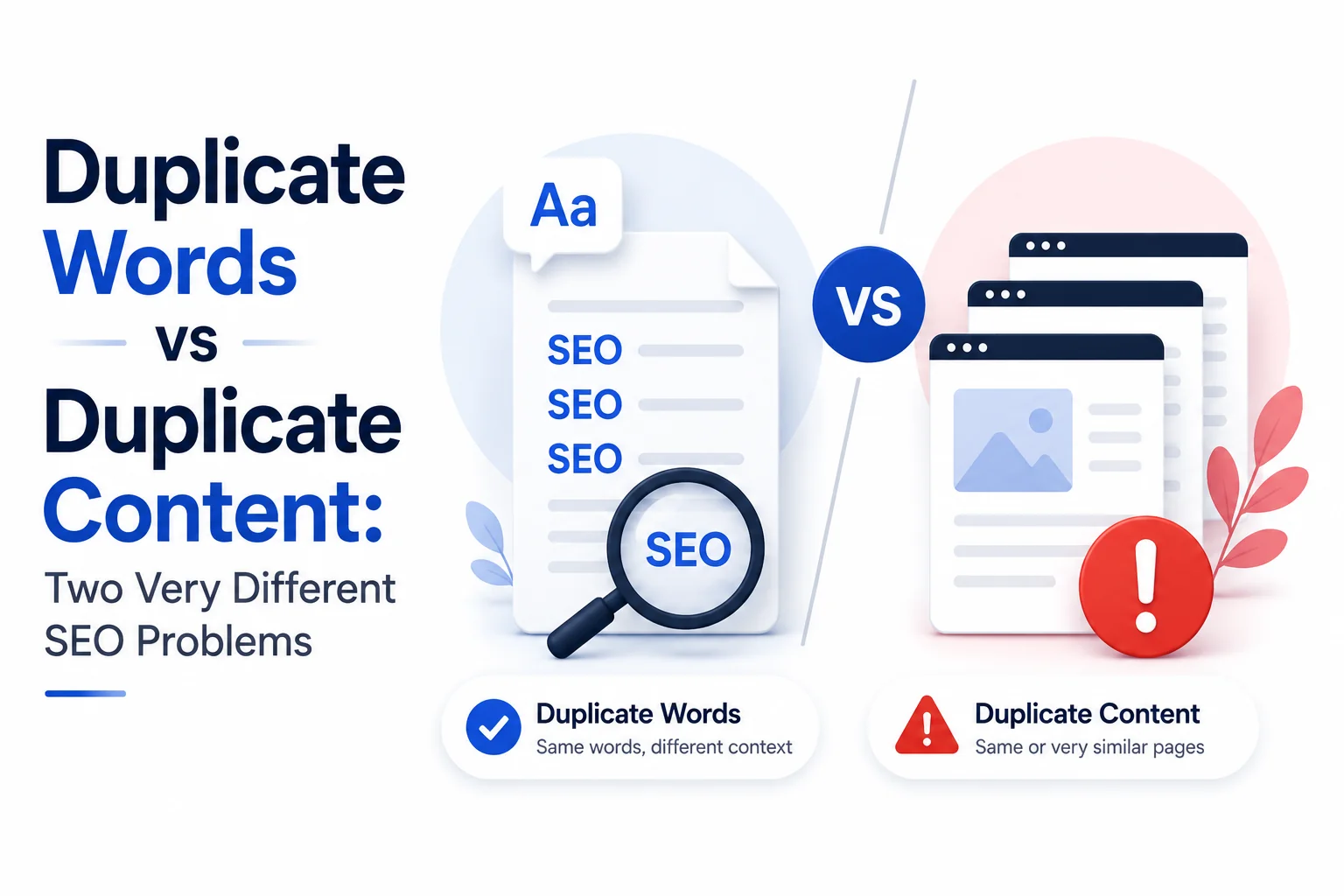
Google’s Search Central documentation addresses duplicate content directly, defining it as substantive blocks of content within or across domains that either completely match or are appreciably similar, a definition that operates at the page or URL level. Nothing in that definition or Google’s broader guidance treats individual repeated words within a single page as the same category of issue, despite the similar-sounding names causing regular confusion between the two.
This comparison separates the two concepts clearly: what each one actually is, how search engines treat each differently, and why fixing one does nothing to address the other.
What Duplicate Words Actually Means
Duplicate words, in the sense covered throughout this content cluster, refers to unintentional repetition within a single piece of writing, the same word, phrase, or sentence appearing more often than natural variation would produce, hurting readability and reading flow. This is a writing quality issue evaluated within one page, with no cross-page or cross-domain dimension to it.
What Duplicate Content Actually Means
Duplicate content refers to substantially identical or near-identical content appearing at multiple distinct URLs, either on the same domain or across different domains. Common causes include URL parameter variations creating multiple addresses for the same page, scraped or syndicated content republished elsewhere without modification, and boilerplate text, such as legal disclaimers, repeated verbatim across many pages of the same site.
How Search Engines Treat Each Differently
Repeated words within a page affect ranking indirectly, through the readability and engagement pathway covered elsewhere in this cluster, with no direct algorithmic penalty specifically targeting word-level repetition. Duplicate content across pages is handled more directly: search engines choose one version to show in results and may consolidate or dilute ranking signals across the duplicates, which can suppress visibility for some or all of the affected URLs.
Severe or intentional duplicate content, such as large-scale content scraping across many domains, can trigger more serious algorithmic action, a distinction from the comparatively minor, indirect effect of word-level repetition within one piece of otherwise original writing.
Side-by-Side Comparison
| Attribute | Duplicate Words | Duplicate Content |
| Scope | Within a single page | Across multiple URLs or domains |
| Primary effect | Readability and reading flow | Ranking consolidation or suppression |
| Search engine treatment | No direct penalty | May choose one version, dilute signals |
| Typical cause | Drafting and editing habits | URL parameters, syndication, boilerplate |
| Fixed by | Editing and dedupe tools | Canonical tags, redirects, or content changes |
Why the Confusion Happens
The similar terminology is the entire source of confusion. Both problems share the word duplicate, both are frequently discussed in SEO content, and both do genuinely relate to repetition in some form, which makes it easy to assume a fix for one addresses the other. It does not. Running a dedupe tool on a page’s word-level repetition has zero effect on whether that page is a duplicate of another URL elsewhere on the site or web.
Fixing Each Problem Correctly
Word-level repetition is fixed through editing, ideally supported by a free remove duplicate words tool that catches instances a manual read-through might miss.
The full method for this, covering word, line, and sentence-level detection separately, is in How to Remove Duplicate Words, Lines and Sentences From Any Text.
Duplicate content across pages requires a different toolkit entirely: canonical tags to indicate the authoritative version, 301 redirects to consolidate genuinely redundant URLs, or, where the duplication was unintentional, revising one of the pages to be substantively different from the other rather than relying on a technical workaround alone.
Checking for Both in the Same Content Review
A content quality review that addresses word-level repetition without also checking for page-level duplication, or vice versa, only catches half the picture. Pairing a dedupe pass with a keyword density checker covers the word-level concern thoroughly, while a separate technical SEO audit checking for URL parameter duplication and syndicated content coverage addresses the page-level concern, and both belong in a complete content review process.
Related Reading in This Cluster
For the underlying reasoning behind why word-level repetition matters for readability specifically, see Why Duplicate Words and Repetition Hurt Readability.
For a full eight-pass pre-publish checklist that includes both word-level and structural checks in the same routine, see Text Cleanup Checklist: 8 Passes Before You Hit Publish.
Same Word, Two Unrelated Problems
Treating these as the same issue leads to solving the easier, lower-stakes problem while leaving the higher-stakes one unaddressed. Word-level repetition is a writing craft issue with a modest, indirect SEO effect. Duplicate content is a technical SEO issue that can meaningfully suppress a page’s visibility. Both deserve attention, but neither substitutes for the other. Explore the rest of WritoryBuzz’s free SEO and content toolkit to address both in the same review pass.
Frequently Asked Questions: Duplicate Words vs Duplicate Content
Are duplicate words and duplicate content the same SEO problem?
No. Duplicate words refers to repetition within a single page affecting readability, while duplicate content refers to substantially identical content appearing at multiple URLs, which search engines handle through ranking consolidation or suppression.
Does removing duplicate words fix duplicate content issues?
No. The two problems are unrelated. Editing a page to remove repeated words has no effect on whether that page is a near-duplicate of another URL elsewhere on the same site or across the web.
What typically causes duplicate content across a website?
Common causes include URL parameter variations creating multiple addresses for the same page, scraped or syndicated content republished without modification, and boilerplate text such as legal disclaimers repeated verbatim across many pages.
How do search engines handle duplicate content differently from repeated words?
Search engines may choose one version among duplicate content URLs to display and dilute or consolidate ranking signals across the rest. Repeated words within a single page carry no equivalent direct penalty, affecting rankings only indirectly through readability.
What tools fix duplicate content versus duplicate words?
Duplicate words are fixed through editing, supported by a dedicated dedupe tool. Duplicate content is fixed through canonical tags, 301 redirects, or substantively revising one of the duplicate pages, an entirely different technical approach.
Can severe duplicate content trigger a more serious search penalty?
Yes, particularly large-scale content scraping across many domains can trigger more serious algorithmic action, a distinction from the comparatively minor, indirect effect that word-level repetition within otherwise original writing has on rankings.