
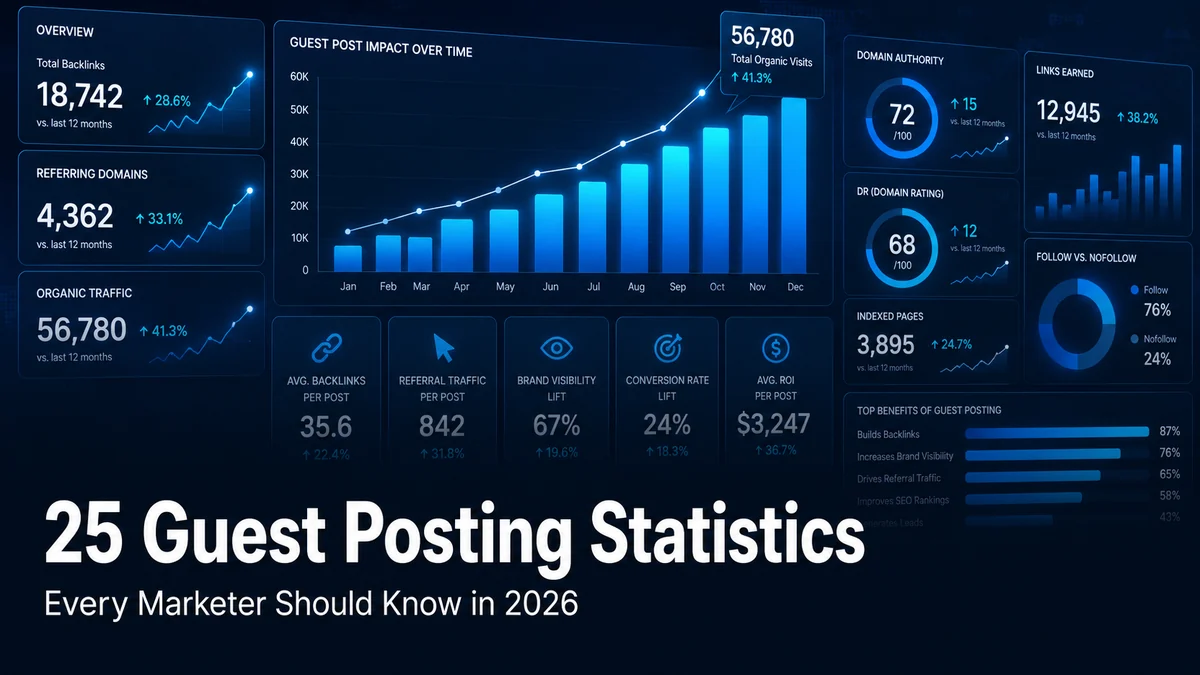
The global link-building services market reached an estimated 25.97 billion US dollars in 2025 and is projected to grow to 57.07 billion US dollars by 2030, according to market data compiled in 2026 industry reporting. That kind of growth means more data than ever is available on what guest posting and link building actually deliver, and also more noise, recycled numbers, and outdated benchmarks circulating alongside the real research. The 25 statistics below are pulled from named, dated 2025 and 2026 surveys and studies so every number here reflects the current state of the industry, not a recycled figure from years ago.
Before the full list, it is worth noting that raw statistics only tell part of the story. Where you actually place a guest post matters as much as any benchmark below, since even a well-written article on the wrong site produces none of the outcomes these numbers describe.
Since site quality is the variable that determines whether any of these statistics apply to your own campaign, it is worth knowing where genuinely editorial placements are still available. WritoryBuzz reviews every contributor pitch across business, AI, fintech, and cybersecurity before publication, which is the kind of editorial standard the data below shows is increasingly rare.
How This List Was Compiled
Every statistic below is drawn from a named, dated source published in 2025 or 2026, cross-checked against at least one additional independent survey wherever the same figure appeared in more than one report. Where two credible sources reported slightly different numbers for the same metric, both are noted rather than averaged, since the underlying survey methodology and sample size differ enough between studies like Editorial.link’s 518-professional survey and Authority Hacker’s 755-practitioner survey that averaging would misrepresent either one. This approach favors transparency over a single tidy number.
Cost and Pricing Statistics
- Average acceptable price for a high-quality backlink: 508.95 US dollars. Based on Editorial.link’s 2026 survey of 518 SEO professionals, one of the largest link building surveys published. This figure represents what respondents said they would consider a fair, justifiable price rather than the average price actually paid, which is a meaningfully different question. Businesses budgeting below this figure should expect either lower-authority placements or a longer search for value, while those consistently paying well above it are likely overpaying relative to industry consensus.
- Average direct guest post cost: 364.76 US dollars. From BuzzStream’s 2025 analysis of over 26,000 guest post sites, before any vendor markup is applied. This number sits notably below the acceptable-price figure above, suggesting that buyers going directly to publishers rather than through an intermediary are already capturing meaningful savings, provided they can find and vet those publishers themselves.
- Average guest post cost through a vendor: 1,459.06 US dollars. The same BuzzStream analysis found vendor markup roughly quadruples the direct publisher price. That markup covers sourcing, negotiation, and often content writing, but it also means a buyer working through a vendor should specifically ask what portion of the fee goes to the publisher versus the intermediary, since transparency on this split varies enormously across the vendor market.
- Average niche edit or link insertion cost: 361.44 US dollars. BuzzStream’s 2025 pricing analysis found the gap between niche edits and guest posts has narrowed compared with prior years, when niche edits were considered the clearly cheaper option. In practice this means the cost argument for choosing a niche edit over a full guest post has weakened, and the decision should now rest more on speed and existing page authority than on price alone.
- Average digital PR cost-per-link: 750 US dollars. Full earned-media campaigns commonly push 1,250 to 1,500 US dollars per unique linking domain, per BuzzStream’s State of Digital PR data. The gap between this per-link figure and the full-campaign figure reflects the reality that not every pitch lands, so the effective cost per successful placement is higher than the headline per-link number once failed pitches are factored in.
- Top-tier guest posts on DR 71 plus, 50,000 plus traffic sites: 692 to 957 US dollars direct, 1,211 to 1,675 US dollars through vendors. Forbes-class placements can exceed 10,000 US dollars, based on 2025 to 2026 vendor pricing analysis. This tier represents a genuinely different market from the mid-range figures elsewhere on this list, and businesses budgeting for even one placement at this level should expect it to consume a meaningful share of a typical monthly link building budget.
- 76 percent of SEO professionals will pay 300 US dollars or more per link, and 47 percent will pay above 500 US dollars. From the Reporter Outreach State of Link Building 2026 survey of 500 professionals. Read alongside the acceptable-price statistic above, this shows the market has broadly converged around the 300 to 500 US dollar range as the realistic floor for a link most practitioners would consider worth pursuing in 2026.
Quality and Effectiveness Statistics
- 85.3 percent of guest posting sites are low quality. Defined as Domain Rating under 40 with fewer than 10,000 monthly organic visitors, based on BuzzStream’s 2025 to 2026 research. This is arguably the single most important statistic on this list for a working marketer, since it means that in an unfiltered outreach list of 100 sites, roughly 85 are statistically unlikely to move rankings meaningfully regardless of price, which makes upfront vetting far more valuable than expanding list size.
- High-authority sites accept only 5 to 10 percent of guest post pitches. A consistent finding across multiple 2026 industry surveys covering Domain Rating 50 plus publications. This acceptance rate should set realistic expectations for outreach volume: a campaign targeting only premium sites needs to send roughly 10 to 20 pitches to land a single placement, which is why most sustainable campaigns blend authority tiers rather than pitching exclusively at the top.
- Guest posts on DR 50 plus sites generate 5.2 times more ranking impact than posts on lower-authority sites. Based on campaign data from over 3,000 backlinks analyzed across 800 plus client campaigns. This figure is one of the clearest arguments for prioritizing fewer, higher-authority placements over a larger volume of lower-tier ones, since the ranking impact gap is large enough that ten low-authority links rarely equal even two well-placed DR 50 plus links.
- Long-form guest posts of 1,500 plus words generate 77.2 percent more links than short-form content. From Editorial.link’s 2026 survey combined with Wytlabs content analysis. This statistic applies specifically to a guest post’s ability to attract further, secondary links after publication, meaning length is not just an editorial preference of host sites but a measurable driver of a placement’s ongoing compounding value.
- Websites with guest post backlinks have a 30 percent higher probability of earning featured snippets. Reported by SEO Sandwitch’s 2025 content and ranking analysis. This connects guest posting directly to a visibility outcome beyond raw rankings, since featured snippets capture a disproportionate share of clicks even when a page does not hold the number one organic position.
Usage and Tactic Statistics
- Guest posting is used by 64.9 percent of link builders. The most widely used single tactic, per Authority Hacker’s 2025 survey of 755 link builders. High adoption alone does not indicate high effectiveness, and the gap between this usage figure and the lower effectiveness rating in the next statistic is one of the more important tensions to understand in current link building strategy.
- Digital PR is rated the most effective tactic by 48.6 percent of SEO professionals, compared with 16 percent for guest posting. From Editorial.link and Aira’s 2026 State of Link Building data. Read together with the adoption statistic above, this gap between what practitioners use most and what they rate as most effective suggests a meaningful share of the market is running guest posting campaigns out of habit or lower barrier to entry rather than because it is genuinely outperforming alternatives.
- 67.3 percent of marketers now use digital PR as their primary link building method. DemandSage’s 2025 data shows the gap between digital PR and guest posting usage has narrowed sharply, and in some surveys digital PR has already overtaken guest posting as the more commonly used primary tactic, a genuine shift from the guest-posting-dominant landscape of just a few years earlier.
- 94.8 percent of digital PR practitioners use data-led content, and 92.5 percent use expert commentary. From a 2025 survey by Thebacklinkcompany on the highest-performing digital PR content types. This pairing, original data plus a credible expert voice, is close to a formula for what makes a pitch newsworthy enough for a journalist to act on, and the same combination strengthens guest post pitches even outside a formal digital PR campaign.
- 54 percent of businesses generate links through competitor gap analysis. Reported by Aira’s 2026 industry data on link building tactics. This tactic, identifying sites that link to a competitor but not to you, remains popular because it is relatively low effort to execute with standard SEO tools, though it does not guarantee the competitor’s existing links meet current quality thresholds.
Budget and Outreach Statistics
- Agencies allocate 32.1 percent of total SEO budget to link building; in-house teams allocate 36.03 percent. From Editorial.link’s 2026 link building statistics report. The higher in-house figure likely reflects the additional overhead of building outreach capability, tools, and publisher relationships from scratch, costs an agency has typically already absorbed and amortized across multiple clients.
- 58 percent of SEO professionals increased their link building budget in 2026 compared with 2025, while only 14 percent cut back. Reporter Outreach’s 2026 survey of 500 SEO professionals. This budget growth is happening despite, or arguably because of, the pricing increases documented elsewhere in this list, suggesting the market broadly believes link building’s return still justifies its rising cost.
- 80.9 percent of SEO professionals expect link building and backlink prices to rise over the next two to three years. A consistent finding across Editorial.link and multiple corroborating 2026 industry surveys. Businesses planning multi-year content and SEO budgets should factor in this expected inflation rather than assuming current per-link pricing will hold steady.
- The average generic cold outreach reply rate has fallen to 3.43 percent industry-wide in 2026, down from Backlinko’s classic 8.5 percent benchmark. Instantly’s 2026 platform-wide data across billions of sent emails; 8.5 percent now represents a strong, top-quartile campaign rather than a typical average. This decline reflects both rising inbox competition and growing editor fatigue with templated, unpersonalized pitches, reinforcing why personalization has become less optional than it was even two years ago.
- Personalized outreach emails generate 33 percent higher response rates than non-personalized emails. Data cited in uSERP’s 2025 to 2026 link building research. Combined with the declining baseline reply rate above, this makes personalization one of the highest-leverage, lowest-cost improvements available to any outreach campaign, since it requires no additional budget, only additional research time per pitch.
- Editorial rejection rates have risen 33 percent since 2023, driven partly by AI content saturation. PressWhizz’s 2025 research on editor scepticism toward AI-written pitches. Editors report growing ability to spot AI-generated drafts, and this rising rejection rate is a direct market response, making genuinely human-researched, specifically-sourced pitches more valuable relative to generic ones than at any point in the past several years.
AI Search and ROI Statistics
- 73.2 percent of SEO professionals believe backlinks influence whether a brand appears in AI search results like ChatGPT and Google AI Overviews. One of the most cited 2026 findings, from Editorial.link’s survey of 518 professionals. A separate, related data point worth pairing with this one: only around a quarter of professionals in comparable surveys report actively tracking AI search visibility yet, meaning belief in the connection currently outpaces measurement of it, a gap that represents real opportunity for teams willing to start tracking early.
- B2B SaaS companies report an average 702 percent ROI from well-executed link building campaigns, the highest of any measured vertical. From RankZ’s 2026 link building ROI research, with legal services following at 526 percent. Both figures reflect campaigns run with real editorial vetting rather than bulk marketplace purchases, and RankZ’s underlying data suggests the ROI gap between well-vetted and poorly-vetted campaigns within the same industry is often larger than the ROI gap between different industries.
What These Numbers Mean for Your Own Campaign
The consistent theme across every source above is that quality has become the deciding variable, not volume. A 508.95 US dollar average acceptable price, an 85.3 percent low-quality rate among guest posting sites, and a 5.2 times ranking impact gap between DR 50 plus and lower-authority placements all point to the same conclusion: fewer, better-vetted placements now outperform a larger batch of unverified ones. Teams that internalize this shift before their competitors do are the ones most likely to capture the ROI figures documented in the statistics above rather than the average outcomes most guest posting campaigns currently produce.
FAQ: Guest Posting Statistics Questions
What percentage of guest posting sites are low quality?
85.3 percent of guest posting sites are classified as low quality, meaning Domain Rating under 40 with fewer than 10,000 monthly organic visitors, according to BuzzStream’s 2025 to 2026 research. This makes careful vetting more important than list volume when building a guest posting campaign.
What is the average cost of a guest post in 2026?
The average direct guest post cost is 364.76 US dollars according to BuzzStream’s 2025 analysis of over 26,000 sites, rising to 1,459.06 US dollars when purchased through a vendor. Premium placements on Domain Rating 71 plus sites with over 50,000 monthly traffic can cost 692 to 1,675 US dollars or more.
Is digital PR more effective than guest posting?
Yes, by effectiveness rating: 48.6 percent of SEO professionals rate digital PR as the most effective link building tactic, compared with 16 percent for guest posting, according to Editorial.link and Aira’s 2026 data. Guest posting remains more widely used overall, at 64.9 percent adoption, but digital PR is considered the stronger performer per placement.
Do backlinks still matter for AI search visibility?
Yes, 73.2 percent of SEO professionals believe backlinks influence whether a brand appears in AI search results like ChatGPT and Google AI Overviews, according to Editorial.link’s 2026 survey of 518 professionals. This is one of the most consistently cited findings across 2026 link building research.
How much do SEO professionals budget for link building in 2026?
Agencies allocate roughly 32.1 percent of total SEO budget to link building, while in-house teams allocate 36.03 percent on average, according to Editorial.link’s 2026 statistics report. 58 percent of SEO professionals increased their link building budget in 2026 compared with the prior year.
Which industries see the highest ROI from link building?
B2B SaaS companies report the highest average ROI from link-building campaigns at 702 percent, followed by legal services at 526 percent, according to RankZ’s 2026 research. Both figures reflect well-executed, properly targeted campaigns rather than industry averages across all quality tiers.
Numbers Change Fast in This Industry, Revisit Them Often
Link building pricing and effectiveness data shift meaningfully year over year, as this list itself demonstrates compared with figures circulating even twelve months earlier. Treat these 25 statistics as a 2026 snapshot, and revisit the underlying sources periodically rather than relying on any single number indefinitely.