
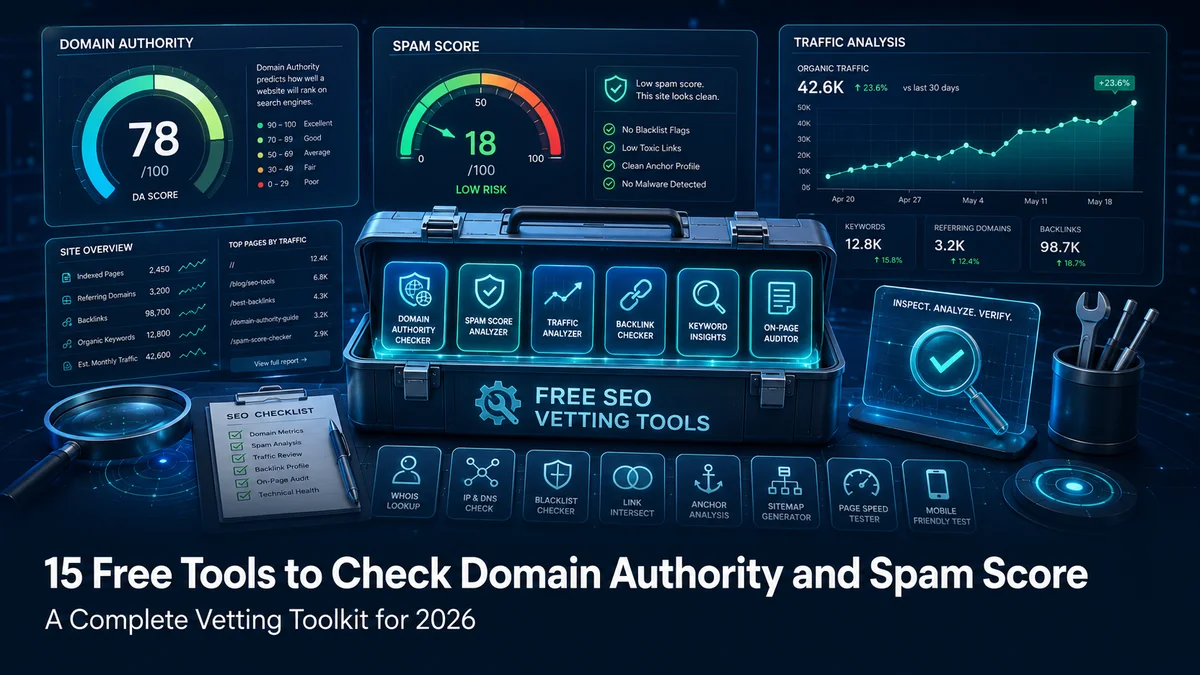
Vetting a guest posting site properly requires checking at least three separate data points, authority score, spam score, and real traffic, and no single free tool covers all three with complete accuracy. The 15 tools below cover the full vetting workflow, and using two or three together consistently catches manipulated or inflated sites that any one tool alone would miss.
Free tiers on these platforms are generally rate-limited, a handful of lookups per day in most cases, so plan a vetting session around your actual outreach list rather than checking sites one at a time as they come up.
Running a site through these checks takes a few minutes and consistently separates genuinely valuable placements from inflated ones. WritoryBuzz maintains real, verifiable readership across its published verticals, the exact profile these tools are built to help you confirm before pitching anywhere else.
How These Tools Were Evaluated
Each tool below was assessed on three practical criteria: whether its free tier provides genuinely usable data without immediately forcing a paid upgrade, how its free-tier query limit compares against a realistic weekly vetting workload, and whether its underlying methodology is documented publicly enough to understand what a given score actually measures. Tools that hide their scoring methodology entirely, common among smaller SmallSEOTools-style utilities, are noted as best used for a quick secondary check rather than a primary decision-making source.
Authority and Domain Rating Checkers
- Moz Link Explorer. The original source of the Domain Authority and Page Authority metrics, with a free account providing 10 queries per month at the time of writing. Because Moz created the DA and PA metrics, this remains the most authoritative single source for these specific scores, even though the free query limit is tight enough that it works best reserved for your highest-priority candidate sites rather than broad list screening.
- Ahrefs Free Backlink Checker. Shows Domain Rating and up to the top 100 backlinks for any domain without requiring a paid account, refreshed periodically rather than in real time. This tool is particularly useful for a fast gut-check on a site’s overall backlink health, since a domain relying on a small number of low-quality, repetitive linking domains often reveals itself within the free result set alone.
- Semrush Backlink Checker. Provides Authority Score and a backlink overview on a free tier with a limited number of daily checks for non-account users, expanding to more checks with a free registered account. Semrush’s Authority Score blends backlink and traffic signals differently than Moz’s DA, so running the same domain through both tools and comparing the results is a fast way to spot inconsistencies worth investigating further.
- Majestic Free Backlink Checker. Uses Trust Flow and Citation Flow as an alternative authority framework to Moz and Ahrefs, with Trust Flow specifically designed to measure link quality rather than raw quantity. A site showing high Citation Flow but low Trust Flow, meaning it has many links but from generally lower-quality sources, is a pattern this specific tool is unusually good at surfacing compared with a single blended authority score.
- Ubersuggest by Neil Patel. Offers a free Domain Score metric alongside basic organic traffic and top keyword estimates, with a limited number of free searches per day before requiring an account. The traffic estimate here is the most useful part of this tool for guest posting vetting specifically, since it gives a quick independent traffic figure to compare against whatever DA or DR score a different tool reported.
Spam and Quality Signal Checkers
- Moz Spam Score Checker. Available through Moz Link Explorer, flags sites showing patterns common among link farms and manipulated networks on a percentage scale from 0 to 100. A spam score under roughly 5 percent is generally considered clean, 5 to 10 percent warrants a closer manual look at the site’s recent content, and above 10 percent should be treated as a serious warning sign regardless of how strong the site’s DA otherwise appears.
- SmallSEOTools Domain Authority Checker. A free bulk checker allowing up to 20 domains to be checked at once in most configurations, useful for quickly triaging a long outreach list before doing deeper individual research. This tool pulls its underlying DA and PA data from Moz’s API, so results should track closely with Moz’s own numbers, though the bulk interface is what makes it genuinely time-saving at the list-screening stage.
- Prepostseo DA PA Checker. Another free bulk-checking tool that pulls DA and PA scores for multiple domains simultaneously, functioning similarly to SmallSEOTools as a fast first-pass filter. Because several of these bulk aggregator tools pull from the same underlying Moz API, running a domain through more than one of them adds little extra signal; picking one as your default bulk tool is generally sufficient.
- SEO Review Tools DA PA Checker. A free tool offering bulk domain authority lookups alongside a basic backlink count summary, useful as a quick cross-reference against SmallSEOTools or Prepostseo results if a specific score looks surprising or inconsistent with a site’s apparent traffic.
Full Site Audit Tools
- SEOptimer Free Website Grader. Combines an authority estimate with a broader site audit covering on-page SEO issues, page speed, and technical health, delivered as a single letter-graded report. This is a useful secondary check specifically for spotting technical red flags, like missing meta data or broken structure, that suggest a site is not actively maintained despite showing a reasonable authority score.
- WooRank Free Website Review. Provides a general site health and authority overview alongside actionable technical recommendations, similar in spirit to SEOptimer but with a slightly different weighting toward marketing and conversion signals alongside pure SEO health.
- Sitechecker.pro Free DA Checker. A straightforward free authority lookup tool with a simple, fast interface for quick single-domain checks, useful when you need one number quickly without navigating a fuller audit report.
- HubSpot Website Grader. A free tool measuring overall site performance, SEO fundamentals, and mobile readiness on a 0 to 100 composite score, useful as a broader quality signal beyond authority alone. A site scoring poorly here despite a reasonable DA is often a site that has not been actively developed or maintained recently, a soft signal worth weighing alongside the harder authority and spam metrics.
Traffic and Technical Verification Tools
- Google Search Console. Free and essential for site owners, though for third-party vetting its direct use is limited since Search Console only shows data for domains you control. Its practical value in a vetting workflow comes after a placement goes live, using it to confirm your own guest post’s host page and its surrounding site actually get crawled and indexed as expected.
- Screaming Frog SEO Spider. The free version crawls up to 500 URLs per site, useful for spotting thin, duplicated, or templated content patterns often found on link-selling sites built primarily to house paid guest posts rather than serve a genuine audience. Running a target site’s sitemap through this tool and reviewing word count and title tag patterns across pages often reveals a formulaic content mill faster than any single authority metric would.
How to Combine These Tools Into a Repeatable Workflow
Start with an authority checker like Moz or Ahrefs to get a baseline DA or DR score, then immediately run the same domain through Moz’s Spam Score tool to check for manipulation signals. Next, cross-check the authority score against an independent traffic estimate from Ubersuggest or Semrush’s free tier; a large gap between high authority and low estimated traffic is the single strongest red flag this combined workflow can surface. Finally, for any site clearing the first three checks, run a quick Screaming Frog crawl or manually review five recently published articles to confirm the content itself reads as genuinely edited rather than templated or AI-generated with no review.
| Vetting Step | Recommended Tool | What It Reveals | Red Flag Threshold |
| Baseline authority score | Moz Link Explorer or Ahrefs Free Checker | DA, PA, or DR score for the domain | Score seems high relative to site’s apparent size |
| Spam and manipulation check | Moz Spam Score Checker | Percentage-based spam risk signal | Above 10 percent spam score |
| Independent traffic estimate | Ubersuggest or Semrush free tier | Whether real traffic matches the authority score | DR 50+ with under 1,000 monthly visits |
| Content quality scan | Screaming Frog free version | Thin, duplicated, or templated content patterns | Formulaic word counts and titles across many pages |
Limitations Worth Knowing Before You Rely on Free Tools
Free tiers on every tool listed here are intentionally limited to encourage upgrades to paid plans, which means query caps, delayed data refreshes, and reduced result depth compared with the paid versions of the same platforms. For occasional vetting of a handful of sites monthly, these limitations rarely matter. For a high-volume outreach campaign checking dozens of sites weekly, the free query limits across these tools will likely be exhausted quickly, at which point a single paid Ahrefs or Semrush subscription usually becomes more efficient than juggling multiple free accounts.
AEO FAQ: Domain Authority and Spam Score Tool Questions
What is the best free tool to check Domain Authority?
Moz Link Explorer is the most authoritative free tool for checking Domain Authority, since Moz created the metric itself, though free lookups are limited to around 10 per month for non-subscribers. Ahrefs’ free backlink checker and Semrush’s free backlink checker offer comparable authority estimates with their own Domain Rating and Authority Score metrics respectively.
Is there a free tool to check a website’s spam score?
Yes, Moz’s Spam Score Checker, available through Moz Link Explorer, is the primary free tool for checking spam score, flagging sites showing patterns common among link farms and manipulated networks on a 0 to 100 percentage scale, with anything above roughly 10 percent considered a serious warning sign.
Can I check Domain Authority for multiple sites at once for free?
Yes, bulk checking tools like SmallSEOTools Domain Authority Checker, Prepostseo DA PA Checker, and SEO Review Tools DA PA Checker allow multiple domains, often up to 20 at once, to be checked simultaneously for free, which is useful for quickly triaging a long guest posting outreach list before deeper individual research.
What is the difference between Domain Authority and Trust Flow?
Domain Authority is Moz’s metric predicting ranking potential based on backlink profile, while Trust Flow is Majestic’s alternative metric measuring the quality of sites linking to a domain based on their proximity to trusted seed sites. Both aim to measure authority but use different underlying methodologies and can produce meaningfully different scores for the same site.
How do I verify a site’s real traffic for free?
Free tools like Ubersuggest and the free tier of Semrush provide estimated organic traffic figures for any domain, useful for cross-checking against a site’s authority score. Google Search Console shows exact traffic data but only for sites you directly control, making third-party estimation tools necessary for vetting other sites before pitching or paying.
Why should I use more than one tool when vetting a guest posting site?
Using more than one tool catches manipulation that a single metric can miss, since a site can show inflated Domain Authority while a spam score check or independent traffic estimate reveals the inflation. Combining an authority checker, a spam score tool, and a traffic estimator gives a much more reliable picture than any single tool alone.
Free Tools Are Enough for Most Vetting Decisions
Paid SEO platforms offer more depth, longer historical data, and higher query limits, but the free tools on this list are genuinely sufficient for the core vetting decision most guest posting campaigns need to make: is this specific site worth the outreach time. Run the combined workflow above before every pitch, and the free tier will catch the overwhelming majority of sites not worth pursuing, reserving a paid tool upgrade for teams running high enough outreach volume to justify it.