

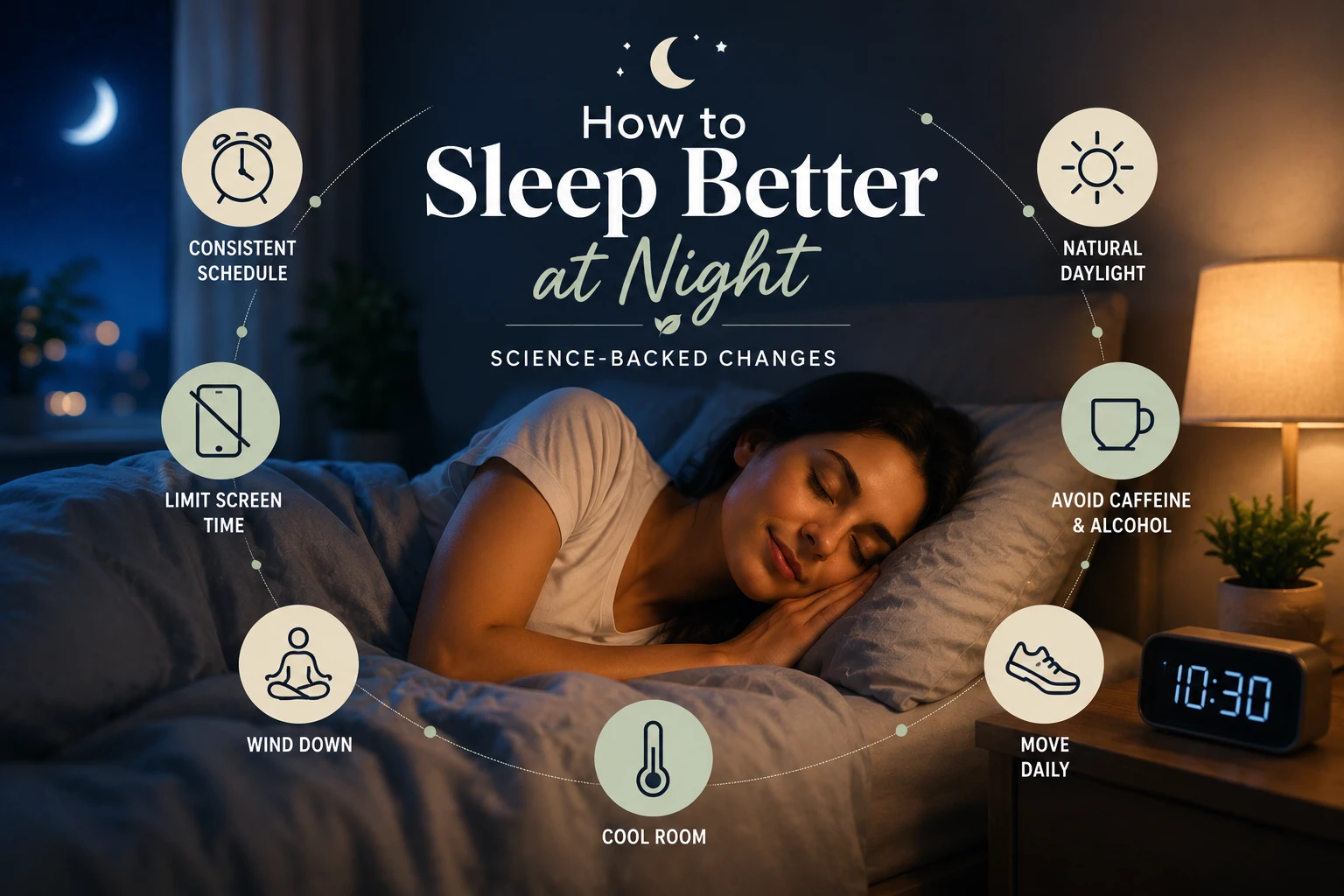
About one in three adults does not get enough sleep regularly. Not occasionally, not when stressed. Regularly.
The consequences go further than tiredness. Poor sleep raises cortisol, impairs immune function, affects how the brain consolidates memory, and over time increases the risk of cardiovascular disease and metabolic disorders. It also makes every hard thing in life harder.
Most sleep advice lists 15 tips in no particular order and leaves you to figure out where to start. This guide is different. It tells you what actually works, in what order to try it, and how long it takes to feel the difference.
Why Sleep Is Harder Now Than It Used to Be
Human sleep is biologically calibrated to light. Darkness triggers melatonin. Light suppresses it. For almost all of human history, that system worked without interference.
Modern life runs artificial light after sunset, screen stimulation until the moment you close your eyes, caffeine well into the afternoon, and schedules dictated by work and social demands rather than biology. None of these things are catastrophic alone. Together, in a consistent daily pattern, they systematically push sleep onset later, reduce sleep quality, and fragment the second half of the night.
What’s Actually Disrupting Your Sleep in 2026
The most common culprits, ranked by how often they appear in sleep research:
- Inconsistent sleep and wake times – the circadian rhythm needs regularity to function. Variable schedules confuse it.
- Late caffeine – caffeine’s half-life is 5 to 6 hours. A 3 PM coffee still has half its caffeine in your system at 9 PM.
- Screens before bed – blue light suppresses melatonin, and stimulating content creates arousal that outlasts the screen itself.
- A bedroom that is too warm – body temperature needs to drop to initiate sleep. A warm room fights that process directly.
- Alcohol – a sedative that fragments sleep architecture and suppresses the REM sleep your brain needs for memory and emotional processing.
- Lying in bed awake – every hour spent awake in bed trains the brain to associate the bed with wakefulness, not sleep.
What Good Sleep Actually Involves
Sleep is not a uniform state. A full night consists of four to six cycles, each roughly 90 minutes. Within each cycle, the brain moves through light sleep, deep slow-wave sleep, and REM (rapid eye movement) sleep.
The Two Types of Sleep That Matter and What Each One Does
Deep sleep (slow-wave sleep): This is when physical restoration happens. Growth hormone is released. Tissue repairs. The immune system consolidates its work. Deep sleep is concentrated in the first half of the night. Going to bed two hours later than usual cuts the amount of deep sleep you get, even if total sleep duration is the same.
REM sleep: This is when emotional processing, memory consolidation, and cognitive restoration happen. REM is concentrated in the second half of the night, in the hours just before you naturally wake. Cutting sleep short by even 90 minutes disproportionately removes REM.
This is why timing matters as much as duration. Getting six hours of sleep from midnight to 6 AM is physiologically different from six hours of sleep from 10 PM to 4 AM. The second window includes significantly more deep sleep.
Changes Organised by How Fast You Will Feel Them
Most sleep advice doesn’t tell you this. Some changes work tonight. Others take weeks. Here’s the honest breakdown so you know what to expect.
| What to Change | When You’ll Feel It | Difficulty |
| Cool the bedroom to 15–19°C | Tonight | Easy |
| Cut caffeine before noon | 2–3 nights | Moderate |
| Fix wake-up time daily | 1–2 weeks | Hard at first |
| No screens 60 min before bed | 3–5 nights | Moderate |
| Morning sunlight within 1 hr of waking | 1–2 weeks | Easy |
| Stop alcohol within 3 hrs of sleep | Immediate | Moderate |
| Write a next-day to-do list before bed | Tonight | Very easy |
Your Sleep Environment: The Fixes That Work Tonight
Temperature
The single most underrated sleep change most people haven’t made. Your core body temperature naturally drops as you fall asleep. A bedroom that is too warm delays and fights that process.
The research-supported range is 15 to 19°C (60 to 67°F). If you share a bed and have conflicting preferences, individual duvets of different weights solve the problem cleanly.
If you cannot control the room temperature, a cool shower 90 minutes before bed lowers core body temperature in a way that supports sleep onset. The effect is real and measurable.
Light
Even small amounts of light during sleep suppress melatonin and reduce sleep quality. The clock face on your bedside table, a gap under the door, the standby light on a TV – these all count. Blackout curtains or a sleep mask are cheap and the effect is immediate.
Morning light matters just as much. Getting outside or near a bright window within the first hour of waking is one of the strongest circadian cues available. It sets the body clock for wakefulness and, crucially, sets the timer for melatonin release that evening.
Sound
Silence is not the ideal sleep environment for most people in urban or shared spaces. Intermittent sounds (traffic, a neighbour, a partner) are more disruptive than consistent background sound because the contrast triggers the brain’s alerting response.
Consistent low-level sound – a fan, a white noise machine, or a brown noise app – masks intermittent sounds by raising the background floor. Most people who try this for a week notice the difference.
Your Evening Habits: The Changes That Build Over Weeks
Fix Your Wake-Up Time First
Most sleep advice focuses on bedtime. The more controllable and more powerful lever is wake-up time. A consistent wake time every day, including weekends, is the strongest anchor for the circadian rhythm.
The reason weekends are so damaging to sleep is not the late nights. It is the late mornings. Sleeping until 10 AM on Saturday after getting up at 6:30 AM all week is the equivalent of flying two time zones east. Your body clock shifts. Monday morning feels like jet lag because it is.
Set a consistent wake time. Hold it for two weeks before making any other changes. You will notice the effect before the two weeks are up.
The Caffeine Cut-Off
Caffeine blocks adenosine, the chemical that builds sleep pressure as the day progresses. With caffeine in your system, you feel less sleepy than you are. When the caffeine clears, the accumulated adenosine hits at once – but by then, your sleep architecture may already be disrupted.
A noon cut-off is the evidence-based recommendation for most people. Those who metabolise caffeine slowly (a genetic variation affecting roughly 50% of people) may need an even earlier cut-off. If you sleep poorly and drink caffeine after 12 PM, this is the first thing to change.
Alcohol’s Effect on Sleep Quality
Alcohol is a sedative. It helps you fall asleep faster. That is the only positive contribution it makes to sleep.
What it does to sleep quality: it suppresses REM sleep, increases awakenings in the second half of the night, and causes more frequent light-sleep periods. People who drink alcohol in the evening often report feeling unrefreshed despite a full night’s sleep. That’s because the sleep they got was structurally poor.
Three hours between your last drink and sleep is the general guideline. Less than that produces measurable sleep quality reduction.
Screens Before Bed: The Real Problem
Blue light from screens does suppress melatonin, but the effect is often overstated in popular coverage. Switching your phone to night mode and calling it sorted misses the bigger issue.
The more significant problem is arousal. Emotionally engaging content – social media, news, suspenseful TV – creates cognitive and emotional activation that does not resolve when you close the app. The brain remains in a state of mild alert for 20 to 40 minutes afterward, regardless of the light the screen emitted.
Stopping screen use 60 minutes before your target sleep time addresses both the light and the arousal problem simultaneously. Reading a physical book, light conversation, or quiet audio are the most effective replacements.
How to Fall Asleep When Your Mind Won’t Slow Down
Trying harder to sleep makes it worse. The frustration of trying creates arousal that competes with sleep. These three techniques work with that reality rather than against it.
4-7-8 breathing: Inhale for 4 counts. Hold for 7. Exhale slowly for 8. The extended exhale activates the parasympathetic nervous system – your body’s rest-and-digest mode. Do this twice and notice the physiological shift. It is not a trick. The mechanism is real.
Progressive muscle relaxation: Starting at your feet, tense each muscle group firmly for 5 seconds, then release completely. Work up through the legs, abdomen, chest, arms, and face. The physical tension and release cycle activates the same parasympathetic response as the breathing technique, but through the body rather than the breath.
The next-day to-do list: Baylor University research found that writing a specific to-do list for the following day before bed significantly reduced time to fall asleep – more so than writing a general reflection journal. The theory is that it off-loads the mental rehearsal loop that keeps many people awake. Spend 5 minutes writing down tomorrow’s tasks before you get into bed.
Sleep Myths That Are Making Things Worse
Several widely repeated sleep beliefs are either wrong or partially right in ways that matter. Here is the honest version.
| The Myth | What’s Actually True |
| You can catch up on sleep at weekends | Weekend lie-ins help partially, but can’t undo a week of poor sleep or fix the cognitive debt it creates |
| 8 hours is right for everyone | Most adults need 7–9 hours. Some function well on 6.5. Oversleeping causes as many issues as undersleeping |
| Alcohol helps you sleep | Alcohol gets you to sleep faster then fragments it. REM sleep is suppressed. Net result is lower quality rest |
| Lying in bed is still resting even if awake | Lying awake in bed trains the brain to associate bed with wakefulness. CBT-I targets exactly this pattern |
When Sleep Hygiene Isn’t Enough
If you have implemented these changes consistently for three to four weeks and still struggle with sleep, the issue may be beyond lifestyle adjustment.
Cognitive Behavioural Therapy for Insomnia (CBT-I): This is the first-line clinical treatment for chronic insomnia according to most sleep medicine guidelines globally. It works better than sleeping medication in the long term and has no side effects. It addresses the behavioural and thought patterns maintaining insomnia, rather than just sedating the brain. CBT-I is available through therapists, digital programmes, and several evidence-based apps.
Sleep apnoea: If you snore, wake frequently, feel exhausted despite adequate time in bed, or have been told you stop breathing during sleep, get a sleep study. Sleep apnoea is significantly underdiagnosed, highly treatable, and directly causes poor sleep quality regardless of any habit changes.
Underlying conditions: Thyroid disorders, iron deficiency, anxiety disorders, and several other conditions directly affect sleep. If poor sleep persists despite genuine effort on habits and environment, a conversation with a doctor is worth having.