
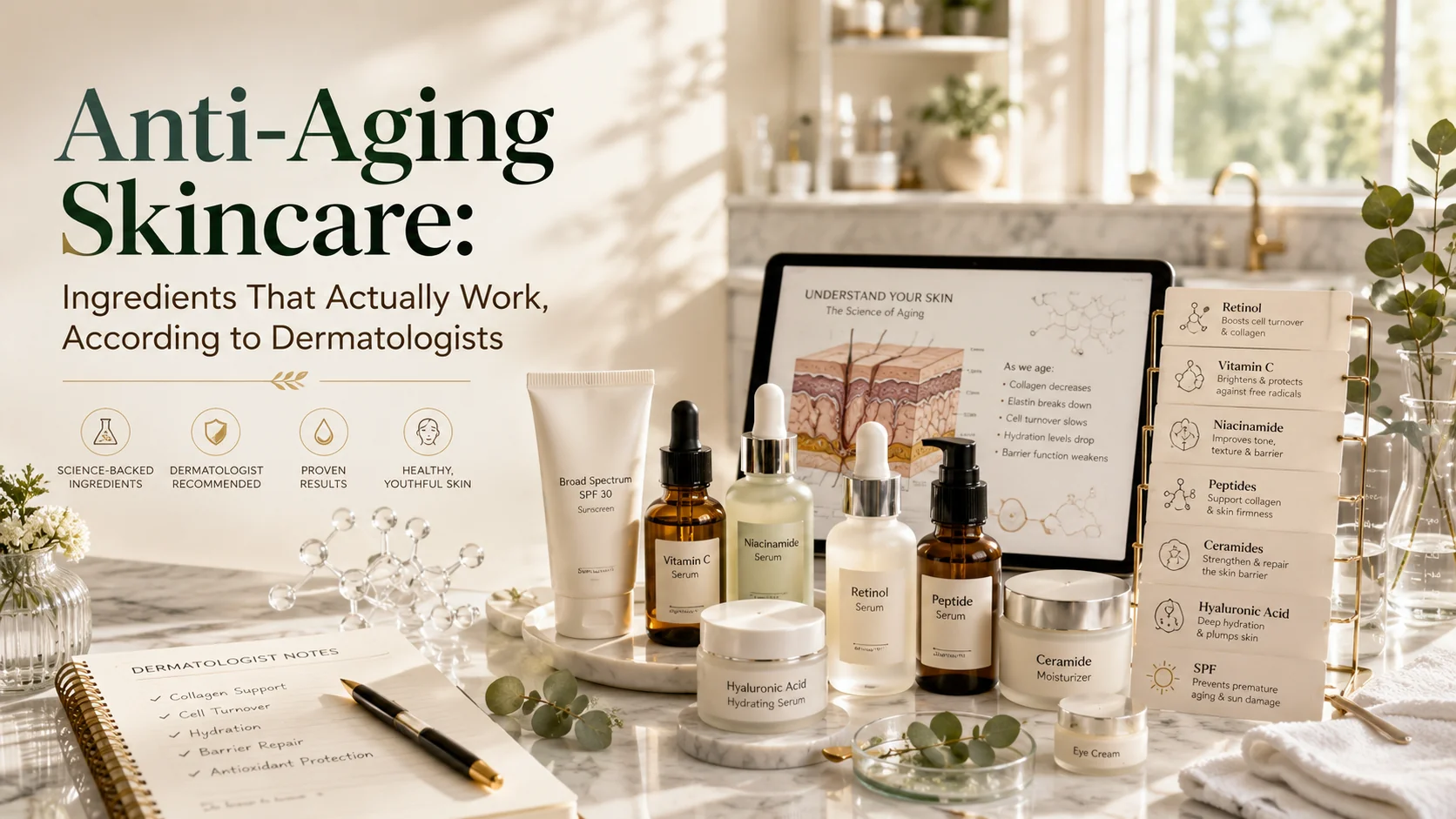
Skincare is a $186 billion industry filled with claims that range from clinically solid to entirely unsupported. Dermatologists consistently agree on a short list of ingredients with robust evidence. Everything else is varying degrees of hope with moisturiser.
Anti-aging skincare ingredients that work are fewer than the industry suggests and more effective than critics allow. The ingredients below have randomised controlled trial data, consistent dermatologist endorsement, and plausible mechanisms that explain their effects. The guidance on how to use them is as important as knowing which ones to choose.
Tier 1: The Highest-Evidence Ingredients
Retinoids (Retinol, Tretinoin, Retinaldehyde)
Retinoids are the single most evidence-backed anti-aging ingredient available. Tretinoin (prescription-only in most countries) and its over-the-counter relatives retinol and retinaldehyde all work by binding to retinoic acid receptors in skin cells, stimulating collagen production, increasing cell turnover, and addressing fine lines, uneven texture, and pigmentation simultaneously.
Tretinoin has the strongest evidence, being the subject of decades of controlled trials. A 1995 study in the Archives of Dermatology found 24 weeks of tretinoin use produced statistically significant improvements in fine lines, roughness, and mottled hyperpigmentation. Subsequent research has consistently confirmed and expanded these findings.
How to use: Start with a low concentration (0.025% tretinoin or 0.1-0.3% retinol) two to three nights per week. Introduce gradually over four to eight weeks to minimise the initial purging and irritation that is common and temporary. Use at night only. Apply sunscreen every morning, as retinoids increase photosensitivity.
Realistic timeline: Visible improvement in texture typically appears within six to twelve weeks. Significant reduction in fine lines requires three to six months of consistent use. Results are real but not instantaneous.
Broad-Spectrum SPF 30 or Higher
Ultraviolet radiation is the primary driver of visible skin aging. An estimated 80 to 90 percent of visible facial skin aging is caused by sun exposure, making SPF the most effective anti-aging product available at any price point. Daily broad-spectrum sunscreen use (UVA and UVB protection) prevents ongoing collagen degradation, pigmentation development, and the texture changes that accumulate with cumulative UV exposure.
No amount of active anti-aging ingredients counteracts ongoing UV damage without daily SPF. The correct order of operations is SPF first (prevention), then actives (correction). Dermatologists consistently rank daily SPF as a higher priority than any other anti-aging intervention.
Vitamin C (L-Ascorbic Acid)
Topical vitamin C, specifically L-ascorbic acid at concentrations of 10 to 20 percent, has robust evidence for brightening hyperpigmentation, stimulating collagen synthesis, and providing antioxidant protection against UV-induced free radical damage. It is most effective applied in the morning before SPF, where it provides additive photoprotection.
Formulation matters significantly: Vitamin C is unstable and oxidises easily. A product that has turned yellow or orange has degraded and will not be effective. Look for products in opaque packaging or dark glass, with an L-ascorbic acid concentration of 10 to 20 percent, and a pH of 2.5 to 3.5 for optimal skin penetration. Store in a cool, dark place.
Tier 2: Strong Supporting Evidence
Niacinamide (Vitamin B3)
Niacinamide at 2 to 10 percent concentration has controlled trial evidence for reducing hyperpigmentation, minimising pore appearance, improving skin barrier function, and addressing fine lines over 12 to 16 weeks. It is one of the best-tolerated active ingredients available, suitable for sensitive and acne-prone skin that reacts to stronger actives.
A notable advantage: niacinamide works through different mechanisms than retinol and vitamin C, making it an effective addition to routines using those ingredients rather than a direct substitute.
Peptides
Peptides are short chains of amino acids that signal skin cells to produce collagen and elastin. Clinical evidence is more limited than for retinoids or vitamin C, but several peptide combinations (including argireline, matrixyl, and palmitoyl peptides) have double-blind, placebo-controlled trials showing measurable improvements in fine lines and firmness.
Peptides are most valuable in the context of a complete routine, particularly for those who cannot tolerate retinoids. They are well-tolerated, work across skin types, and can be used morning and night.
Hyaluronic Acid
Hyaluronic acid is a humectant that attracts and retains water in the skin. It reduces the immediate appearance of fine lines by plumping the skin with moisture. It does not address the underlying causes of skin aging (collagen degradation, cell turnover slowdown) but provides significant short-term visual improvement and supports skin barrier function. Best used on slightly damp skin with a moisturiser applied immediately after to seal in the hydration.
The Honest Tier 3: Trendy but Limited Evidence
Bakuchiol: Marketed as a natural retinol alternative. Some small studies show mild effects comparable to low-concentration retinol. The evidence does not support replacing tretinoin or retinol with bakuchiol for significant anti-aging effects, but it is a reasonable option for those who cannot tolerate any retinoid.
Collagen supplements: Oral collagen peptides have limited but growing evidence for skin hydration and some elasticity improvements. The collagen in supplements is broken down by digestion and does not directly replace skin collagen, but some research suggests the breakdown products may stimulate the body’s own collagen production. Evidence quality is improving but not yet at the level of topical retinoids.
NAD+ precursors and longevity actives: Niacinamide aside (which has strong evidence), most longevity-positioned skincare actives (NMN, NR, resveratrol in topical form) have very limited human skin evidence. The biochemical theory is interesting. The clinical data in skin specifically is thin.
| Ingredient | Evidence Level | Primary Benefit | Key Caution |
| Tretinoin (prescription) | Very strong | Lines, texture, pigmentation | Start slow, daily SPF mandatory |
| SPF 30+ daily | Very strong | Prevents photoaging | Must be broad-spectrum |
| Vitamin C (L-ascorbic acid) | Strong | Brightening, collagen support | Formulation stability matters |
| Retinol (OTC) | Strong | Lines, texture | Start low concentration |
| Niacinamide | Strong | Pigmentation, barrier | Well-tolerated across types |
| Peptides | Moderate | Lines, firmness | Most useful supporting others |
| Hyaluronic acid | Good for hydration | Plumping, moisture | No structural anti-aging |
| Bakuchiol | Limited | Mild retinol alternative | Not equivalent to retinol |
What is the most evidence-based anti-aging skincare ingredient?
Retinoids (tretinoin at prescription strength, retinol over the counter) have the most robust evidence across the widest range of skin aging concerns: fine lines, texture, pigmentation, and collagen stimulation. Daily broad-spectrum SPF is equally important as prevention. Together, these two form the foundation of any evidence-based anti-aging routine.
Does retinol actually reduce wrinkles?
Yes, with consistent long-term use. Retinol increases cell turnover and stimulates collagen production, producing measurable improvements in fine lines and texture over three to six months. Effects are real but gradual. Prescription-strength tretinoin produces faster and more significant results than over-the-counter retinol at equivalent application frequency.
What order should you apply anti-aging skincare products?
Morning: cleanser, vitamin C serum, moisturiser, broad-spectrum SPF. Evening: cleanser, retinol or retinoid (if using), moisturiser. Niacinamide and hyaluronic acid can be used morning or evening. Apply products from thinnest to thickest consistency. Allow active serums 1 to 2 minutes to absorb before applying moisturiser.
How long does it take for anti-aging skincare to show results?
Hyaluronic acid provides immediate hydration-based plumping visible within hours. Vitamin C typically shows brightening improvements within four to eight weeks. Retinol shows texture improvements within six to twelve weeks and measurable fine line reduction within three to six months. SPF benefits are cumulative and primarily preventive.
What anti-aging ingredients should you not mix together?
Retinol and vitamin C can irritate sensitive skin when used together, though the incompatibility is overstated in popular advice. Alternating (vitamin C in the morning, retinol in the evening) avoids any interaction. Retinol and AHAs used simultaneously can cause significant irritation. Benzoyl peroxide deactivates retinol and should be used separately.
Is SPF really the most important anti-aging product?
Yes. UV radiation drives an estimated 80 to 90 percent of visible facial skin aging. Daily broad-spectrum SPF 30 or higher prevents ongoing collagen degradation and pigmentation development. No corrective skincare ingredient addresses aging as efficiently as consistent sun protection prevents it. SPF should be applied every morning regardless of indoor/outdoor plans, as UVA penetrates windows.
Start With Two, Then Add
The most common anti-aging skincare mistake is buying a large collection of products before building the foundation. Start with daily SPF and a retinoid or retinol used consistently. These two ingredients alone, applied correctly over months, produce more visible improvement than ten products with uncertain efficacy.
Add vitamin C in the mornings once SPF and retinol are established habits. Layer niacinamide or peptides when the core routine is stable. Everything after that is refinement of an already-working system.