
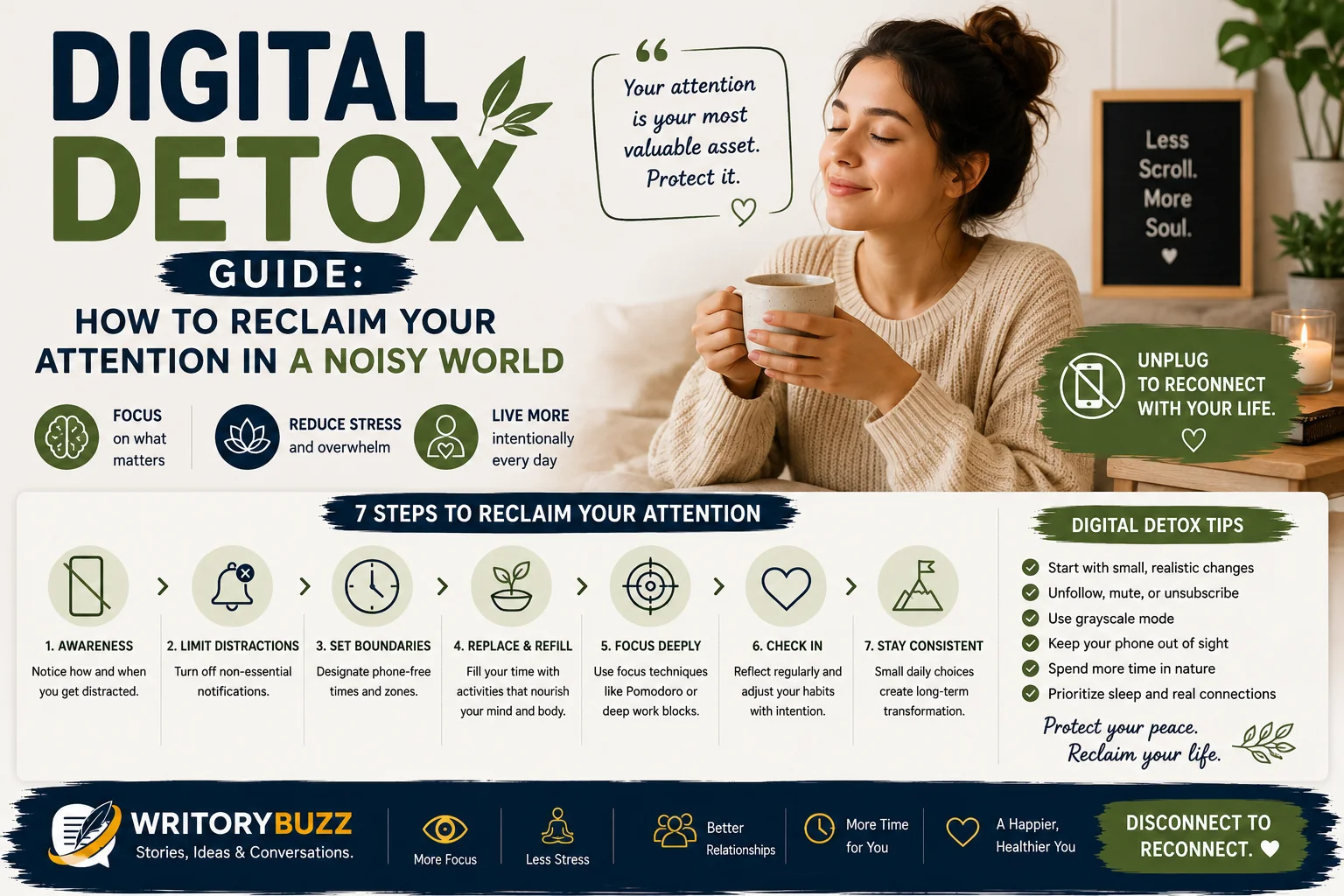
The average person in 2026 receives 46 push notifications per day and checks their phone 96 times daily. Attention is finite, fragmented attention is cognitively expensive, and the technology designed to compete for attention is optimized by organizations with vastly more data and resources than any individual has time to resist. A digital detox is not a wellness trend. It is a rational response to an asymmetric competition.
Digital detox is the deliberate, temporary or permanent reduction of digital technology use to restore attention capacity, reduce stress, improve sleep, and recover the experience of boredom and uninterrupted thought that constant connectivity eliminates. It exists on a spectrum from a single phone-free weekend to a comprehensive lifestyle redesign of digital habits.
Why Detox Matters: The Attention Economy
The attention economy framework, described by economist Michael Goldhaber and developed by Tim Wu and James Williams, understands the internet as a market where human attention is the commodity being bought and sold. Social media platforms, news sites, and apps are not primarily tools that serve users. They are advertising platforms that monetise user attention. Their engineering is optimised to maximise time spent, not user wellbeing.
The consequence of this alignment: the systems that billions of people use daily are designed by extraordinarily talented engineers with billions in resources to capture and hold attention using every psychological insight available. Individual willpower against this system is not a fair fight. Digital detox is not about being strong enough to resist your phone. It is about changing the rules of the competition.
How to Do a Structured Weekend Digital Detox
A 48-hour digital detox produces measurable improvements in sustained attention capacity, sleep quality, and reported wellbeing in multiple studies. The first 4 to 6 hours are the hardest. After that, withdrawal symptoms (anxiety, FOMO, the phantom phone vibration sensation) decline significantly.
Preparation (Thursday or Friday): Tell people you are unreachable for the weekend and provide an emergency contact method (calling on a real phone number for genuine emergencies). Set an out-of-office on email. Turn off all notifications. Put your phone in a drawer or give it to someone else for the weekend.
What to do instead: Physical activity outdoors (the most consistently effective attention restoration activity). In-person social time without devices. Cooking something time-consuming. Reading a physical book. Manual projects (garden, repair, craft). These are not substitutes for technology. They are how humans spent their attention before the last 15 years of smartphones.
What to expect: Hour 1 to 4: anxiety, restlessness, the strong urge to check something. Hour 5 to 12: increasing calm, noticeably different quality of present-moment awareness. Hour 13 to 48: the kind of boredom that produces creativity, the deep engagement with non-digital activities that feels genuinely restorative.
Structured Partial Detox: Long-Term Practices
A 48-hour detox is a reset. The long-term value comes from the structural changes that follow it. These are the practices that protect attention on an ongoing basis:
The daily log-off time: Choose a specific time each day when you stop using social media, email, and news. 6pm or 7pm is common. This creates a predictable daily window of restored attention that compounds across months.
The weekly off day: One day per week (most commonly Sunday) without social media and non-essential digital communication. Not a productivity day. A rest day. This is the practice that most consistently reduces baseline anxiety and improves sleep quality across weekly cycles.
Annual digital audit: Once per year, spend 30 minutes reviewing every app on your phone and every subscription in your email inbox. Delete apps you have not consciously chosen to use in the past month. Unsubscribe from every mailing list you do not actively read. The cumulative attention drain from unused digital commitments is significant and largely invisible.
Reentry: The Most Important Part
How you re-engage with technology after a detox determines whether the detox produces lasting change or simply postpones existing patterns. Most people who complete a 48-hour detox and return to their previous habits the following Monday have not produced durable change. The detox’s value is in the contrast it creates: you notice the difference in your attention quality and choose to preserve some of it.
Structured reentry: Return to technology with intention. Turn on only the notifications you want rather than accepting all defaults. Reinstall apps selectively rather than defaulting to everything. Establish the phone-free contexts from the screen time post (bedroom, meals, first 30 minutes of day) as new defaults rather than reverting to previous ones.
For Families: The Collective Detox
A family digital detox is significantly more effective than an individual one because the social environment during the detox matches the technology-free intention. The key elements: no-phone dinner table as permanent practice, phones charging outside bedrooms for all family members, and one weekly family activity that is explicitly phone-free.
What is a digital detox and why do people do them?
A digital detox is a deliberate, temporary reduction of digital technology use to restore attention capacity, reduce stress, and recover the experience of uninterrupted thought. People do them because the technology designed to capture attention is engineered to defeat individual willpower, and periodic intentional disconnection restores the cognitive baseline that constant connectivity erodes.
How do you do a 48-hour digital detox?
Tell contacts you are unreachable (with an emergency number for genuine emergencies). Set out-of-office on email. Turn off all notifications. Put the phone away. Replace screen time with physical activity, in-person social time, reading, and manual activities. Expect the first 4 to 6 hours to be uncomfortable. The discomfort reflects how much of your attention has been captured.
What are the benefits of a digital detox?
Studies show 48-hour digital detoxes produce improvements in sustained attention capacity, sleep quality, reported wellbeing, and creativity. The reduction in anxiety is measurable within 12 to 24 hours. The contrast effect (noticeably different quality of attention and presence) is the most commonly reported subjective benefit.
How do you maintain digital detox benefits long-term?
Through structural practices rather than willpower: a daily log-off time when social media and email stop, a weekly off day without non-essential digital use, and an annual digital audit removing unused apps and mailing lists. These change the default digital environment rather than requiring daily resistance.
Is a digital detox realistic for people with demanding jobs?
Yes with planning. Partial detoxes (weekends, evenings, one day per week) are more realistic than complete disconnection for people with professional responsibilities. Setting an out-of-office and identifying a genuine emergency contact method removes the anxiety about missing critical communications during planned detox periods.
How do you do a digital detox as a family?
The collective approach is more effective than individual. Key practices: no-phone dinner table as permanent household rule, phones charging outside bedrooms, one weekly family activity that is explicitly phone-free, and consistent parental modelling. Children adopt the technology relationship they see modelled, not the rules they are given.
Protect What You Find on the Other Side
The experience of a successful digital detox is almost universally described the same way: people are surprised by how different their own mind feels without constant input. They notice richer sensory experience, more natural conversational flow, and the return of voluntary attention rather than captured attention. What matters is protecting some of that on the way back in.
A healthier relationship with technology starts with small, intentional changes. Discover more wellness tips, productivity strategies, and lifestyle insights with WritoryBuzz to stay focused, reduce digital distractions, and create a more balanced everyday life.