Average cold email open rates run 25 to 40 percent for well-targeted lists. Reply rates average 5 to 15 percent for good sequences. The gap between the top and bottom performers is almost entirely in the first two lines of the message. The most reliably effective cold outreach is specific, relevant, and brief. Not clever. Not aggressive. Specific.
Cold outreach in 2026 is harder than it was five years ago because AI tools have made volume easy and quality rare. An inbox receiving 50 AI-generated cold emails per day develops rapid pattern recognition for the signals of template reuse, false personalisation, and generic value propositions. The outreach that cuts through is the kind that makes the recipient think ‘this person clearly knows something about our situation.’ That requires research, not tools.
The Framework Behind Every Effective Cold Outreach Message
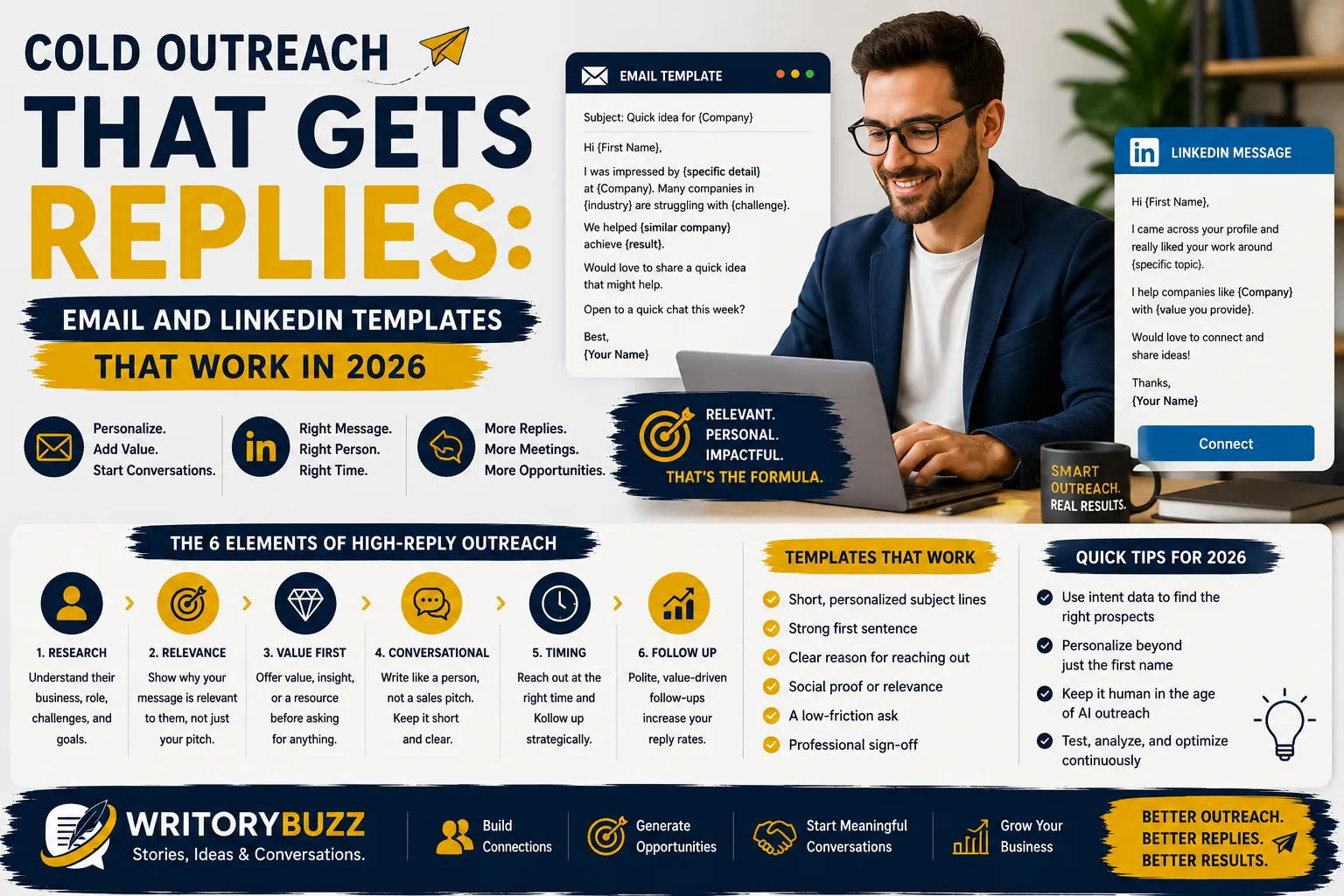
Relevant hook: The opening should immediately signal that you have done specific research. Not ‘I came across your LinkedIn profile’ (generic) but ‘I saw your post about the ServiceNow implementation challenges last Tuesday’ (specific). The signal is that this message is not a mail merge.
One clear problem or observation: Name a specific problem, challenge, or transition relevant to this prospect now. Not what your product does generally. What their situation is specifically and why now is the relevant moment.
One relevant proof point: One specific result you achieved for a similar company. Not a feature list. One number: ‘We helped [similar company] reduce [specific thing] by [specific amount] in [specific timeframe].’
Single low-friction ask: Not ‘can we schedule a call’. Not ‘are you free for 30 minutes this week’. Instead: ‘Would it be useful to send you our one-page on how we approach this?’ or ‘Is this something worth a quick 10-minute call?’ The ask should cost minimal social capital to say yes to.
Email Templates
Template 1: The Trigger Event Email
Subject: [Company] + [your specific capability]
Hi [Name], I noticed [Company] just [specific trigger event: raised a Series A / hired 15 salespeople / launched in [market] / posted about [specific challenge]]. When companies [trigger event], they typically [common problem that follows]. We recently helped [similar company] [specific result]. Worth 10 minutes to compare notes on whether the same approach applies to [Company]? [Your name]
Template 2: The Case Study Hook
Subject: How [Similar Company] [achieved specific result]
Hi [Name], [Similar Company] came to us 6 months ago [facing specific problem you helped solve]. By [month], they had [specific measurable result]. I have been looking at [prospect company’s] situation and think the same approach could work for you, specifically around [one specific element]. Is this worth a short conversation? [Your name]
Template 3: The Insight Lead
Subject: [Specific observation about their industry/market]
Hi [Name], [One specific, non-obvious insight about their industry or situation. E.g., ‘Most [role] at [company type] are spending 30% of their week on [specific task] that should be automated by now.’]. We have built something that addresses this specifically for [their sector]. [Similar company] reduced [specific metric] by [%] in [timeframe]. If this is on your radar, happy to share how they did it. [Your name]
LinkedIn Templates
Connection Request Note (Under 300 Characters)
Hi [Name], I work with [company types] on [specific thing you do]. I noticed [specific thing about their profile/company/recent post]. I’d value connecting. [Your name]
Follow-Up After Accepting (Send Within 24 Hours)
Thanks for connecting [Name]. [One specific observation about their work, company, or recent activity]. I’ve been working with [similar company] on [specific thing relevant to their situation] — curious whether [specific challenge] is something your team is working on at the moment. No pitch — just comparing notes if it’s relevant. [Your name]
The Follow-Up Sequence
One message rarely produces a reply. A three-message sequence over 10 to 14 days is standard practice. The sequence should add value rather than repeat the same message:
Message 1: The primary outreach above.
Message 2 (Day 5): Add a relevant resource. ‘Thought this [article/report/case study] was relevant to what I mentioned — [one sentence on why it is relevant to them]. Original note below if you missed it.’
Message 3 (Day 10): A polite close. ‘I will leave this here unless this is relevant. If timing is off, happy to reconnect when it is.’
After three messages with no response, stop. Re-engage in 3 to 6 months if a new trigger event is relevant.
What Destroys Cold Outreach
- False personalisation (‘I came across your impressive work at [Company]’ — this could apply to anyone)
- Feature-led opening (‘We offer a platform that…’)
- Long messages: anything over 150 words reduces reply rates significantly
- Multiple asks in one message
- Obvious template signs (mismatched variable names, wrong company name, wrong industry terminology)
What makes cold email outreach actually work?
Specificity is the primary driver. Opening with a specific observation that could only apply to that recipient signals genuine research. One clear problem relevant to their current situation, one specific proof point from a similar company, and one low-friction ask produces above-average reply rates. Volume with generic content produces near-zero results.
What is a good cold email reply rate?
Average cold email reply rates are 5 to 15 percent for well-targeted, well-written sequences. Above 15 percent is strong. Below 3 percent typically indicates targeting, relevance, or copy problems. Reply rate is more meaningful than open rate: opens measure curiosity, replies measure interest.
How long should a cold email be?
Under 150 words. Every sentence should earn its place. The most effective cold emails are 75 to 125 words. Long emails with multiple value propositions, feature lists, and social proof paragraphs produce lower reply rates than shorter, sharper messages with one clear reason to reply.
What is the best subject line for cold email?
Short (under 7 words), specific, and low-promise. Curiosity-based subject lines that reference the prospect specifically (‘[Company] + [specific capability]’ or ‘How [Similar Company] solved [specific problem]’) perform better than benefit claims (‘Increase your revenue by 40%’) which trigger spam recognition.
How many follow-ups should you send after a cold email?
Three messages over 10 to 14 days is the standard effective sequence. The second message should add value (a relevant resource). The third should politely close. Beyond three messages without response, persistence moves from persistence to harassment. Re-engage after 3 to 6 months if a new trigger event is relevant.
Is cold LinkedIn outreach more effective than cold email?
LinkedIn outreach has lower volume and therefore higher novelty value. Connection acceptance rates are higher than email open rates for well-targeted prospects. The format is more conversational and lower-stakes. The limitation is LinkedIn’s character limits and the expectation of professional context. Both channels work when the message is specific and relevant; neither works when generic.
Research Earns the Reply
The cold outreach that produces replies is built on research: knowing something specific about the prospect’s situation that a mass-produced template cannot contain. Five minutes of genuine research per prospect, producing one specific observation that opens the message, outperforms 500 generic emails from a template. The equation is always specificity over volume.
Ready to improve your outreach results? Explore more sales strategies, marketing insights, and lead generation tips with WritoryBuzz to build meaningful connections and grow your business with confidence.