
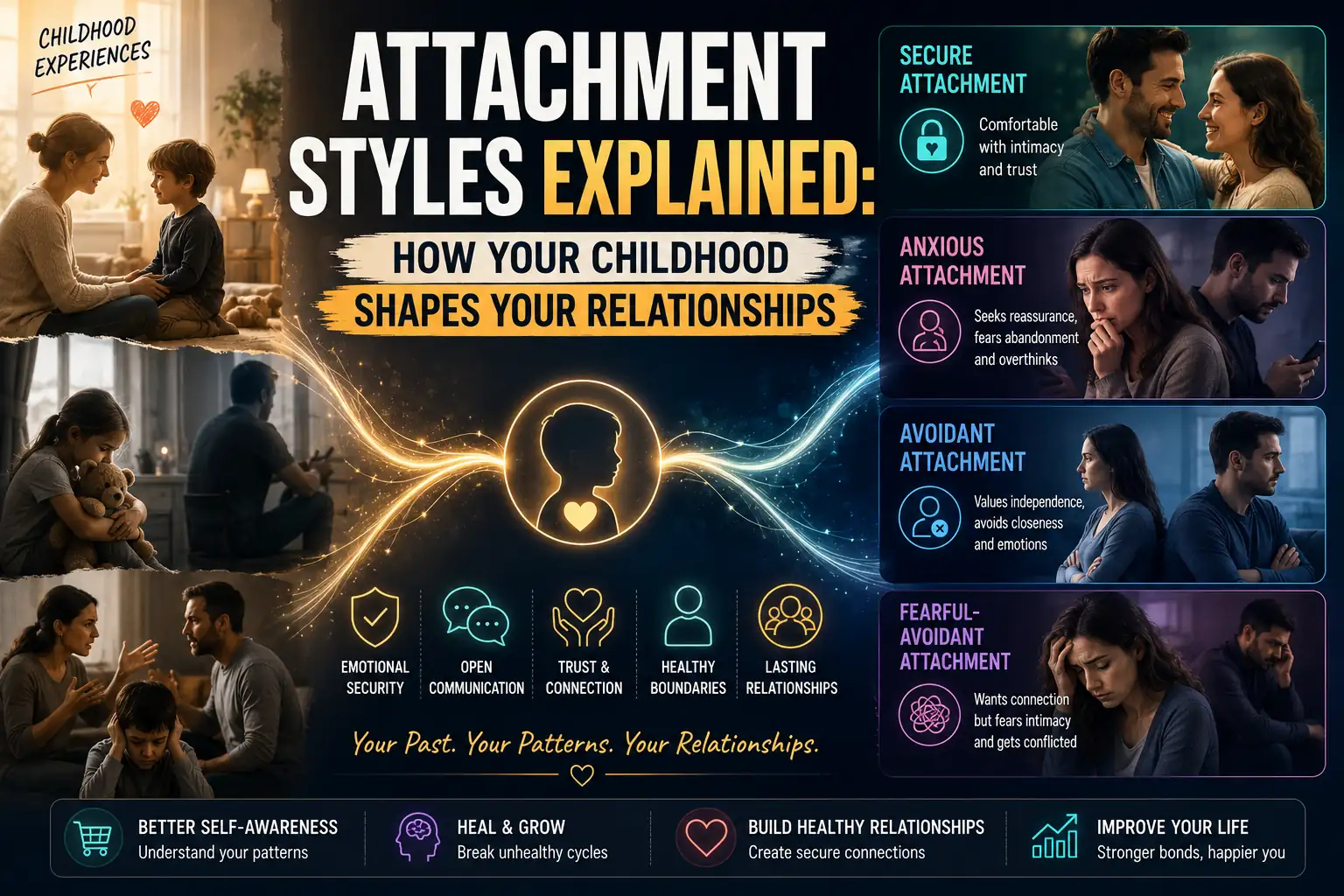
Attachment theory starts from a simple observation: the way infants relate to their primary caregivers creates a template for how they expect relationships to work. That template does not disappear in adulthood. It goes underground and re-emerges in romantic partnerships, close friendships, and parenting relationships with striking consistency.
John Bowlby, the British psychiatrist who developed attachment theory in the 1950s and 1960s, and Mary Ainsworth, who developed the empirical research framework, gave us a way to understand patterns in adult relationships that otherwise seem inexplicable. Understanding your own attachment pattern is not a diagnosis. It is a map that helps explain why certain relationship dynamics feel familiar, compulsive, or impossible to change through willpower alone.
The Four Attachment Styles
| Style | Early Experience | Adult Relationship Pattern | Core Fear |
|---|---|---|---|
| Secure | Consistent, responsive caregiving | Comfortable with intimacy and independence | None dominant |
| Anxious (Preoccupied) | Inconsistent caregiving; sometimes warm, sometimes absent | Craves closeness, fears abandonment, hypervigilant to partner signals | Being abandoned or unloved |
| Avoidant (Dismissing) | Emotionally distant caregiving; independence rewarded | Uncomfortable with intimacy, values self-sufficiency, withdraws under stress | Losing independence or being controlled |
| Disorganised (Fearful-Avoidant) | Frightening or abusive caregiving; caregiver was source of both safety and fear | Wants closeness but fears it; unpredictable push-pull dynamic | Both intimacy and abandonment |
Secure Attachment: The Reference Point
Securely attached adults are comfortable being close to others and comfortable being alone. They do not interpret a partner’s need for space as rejection. They do not feel threatened by their partner’s independence. When conflict arises, they can engage with it without feeling the relationship is fundamentally at risk.
Secure attachment develops when early caregivers were reliably available and responsive: not perfect, but consistent enough that the child learned the world is basically safe and other people are basically trustworthy. Research by Cindy Hazan and Phillip Shaver in the late 1980s estimated that approximately 56% of adults show a primarily secure attachment pattern.
Anxious Attachment: The Hypervigilant Pattern
Anxiously attached adults experienced caregiving that was unpredictably warm and cold. The caregiver was sometimes attentive and sometimes emotionally unavailable, with no clear pattern the child could rely on. The child’s response was to become hypervigilant: monitoring the caregiver’s emotional state constantly, seeking reassurance frequently, and expressing distress loudly to ensure the caregiver responded.
In adult relationships, this pattern produces a person who is highly attuned to their partner’s emotional state, reads potential rejection into neutral behaviour, and seeks reassurance in ways that can feel suffocating to partners. The anxious person typically describes their experience as caring deeply; their partner often describes it as pressure or monitoring.
The underlying logic is completely coherent given the original experience. If attention was inconsistent, constant monitoring and protest were the strategy that occasionally worked. The strategy is now applied to partners who are not actually inconsistent, producing results that confirm the anxious person’s worst fears.
Avoidant Attachment: The Self-Sufficient Pattern
Avoidantly attached adults experienced caregiving where emotional needs were either ignored or actively discouraged. Independence and self-sufficiency were rewarded; emotional expression was met with withdrawal or discomfort. The child learned to suppress emotional needs to maintain the caregiver relationship.
In adult relationships, avoidantly attached people typically value independence highly, feel uncomfortable when partners want more closeness than they can give, and withdraw under emotional stress rather than moving toward connection. They may describe themselves as private or not needing much reassurance, which is accurate: they have suppressed the need rather than had it met.
The avoidant person and the anxious person in a relationship produce a classic pattern that relationship researchers call the pursuit-withdrawal dynamic. The more the anxious person pursues closeness, the more the avoidant person withdraws. The more the avoidant person withdraws, the more the anxious person pursues. Each person’s behaviour triggers the other’s insecurity in a self-reinforcing loop.
Disorganised Attachment: The Most Complex Pattern
Disorganised attachment develops when the primary caregiver was also the source of fear, through abuse, severe neglect, or unpredictable frightening behaviour. The child faces an impossible biological dilemma: the brain’s threat response says run from danger, while the attachment system says run toward the caregiver for safety. When those two imperatives point in the same direction, the child’s behaviour becomes disorganised.
In adults, disorganised attachment shows up as a deeply conflicted relationship pattern. The person wants closeness and fears it simultaneously. They may push partners away when intimacy increases, then desperately seek reconnection when the partner withdraws. The pattern can look volatile and confusing to partners who are trying to understand what the person actually wants.
Disorganised attachment is associated with higher rates of trauma history and more difficulty in relationships than the other insecure patterns. It responds well to trauma-informed therapy but requires more sustained work than the anxious or avoidant patterns.
Can Attachment Styles Change?
Yes, though slowly. Attachment patterns are not fixed personality traits. They are learned strategies that can be updated through new relational experiences. The two most consistent sources of attachment style change in adulthood are: a long-term relationship with a securely attached partner who consistently behaves differently than the original template predicted, and therapy, particularly attachment-informed therapy, that provides a corrective relational experience.
The change process is not primarily cognitive. Knowing intellectually that your partner is trustworthy does not automatically update the nervous system’s threat responses, which operate faster than conscious thought. The update happens through repeated embodied experiences of safety, not through understanding the theory.
Research by Everett Waters and others has shown that between 20 and 25% of adults change their primary attachment classification over a five-year period, typically in the direction of greater security. The most common catalyst for change in the research is entry into or exit from a significant relationship.
Practical Applications of Knowing Your Attachment Style
Understanding your own pattern makes your reactions more legible to you. When an anxiously attached person recognises that the panic they feel when their partner does not text back is their nervous system running an old script rather than evidence of actual abandonment, they have slightly more choice in how they respond.
Understanding your partner’s pattern makes their behaviour more legible to you. An avoidant partner who goes quiet under stress is not withholding maliciously; they are running the strategy that their nervous system learned kept relationships safe. That understanding does not eliminate the pain of the dynamic, but it changes the interpretation.
The most useful couple’s conversation that attachment theory enables is: here is what I need when I feel stressed in our relationship, and here is what I find hard to give when I am stressed. That conversation, had outside of a moment of conflict, builds the mutual understanding that reduces the intensity of the anxious-avoidant pursuit-withdrawal loop.
FAQs
Is it possible to be securely attached in some relationships and insecurely in others?
Yes. Attachment style is not a fixed property of a person in isolation; it is a property of specific relationship systems. Someone with a primarily secure attachment style can show anxious patterns in a relationship with an unpredictable partner, and an anxiously attached person can function more securely with a patient, consistent partner. This relational context-dependence is why the partner’s attachment style matters as much as your own.
How do I find out my attachment style?
Several validated self-report questionnaires are available online, including the Experiences in Close Relationships scale (ECR-R), which measures anxiety and avoidance dimensions of attachment. These questionnaires are not diagnoses but provide a useful starting point. Therapy with an attachment-informed therapist provides a more nuanced understanding, particularly for disorganised patterns.
Does attachment style affect parenting?
Significantly. Research consistently shows that a parent’s attachment style predicts their child’s attachment style at rates significantly above chance. However, a process called earned security, where adults gain insight into their own attachment history and actively work to provide different experiences for their children, can break the intergenerational transmission. Mindfulness of one’s own patterns is protective even without formal therapy.
Reading Further
Attachment theory has moved significantly beyond its clinical origins. Popular books including Attached by Levine and Heller, Hold Me Tight by Sue Johnson, and The Body Keeps the Score by Bessel van der Kolk provide accessible entry points. For the original research, Bowlby’s Attachment trilogy and Ainsworth’s Patterns of Attachment are the foundational texts.
Understanding your attachment pattern is not the end of the process; it is the beginning of a more conscious relationship with your own relational instincts. Most people find that the self-recognition alone reduces the intensity of patterns they could not previously explain.
For relationship psychology, evidence-based personal development, and mental health resources throughout 2026, WritoryBuzz covers the science of human relationships with respect for the complexity involved.