
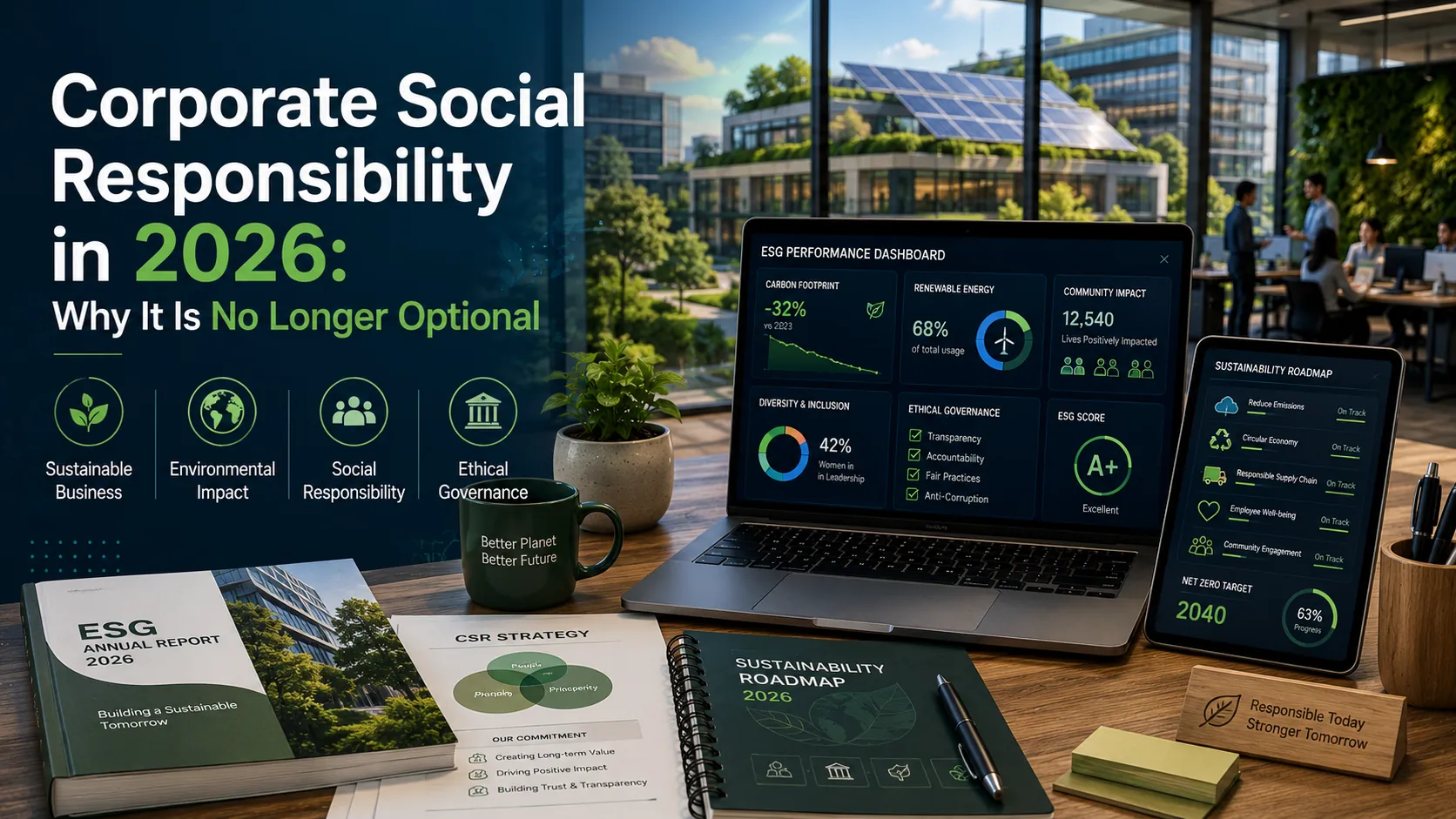
73 percent of global consumers say they are willing to pay more for sustainable products. BlackRock manages $10 trillion in assets with ESG integration in investment decisions. The EU’s Corporate Sustainability Reporting Directive requires 50,000 European companies to publish detailed sustainability reports from 2026. CSR has moved from voluntary philanthropy to regulated disclosure and market expectation.
Corporate social responsibility in 2026 is not the same discipline it was in 2015. The CSR of 2015 was largely voluntary, primarily reputational, and measured by charitable giving and pleasant-sounding mission statements. The CSR of 2026 is measured in carbon accounting, supply chain audits, pay equity disclosures, and structured third-party verification. The shift is from ‘we care’ to ‘we prove it.’
The Four Drivers Making CSR Non-Optional
1. Regulatory Requirements
The EU’s Corporate Sustainability Reporting Directive (CSRD) requires approximately 50,000 companies with EU operations to disclose detailed sustainability information from 2026 onwards, including climate, social, and governance metrics. These are auditable, standardised disclosures, not voluntary communications.
The US SEC adopted climate disclosure rules in 2024 requiring publicly traded companies to disclose material climate risks and Scope 1 and Scope 2 greenhouse gas emissions. California’s climate disclosure laws (SB 253 and SB 261) extend requirements to large companies operating in California regardless of public listing status.
2. Investor Expectations
ESG-integrated investing is not a niche strategy. BlackRock, Vanguard, and State Street, collectively managing over $20 trillion in assets, have integrated ESG considerations into their investment and voting processes. Companies with poor ESG scores face higher costs of capital, activist shareholder campaigns, and divestment risk from major institutional holders.
The MSCI ESG Ratings cover over 14,000 companies globally and directly influence institutional investment decisions. A company’s ESG rating affects its inclusion in major indices, its attractiveness to pension funds and sovereign wealth funds, and the interest rate on sustainability-linked bonds.
3. Talent and Employee Expectations
77 percent of workers want to work for companies that actively contribute to sustainability. For Gen Z workers (born 1997 to 2012), who now represent a growing share of the workforce, company values are a primary job selection criterion. Companies with credible sustainability commitments attract talent from a deeper pool and at lower recruitment cost.
The reverse is equally important. Companies with sustainability scandals face severe talent consequences. When a major company’s environmental claims were revealed as misleading in 2024, employee attrition in the 90 days following the exposure was 3 times the baseline quarterly rate.
4. Consumer Behaviour and Brand Risk
Social media has made corporate practices transparent and consequences for perceived hypocrisy immediate. Supply chain labour conditions, environmental impacts, and executive behaviour that would previously have remained internal are now publicly visible through employee review platforms, investigative journalism, and activist campaigns that spread via social media.
A product boycott mobilised through social media can reach millions of engaged consumers within 48 hours. The reputational risk of CSR failures has become asymmetric: the benefit of authentic commitment accrues slowly through brand equity; the cost of exposed hypocrisy lands immediately in sales and talent pipelines.
What CSR Must Actually Contain in 2026
Climate: Scope 1, 2, and 3 accounting. Scope 1 covers direct emissions from owned operations. Scope 2 covers purchased energy emissions. Scope 3 covers the full supply chain and product use emissions. Scope 3 is typically the largest and hardest to measure. Companies that measure only Scope 1 and 2 while their Scope 3 emissions are the material issue are increasingly recognised as doing incomplete accounting.
Supply chain transparency: Where are products made, under what labour conditions, and by whom? The EU’s Corporate Sustainability Due Diligence Directive (CS3D) requires large companies to identify, prevent, and mitigate human rights and environmental risks across their supply chains.
DEI with measurement: Diversity, equity, and inclusion commitments without measurement data are not credible. Investors and regulators increasingly want representation metrics by level, pay equity analysis, and year-on-year progress data. The absence of measurement is itself an indication of the quality of the commitment.
Community and social impact: Not the charitable giving amount but the measured outcome. How many jobs were created, what communities benefited, what is the documented social return on investment of community programmes.
The Greenwashing Problem
The EU’s Green Claims Directive, effective from 2026 for large companies, prohibits vague environmental claims (‘eco-friendly’, ‘sustainable’, ‘green’) without substantiated evidence. Claims must be specific, verifiable, and independently audited. The EU has already fined several major companies for misleading environmental claims under earlier consumer protection rules.
In the US, the FTC’s Green Guides are being updated to address online ESG claims more explicitly. The pattern of consumers and regulators becoming more sophisticated at identifying the gap between commitment and delivery has made generic sustainability language increasingly costly rather than costless.
What is CSR and why does it matter in 2026?
CSR (Corporate Social Responsibility) covers a company’s impact on environment, employees, communities, and governance. In 2026 it matters because EU CSRD requires detailed sustainability disclosure from 50,000 companies, investors managing over $20 trillion integrate ESG into decisions, 77 percent of workers want sustainable employers, and consumer social media boycotts can materialise within days of credibility failures.
What is the EU CSRD and who does it affect?
The EU Corporate Sustainability Reporting Directive requires approximately 50,000 companies with EU operations to publish detailed, auditable sustainability reports covering climate, social, and governance metrics from 2026. It applies to EU-listed companies, large EU companies, and non-EU companies with significant EU market revenue. It replaces the previous non-financial reporting directive with significantly more rigorous requirements.
What is the difference between Scope 1, 2, and 3 emissions?
Scope 1: direct emissions from operations the company owns. Scope 2: indirect emissions from purchased electricity and energy. Scope 3: all other indirect emissions across the supply chain, product use, and end-of-life. Scope 3 is typically the largest share but hardest to measure. Credible climate commitments require addressing all three scopes.
What is greenwashing and how is it being addressed in 2026?
Greenwashing is making environmental or sustainability claims that are misleading, unsubstantiated, or exaggerated. The EU’s Green Claims Directive (2026) prohibits vague environmental language without verified evidence. The FTC is updating its Green Guides for digital claims. Companies making generic sustainability claims without measurement data and third-party verification face increasing regulatory and reputational risk.
Does CSR actually affect consumer purchasing decisions?
73 percent of global consumers report willingness to pay more for sustainable products. Consumer purchasing behaviour shows meaningful correlation with sustainability reputation for certain product categories (food, fashion, personal care). The effect is stronger for Gen Z and Millennial consumers. The reverse effect, boycotts following sustainability credibility failures, is more immediate and severe than the positive purchase premium.
Do investors actually use ESG in investment decisions?
Yes. MSCI ESG Ratings cover over 14,000 companies and directly influence institutional investment decisions by pension funds and sovereign wealth funds. BlackRock, Vanguard, and State Street integrate ESG in voting and investment processes for over $20 trillion in assets. Poor ESG scores increase cost of capital, affect index inclusion, and attract activist shareholders.
The Standard Has Changed
The question for corporations is no longer ‘should we have a CSR programme?’ but ‘is our CSR substantive enough to meet investor, regulator, and talent expectations?’ The programmes that were considered exemplary in 2018 are insufficient by 2026 standards. The measurement, disclosure, verification, and integration of sustainability into core business decisions has become the minimum credible standard.