
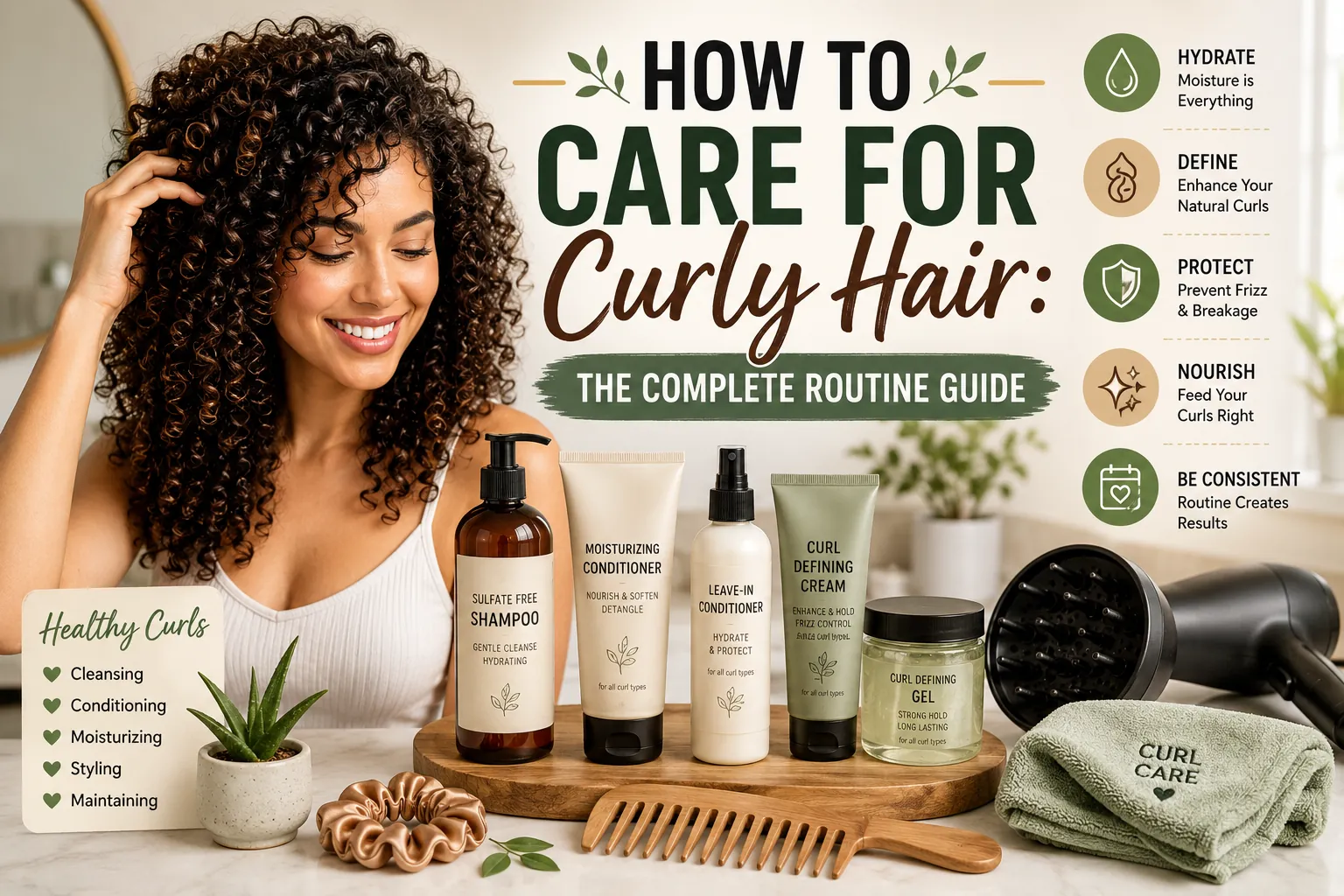
Curly hair is structurally different from straight hair. The helical shape makes it naturally drier (oils cannot travel down the curl as easily), more fragile at mechanical contact points, and more responsive to moisture and protein balance than straight hair. Caring for it well starts with understanding why it needs different treatment, not just different products.
The Curly Girl Method, developed by Lorraine Massey and adapted extensively since its 2001 introduction, remains the most widely referenced framework for curly hair care. Its core principles: avoid harsh sulphate shampoos that strip natural oils, avoid silicones that create product buildup without moisture penetration, and prioritise hydration and gentle handling. In 2026, the method has been expanded with more nuance around protein balance, co-washing versus low-poo cleansing, and adaptation for different curl types.
Understanding Your Curl Type
The Andre Walker hair typing system classifies curls from Type 2 (wavy) through Type 4 (very tightly coiled). Within each type, subcategories A to C indicate curl diameter.
Type 2 (Wavy): S-shaped waves ranging from loose (2A) to more defined (2C). Prone to frizz and can be weighed down easily. Needs lightweight hydration without heavy creams or oils.
Type 3 (Curly): Defined spring-back curls from loose ringlets (3A) to tighter corkscrew curls (3C). The most varied category. Needs consistent moisture and some hold for definition.
Type 4 (Coily): Very tight coils or zigzag patterns from looser (4A) to very tight shrinkage-prone coils (4C). Highest porosity issues, most prone to dryness, and most vulnerable to breakage.
Curl type guides product choice. Hair porosity (low, normal, high) guides how products penetrate and how much protein or moisture the hair needs at any given time. High porosity hair absorbs and loses moisture quickly; low porosity hair resists product penetration.
The Core Curly Hair Routine
Step 1: Cleansing
Sulphate-free shampoos (low-poo) or co-washing (conditioner washing) replace traditional sulphate shampoos. The choice depends on scalp type: oily scalps typically need low-poo cleansing one to two times per week. Normal to dry scalps can co-wash more frequently.
Avoid: sodium lauryl sulphate (SLS) and sodium laureth sulphate (SLES), which strip natural oils aggressively. Also avoid non-water-soluble silicones (dimethicone, cyclopentasiloxane) that build up without moisture penetration. These are the core CGM ingredient exclusions.
Recommended technique: Apply shampoo only to the scalp. Allow it to run through the lengths during rinsing rather than manipulating lengths directly. Gentle scalp massage rather than scrubbing. Rinse thoroughly with warm water.
Step 2: Conditioning
Conditioner is the foundation of a curly routine. Apply generously after cleansing, working through from mid-lengths to ends. Detangle with a wide-tooth comb or fingers while conditioner is in the hair, never on dry hair. The slip from conditioner prevents mechanical damage during detangling.
Deep conditioning weekly (or bi-weekly for types 3 and 4) provides intensive moisture treatment. Leave in for 15 to 30 minutes under a shower cap. Heat accelerates penetration if a warm towel or heating cap is used.
Step 3: Leave-In Conditioner and Styling
The LOC or LCO method (Liquid, Oil, Cream or Liquid, Cream, Oil) layers products to seal in moisture. The order depends on hair porosity: high porosity hair benefits from LOC (liquid then oil to seal), low porosity hair benefits from LCO (liquid then cream then lighter oil to seal).
Leave-in conditioner: Applied to soaking wet hair to provide base hydration and preparation for styling products.
Curl cream or gel: Defines and holds curl pattern. Gel provides the strongest hold and the ‘gel cast’ that protects curl definition while drying. The cast is scrunched out after hair is fully dry.
The scrunch, not rake: Applying products by scrunching upward toward the scalp encourages curl clumping. Raking products through with fingers stretched can disrupt curl formation.
Step 4: Drying
Air drying or diffusing are the two options. Air drying is lower manipulation but takes longer and can cause frizz in high humidity if hair is disturbed while drying. Diffusing with a diffuser attachment on low heat and medium to high airspeed is faster and produces similar or better definition.
Diffusing technique: Hover over the diffuser bowl rather than moving the dryer. Cup sections of hair into the bowl and hold for 30 to 60 seconds. Move slowly through the whole head before repeating. Using the cool shot button to set each section reduces heat damage.
Plopping: Wrapping wet hair in a microfibre towel or old t-shirt (not a regular towel, which roughens the cuticle) for 10 to 20 minutes before diffusing removes excess water and reduces frizz during the drying process.
Common Curly Hair Problems and Solutions
| Problem | Likely Cause | Solution |
| Frizz | Moisture loss, humidity, rough handling | Seal with cream or gel on soaking wet hair; avoid touching while drying |
| Undefined curls | Insufficient product, wrong technique | Increase leave-in and cream; scrunch rather than rake |
| Weighed-down, limp curls | Too much product or too heavy products | Reduce cream amount or switch to lighter gel only |
| Excessive dryness | Over-cleansing, low moisture routine | Reduce shampoo frequency; increase deep conditioning |
| Breakage | Protein deficiency, mechanical damage | Weekly protein treatment; never detangle dry hair |
| Product buildup | Silicones, insufficient cleansing | Clarifying wash monthly with diluted clarifying shampoo |
What is the Curly Girl Method?
The Curly Girl Method is a haircare framework developed by Lorraine Massey that avoids sulphate shampoos (which strip natural oils) and silicones (which build up and block moisture penetration), while prioritising hydration through co-washing and conditioner-based routines. It is widely adapted for different curl types and porosity levels rather than followed as a strict set of rules.
How often should curly hair be washed?
Type 2 wavy hair: 2 to 3 times per week. Type 3 curly hair: 1 to 2 times per week. Type 4 coily hair: once per week or less. Oily scalps need more frequent cleansing than dry scalps regardless of curl type. Over-cleansing strips natural oils and leads to the dryness and frizz that characterises most under-moisturised curly hair.
What products should you use for curly hair?
At minimum: a sulphate-free shampoo or conditioner wash, a generous rinse-out conditioner for detangling, a leave-in conditioner for base hydration, and a gel or cream for definition and hold. The specific products depend on curl type (lighter for Type 2, richer for Type 4) and porosity (less product for low porosity, more for high porosity).
Why is my curly hair frizzy even with products?
Most curly hair frizz results from applying products on hair that is not wet enough, using a regular towel that roughens the cuticle, touching hair while it dries, or insufficient product forming a protective moisture seal. Apply products to soaking wet hair immediately after showering, use a microfibre towel or t-shirt, and avoid disturbing hair until fully dry.
What is the difference between high and low porosity curly hair?
High porosity hair has open cuticles that absorb moisture quickly but also release it quickly, leading to dryness and frizz. It benefits from protein treatments and sealing products. Low porosity hair has tightly closed cuticles that resist moisture absorption. It benefits from lightweight products and heat during deep conditioning to help penetration. Most naturally curly and coily hair tends toward higher porosity.
Is diffusing better than air drying for curly hair?
Both work. Diffusing is faster, produces more consistent definition, and can be done in any weather. Air drying produces good results in low humidity environments and requires zero heat. The key difference is manipulation: avoid touching hair during either method. Diffusing is generally better for definition and for reducing humidity-induced frizz in humid climates.
Build the Routine Before Optimising the Products
The most common curly hair mistake is product-hopping before establishing a consistent technique. The right application method, the right wetness level, and the no-touching-while-drying rule produce more results than switching products weekly.
Establish the routine and run it consistently for 6 to 8 weeks before evaluating what to change. Curly hair takes time to adjust to new routines and products, and early judgments based on the first few washes are often inaccurate.