
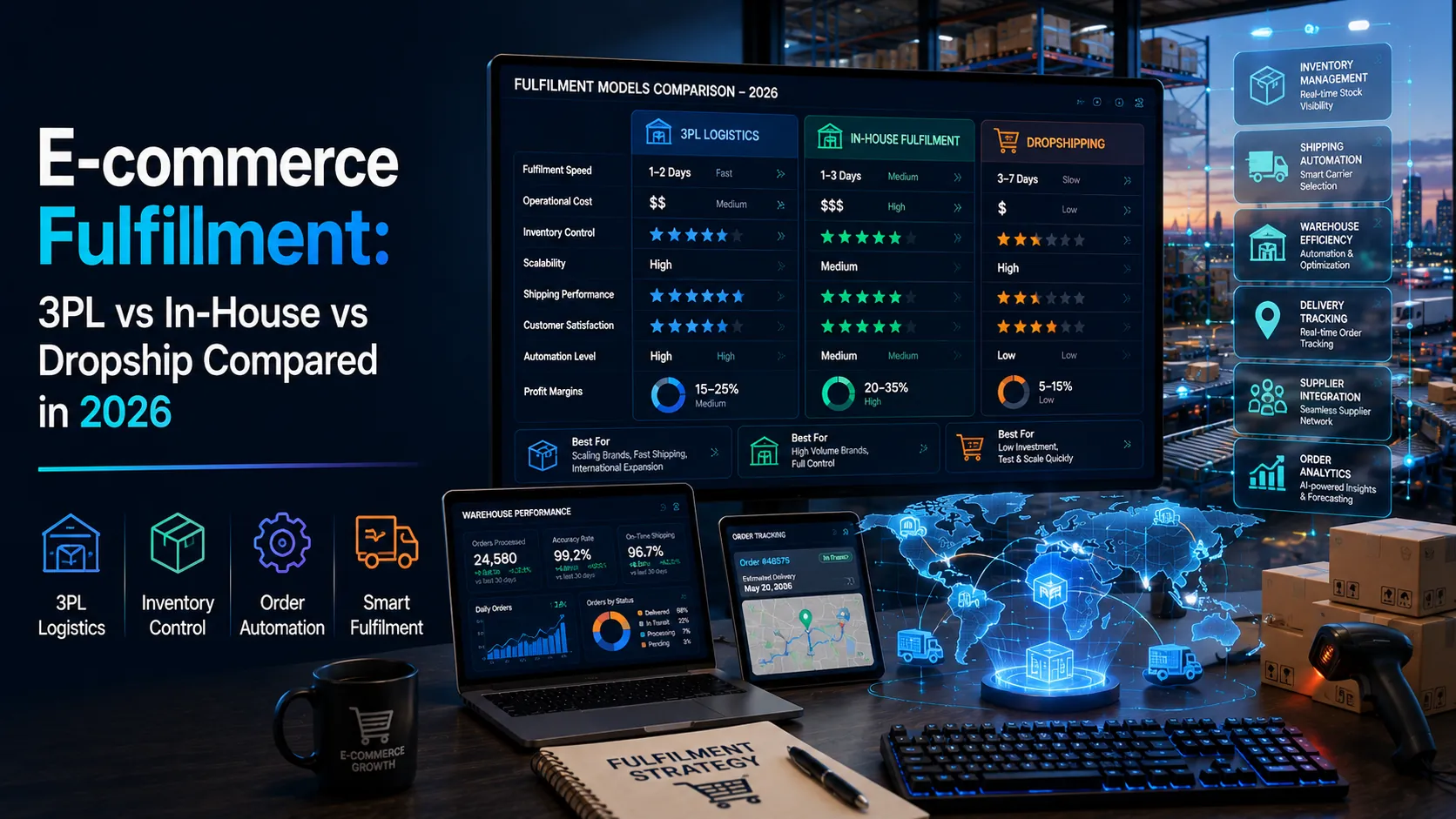
Fulfilment is the physical contract between you and your customer. Every order that ships late, arrives damaged, or goes to the wrong address is a customer service problem that costs 5 to 25 times more to fix than to prevent. Choosing the right fulfilment model is not a logistics decision. It is a brand decision.
E-commerce fulfilment in 2026 operates in a market shaped by Amazon-trained customer expectations: 2-day delivery is the standard, free shipping is the default expectation, and seamless returns are non-negotiable for most product categories. The fulfilment model you choose determines whether you can meet these expectations at your current scale and margin structure.
The Three Models: What Each Actually Involves
In-House Fulfilment
You receive inventory, store it in your own facility (home, storage unit, or warehouse), pick and pack orders yourself or with your own staff, and arrange shipping directly with carriers or through a multi-carrier platform like ShipBob, EasyPost, or ShipStation.
Best for: Under 200 orders per month, products requiring specialist handling, businesses where packaging and unboxing experience is a core brand differentiator, and early-stage businesses wanting maximum cost control and flexibility.
Cost structure: Low fixed costs (your own time and space), variable shipping costs negotiated directly with carriers, and packaging materials. The hidden cost is your time: at 50 orders per week, in-house fulfilment consumes 5 to 10 hours weekly that could be spent on growth activities.
When to move on: When fulfilment consumes more than 15 percent of a founder’s time, when inconsistent fulfilment is damaging reviews, or when shipping cost disadvantage versus 3PLs’ carrier rates is measurable.
Third-Party Logistics (3PL)
A 3PL receives your inventory at its warehouse, stores it, picks, packs, and ships orders when they come in, and handles returns. You retain full ownership of inventory and control over product; the physical fulfilment operations are outsourced to specialists.
Best for: 100 to 10,000-plus orders per month, businesses wanting to scale without operational complexity, and brands selling on multiple channels (Shopify, Amazon, wholesale) that benefit from unified inventory management.
Cost structure: Receiving fees (per pallet or per unit), monthly storage fees (per cubic foot or pallet position), pick and pack fees (per order plus per item), and shipping (typically at negotiated carrier rates the 3PL passes through with small markup). All-in 3PL costs typically range from $4 to $15 per order depending on size, weight, and location distribution.
Major providers in 2026: ShipBob (Shopify-integrated, strong US network), Shipmonk (small to mid-size focus), Whiplash (premium brands), and Flexport (international and enterprise). Amazon FBA is a separate category discussed below.
Amazon FBA (Fulfilment by Amazon)
FBA is a specific type of 3PL where Amazon stores your inventory in its fulfilment centres, ships orders with Amazon Prime eligibility, and handles returns. In exchange, Amazon charges storage and fulfilment fees and places your products within the Amazon ecosystem exclusively.
Best for: Products naturally suited to Amazon’s marketplace, categories where Prime eligibility is a significant conversion driver, and businesses willing to build within Amazon’s constraints.
FBA cost structure: Per-unit fulfilment fees ($3 to $20 depending on size and weight), monthly storage fees (higher October through December), long-term storage fees for slow-moving inventory, and returns processing fees. The total cost per order is often lower than comparable 3PLs for standard-size products because of Amazon’s scale and carrier rates.
Limitations: Brand experience is Amazon’s (their boxes, their inserts). You cannot include marketing materials that direct customers elsewhere. Returns policies are Amazon’s, not yours. Inventory in FBA is within Amazon’s system and subject to their rules.
Dropshipping
Dropshipping means you take orders and pass them to your supplier, who ships directly to your customer. You never handle inventory. The margin is the difference between what you charge the customer and what you pay the supplier.
Best for: Product testing before inventory commitment, niche products with low volume, and businesses wanting zero inventory risk.
The honest limitations: Shipping times are often long (especially for overseas suppliers), quality control is at the supplier’s standard not yours, and you cannot differentiate the unboxing experience. Average dropshipping margins are 10 to 30 percent, significantly lower than branded e-commerce.
Viable in 2026: Dropshipping with domestic suppliers using services like Faire for wholesale or print-on-demand suppliers (Printful, Printify) avoids the long-shipping-time problem but at lower margins than inventory-based models.
| Model | Min. Volume | Cost per Order | Control | Scalability |
| In-House | 1+ | Lowest ($2-5) | Maximum | Limited by ops time |
| 3PL | ~100/mo+ | Medium ($4-15) | High | High |
| Amazon FBA | 1+ | Low-medium (varies) | Low (Amazon’s rules) | Very high |
| Dropshipping | 1+ | Lowest margin (10-30%) | Very low | High but low margin |
The Decision Framework by Business Stage
0 to 100 orders/month: In-house. The time cost is manageable. The flexibility to test packaging and processes is valuable. The capital preserved is meaningful.
100 to 1,000 orders/month: Evaluate 3PL. At 500 orders per month, in-house fulfilment typically consumes enough founder time that outsourcing the operation at $6 to $10 per order is positive ROI. Get quotes from three 3PLs and model the total cost against your current operation.
1,000-plus orders/month: 3PL is standard for most brands. FBA is appropriate if Amazon is your primary channel. Multi-warehouse 3PL (storing inventory across multiple facilities to reduce shipping distance and time) becomes valuable when shipping time is a competitive factor.
Multi-channel: If selling across Shopify, Amazon, wholesale, and retail simultaneously, a 3PL with robust multichannel inventory management (Linnworks, Skubana) is essential for accurate stock levels across channels.
What is the difference between 3PL and dropshipping?
In a 3PL model you own inventory stored at the 3PL’s warehouse and they ship on your behalf. Your margins are full wholesale-to-retail. In dropshipping you own no inventory: the supplier ships directly to your customer, you keep the margin between your selling price and supplier cost. 3PL gives more control, brand consistency, and better margins. Dropshipping gives zero inventory risk.
When should an e-commerce business switch from in-house to 3PL?
When fulfilment consumes more than 15 percent of founder time, when you hit consistent 100-plus orders per month, when shipping delays or inconsistency are generating negative reviews, or when 3PL carrier rates produce lower per-order shipping costs than your current carrier agreements.
How much does a 3PL cost in 2026?
All-in 3PL costs typically range from $4 to $15 per order depending on product size, weight, packaging complexity, and shipping distance. This includes receiving, storage, pick and pack, and shipping. Get itemised quotes from multiple providers: storage fees vary significantly and are the largest hidden cost for slow-moving products.
Is Amazon FBA better than a third-party 3PL?
For products primarily sold on Amazon where Prime eligibility drives conversion, FBA is usually the better choice due to Amazon’s carrier rates and fulfilment quality. For brands building their own DTC channel or selling across multiple platforms, an independent 3PL provides more control, better brand experience, and multichannel flexibility that FBA does not offer.
Can you use multiple fulfilment models simultaneously?
Yes. Many brands use FBA for Amazon channel orders and a separate 3PL for their Shopify DTC channel. This optimises for each channel’s specific requirements while maintaining inventory visibility through multichannel management software. The complexity increases with each added model.
What is the main risk of dropshipping in 2026?
Long shipping times (especially from overseas suppliers) and quality control you cannot enforce are the primary risks. Customer expectations for 2-day shipping have been set by Amazon Prime and are difficult to meet through typical dropshipping supply chains. Domestic dropshipping suppliers and print-on-demand services partially address the time issue but at lower margins.
Model the True All-In Cost Before Deciding
Every fulfilment model comparison should be modelled on all-in cost per order: your time at an hourly rate you value your labour at, plus all fees, plus the cost of shipping. In-house looks cheapest until you price your own time. 3PL looks expensive until you price the shipping rate advantages at volume. Run the real numbers for your specific products, volumes, and margins.